Species · Birds
Bronze Parotia Parotia berlepschi
The scientific name of the Bronze Parotia is Parotia berlepschi. It is a species of bird in the family Paradisaeidae (bird-of-paradise), order Passeriformes. The name dates from 1897.
- Scientific name
- Parotia berlepschi Kleinschmidt, 1897
- Common name
- Bronze Parotia
- Genus
- Parotia
- Family
- Paradisaeidae (Bird-of-paradise)
- Order
- Passeriformes
- Class
- Aves
- Red List category
- LC Least Concern
- Recorded in
- 3 countries
- Name status
- accepted in the Catalogue of Life

Overview
The species is recorded from the Foja Mountains in West Papua, Indonesia.
Written 26 November 2026 from the sources listed below. Each statement was checked against the passage it cites; statements that could not be supported were removed.
Appearance
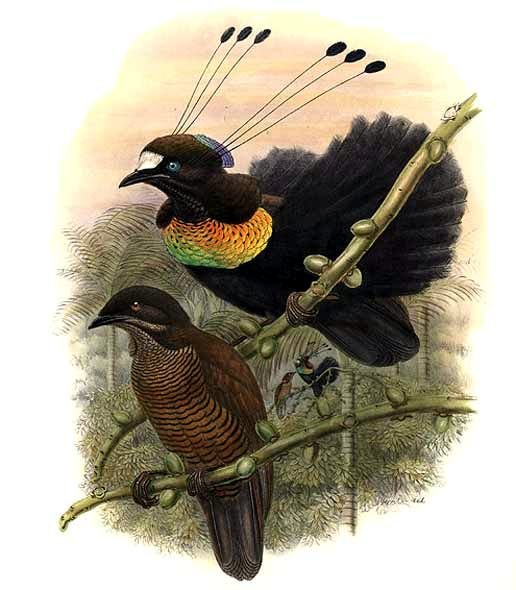
The male has a generally blackish body with a conspicuous oily bronze sheen that becomes greener around the neck. Its frontal crest is predominantly black, with a reduced area of white tips near the center and a greenish-gold inner bowl.[1][2][3]
The male has an iridescent breast plate composed of scale-like feathers with black dotted centers. Its breast shield can appear pink, orange, green, blue, yellow, gold, or violet depending on the viewing angle of light.[4][5]
The male has a relatively robust grey-black bill with a prominent hook, light blue-greyish eyes surrounded by an orange ring, and grey-black legs and feet.[6][7][8]
The female has light brown upperparts, reddish wings, a light brown tail, and a brown-and-white head. Its underparts are creamy with brown-blackish barring.[9][10]
Habitat
The species is recorded from the Foja Mountains in West Papua, Indonesia.[11]
Diet
The species may feed on fruits and arthropods, as well as potentially other animal prey.[12]
Behaviour
The species' courtship behaviour may resemble that of Carola's parotia. Reported possible courtship actions include clearing a court, constructing a mat, pivoting horizontally on a perch, hopping and shaking, and presenting leaves.[13][14]
Parotias maintain clean display courts by removing leaves, twigs, and moss. Leaf presentation can serve as a territorial ownership signal that discourages prospecting males.[15][16]
Similar species
Bronze Parotia resembles Carola's parotia and has historically been treated as a subspecies of that species. The two were previously classified together as P. carolae.[17][18]
Most taxonomic authorities support recognizing Bronze Parotia as a distinct species.[19]
Uses
The genus name Parotia combines a term meaning near with the Ancient Greek word for ear. It refers specifically to the curls of hair beside the ears, represented by the male's six head plumes on each side.[20][21]
The specific name berlepschi honors German ornithologist Hans von Berlepsch, who lived from 1850 to 1915. Otto Kleinschmidt first described the species in 1897.[22][23]
Classification of the Bronze Parotia
| Kingdom | Animalia |
|---|---|
| Phylum | Chordata |
| Subphylum | Vertebrata |
| Infraphylum | Gnathostomata |
| Parvphylum | Osteichthyes |
| Megaclass | Tetrapoda |
| Class | Aves (Bird) |
| Order | Passeriformes (Passerine) |
| Family | Paradisaeidae (Bird-of-paradise) |
| Genus | Parotia (Six-plumed Birds of Paradise) |
| Species | Parotia berlepschi Kleinschmidt, 1897 |
Where the Bronze Parotia is found
Checklists and occurrence records place Parotia berlepschi in 3 countries across Oceania. GBIF holds 18 georeferenced records of it.
Countries
Regions and cities with the most records
Range as the checklists state it
Australia
A number beside a place is its count of GBIF occurrence records. A place without a number comes from a checklist alone. Records show where a species has been observed or collected, which can include escapes and vagrants.
Common names
English
- Bronze Parotia
Names in 26 other languages
- Arabic
- رفول برونزي
- Bulgarian
- Бронзова паротия
- Catalan
- ocell del paradís de Berlepsch
- Chinese
- 銅色六線天堂鳥, 青铜六线风鸟
- Croatian
- brončana rajska ptica
- Czech
- rajka šestistrunná
- Dutch
- Berlepsch' Parotia, Berlepsch' zesdradige paradijsvogel
- Esperanto
- bronza paradizeo
- Estonian
- foja paradiisilind
- Finnish
- fojanliputtaja
- French
- Paradisier de Berlepsch
- German
- Berlepschparadiesvogel
- Indonesian
- Parotia carola
- Italian
- Paradisea dalle sei penne di von Berlepsch
- Japanese
- ブロンズカンザシフウチョウ
- Lithuanian
- rudagurklė parotija
- Norwegian
- fojaparadisfugl
- Polish
- sześciopiór brązowawy
- Portuguese
- ave-do-paraíso-de-berlepsch, parótia-bronzeada
- Russian
- Бронзовая паротия, Паротия Берлепша
- Serbian
- Bronzana parotija
- Slovak
- rajka bronzová
- Spanish
- Ave del paraíso de Berlepsch, Ave-del-paraíso de Berlepsch
- Swedish
- bronsparotia, bronsstrålparadisfågel
- Turkish
- Foja Parotyası
- Ukrainian
- паротія фойська
Synonyms
One other scientific name has been used for this species and is now treated as a synonym of Parotia berlepschi.
- Parotia carolae berlepschi Kleinschmidt, O, 1897
Related species
-
 Western ParotiaParotia sefilata
-
 Lawes's ParotiaParotia lawesii
-
 Carola's ParotiaParotia carolae
-
 Wahnes's ParotiaParotia wahnesi
- Eastern ParotiaParotia helenae
-
 Raggiana Bird-of-paradiseParadisaea raggiana
-
 Wilson's Bird-of-paradiseDiphyllodes respublica
-
 Vogelkop LophorinaLophorina superba
Compare
Questions and answers
What is the scientific name of the Bronze Parotia?
The scientific name of the Bronze Parotia is Parotia berlepschi. Written with its author, the full name is Parotia berlepschi Kleinschmidt, 1897.
Which family does the Bronze Parotia belong to?
Parotia berlepschi belongs to the family Paradisaeidae, in the order Passeriformes and the class Aves.
Where is the Bronze Parotia found?
Checklists and occurrence records place Parotia berlepschi in 3 countries: Indonesia, Papua New Guinea and Australia.
What is the conservation status of the Bronze Parotia?
The IUCN Red List category recorded for Parotia berlepschi is Least Concern (LC).
Sources
Passages the profile rests on
- The male has a generally blackish body with a conspicuous oily bronze sheen that becomes greener around the neck. Source passage: “the male bronze parotia has a blackish body in general with a conspicuous oily bronze sheen, more greenish in the neck area” — English Wikipedia
- The male's frontal crest is predominantly black, with a reduced area of white tips near its center. Source passage: “the frontal crest of the bronze parotia is mostly black with only a more reduced portion of white tips towards the center of it” — English Wikipedia
- The inner bowl of the male's frontal crest is greenish gold. Source passage: “the inner "bowl" of the frontal crest is greenish gold.” — English Wikipedia
- The male has an iridescent breast plate composed of scale-like feathers with black dotted centers. Source passage: “iridescent breast plate composed of scale-like feathers, each with a black, dotted center” — English Wikipedia
- The male's breast shield can appear pink, orange, green, blue, yellow, gold, or violet depending on the viewing angle of light. Source passage: “shine pink, orange, green, blue, yellow, gold, violet and orange, depending on the light angle” — English Wikipedia
- The male has a relatively robust grey-black bill with a prominent hook. Source passage: “It has a relatively robust, more prominently hooked, grey-black bill” — English Wikipedia
- The male has light blue-greyish eyes surrounded by an orange ring. Source passage: “light blue-greyish eyes surrounded by an orange ring” — English Wikipedia
- The male's legs and feet are grey-black. Source passage: “grey-black legs and feet.” — English Wikipedia
- The female has light brown upperparts, reddish wings, a light brown tail, and a brown-and-white head. Source passage: “being light brown above with reddish wings, light brown tail, and a brown and white head.” — English Wikipedia
- The female has creamy underparts with brown-blackish barring. Source passage: “She is creamy below, covered by brown-blackish barring.” — English Wikipedia
- The species is recorded from the Foja Mountains in West Papua, Indonesia. Source passage: “Indonesia: West Papua: Foja Mountains.” — australian.museum
- The species may feed on fruits and arthropods, as well as potentially other animal prey. Source passage: “Its diet may consist of fruits, arthropods, and possibly other animal prey.” — English Wikipedia
- The species' courtship behaviour may resemble that of Carola's parotia. Source passage: “Its courtship behavior may be similar to Carola's parotia courtship behavior.” — English Wikipedia
- Reported possible courtship actions include clearing a court, constructing a mat, pivoting horizontally on a perch, hopping and shaking, and presenting leaves. Source passage: “actions include court clearing, mat construction, horizontal perch pivot display, hop and shake display, and leaf presentation.” — English Wikipedia
- Parotias maintain clean display courts by removing leaves, twigs, and moss. Source passage: “Parotias, along with other ground-performing birds-of-paradise, like to keep a clean court, tossing leaves, twigs, moss, etc.” — English Wikipedia
- Leaf presentation can serve as a territorial ownership signal that discourages prospecting males. Source passage: “The presentation of leaves is used as a "badge of ownership" to rid of prospecting males” — English Wikipedia
- Bronze parotia resembles Carola's parotia and has historically been treated as a subspecies of that species. Source passage: “It resembles and is often considered to be a subspecies of Carola's parotia” — English Wikipedia
- Carola's parotia and Bronze parotia were previously classified together as P. carolae. Source passage: “Parotia carolae and P. berlepschi (del Hoyo and Collar 2016) were previously lumped as P. carolae following Sibley and Monroe (1990, 1993).” — datazone.birdlife.org
- Most taxonomic authorities support recognizing Bronze parotia as a distinct species. Source passage: “a high majority of authorities support its specific status.” — English Wikipedia
- The genus name Parotia combines a term meaning near with the Ancient Greek word for ear. Source passage: “The genus name, Parotia is composed of par, meaning "near" and Ancient Greek ωτος ōtos for "ear"” — English Wikipedia
- The genus name refers specifically to the curls of hair beside the ears, represented by the male's six head plumes on each side. Source passage: “specifically meaning "curl of hair by the ear", referring to six head plumes on each side of the head” — English Wikipedia
- The specific name berlepschi honors German ornithologist Hans von Berlepsch, who lived from 1850 to 1915. Source passage: “Its specific name, berlepschi, honors Hans von Berlepsch, a German ornithologist (1850-1915).” — English Wikipedia
- Otto Kleinschmidt first described the species in 1897. Source passage: “The species was first described by Otto Kleinschmidt in 1897.” — English Wikipedia
Data
- Catalogue of Life, 2026-10-16 XR cc by
- Global Biodiversity Information Facility CC BY 4.0
- Wikidata CC0
- GeoNames CC BY 4.0
- Wikimedia Commons per image; credit shown with each image
- Within the Catalogue of Life, this name comes from The Integrated Taxonomic Information System cc0
References
- Kleinschmidt, & Otto. (1897). Beschreibung eines neuen Paradiesvogels. Ornithologische Monatsberichte, Vol. 5. where the name was published
This species in other databases
Page built on 28 November 2026. See how the catalog is made and all sources and licences.
Cite this page
ScientificNames.org. (2026). Parotia berlepschi (Bronze Parotia). Retrieved November 28, 2026, from https://scientificnames.org/species/parotia-berlepschi
“Parotia berlepschi (Bronze Parotia).” ScientificNames.org, 2026, scientificnames.org/species/parotia-berlepschi. Accessed 28 Nov. 2026.
ScientificNames.org. “Parotia berlepschi (Bronze Parotia).” Accessed November 28, 2026. https://scientificnames.org/species/parotia-berlepschi.
@misc{scientificnames_parotia_berlepschi_bronze_parotia,
  author = {{ScientificNames.org}},
  title = {Parotia berlepschi (Bronze Parotia)},
  year = {2026},
  url = {https://scientificnames.org/species/parotia-berlepschi},
  note = {Accessed 2026-11-28}
}