Species · Molluscs
Partula Snail Partula hyalina
The scientific name of the Partula Snail is Partula hyalina. It is a species of mollusc in the family Partulidae (partulids). The name dates from 1832.
- Scientific name
- Partula hyalina Broderip, 1832
- Common name
- Partula Snail
- Genus
- Partula
- Family
- Partulidae (Partulids)
- Class
- Gastropoda
- Red List category
- VU Vulnerable
- Environment
- terrestrial
- Recorded in
- 2 countries
- Name status
- accepted in the Catalogue of Life

Overview
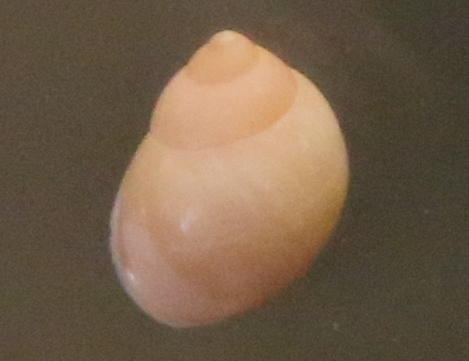
The Partula snail is a mollusc in the family Partulidae. It occurs on seven islands across the Society, Austral and Southern Cook Islands. It has a distinctive white shell.
Written 27 November 2026 from the sources listed below. Each statement was checked against the passage it cites; statements that could not be supported were removed.
Appearance
The Partula snail has a distinctive white shell.[1]
Habitat
The Partula snail belongs to a predominantly arboreal land snail family. Some islands inhabited by the species lack the typical high-island rainforest ecosystem associated with partulid habitat.[2][3]
Behaviour
Individual tree snails in the Partulidae family rarely travel more than a few metres during their lifetimes.[4]
Uses
Partula snail shells were valued for their aesthetic qualities and used in regional Polynesian jewellery. Dead shells were traded to meet demand for the species within the Society Islands.[5][6]
Conservation
The alien carnivorous land snail Euglandina rosea has devastated populations of all 61 endemic Society Island partulid species.[7]
Wild populations of the Partula snail in the Southern Cook and Austral Islands remain unaffected by this devastation.[8]
Similar species
The source lineage of the Partula snail also contains the nominal species Partula clara, which has a dark shell.[9]
Classification of the Partula Snail
| Kingdom | Animalia |
|---|---|
| Phylum | Mollusca |
| Class | Gastropoda (Gastropod) |
| Subclass | Heterobranchia |
| Infraclass | Euthyneura |
| Subterclass | Tectipleura |
| Superorder | Eupulmonata |
| Infraorder | Pupilloidei |
| Family | Partulidae (Partulids) |
| Genus | Partula (Polynesian Tree Snails) |
| Species | Partula hyalina Broderip, 1832 |
Where the Partula Snail is found
Checklists and occurrence records place Partula hyalina in 2 countries. GBIF holds 437 georeferenced records of it.
Countries
Regions and cities with the most records
- Îles du Vent, French Polynesia 146
- Papeete, French Polynesia 70
- Punaauia, French Polynesia 67
- Austral Islands, French Polynesia 57
- Faaa, French Polynesia 54
- Mangaia, Cook Islands 7
1 more country has a few records outside this range
These countries hold a few records of Partula hyalina but lie outside the range the checklists give for it. Such records are often zoo or garden specimens, museum material or vagrants, so the species is not counted as occurring there.
A number beside a place is its count of GBIF occurrence records. A place without a number comes from a checklist alone. Records show where a species has been observed or collected, which can include escapes and vagrants.
Common names
English
- Partula Snail
- Polynesian Tree Snail
- The Hyaline Partula
- White Partula
- White Partula Tree Snail
Names in 1 other language
- tah
- Areho, areho poe
Synonyms
One other scientific name has been used for this species and is now treated as a synonym of Partula hyalina.
- Partula clara marmorata H. E. Crampton, 1916
Related species
-
 Moorean Viviparous Tree SnailPartula suturalis
-
 Clarke's Tree SnailPartula clarkei
-
 Captain Cook's Bean SnailPartula faba
- Polynesian Tree SnailPartula nodosa
-
 Partula SnailPartula rosea
-
 Rose-tipped PartulaPartula hebe
- Moorean Viviparous Tree SnailPartula mirabilis
- Garrett's Tree SnailPartula garrettii
Compare
Questions and answers
What is the scientific name of the Partula Snail?
The scientific name of the Partula Snail is Partula hyalina. Written with its author, the full name is Partula hyalina Broderip, 1832.
Which family does the Partula Snail belong to?
Partula hyalina belongs to the family Partulidae and the class Gastropoda.
Where is the Partula Snail found?
Checklists and occurrence records place Partula hyalina in 2 countries: French Polynesia and Cook Islands.
What is the conservation status of the Partula Snail?
The IUCN Red List category recorded for Partula hyalina is Vulnerable (VU).
What other names does the Partula Snail have?
Partula hyalina is also known in English as Polynesian Tree Snail, The Hyaline Partula, White Partula and White Partula Tree Snail.
Sources
Passages the profile rests on
- Partula hyalina has a distinctive white shell. Source passage: “Partula hyalina, a distinctive white-shelled species, is the only partulid with a multi-archipelago distribution” — pmc.ncbi.nlm.nih.gov
- Partula hyalina belongs to a predominantly arboreal land snail family. Source passage: “The predominantly arboreal land snail family Partulidae is endemic to tropical Pacific islands” — pmc.ncbi.nlm.nih.gov
- Some islands inhabited by Partula hyalina lack the typical high-island rainforest ecosystem associated with partulid habitat. Source passage: “Mangaia, Mauke and Rimatara lack the classic ‘high island’ rainforest ecosystem that comprises typical partulid habitat” — pmc.ncbi.nlm.nih.gov
- Individual tree snails in the Partulidae family rarely travel more than a few metres during their lifetimes. Source passage: “Individual tree snails rarely disperse more than a few metres during their lives” — pmc.ncbi.nlm.nih.gov
- Partula hyalina shells were valued for their aesthetic qualities and used in regional Polynesian jewellery. Source passage: “Partulid shells were commonly used in regional Polynesian jewellery, and we propose that the white-shelled P. hyalina, originally restricted to Tahiti, had aesthetic value throughout these archipelagoes.” — pmc.ncbi.nlm.nih.gov
- Dead shells were traded to meet demand for Partula hyalina within the Society Islands. Source passage: “Demand within the Society Islands could be best met by trading dead shells” — pmc.ncbi.nlm.nih.gov
- The alien carnivorous land snail Euglandina rosea has devastated populations of all 61 endemic Society Island partulid species. Source passage: “The alien carnivorous land snail Euglandina rosea has recently devastated populations of all 61 endemic species of Society Island partulid snails.” — pmc.ncbi.nlm.nih.gov
- Wild populations of Partula hyalina in the Southern Cook and Austral Islands remain unaffected by the devastation described for Society Island partulids. Source passage: “Southern Cooks and Australs P. hyalina now represent the only unscathed wild populations remaining of this once spectacular land snail radiation.” — pmc.ncbi.nlm.nih.gov
- The source lineage of Partula hyalina also contains the nominal species Partula clara, which has a dark shell. Source passage: “The source lineage is polymorphic in shell coloration and contains a second nominal species, the dark-shelled Partula clara, in addition to the white-shelled P. hyalina.” — pmc.ncbi.nlm.nih.gov
Data
- Catalogue of Life, 2026-10-16 XR cc by
- Global Biodiversity Information Facility CC BY 4.0
- Wikidata CC0
- GeoNames CC BY 4.0
- Wikimedia Commons per image; credit shown with each image
- Within the Catalogue of Life, this name comes from World Register of Marine Species cc by
References
- Broderip, W. J. & Sowerby, G. B. I. (1832). [Descriptions of new species of shells from the collection formed by Mr. Cuming on the western coast of South America, and among the islands of the southern Pacific Ocean.]. Proceedings of the Committee of Science and Correspondence of the Zoological Society of London, Part II for 1832: 25–33 [21 April 1832], 50–61 [5 June 1832], 104–108 [31 July 1832], 113–120 [14 August 1832]; 173–179 [14 Jan. 1833], 194–202 [13 March 1833]. where the name was published
This species in other databases
Page built on 29 November 2026. See how the catalog is made and all sources and licences.
Cite this page
ScientificNames.org. (2026). Partula hyalina (Partula Snail). Retrieved November 29, 2026, from https://scientificnames.org/species/partula-hyalina
“Partula hyalina (Partula Snail).” ScientificNames.org, 2026, scientificnames.org/species/partula-hyalina. Accessed 29 Nov. 2026.
ScientificNames.org. “Partula hyalina (Partula Snail).” Accessed November 29, 2026. https://scientificnames.org/species/partula-hyalina.
@misc{scientificnames_partula_hyalina_partula_snail,
  author = {{ScientificNames.org}},
  title = {Partula hyalina (Partula Snail)},
  year = {2026},
  url = {https://scientificnames.org/species/partula-hyalina},
  note = {Accessed 2026-11-29}
}