Species · Fishes
Sidespot Goatfish Parupeneus pleurostigma
The scientific name of the Sidespot Goatfish is Parupeneus pleurostigma. It is a species of fish in the family Mullidae (goatfish), order Mulliformes. The name dates from 1831.
- Scientific name
- Parupeneus pleurostigma (Bennett, 1831)
- Common name
- Sidespot Goatfish
- Genus
- Parupeneus
- Family
- Mullidae (Goatfish)
- Order
- Mulliformes
- Class
- Teleostei
- Red List category
- LC Least Concern
- Environment
- marine
- Recorded in
- 41 countries
- Name status
- accepted in the Catalogue of Life

Overview
Parupeneus pleurostigma is native to the Indian and Pacific oceans and occurs mainly in island waters, inhabiting coral and rocky seaward reefs, sandy and coral bottoms, and shallow lagoons. It has a broad black spot along its lateral line, sometimes followed by a large pinkish spot, and a black band below the base of its dorsal fin.
Written 27 November 2026 from the sources listed below. Each statement was checked against the passage it cites; statements that could not be supported were removed.
Appearance
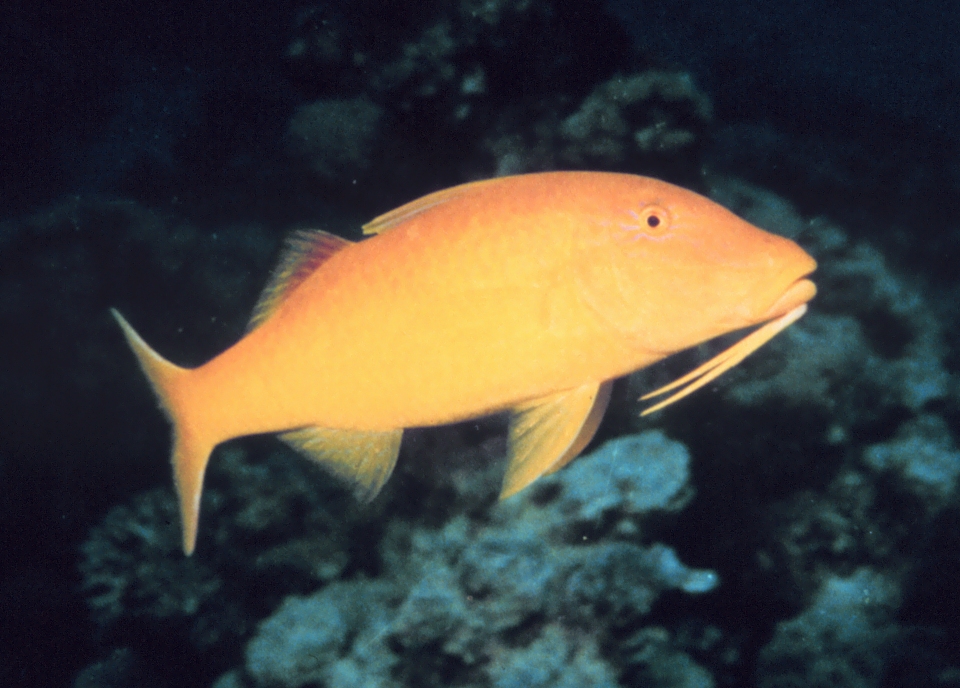
The body coloration ranges from pinkish to yellowish gray. The species has a slightly convex snout and caudal-fin lobes with straight to slightly convex margins.[1][2]
It has nine dorsal soft rays, seven anal soft rays and sixteen pectoral rays. Blue spots occur on the scales above its lateral line.[3][4]
The two barbels extending from the chin are pale pink to white. A broad black spot occurs along the lateral line, sometimes followed by a large pinkish spot.[5][6]
The species can reach a total length of 20–33 centimetres.[7]
Habitat
The sidespot goatfish is native to the Indian and Pacific oceans, ranging from East Africa to Hawaii, the Line Islands, Marquesas Islands and Tuamotus, and from Ryukyu to Lord Howe Island, Rapa Iti and French Polynesia.[8]
It occurs mainly in island waters, inhabiting coral and rocky seaward reefs, sandy and coral bottoms, and shallow lagoons. Its reported depth range is 40–120 metres.[9][10]
Diet
The sidespot goatfish feeds during daylight hours on small fish and various invertebrates. It feeds on a range of benthic animals.[11][12]
Its documented invertebrate prey includes gastropods, crabs, shrimps, polychaetes, worms, foraminiferans, brittle stars and heart urchins.[13]
The species uses its two chin barbels to locate food.[14]
Behaviour
Individuals of this species are usually solitary.[15]
Conservation
The species is assigned a low to moderate vulnerability score of 32 out of 100.[16]
Classification of the Sidespot Goatfish
| Kingdom | Animalia |
|---|---|
| Phylum | Chordata |
| Subphylum | Vertebrata |
| Infraphylum | Gnathostomata |
| Parvphylum | Osteichthyes |
| Gigaclass | Actinopterygii |
| Superclass | Actinopteri |
| Class | Teleostei (Teleost) |
| Order | Mulliformes |
| Family | Mullidae (Goatfish) |
| Genus | Parupeneus |
| Species | Parupeneus pleurostigma (Bennett, 1831) |
Where the Sidespot Goatfish is found
Checklists and occurrence records place Parupeneus pleurostigma in 41 countries. GBIF holds 4,237 georeferenced records of it.
Countries
- American Samoa 79
- Australia 631
- Christmas Island 6
- Comoros 5
- Cook Islands 7
- Fiji 106
- French Polynesia 190
- Guam 20
- India 5
- Indonesia 17
- Japan 227
- Kenya 6
- Kiribati 4
- Madagascar 16
- Maldives 7
- Marshall Islands 55
- Mauritius 7
- Mayotte 153
- Micronesia 7
- Mozambique 31
- New Caledonia 386
- Niue 4
- Northern Mariana Islands 60
- Palau 5
- Philippines 33
- Reunion 64
- Samoa 3
- Seychelles 24
- Solomon Islands 14
- South Africa 10
- Taiwan 14
- Tanzania 8
- Thailand 5
- Timor Leste 3
- Tonga 17
- Tuvalu 3
- United States 1,796
- United States Minor Outlying Islands 163
- Vanuatu 27
- Vietnam 5
- Wallis and Futuna 14
Regions and cities with the most records
- Kaneohe, United States 113
- ʻEwa Beach-Iroquois Point, United States 108
- ‘Ewa Beach, United States 108
- Kalihi Valley, United States 107
- Kailua, United States 106
- Manoa, United States 105
- ‘Ewa Gentry, United States 105
- Makiki / Lower Punchbowl / Tantalus, United States 103
- Joint Base Pearl Harbor Hickam, United States 99
- Kuliouou - Kalani Iki, United States 99
- East Honolulu, United States 98
- Niu Valley, United States 98
- ʻEwa Gentry-West Loch, United States 98
- Waipahu, United States 97
- Diamond Head / Kapahulu / Saint Louis Heights, United States 96
- Waikīkī, United States 96
- Schofield Barracks, United States 92
- Honolulu, United States 91
- Pearl City, United States 91
- Aliamanu / Salt Lakes / Foster Village, United States 85
- Schofield-Wheeler, United States 82
- Sydney, Australia 78
- Wahiawā-Whitmore, United States 75
- Mamoudzou, Mayotte 73
- Nouméa, New Caledonia 73
- Kaouéni, Mayotte 72
- Dzaoudzi, Mayotte 70
- Kapolei, United States 69
- Koungou, Mayotte 69
- Kapolei Villages, United States 68
- Wahiawā, United States 67
- Makakilo City, United States 65
- Makakilo-Makaīwa Hills-Kunia, United States 65
- Makakilo, United States 64
- Makakilo / Kapolei / Honokai Hale, United States 64
- Labattoir, Mayotte 62
1 more country has a few records outside this range
These countries hold a few records of Parupeneus pleurostigma but lie outside the range the checklists give for it. Such records are often zoo or garden specimens, museum material or vagrants, so the species is not counted as occurring there.
A number beside a place is its count of GBIF occurrence records. A place without a number comes from a checklist alone. Records show where a species has been observed or collected, which can include escapes and vagrants.
Common names
English
- Sidespot Goatfish
- Goatfish
- Round-spot Goatfish
- Sidedpot Goatfish
- Spotted Goatfish
- Whitespot Goatfish
- Blackspot Goatfish
Names in 23 other languages
- Cebuano
- Bud-bod
- Chinese
- 秋姑, 鬚哥, 黑斑副緋鯉, 黑斑副緋鯉(黑斑海緋鯉), 黑斑副绯鲤, 黑斑海緋鯉
- Czech
- parmice okrouhloskvrnná
- Danish
- Sideplettet mulle
- Fijian
- iosi
- French
- Barbet à tache noire, Capucin barbet pastille, Poisson-chèvre à tache latérale, Rouget-barbet pastille
- Italian
- Pesce capra a macchia singola, Triglia a macchia singola
- Japanese
- リュウキュウヒメジ
- Korean
- 큰점촉수
- Malay
- Biji nangka karang, Butir nangka, Lebai
- Malayalam
- Manakkam, മണക്കം
- Portuguese
- Trilha-de-mancha-escura
- Russian
- Чернопятнистая зубатая барабуля
- Tagalog
- Yangutan
- agn
- Ubakan
- cbk
- Timbugan
- ilo
- Balaki
- mrv
- muhutea
- pam
- Saramulyete
- ray
- 'atiatia
- som
- Fangalaato
- tah
- 'ati'ati'a
- war
- Ti-aw
Synonyms
7 other scientific names have been used for this species and are now treated as synonyms of Parupeneus pleurostigma.
- Parupenaeus pleurostigma (Bennett, 1831)
- Parupeneus brandesii (Bleeker, 1851)
- Parupeneus pelurostigma (Bennett, 1831)
- Pseudupeneus brandesii (Bleeker, 1851)
- Pseudupeneus pleurostigma (Bennett, 1831)
- Upeneus brandesii Bleeker, 1851
- Upeneus pleurostigma Bennett, 1831
Related species
-
 Manybar GoatfishParupeneus multifasciatus
-
 Goldsaddle GoatfishParupeneus cyclostomus
-
 Red Sea GoatfishParupeneus forsskali
-
 Whitestriped GoatfishParupeneus porphyreus
-
 Dash-and-dot GoatfishParupeneus barberinus
-
 Bicolor GoatfishParupeneus barberinoides
-
 Doublebar GoatfishParupeneus trifasciatus
-
 Joe LouisParupeneus insularis
Compare
Questions and answers
What is the scientific name of the Sidespot Goatfish?
The scientific name of the Sidespot Goatfish is Parupeneus pleurostigma. Written with its author, the full name is Parupeneus pleurostigma (Bennett, 1831).
Which family does the Sidespot Goatfish belong to?
Parupeneus pleurostigma belongs to the family Mullidae, in the order Mulliformes and the class Teleostei.
Where is the Sidespot Goatfish found?
Checklists and occurrence records place Parupeneus pleurostigma in 41 countries, including United States, Australia, New Caledonia, Japan, French Polynesia and United States Minor Outlying Islands.
What is the conservation status of the Sidespot Goatfish?
The IUCN Red List category recorded for Parupeneus pleurostigma is Least Concern (LC).
What other names does the Sidespot Goatfish have?
Parupeneus pleurostigma is also known in English as Goatfish, Round-spot Goatfish, Sidedpot Goatfish, Spotted Goatfish, Whitespot Goatfish and Blackspot Goatfish.
How big do goatfish get?
The sidespot goatfish can reach a total length of 20–33 centimetres.[7]
Sources
Passages the profile rests on
- The species has a slightly convex snout and caudal-fin lobes with straight to slightly convex margins. Source passage: “Snout is slightly convex and the margin of caudal-fin lobes is straight to slightly convex.” — English Wikipedia
- The body coloration ranges from pinkish to yellowish gray. Source passage: “Body color range from pinkish to yellowish gray” — English Wikipedia
- The species has nine dorsal soft rays, seven anal soft rays and sixteen pectoral rays. Source passage: “They have nine dorsal soft rays, seven anal soft ray and sixteen pectoral rays.” — English Wikipedia
- The species has a black band below the base of its dorsal fin and blue spots on the scales above its lateral line. Source passage: “A black band is present below the basal dorsal fin and blue spots on the scales above lateral line.” — English Wikipedia
- The species has a broad black spot along its lateral line, sometimes followed by a large pinkish spot. Source passage: “with a broad black spot on lateral line, sometimes followed by a large pinkish spot.” — English Wikipedia
- The two barbels extending from the chin are pale pink to white. Source passage: “The two barbels extending form the chin are pale pink to white.” — English Wikipedia
- The species can reach a total length of 20–33 centimetres. Source passage: “Parupeneus pleurostigma can reach a length of 20–33 centimetres (7.9–13.0 in).” — English Wikipedia
- The species is native to the Indian and Pacific oceans, ranging from East Africa to Hawaii, the Line Islands, Marquesas Islands and Tuamotus, and from Ryukyu to Lord Howe Island, Rapa Iti and French Polynesia. Source passage: “This species is native to the Indian and Pacific oceans, from East Africa to Hawaii, Line Islands, Marquesas Islands and Tuamotus, from Ryukyu to Lord Howe Island, Rapa Iti and French Polynesia.” — English Wikipedia
- The species occurs mainly in island waters, inhabiting coral and rocky seaward reefs, sandy and coral bottoms, and shallow lagoons. Source passage: “These tropical benthopelagic goatfishes can be found mainly in island waters and occur on coral and rocky seaward reefs, over sandy and coral bottoms and in shallow lagoons” — English Wikipedia
- The species has a reported depth range of 40–120 metres. Source passage: “to a depth of 40–120 metres (130–390 ft).” — English Wikipedia
- The species feeds during daylight hours on small fish and various invertebrates. Source passage: “They feed during the day on small fish and invertebrates” — English Wikipedia
- The species feeds on a range of benthic animals. Source passage: “The species feeds on a range of benthic animals ...” — australian.museum
- Its documented invertebrate prey includes gastropods, crabs, shrimps, polychaetes, worms, foraminiferans, brittle stars and heart urchins. Source passage: “as gastropods, crabs, crustaceans (mainly crabs and shrimps), polychaetes and worms, foraminiferans, brittle stars and heart urchins” — English Wikipedia
- The species uses its two chin barbels to locate food. Source passage: “found by means of the two barbels.” — English Wikipedia
- Individuals of this species are usually solitary. Source passage: “These goatfishes are usually solitary.” — English Wikipedia
- The species is assigned a low to moderate vulnerability score of 32 out of 100. Source passage: “Low to moderate vulnerability (32 of 100).” — fishbase.se
Data
- Catalogue of Life, 2026-10-16 XR cc by
- Global Biodiversity Information Facility CC BY 4.0
- Wikidata CC0
- GeoNames CC BY 4.0
- Wikimedia Commons per image; credit shown with each image
- Within the Catalogue of Life, this name comes from World Register of Marine Species cc by
This species in other databases
- Catalogue of Life 764VC
- Wikidata Q1955122
- iNaturalist 121673
- WoRMS urn:lsid:marinespecies.org:taxname:218656
- ITIS 169451
Page built on 28 November 2026. See how the catalog is made and all sources and licences.
Cite this page
ScientificNames.org. (2026). Parupeneus pleurostigma (Sidespot Goatfish). Retrieved November 28, 2026, from https://scientificnames.org/species/parupeneus-pleurostigma
“Parupeneus pleurostigma (Sidespot Goatfish).” ScientificNames.org, 2026, scientificnames.org/species/parupeneus-pleurostigma. Accessed 28 Nov. 2026.
ScientificNames.org. “Parupeneus pleurostigma (Sidespot Goatfish).” Accessed November 28, 2026. https://scientificnames.org/species/parupeneus-pleurostigma.
@misc{scientificnames_parupeneus_pleurostigma_sidespot_goatfish,
  author = {{ScientificNames.org}},
  title = {Parupeneus pleurostigma (Sidespot Goatfish)},
  year = {2026},
  url = {https://scientificnames.org/species/parupeneus-pleurostigma},
  note = {Accessed 2026-11-28}
}