Species · Flowering plants
Brown Beech Pennantia cunninghamii
The scientific name of the Brown Beech is Pennantia cunninghamii. It is a species of flowering plant in the family Pennantiaceae (kaikomako family), order Apiales.
- Scientific name
- Pennantia cunninghamii Miers
- Common name
- Brown Beech
- Genus
- Pennantia
- Family
- Pennantiaceae (Kaikomako Family)
- Order
- Apiales
- Class
- Magnoliopsida
- Red List category
- LC Least Concern
- Recorded in
- 1 country
- Name status
- accepted in the Catalogue of Life
Overview
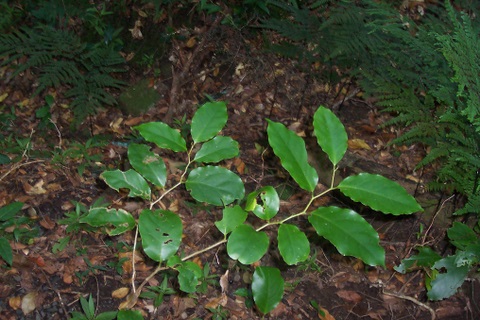
Pennantia cunninghamii grows in rainforest and occurs from Clyde Mountain near Batemans Bay in southern New South Wales to Atherton in tropical Queensland. It has an irregularly fluted trunk, often-sc aly bark, glossy leaves with prominent domatia, and fleshy black fruits.
Written 27 November 2026 from the sources listed below. Each statement was checked against the passage it cites; statements that could not be supported were removed.
Appearance
The leaves are elliptic or oblong and grow along zig-zagging branchlets. Both leaf surfaces are glossy and have prominent domatia on the veins.[1][2][3]
The flowers are bisexual or male and grow in panicles. They have inconspicuous sepals and hairless petals.[4][5]
The fruit is a fleshy black drupe containing a single seed.[6][7]
The petals measure 3–4 mm long and 1.0–1.5 mm wide. The fruits measure 10–15 mm long and 7–9 mm wide.[8][9]
Habitat
Brown beech grows in rainforest. It occurs from Clyde Mountain near Batemans Bay in southern New South Wales to Atherton in tropical Queensland.[10][11]
Diet
The fruits of brown beech are eaten by grey-headed flying foxes.[12]
Behaviour
The moth Cardamyla carinentalis pupates between the leaves of brown beech.[13]
Reproduction and life cycle
Brown beech produces bisexual or male flowers. Flowering occurs between November and January.[14][15]
Classification of the Brown Beech
| Kingdom | Plantae |
|---|---|
| Subkingdom | Pteridobiotina |
| Phylum | Tracheophyta |
| Class | Magnoliopsida |
| Order | Apiales |
| Family | Pennantiaceae (Kaikomako Family) |
| Genus | Pennantia |
| Species | Pennantia cunninghamii Miers |
Where the Brown Beech is found
Checklists and occurrence records place Pennantia cunninghamii in 1 country across Oceania. GBIF holds 1,558 georeferenced records of it.
Countries
Regions and cities with the most records
- New South Wales, Australia 1,141
- Queensland, Australia 342
- Wollongong, Australia 93
- Parramatta, Australia 16
- Gold Coast, Australia 15
- Liverpool, Australia 14
- Coffs Harbour, Australia 6
- Taree, Australia 6
Range as the checklists state it
Australia (Queensland: Atherton Tableland, to Milton, New South Wales)
A number beside a place is its count of GBIF occurrence records. A place without a number comes from a checklist alone. Records show where a species has been observed or collected, which can include escapes and vagrants.
Common names
English
- Brown Beech
Related species

Compare
Questions and answers
What is the scientific name of the Brown Beech?
The scientific name of the Brown Beech is Pennantia cunninghamii. Written with its author, the full name is Pennantia cunninghamii Miers.
Which family does the Brown Beech belong to?
Pennantia cunninghamii belongs to the family Pennantiaceae, in the order Apiales and the class Magnoliopsida.
Where is the Brown Beech found?
Checklists and occurrence records place Pennantia cunninghamii in 1 country: Australia.
What is the conservation status of the Brown Beech?
The IUCN Red List category recorded for Pennantia cunninghamii is Least Concern (LC).
Sources
Passages the profile rests on
- The leaves are elliptic or oblong in shape. Source passage: “The leaves are elliptic or oblong” — English Wikipedia
- Both surfaces of the leaves are glossy and have prominent domatia on the veins. Source passage: “Both sides of the leaves are glossy with prominent domatia on the veins.” — English Wikipedia
- The leaves grow along zig-zagging branchlets. Source passage: “arranged along zig-zagging branchlets.” — English Wikipedia
- The flowers are bisexual or male and grow in panicles. Source passage: “The flowers are bisexual or male, arranged in panicles” — English Wikipedia
- The flowers have inconspicuous sepals and hairless petals. Source passage: “the sepals insignificant, the petals glabrous” — English Wikipedia
- The fruit is a fleshy black drupe. Source passage: “the fruit is a fleshy black drupe” — English Wikipedia
- The fruits contain a single seed. Source passage: “containing a single seed.” — English Wikipedia
- The petals measure 3–4 mm long and 1.0–1.5 mm wide. Source passage: “the petals glabrous, 3–4 mm (0.12–0.16 in) long and 1.0–1.5 mm (0.039–0.059 in) wide.” — English Wikipedia
- The fleshy black fruits measure 10–15 mm long and 7–9 mm wide. Source passage: “10–15 mm (0.39–0.59 in) long and 7–9 mm (0.28–0.35 in) wide” — English Wikipedia
- Pennantia cunninghamii grows in rainforest. Source passage: “Brown beech grows in rainforest” — English Wikipedia
- The species occurs from Clyde Mountain near Batemans Bay in southern New South Wales to Atherton in tropical Queensland. Source passage: “from Clyde Mountain near Batemans Bay (35° S) in southern New South Wales to Atherton (17° S) in tropical Queensland.” — English Wikipedia
- The fruits of Pennantia cunninghamii are eaten by grey-headed flying foxes. Source passage: “The fruit of P. cunninghamii is eaten by grey-headed flying fox” — English Wikipedia
- The moth Cardamyla carinentalis pupates between the leaves of Pennantia cunninghamii. Source passage: “The larva of the moth Cardamyla carinentalis pupates between leaves of this species.” — English Wikipedia
- The species produces bisexual or male flowers. Source passage: “The flowers are bisexual or male” — English Wikipedia
- Flowering occurs between November and January. Source passage: “Flowering occurs from November to January” — English Wikipedia
Data
- Catalogue of Life, 2026-10-16 XR cc by
- Global Biodiversity Information Facility CC BY 4.0
- Wikidata CC0
- GeoNames CC BY 4.0
- Wikimedia Commons per image; credit shown with each image
- Within the Catalogue of Life, this name comes from Synonymic Checklists of the Vascular Plants of the World cc by
References
- Miers. (1852). Ann. Mag. Nat. Hist., Ser. 2, 9: 491 (1852). where the name was published
This species in other databases
Page built on 27 November 2026. See how the catalog is made and all sources and licences.
Cite this page
ScientificNames.org. (2026). Pennantia cunninghamii (Brown Beech). Retrieved November 27, 2026, from https://scientificnames.org/species/pennantia-cunninghamii
“Pennantia cunninghamii (Brown Beech).” ScientificNames.org, 2026, scientificnames.org/species/pennantia-cunninghamii. Accessed 27 Nov. 2026.
ScientificNames.org. “Pennantia cunninghamii (Brown Beech).” Accessed November 27, 2026. https://scientificnames.org/species/pennantia-cunninghamii.
@misc{scientificnames_pennantia_cunninghamii_brown_beech,
  author = {{ScientificNames.org}},
  title = {Pennantia cunninghamii (Brown Beech)},
  year = {2026},
  url = {https://scientificnames.org/species/pennantia-cunninghamii},
  note = {Accessed 2026-11-27}
}