Species · Fishes
Armoured Searobin Peristedion miniatum
The scientific name of the Armoured Searobin is Peristedion miniatum. It is a species of fish in the family Peristediidae (armored gurnards), order Perciformes. The name dates from 1880.
- Scientific name
- Peristedion miniatum Goode, 1880
- Common name
- Armoured Searobin
- Genus
- Peristedion
- Family
- Peristediidae (Armored Gurnards)
- Order
- Perciformes
- Class
- Teleostei
- Red List category
- LC Least Concern
- Environment
- marine
- Recorded in
- 3 countries
- Name status
- accepted in the Catalogue of Life

Overview
The recorded distribution includes the Greater Caribbean region, from tropical and equatorial waters to subtropical waters between 0°N and 35°N. It has four rows of bony, spiny scales covering its body and an orange-red colouration with dark markings on its fins and upper back.
Written 28 November 2026 from the sources listed below. Each statement was checked against the passage it cites; statements that could not be supported were removed.
Appearance
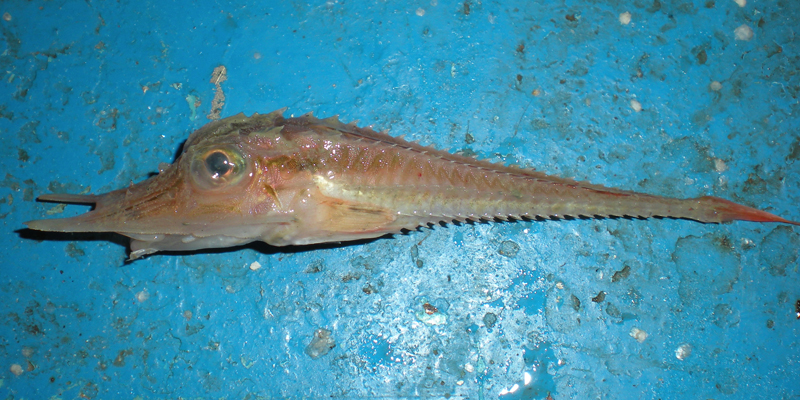
The body is entirely covered by four rows of bony, spiny scales. The head is short, extremely wide and depressed.[1][2]
The snout plates are usually shorter than the eye, moderately broad and non-divergent. Strong, curved spines occur at their bases and around the nostrils.[3][4]
The bony rim along each side of the head is wide and undulating, ending in a broad angular wing behind the head. Two separate, slender barbels occur on the lower lip, with eight to nine chin barbels on each side arranged in four to five clusters.[5][6][7]
The filamentous lower-jaw barbel measures 21–31% of standard length.[8]
The dorsal fin is divided into separate spiny and soft sections, with seven to eight spines and 17–18 soft rays. The anal fin has 17–19 rays and no spines.[9][10]
The short pectoral fins have 11–13 rays and two free rays. The pelvic fins are widely separated and positioned below the bases of the pectoral fins.[11][12]
The head, body and fins are orange-red, with indistinct dark bars across the upper back. The dorsal fins have reddish-black borders.[13][14]
The pectoral fin has a diffuse dark bar across the upper half of its base and a black outer two-thirds. The tail fin has a black upper half on the outer third and a dark bar at its base.[15][16]
Uses
The reported nutritional composition includes 16.9% protein by wet weight. Its omega-3 content is 0.642 grams per 100 grams of wet weight.[17][18]
The reported calcium content is 36 milligrams per 100 grams of wet weight, and its iron content is 0.496 milligrams per 100 grams of wet weight.[19][20]
The reported selenium content is 18 micrograms per 100 grams of wet weight. Its vitamin A content is 14.2 micrograms per 100 grams of wet weight.[21][22]
The reported zinc content is 0.453 milligrams per 100 grams of wet weight.[23]
Conservation
FishBase reports a moderate vulnerability score of 39 out of 100.[24]
Classification of the Armoured Searobin
| Kingdom | Animalia |
|---|---|
| Phylum | Chordata |
| Subphylum | Vertebrata |
| Infraphylum | Gnathostomata |
| Parvphylum | Osteichthyes |
| Gigaclass | Actinopterygii |
| Superclass | Actinopteri |
| Class | Teleostei (Teleost) |
| Order | Perciformes |
| Suborder | Scorpaenoidei |
| Family | Peristediidae (Armored Gurnards) |
| Genus | Peristedion |
| Species | Peristedion miniatum Goode, 1880 |
Where the Armoured Searobin is found
Checklists and occurrence records place Peristedion miniatum in 3 countries. GBIF holds 1,415 georeferenced records of it.
Countries
4 more countries have a few records outside this range
These countries hold a few records of Peristedion miniatum but lie outside the range the checklists give for it. Such records are often zoo or garden specimens, museum material or vagrants, so the species is not counted as occurring there.
A number beside a place is its count of GBIF occurrence records. A place without a number comes from a checklist alone. Records show where a species has been observed or collected, which can include escapes and vagrants.
Common names
English
- Armoured Searobin
- Armored Searobin
Names in 4 other languages
- Czech
- brňák šelfový
- French
- malarmat à dix aiguillons
- Portuguese
- Falso-voador-de-chifre-de-espinho
- Russian
- Малая панцирная тригла
Synonyms
2 other scientific names have been used for this species and are now treated as synonyms of Peristedion miniatum.
- Peristedion mcgintyi Fowler, 1952
- Peristedium miniatum Goode, 1880
Related species
-
 Armed GurnardPeristedion cataphractum
-
 Alligator Armored SearobinPeristedion greyae
-
 Flathead Armored SearobinPeristedion brevirostre
-
 Slender SearobinPeristedion gracile
-
 Armoured GurnardPeristedion liorhynchus
-
 Peristedion altipinne
- Peristedion barbiger
-
 Widehead Armored SearobinPeristedion longispatha
Compare
Questions and answers
What is the scientific name of the Armoured Searobin?
The scientific name of the Armoured Searobin is Peristedion miniatum. Written with its author, the full name is Peristedion miniatum Goode, 1880.
Which family does the Armoured Searobin belong to?
Peristedion miniatum belongs to the family Peristediidae, in the order Perciformes and the class Teleostei.
Where is the Armoured Searobin found?
Checklists and occurrence records place Peristedion miniatum in 3 countries: United States, Canada and Mexico.
What is the conservation status of the Armoured Searobin?
The IUCN Red List category recorded for Peristedion miniatum is Least Concern (LC).
What other names does the Armoured Searobin have?
Peristedion miniatum is also known in English as Armored Searobin.
Sources
Passages the profile rests on
- Its body is entirely covered by four rows of bony, spiny scales. Source passage: “body completely covered in a heavy armor of 4 rows of bony spiny scales” — biogeodb.stri.si.edu
- Its head is short, extremely wide and depressed. Source passage: “head short, extremely wide, depressed” — biogeodb.stri.si.edu
- Its snout plates are usually shorter than the eye, moderately broad and non-divergent. Source passage: “snout plates very short (length usually <eye), moderately broad, not diverging” — biogeodb.stri.si.edu
- Strong, curved spines occur at the bases of the snout plates and around the nostrils. Source passage: “base of snout plates and nostrils with strong, curved spines” — biogeodb.stri.si.edu
- The bony rim along each side of the head is wide and undulating, ending in a broad angular wing behind the head. Source passage: “Bony rim around side of head wide, undulating, ends in a wide angular wing behind head” — biogeodb.stri.si.edu
- The species has two separate, slender barbels on its lower lip. Source passage: “barbels: 2 slender, separate lower lip barbels” — biogeodb.stri.si.edu
- It has eight to nine chin barbels on each side, arranged in four to five clusters. Source passage: “8-9 chin barbells on each side arranged in 4-5 clusters” — biogeodb.stri.si.edu
- Its filamentous lower-jaw barbel measures 21–31% of standard length. Source passage: “filamentous lower jaw barbell very long (21-31% of SL)” — biogeodb.stri.si.edu
- Its dorsal fin is divided into separate spiny and soft sections, with seven to eight spines and 17–18 soft rays. Source passage: “dorsal fin divided into separate spiny and soft parts, VII-VIII + 17-18” — biogeodb.stri.si.edu
- Its anal fin has 17–19 rays and no spines. Source passage: “anal fin without spines, 17-19” — biogeodb.stri.si.edu
- Its short pectoral fins have 11–13 rays and two free rays. Source passage: “pectoral fin 11-13 + 2 free rays, fin short” — biogeodb.stri.si.edu
- Its pelvic fins are widely separated and positioned below the bases of the pectoral fins. Source passage: “pelvic fins wide apart, below base of pectorals, I, 5 rays.” — biogeodb.stri.si.edu
- Its head, body and fins are orange-red, with indistinct dark bars across the upper back. Source passage: “Head, body and fins orange-red, indistinct dark bars across upper back” — biogeodb.stri.si.edu
- Its dorsal fins have reddish-black borders. Source passage: “reddish black borders to dorsal fins” — biogeodb.stri.si.edu
- The pectoral fin has a diffuse dark bar across the upper half of its base and a black outer two-thirds. Source passage: “pectoral fin with a diffuse dark bar across the upper half of its base, outer 2/3 black” — biogeodb.stri.si.edu
- The tail fin has a black upper half on the outer third and a dark bar at its base. Source passage: “tail fin with upper half of outer 1/3 black, base of fin with a dark bar.” — biogeodb.stri.si.edu
- The reported nutritional composition includes 16.9% protein by wet weight. Source passage: “Protein = 16.9 [15.4, 18.2] %” — fishbase.se
- The reported omega-3 content is 0.642 grams per 100 grams of wet weight. Source passage: “Omega3 = 0.642 [0.265, 1.851] g/100g” — fishbase.se
- The reported calcium content is 36 milligrams per 100 grams of wet weight. Source passage: “Calcium = 36 [19, 82] mg/100g” — fishbase.se
- The reported iron content is 0.496 milligrams per 100 grams of wet weight. Source passage: “Iron = 0.496 [0.250, 0.971] mg/100g” — fishbase.se
- The reported selenium content is 18 micrograms per 100 grams of wet weight. Source passage: “Selenium = 18 [8, 44] μg/100g” — fishbase.se
- The reported vitamin A content is 14.2 micrograms per 100 grams of wet weight. Source passage: “VitaminA = 14.2 [3.3, 59.2] μg/100g” — fishbase.se
- The reported zinc content is 0.453 milligrams per 100 grams of wet weight. Source passage: “Zinc = 0.453 [0.306, 0.678] mg/100g” — fishbase.se
- FishBase reports a moderate vulnerability score of 39 out of 100. Source passage: “Moderate vulnerability (39 of 100).” — fishbase.se
Data
- Catalogue of Life, 2026-10-16 XR cc by
- Global Biodiversity Information Facility CC BY 4.0
- Wikidata CC0
- GeoNames CC BY 4.0
- Wikimedia Commons per image; credit shown with each image
- Within the Catalogue of Life, this name comes from World Register of Marine Species cc by
References
- Goode, G. B. (1880). Descriptions of seven new species of fishes from deep soundings on the southern New England coast, with diagnoses of two undescribed genera of flounders and a genus related to Merlucius. Proceedings of the United States National Museum, v. 3 (no. 165): 337–350. https://doi.org/10.5479/si.00963801.3-165.337 Link where the name was published
This species in other databases
- Catalogue of Life 4F4VB
- Wikidata Q1890857
- iNaturalist 450416
- WoRMS urn:lsid:marinespecies.org:taxname:159550
- ITIS 167010
Page built on 29 November 2026. See how the catalog is made and all sources and licences.
Cite this page
ScientificNames.org. (2026). Peristedion miniatum (Armoured Searobin). Retrieved November 29, 2026, from https://scientificnames.org/species/peristedion-miniatum
“Peristedion miniatum (Armoured Searobin).” ScientificNames.org, 2026, scientificnames.org/species/peristedion-miniatum. Accessed 29 Nov. 2026.
ScientificNames.org. “Peristedion miniatum (Armoured Searobin).” Accessed November 29, 2026. https://scientificnames.org/species/peristedion-miniatum.
@misc{scientificnames_peristedion_miniatum_armoured_searobin,
  author = {{ScientificNames.org}},
  title = {Peristedion miniatum (Armoured Searobin)},
  year = {2026},
  url = {https://scientificnames.org/species/peristedion-miniatum},
  note = {Accessed 2026-11-29}
}