Species · Crustaceans
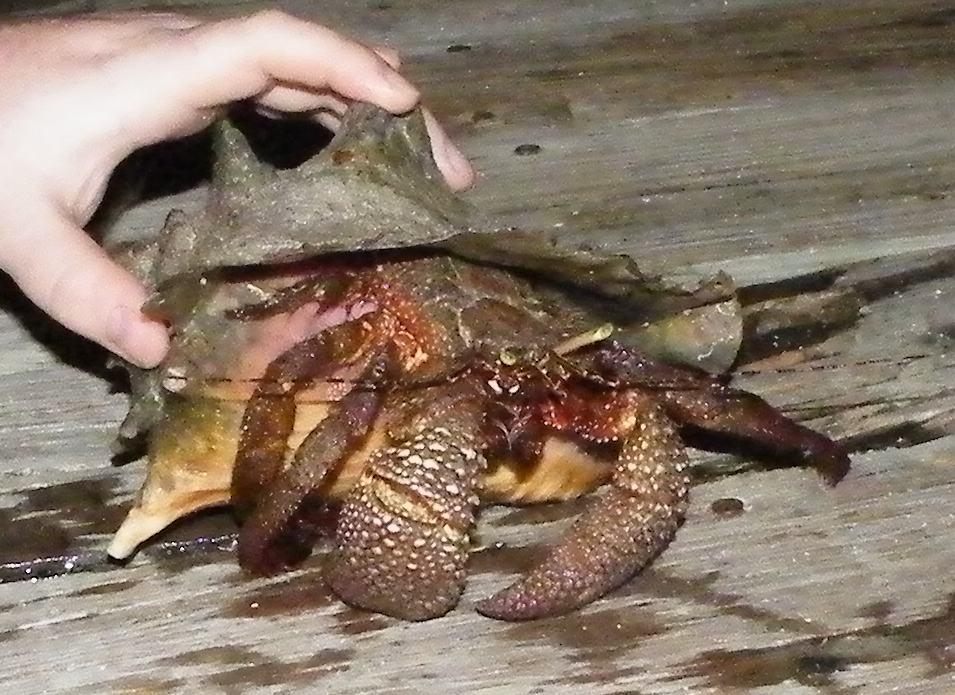
Giant Hermit Crab Petrochirus diogenes
The scientific name of the Giant Hermit Crab is Petrochirus diogenes. It is a species of crustacean in the family Diogenidae (lefthanded hermit crabs), order Decapoda. The name dates from 1758.
- Scientific name
- Petrochirus diogenes (Linnaeus, 1758)
- Common name
- Giant Hermit Crab
- Genus
- Petrochirus
- Family
- Diogenidae (Lefthanded Hermit Crabs)
- Order
- Decapoda
- Class
- Malacostraca
- Environment
- marine
- Recorded in
- 30 countries
- Name status
- accepted in the Catalogue of Life
Overview
The giant hermit crab inhabits the Caribbean Sea. It often occupies conch shells and can obtain both food and a shell by attacking and eating a conch.
Written 26 November 2026 from the sources listed below. Each statement was checked against the passage it cites; statements that could not be supported were removed.
Habitat
The giant hermit crab inhabits the Caribbean Sea. It often occupies conch shells.[1][2]
It is large enough to occupy a fully grown queen conch shell.[3]
Diet
The giant hermit crab attacks and eats conchs.[4]
Behaviour
By attacking and eating a conch, the giant hermit crab can obtain both food and a shell.[5]
Classification of the Giant Hermit Crab
| Kingdom | Animalia |
|---|---|
| Phylum | Arthropoda |
| Subphylum | Crustacea |
| Class | Malacostraca |
| Order | Decapoda |
| Suborder | Pleocyemata |
| Infraorder | Anomura |
| Superfamily | Paguroidea (Hermit Crabs) |
| Family | Diogenidae (Lefthanded Hermit Crabs) |
| Genus | Petrochirus |
| Species | Petrochirus diogenes (Linnaeus, 1758) |
Where the Giant Hermit Crab is found
Checklists and occurrence records place Petrochirus diogenes in 30 countries. GBIF holds 2,045 georeferenced records of it.
Countries
- Antigua and Barbuda 8
- Bahamas 53
- Barbados 3
- Belize 65
- Bermuda 3
- Bonaire, Saint Eustatius and Saba 8
- Brazil 153
- British Virgin Islands 10
- Cayman Islands 5
- Colombia 16
- Cuba 40
- Dominica 6
- Dominican Republic 7
- Guadeloupe 33
- Guyana 3
- Haiti 12
- Honduras 33
- Jamaica 14
- Martinique 8
- Mexico 162
- Panama 22
- Puerto Rico 25
- Saint Barthelemy 25
- Saint Martin 8
- Suriname 4
- Trinidad and Tobago 4
- Turks and Caicos Islands 3
- U.S. Virgin Islands 43
- United States 1,241
- Venezuela 28
Regions and cities with the most records
- Florida, United States 372
- Palm Beach Gardens, United States 181
- Jupiter, United States 176
- Riviera Beach, United States 174
- Lake Worth Beach, United States 170
- Palm Springs, United States 170
- West Palm Beach, United States 169
- Lake Worth Corridor, United States 167
- Greenacres City, United States 165
- Little Havana, United States 66
- Miami, United States 66
- Allapattah, United States 65
- Brownsville, United States 65
- Miami Beach, United States 65
- West Little River, United States 61
- Coconut Grove, United States 60
- Coral Gables, United States 60
- Coral Terrace, United States 60
- Marco Island, United States 59
- Flagami, United States 58
- Glenvar Heights, United States 58
- Pinewood, United States 58
- Kendall, United States 57
- Pinecrest, United States 57
- Westchester, United States 57
- North Miami, United States 55
- Bayshore Gardens, United States 50
- South Bradenton, United States 48
- Hialeah, United States 44
- Iona, United States 44
- Cozumel, Mexico 43
- Sarasota, United States 41
- Bradenton, United States 40
- Cutler, United States 33
- East Naples, United States 30
- Sunset, United States 30
1 more country has a few records outside this range
These countries hold a few records of Petrochirus diogenes but lie outside the range the checklists give for it. Such records are often zoo or garden specimens, museum material or vagrants, so the species is not counted as occurring there.
Range as the checklists state it
Western Atlantic Ocean
A number beside a place is its count of GBIF occurrence records. A place without a number comes from a checklist alone. Records show where a species has been observed or collected, which can include escapes and vagrants.
Common names
English
- Giant Hermit Crab
- Giant Hermit
Names in 4 other languages
- French
- Pagure granulé, Pagure géant des lambis
- German
- Amerikanischer Riesen-Einsiedler
- Lithuanian
- Didysis krabas atsiskyrėlis
- Spanish
- Cangrejo ermitaño gigante
Synonyms
7 other scientific names have been used for this species and are now treated as synonyms of Petrochirus diogenes.
- Cancer bahamensis Herbst, 1791
- Cancer diogenes Linnaeus, 1758
- Cenobita diogenes (Linnaeus, 1758)
- Coenobita diogenes (Linnaeus, 1758)
- Pagurus granulatus Olivier, 1812
- Petrochirus bahamensis (J. F. W. Herbst, 1791)
- Petrochirus granulatus (Olivier, 1812)
Related species
- Big Claw Purple Hermit CrabPetrochirus californiensis
- Petrochirus pustulatus
-
 Mediterranean Hermit CrabDardanus calidus
- Clibanarius fonticola
-
 Thinstripe Hermit CrabClibanarius vittatus
-
 White-spotted Hermit CrabDardanus megistos
-
 Blue Leg Hermit CrabClibanarius tricolor
-
 Hermit CrabClibanarius erythropus
Compare
Questions and answers
What is the scientific name of the Giant Hermit Crab?
The scientific name of the Giant Hermit Crab is Petrochirus diogenes. Written with its author, the full name is Petrochirus diogenes (Linnaeus, 1758).
Which family does the Giant Hermit Crab belong to?
Petrochirus diogenes belongs to the family Diogenidae, in the order Decapoda and the class Malacostraca.
Where is the Giant Hermit Crab found?
Checklists and occurrence records place Petrochirus diogenes in 30 countries, including United States, Mexico, Brazil, Belize, Bahamas and U.S. Virgin Islands.
What other names does the Giant Hermit Crab have?
Petrochirus diogenes is also known in English as Giant Hermit.
Sources
Passages the profile rests on
- The species inhabits the Caribbean Sea. Source passage: “This species lives in the Caribbean Sea” — English Wikipedia
- The species often occupies conch shells. Source passage: “often inhabits conch shells.” — English Wikipedia
- The species is large enough to occupy a fully grown queen conch shell. Source passage: “This species of hermit crab is large enough that it can inhabit a fully grown shell of the queen conch.” — English Wikipedia
- The species attacks and eats conchs. Source passage: “It will attack and eat a conch” — English Wikipedia
- The species can obtain both food and a shell by attacking and eating a conch. Source passage: “It will attack and eat a conch, thus obtaining a meal and a shell.” — English Wikipedia
Data
- Catalogue of Life, 2026-10-16 XR cc by
- Global Biodiversity Information Facility CC BY 4.0
- Wikidata CC0
- GeoNames CC BY 4.0
- Wikimedia Commons per image; credit shown with each image
- Within the Catalogue of Life, this name comes from The Integrated Taxonomic Information System cc0
References
- Lemaitre, R.; McLaughlin, P., 2020, World Paguroidea & Lomisoidea database. Petrochirus diogenes (Linnaeus, 1758). Accessed through: World Register of Marine Species at: http://www.marinespecies.org/aphia.php?p=taxdetails&id=368346 on 2020-03-02 where the name was published
- Williams, Austin B., Lawrence G. Abele, D. L. Felder, H. H. Hobbs, Jr., R. B. Manning, et al. (1989). Common and Scientific Names of Aquatic Invertebrates from the United States and Canada: Decapod Crustaceans. American Fisheries Society Special Publication 17.
- Nizinski, Martha S. (2003). Annotated checklist of decapod crustaceans of Atlantic coastal and continental shelf waters of the United States. Proceedings of the Biological Society of Washington, Vol. 116, No. 1.
- McLaughlin, P. A., D. K. Camp, M. V. Angel, E. L. Bousfield, P. Brunel, R. C. Brusca, et al. (2005). Common and scientific names of aquatic invertebrates from the United States and Canada: Crustaceans. American Fisheries Society Special Publication 31.
- McLaughlin, Patsy A., Tomoyuki Komai, Rafael Lemaitre, and Dwi Listyo Rahayu. (2010). Annotated checklist of Anomuran decapod crustaceans of the world [...]. Part 1 - Lithodoidea, Lomisoidea and Paguroidea. Raffles Bulletin of Zoology, Supplement No. 23.
- Nucci, Paulo Ricardo, & and Gustavo Augusto Schmidt de Melo. (2015). Hermit crabs from Brazil: Family Diogenidae (Crustacea: Decapoda: Paguroidea), except Paguristes. Zootaxa, Vol. 3947, No. 3.
This species in other databases
- Catalogue of Life B3Z7R
- Wikidata Q3934026
- iNaturalist 260326
- WoRMS urn:lsid:marinespecies.org:taxname:368346
Page built on 27 November 2026. See how the catalog is made and all sources and licences.
Cite this page
ScientificNames.org. (2026). Petrochirus diogenes (Giant Hermit Crab). Retrieved November 27, 2026, from https://scientificnames.org/species/petrochirus-diogenes
“Petrochirus diogenes (Giant Hermit Crab).” ScientificNames.org, 2026, scientificnames.org/species/petrochirus-diogenes. Accessed 27 Nov. 2026.
ScientificNames.org. “Petrochirus diogenes (Giant Hermit Crab).” Accessed November 27, 2026. https://scientificnames.org/species/petrochirus-diogenes.
@misc{scientificnames_petrochirus_diogenes_giant_hermit_crab,
  author = {{ScientificNames.org}},
  title = {Petrochirus diogenes (Giant Hermit Crab)},
  year = {2026},
  url = {https://scientificnames.org/species/petrochirus-diogenes},
  note = {Accessed 2026-11-27}
}