Species · Birds
White-whiskered Hermit Phaethornis yaruqui
The scientific name of the White-whiskered Hermit is Phaethornis yaruqui. It is a species of bird in the family Trochilidae (hummingbird), order Apodiformes. The name dates from 1851.
- Scientific name
- Phaethornis yaruqui (Bourcier, 1851)
- Common name
- White-whiskered Hermit
- Genus
- Phaethornis
- Family
- Trochilidae (Hummingbird)
- Order
- Apodiformes
- Class
- Aves
- Red List category
- LC Least Concern
- Recorded in
- 2 countries
- Name status
- accepted in the Catalogue of Life
Overview
Phaethornis yaruqui occurs in western Colombia and western Ecuador, inhabiting humid forests and other vegetated habitats.
Written 26 November 2026 from the sources listed below. Each statement was checked against the passage it cites; statements that could not be supported were removed.
Appearance
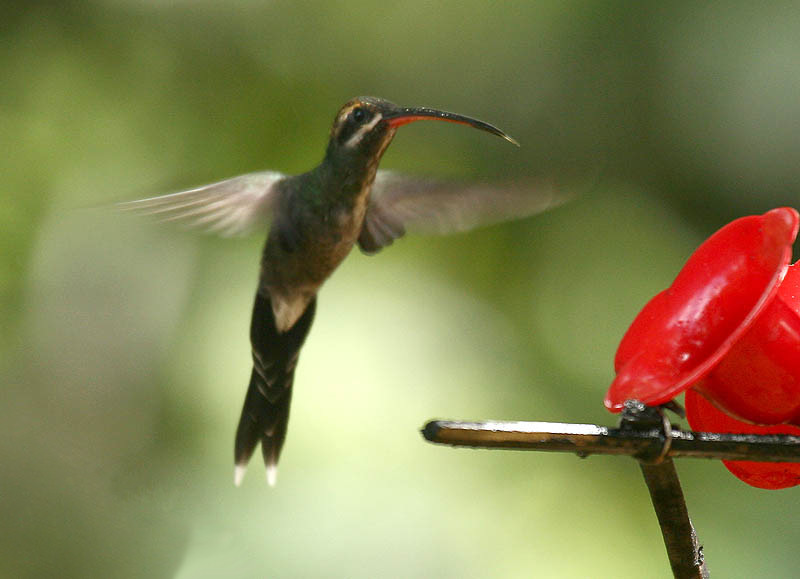
Males have an almost straight bill. Females have a shorter, gently decurved bill and more grayish underparts than males, as well as shorter wings and longer tails.[1][2][3]
The species has a dark greenish overall appearance, a buffy eyebrow, and a white mustache. It is approximately 13 cm long.[4][5]
Male individuals weigh between 4 and 7 g, while female individuals weigh between 4 and 6.5 g.[6][7]
Habitat
The White-whiskered Hermit inhabits humid mid-elevation and montane forests, humid secondary forests, dense shrublands, and plantations. It usually occurs below 1,200 m elevation but has been recorded at elevations up to 2,000 m.[8][9][10]
The species occurs in Colombia and Ecuador, with a range extending from northern Chocó Department in Colombia south through western Ecuador to El Oro Province. It has also been reported in Panama near the Colombian border.[11][12][13]
It is frequently observed moving through wet forest undergrowth.[14]
Diet
The White-whiskered Hermit feeds on nectar by visiting circuits of various flowering plants. It also consumes small arthropods.[15][16]
Behaviour
The species primarily remains sedentary but apparently makes seasonal movements between elevations in Ecuador. It uses trap-line feeding, visiting multiple flowering plants for nectar.[17][18][19]
Males attract mates by congregating at leks, where they sit on low perches and wag their tails while making seek vocalizations. Individuals also produce seek notes while wagging their tails from low perches at leks.[20][21][22]
The species produces a continuous song consisting of harsh kree-u notes.[23]
Reproduction and life cycle
The breeding season has not been fully described but apparently extends from November through July.[24]
The species builds cone-shaped cup nests suspended beneath drooping leaves. The clutch consists of two eggs.[25][26]
Conservation
The White-whiskered Hermit is classified as Least Concern by the IUCN. The population size is unknown and believed to be decreasing.[27][28]
The species is generally common in wet forests, but its long-term survival depends on habitat conservation. It was most recently assessed for the IUCN Red List in 2022.[29][30]
Similar species
The species is monotypic. The western Colombia population was previously treated as a subspecies named Phaethornis yaruqui sanctijohannis, but its description was determined to describe immature birds.[31][32][33]
Classification of the White-whiskered Hermit
| Kingdom | Animalia |
|---|---|
| Phylum | Chordata |
| Subphylum | Vertebrata |
| Infraphylum | Gnathostomata |
| Parvphylum | Osteichthyes |
| Megaclass | Tetrapoda |
| Class | Aves (Bird) |
| Order | Apodiformes (Swifts) |
| Family | Trochilidae (Hummingbird) |
| Subfamily | Phaethornithinae |
| Genus | Phaethornis (Hermits) |
| Species | Phaethornis yaruqui (Bourcier, 1851) |
Where the White-whiskered Hermit is found
Checklists and occurrence records place Phaethornis yaruqui in 2 countries across South America. GBIF holds 38,187 georeferenced records of it.
Countries
Regions and cities with the most records
- Pichincha, Ecuador 24,323
- Valle del Cauca Department, Colombia 4,417
- Nariño, Colombia 2,600
- Esmeraldas, Ecuador 1,190
- Buenaventura, Colombia 1,080
- Buenaventura, Colombia 1,018
- El Oro, Ecuador 967
- Piñas, Ecuador 951
- Chocó, Colombia 891
- Chimborazo Province, Ecuador 808
- Risaralda Department, Colombia 582
- La Troncal, Ecuador 450
- Canar, Ecuador 448
- Santo Domingo de los Tsáchilas, Ecuador 408
- Manabí, Ecuador 282
- Santo Domingo de los Colorados, Ecuador 277
- Imbabura, Ecuador 225
- Antioquia, Colombia 162
- Azuay, Ecuador 111
- Guayas, Ecuador 111
- Cauca Department, Colombia 110
- Darien, Colombia 99
- Timbiquí, Colombia 91
- Los Ríos, Ecuador 78
- Bolívar, Ecuador 67
- Ciudad Bolívar, Colombia 62
- Naranjal, Ecuador 62
- Quibdó, Colombia 61
- Carchi, Ecuador 52
- Tadó, Colombia 47
- Cotopaxi, Ecuador 29
- Rosa Zarate, Ecuador 19
- Pasaje, Ecuador 17
- La Maná, Ecuador 16
- Belén de Umbría, Colombia 15
- Cali, Colombia 15
1 more country has a few records outside this range
These countries hold a few records of Phaethornis yaruqui but lie outside the range the checklists give for it. Such records are often zoo or garden specimens, museum material or vagrants, so the species is not counted as occurring there.
Range as the checklists state it
South America
A number beside a place is its count of GBIF occurrence records. A place without a number comes from a checklist alone. Records show where a species has been observed or collected, which can include escapes and vagrants.
Common names
English
- White-whiskered Hermit
Names in 25 other languages
- Catalan
- colibrí ermità de Yaruqui
- Chinese
- 白须隐蜂鸟, 白鬚隱蜂鳥
- Croatian
- bjelogrli kolibrić
- Czech
- kolibřík bělovousý
- Danish
- Yaruquieremit
- Dutch
- Witsnorheremietkolibrie
- Esperanto
- blankliphara ermitkolibro
- Finnish
- viiksierakkokolibri
- French
- Ermite yaruqui
- German
- Blauschwanz-Eremit, Smaragdschattenkolibri
- Hungarian
- Smaragd remetekolibri, smaragd-remetekolibri
- Italian
- Eremita baffibianchi
- Japanese
- シラヒゲユミハチドリ
- Lithuanian
- ūsuotasis saulėtasis kolibris
- Norwegian
- kårdeeremitt
- Polish
- pustelnik białowąsy
- Portuguese
- eremita-do-chocó, rabo-branco-do-pacífico
- Russian
- Синехвостый солнечный колибри, Усатый колибри-отшельник
- Serbian
- Belobrki kolibri pustinjak
- Slovak
- slnečníček modrochvostý
- Spanish
- Ermitaño de Yaruqui, Ermitaño del Pacífico
- Swedish
- yaruquíeremit
- Turkish
- Bıyıklı Hermit
- Ukrainian
- ерміт колумбійський
- Welsh
- meudwy mwstasiog
Synonyms
2 other scientific names have been used for this species and are now treated as synonyms of Phaethornis yaruqui.
- Phaethornis yaruqui yaruqui Bourcier, J, 1851
- Trochilus yaruqui Bourcier, 1851
Related species
-
 Long-billed HermitPhaethornis longirostris
-
 Green HermitPhaethornis guy
-
 Stripe-throated HermitPhaethornis striigularis
-
 Long-tailed HermitPhaethornis superciliosus
-
 Planalto HermitPhaethornis pretrei
-
 Reddish HermitPhaethornis ruber
-
 Little HermitPhaethornis longuemareus
-
 Koepcke's HermitPhaethornis koepckeae
Compare
Questions and answers
What is the scientific name of the White-whiskered Hermit?
The scientific name of the White-whiskered Hermit is Phaethornis yaruqui. Written with its author, the full name is Phaethornis yaruqui (Bourcier, 1851).
Which family does the White-whiskered Hermit belong to?
Phaethornis yaruqui belongs to the family Trochilidae, in the order Apodiformes and the class Aves.
Where is the White-whiskered Hermit found?
Checklists and occurrence records place Phaethornis yaruqui in 2 countries: Ecuador and Colombia.
What is the conservation status of the White-whiskered Hermit?
The IUCN Red List category recorded for Phaethornis yaruqui is Least Concern (LC).
Where does the White-whiskered Hermit occur?
It occurs in Colombia and Ecuador, with a range extending from northern Chocó Department in Colombia through western Ecuador to El Oro Province. It has also been reported in Panama near the Colombian border.[11][12][13][34]
What does the White-whiskered Hermit eat?
It feeds on nectar from various flowering plants and also consumes small arthropods.[15][16]
How large is the White-whiskered Hermit?
It is approximately 13 cm long. Males weigh between 4 and 7 g, and females weigh between 4 and 6.5 g.[5][6][7]
What is the conservation status of the White-whiskered Hermit?
It is classified as Least Concern by the IUCN. Its population size is unknown and believed to be decreasing.[27][28]
Sources
Passages the profile rests on
- Males have an almost straight bill. Source passage: “The male's bill is almost straight.” — English Wikipedia
- Females have a shorter, gently decurved bill and more grayish underparts than males. Source passage: “The female has a shorter and gently decurved bill, shorter wings, more grayish underparts, and a longer tail than the male.” — English Wikipedia
- Females have shorter wings and longer tails than males. Source passage: “The female has a shorter and gently decurved bill, shorter wings, more grayish underparts, and a longer tail than the male.” — English Wikipedia
- The species has a dark greenish overall appearance, a buffy eyebrow, and a white mustache. Source passage: “Dark greenish overall with a buffy eyebrow and a white mustache.” — ebird.org
- The species is approximately 13 cm long. Source passage: “The white-whiskered hermit is about 13 cm (5.1 in) long.” — English Wikipedia
- Male individuals weigh between 4 and 7 g. Source passage: “Males weigh 4 to 7 g (0.14 to 0.25 oz)” — English Wikipedia
- Female individuals weigh between 4 and 6.5 g. Source passage: “females 4 to 6.5 g (0.14 to 0.23 oz).” — English Wikipedia
- The species inhabits humid mid-elevation and montane forests. Source passage: “It inhabits humid mid-elevation and montane forest, humid secondary forest, dense shrublands, and plantations.” — English Wikipedia
- The species also inhabits humid secondary forests, dense shrublands, and plantations. Source passage: “It inhabits humid mid-elevation and montane forest, humid secondary forest, dense shrublands, and plantations.” — English Wikipedia
- The species usually occurs below 1,200 m elevation but has been recorded at elevations up to 2,000 m. Source passage: “In elevation it usually occurs below 1,200 m (3,900 ft) but has been recorded as high as 2,000 m (6,600 ft).” — English Wikipedia
- The species occurs in Colombia and Ecuador. Source passage: “It is found in Colombia and Ecuador.” — English Wikipedia
- Its range extends from northern Chocó Department in Colombia south through western Ecuador to El Oro Province. Source passage: “The white-whiskered hermit is found from Colombia's northern Chocó Department south through western Ecuador to El Oro Province.” — English Wikipedia
- The species has also been reported in Panama near the Colombian border. Source passage: “It has also been reported in Panama near the Colombian border.” — English Wikipedia
- The species is frequently observed moving through wet forest undergrowth. Source passage: “These hermits are most often seen zooming around in wet forest undergrowth, singing as they go.” — neotropical.birds.cornell.edu
- The species feeds on nectar by visiting circuits of various flowering plants. Source passage: “visiting a circuit of a wide variety of flowering plants for nectar.” — English Wikipedia
- The species also consumes small arthropods. Source passage: “It also consumes small arthropods.” — English Wikipedia
- The species primarily remains sedentary. Source passage: “The white-whiskered hermit is primarily sedentary” — English Wikipedia
- The species apparently makes seasonal movements between elevations in Ecuador. Source passage: “but apparently makes seasonal elevation movements in Ecuador.” — English Wikipedia
- The species uses trap-line feeding, visiting multiple flowering plants for nectar. Source passage: “The white-whiskered hermit is a "trap-line" feeder like other hermit hummingbirds, visiting a circuit of a wide variety of flowering plants for nectar.” — English Wikipedia
- Males attract mates by congregating at leks. Source passage: “Like many other hermits, males attract mates by congregating at leks.” — neotropical.birds.cornell.edu
- Males sit on low perches at leks and wag their tails while making seek vocalizations. Source passage: “Within the lek, males sit on a low perch, wagging their tales as they make a seek vocalization dozens of times each minute.” — neotropical.birds.cornell.edu
- Individuals produce seek notes while wagging their tails from low perches at leks. Source passage: “It also gives a series of "seek" notes while wagging its tail on a low perch at a lek.” — English Wikipedia
- The species produces a continuous song consisting of harsh kree-u notes. Source passage: “The white-whiskered hermit's song is "a continuous series of rather harsh 'kree-u' notes".” — English Wikipedia
- The breeding season has not been fully described but apparently extends from November through July. Source passage: “The white-whiskered hermit's breeding season has not been described, though it appears to span from November to July.” — English Wikipedia
- The species builds cone-shaped cup nests suspended beneath drooping leaves. Source passage: “The nest is a cone-shaped cup suspended from the underside of a drooping leaf.” — English Wikipedia
- The clutch consists of two eggs. Source passage: “The clutch size is two eggs.” — English Wikipedia
- The species is classified as Least Concern by the IUCN. Source passage: “The IUCN has assessed the white-whiskered hermit as being of Least Concern” — English Wikipedia
- The population size is unknown and believed to be decreasing. Source passage: “though its population size is unknown and believed to be decreasing.” — English Wikipedia
- The species is generally common in wet forests, but its long-term survival depends on habitat conservation. Source passage: “"[g]enerally common in wet forests [but] long-term survival clearly depends on habitat conservation."” — English Wikipedia
- The species was most recently assessed for the IUCN Red List in 2022. Source passage: “White-whiskered Hermit Phaethornis yaruqui has most recently been assessed for The IUCN Red List of Threatened Species in 2022.” — iucnredlist.org
- The western Colombia population was previously treated as a subspecies named Phaethornis yaruqui sanctijohannis. Source passage: “The western Colombia population was at one time considered to be a subspecies P. y. sanctijohannis” — English Wikipedia
- The species is monotypic. Source passage: “The white-whiskered hermit is monotypic.” — English Wikipedia
- The description of the formerly recognized western Colombia subspecies was determined to describe immature birds. Source passage: “but the description was found to be that of immature birds.” — English Wikipedia
- The species occurs in western Colombia and western Ecuador. Source passage: “The white-whiskered hermit is found in western Colombia and western Ecuador at elevations below ...” — digitalcollections.sit.edu
Data
- Catalogue of Life, 2026-10-16 XR cc by
- Global Biodiversity Information Facility CC BY 4.0
- Wikidata CC0
- GeoNames CC BY 4.0
- Wikimedia Commons per image; credit shown with each image
- Within the Catalogue of Life, this name comes from The Integrated Taxonomic Information System cc0
References
- Dickinson, Edward C., ed. (2003). The Howard and Moore Complete Checklist of the Birds of the World, 3rd Edition.
- Gill, Frank, & and Minturn Wright. (2006). Birds of the World: Recommended English Names.
This species in other databases
Page built on 27 November 2026. See how the catalog is made and all sources and licences.
Cite this page
ScientificNames.org. (2026). Phaethornis yaruqui (White-whiskered Hermit). Retrieved November 27, 2026, from https://scientificnames.org/species/phaethornis-yaruqui
“Phaethornis yaruqui (White-whiskered Hermit).” ScientificNames.org, 2026, scientificnames.org/species/phaethornis-yaruqui. Accessed 27 Nov. 2026.
ScientificNames.org. “Phaethornis yaruqui (White-whiskered Hermit).” Accessed November 27, 2026. https://scientificnames.org/species/phaethornis-yaruqui.
@misc{scientificnames_phaethornis_yaruqui_white_whiskered_hermit,
  author = {{ScientificNames.org}},
  title = {Phaethornis yaruqui (White-whiskered Hermit)},
  year = {2026},
  url = {https://scientificnames.org/species/phaethornis-yaruqui},
  note = {Accessed 2026-11-27}
}