Species · Birds
Common Poorwill Phalaenoptilus nuttallii
The scientific name of the Common Poorwill is Phalaenoptilus nuttallii. It is a species of bird in the family Caprimulgidae (nightjar), order Caprimulgiformes. The name dates from 1844.
- Scientific name
- Phalaenoptilus nuttallii (Audubon, 1844)
- Common name
- Common Poorwill
- Genus
- Phalaenoptilus
- Family
- Caprimulgidae (Nightjar)
- Order
- Caprimulgiformes
- Class
- Aves
- Red List category
- LC Least Concern
- Environment
- terrestrial
- Recorded in
- 3 countries
- Name status
- accepted in the Catalogue of Life
Overview
Phalaenoptilus nuttallii inhabits dry, open areas containing grasses or shrubs, as well as grasslands, forests, hills, and deserts. It is known for entering extended periods of torpor lasting weeks to months.
Written 26 November 2026 from the sources listed below. Each statement was checked against the passage it cites; statements that could not be supported were removed.
Appearance
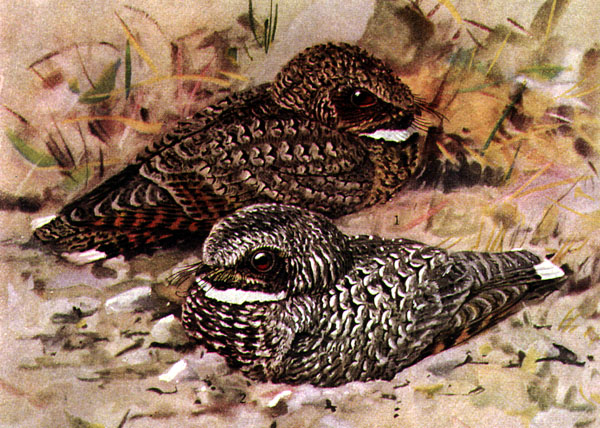
The Common Poorwill has gray and black patterned upperparts, with white tips on its outer tail feathers. Its plumage ranges from mottled brown and white to mottled black and white, with a gray-white underside, thin charcoal-colored lateral bands, and a dark throat band.[1][2][3]
The species has a short bill and rounded wings whose tips reach the end of its tail when resting. Its short, wide beak curves ventrally and has pronounced bristles extending from its base.[4][5]
The Common Poorwill measures approximately 18 centimetres in length, with a wingspan of approximately 30 centimetres. Its reported body mass ranges from 36 to 58 grams.[6][7][8]
Adult individuals measure between 19 and 21 centimetres in length. In a British Columbia sample, males averaged 47.2 grams and females averaged 49.5 grams.[9][10]
Habitat
The Common Poorwill inhabits dry, open areas containing grasses or shrubs, as well as stony desert slopes with very little vegetation. Its habitats include grasslands, forests, hills, and deserts.[11][12][13]
The species prefers short grasses, shrubs, and open forests with deciduous or coniferous vegetation. Its nesting elevations are typically between 500 and 1,000 metres, although some nests occur above 2,500 metres.[14][15]
Roost sites are generally open areas with little live vegetation and nearby bare ground and vegetative debris.[16]
Diet
The Common Poorwill feeds on nocturnal insects, including moths, beetles, and grasshoppers.[17]
Behaviour
The Common Poorwill is known to enter extended periods of torpor lasting weeks to months. During winter torpor, individuals can remain inactive and concealed in piles of rocks.[18][19]
The species frequently captures prey from the ground or by jumping into the air from the ground. It has also been reported drinking while flying.[20][21]
Male Common Poorwills establish and defend territories after returning to their breeding areas in spring. Male calling occurs from evening until dawn, particularly during the beginning of the breeding season.[22][23]
The species produces a three-note vocalization described as poor-will-ow. Pairs are monogamous during a single breeding season.[24][25]
Reproduction and life cycle
Breeding occurs from March to August in southern populations and from late May to September in northern populations. The species usually produces one brood annually.[26][27]
The Common Poorwill lays its eggs in shallow scrapes on the ground, frequently near hills and partially shaded by vegetation. A typical clutch contains two eggs, which can be white, creamy, or pale pink, sometimes with darker mottling.[28][29][30]
Both parents incubate the eggs for approximately 20 to 21 days. Young typically fledge 20 to 23 days after hatching, and nestlings are semiprecocial.[31][32][33]
Females sometimes lay and incubate a second clutch within 100 metres of the first nest. Parents may enter torpor while incubating eggs during adverse weather, with recorded cloacal temperatures as low as 11.5 degrees Celsius.[34][35]
Classification of the Common Poorwill
| Kingdom | Animalia |
|---|---|
| Phylum | Chordata |
| Subphylum | Vertebrata |
| Infraphylum | Gnathostomata |
| Parvphylum | Osteichthyes |
| Megaclass | Tetrapoda |
| Class | Aves (Bird) |
| Order | Caprimulgiformes (Nightjar) |
| Family | Caprimulgidae (Nightjar) |
| Genus | Phalaenoptilus (Poorwills) |
| Species | Phalaenoptilus nuttallii (Audubon, 1844) |
Where the Common Poorwill is found
Checklists and occurrence records place Phalaenoptilus nuttallii in 3 countries across North America. GBIF holds 90,196 georeferenced records of it.
Countries
Regions and cities with the most records
- California, United States 20,817
- Arizona, United States 20,317
- Texas, United States 9,638
- Colorado, United States 7,842
- New Mexico, United States 4,889
- Utah, United States 4,297
- Oregon, United States 4,062
- Green Valley, United States 3,017
- Nevada, United States 2,996
- Washington, United States 2,742
- Altadena, United States 2,571
- La Cañada Flintridge, United States 2,531
- Pasadena, United States 2,528
- La Crescenta-Montrose, United States 2,452
- South Pasadena, United States 2,444
- British Columbia, Canada 2,388
- Glendale, United States 2,353
- Alhambra, United States 2,349
- San Gabriel, United States 2,323
- Sierra Vista, United States 2,257
- Arcadia, United States 2,191
- Burbank, United States 2,176
- Monrovia, United States 2,131
- Temple City, United States 2,038
- Duarte, United States 1,970
- Monterey Park, United States 1,879
- Rosemead, United States 1,805
- Idaho, United States 1,654
- Casas Adobes, United States 1,585
- Flowing Wells, United States 1,463
- Poway, United States 1,462
- Catalina Foothills, United States 1,426
- Tanque Verde, United States 1,308
- Montana, United States 1,298
- Rancho San Diego, United States 1,295
- Spring Valley, United States 1,289
Range as the checklists state it
Middle America
North America
A number beside a place is its count of GBIF occurrence records. A place without a number comes from a checklist alone. Records show where a species has been observed or collected, which can include escapes and vagrants.
Common names
English
- Common Poorwill
- Northern Poorwill
Names in 27 other languages
- Catalan
- enganyapastors de Nutall
- Chinese
- 北美小夜鹰, 弱夜鷹
- Croatian
- crnolici leganj
- Czech
- lelek americký
- Danish
- Amerikansk Poorwill
- Dutch
- Nuttalls Nachtzwaluw, Poorwill
- Esperanto
- nutala kaprimulgo
- Estonian
- uni-öösorr
- Finnish
- horroskehrääjä
- French
- Engoulevent de Nuttall
- German
- Winternachtschwalbe
- Hungarian
- téli estifecske
- Italian
- Succiacapre di Nuttall
- Japanese
- プアーウィルヨタカ
- Latvian
- Amerikas lēlītis
- Lithuanian
- baltagurklis lėlys
- Norwegian
- dvalenattravn
- Polish
- lelkowiec zimowy
- Portuguese
- Noitibó-de-Nutall, noitibó-de-garganta-branca, noitibó-de-nuttall
- Russian
- Американский белогорлый козодой, Спящий козодой
- Slovak
- lelek spáč
- Spanish
- Chotacabras pachacua, Tapacamino tevíi, Tapacaminos Pandeagua
- Swedish
- dvalnattskärra
- Turkish
- Purvil
- Ukrainian
- пораке чорнощокий
- Welsh
- whiparwhîl bach
- hop
- Hölchoko
Synonyms
2 other scientific names have been used for this species and are now treated as synonyms of Phalaenoptilus nuttallii.
- Caprimulgus nuttallii Audubon, 1844
- Phalaenoptilus nuttalli (Audubon, 1844)
Subspecies and varieties
- Phalaenoptilus nuttallii adustus subspecies
- Phalaenoptilus nuttallii californicus (Dusky Poorwill) subspecies
- Phalaenoptilus nuttallii centralis subspecies
- Phalaenoptilus nuttallii dickeyi (San Ignatio Poorwill) subspecies
- Phalaenoptilus nuttallii hueyi (Desert Poorwill) subspecies
- Phalaenoptilus nuttallii nuttallii (Nuttall's Poorwill) subspecies
Related species
-
 Pennant-winged NightjarCaprimulgus vexillarius
-
 Great Eared NightjarLyncornis macrotis
-
 Eastern Whip-poor-willAntrostomus vociferus
-
 European NightjarCaprimulgus europaeus
-
 Common NighthawkChordeiles minor
-
 Standard-winged NightjarCaprimulgus longipennis
-
 Chuck-will's-widowAntrostomus carolinensis
-
 Satanic NightjarEurostopodus diabolicus
Compare
Questions and answers
What is the scientific name of the Common Poorwill?
The scientific name of the Common Poorwill is Phalaenoptilus nuttallii. Written with its author, the full name is Phalaenoptilus nuttallii (Audubon, 1844).
Which family does the Common Poorwill belong to?
Phalaenoptilus nuttallii belongs to the family Caprimulgidae, in the order Caprimulgiformes and the class Aves.
Where is the Common Poorwill found?
Checklists and occurrence records place Phalaenoptilus nuttallii in 3 countries: United States, Canada and Mexico.
What is the conservation status of the Common Poorwill?
The IUCN Red List category recorded for Phalaenoptilus nuttallii is Least Concern (LC).
What other names does the Common Poorwill have?
Phalaenoptilus nuttallii is also known in English as Northern Poorwill.
What does the Common Poorwill eat?
The Common Poorwill feeds on nocturnal insects, including moths, beetles, and grasshoppers.[17]
Sources
Passages the profile rests on
- The Common Poorwill has gray and black patterned upperparts, with white tips on its outer tail feathers. Source passage: “The sexes are similar, both gray and black patterned above. The outer tail-feathers are tipped with white” — English Wikipedia
- Its plumage ranges from mottled brown and white to mottled black and white. Source passage: “Overall color ranges from mottled brown and white to mottled black and white patterns.” — animaldiversity.org
- The species has a gray-white underside with thin charcoal-colored lateral bands and a dark throat band. Source passage: “The ventral side is grey-white with thin charcoal lateral bands progressing to a dark band at the throat.” — animaldiversity.org
- The species has a short bill and rounded wings whose tips reach the end of its tail when resting. Source passage: “short bill, rounded wings with tips that reach the end of the short tail at rest” — English Wikipedia
- Its short, wide beak curves ventrally and has pronounced bristles extending from its base. Source passage: “The beak has a ventral curve, is short and wide, and has large open gape with pronounced bristles extending laterally from base.” — animaldiversity.org
- The Common Poorwill measures approximately 18 centimetres in length. Source passage: “about 18 centimetres (7.1 in) in length” — English Wikipedia
- Its wingspan is approximately 30 centimetres. Source passage: “with a wingspan of approximately 30 centimetres (12 in).” — English Wikipedia
- Its reported body mass ranges from 36 to 58 grams. Source passage: “It weighs 36–58 grams (1.3–2.0 oz).” — English Wikipedia
- Adult individuals measure between 19 and 21 centimetres in length. Source passage: “Common poorwills are medium-sized birds with an adult length of 19 to 21 cm.” — animaldiversity.org
- In a British Columbia sample, males averaged 47.2 grams and females averaged 49.5 grams. Source passage: “The average mass within a sample of Phalaenoptilus nuttallii in British Columbia was 47.2 +/- 6.0 grams for males and 49.5 +/- 6.3 grams for females.” — animaldiversity.org
- The species inhabits dry, open areas containing grasses or shrubs. Source passage: “The bird's habitat is dry, open areas with grasses or shrubs” — English Wikipedia
- The Common Poorwill also inhabits stony desert slopes with very little vegetation. Source passage: “and even stony desert slopes with very little vegetation.” — English Wikipedia
- Its habitats include grasslands, forests, hills, and deserts. Source passage: “Common poorwills are found in dry, open areas in diverse habitats such as grasslands, forest, hills, and deserts.” — animaldiversity.org
- The species prefers short grasses, shrubs, and open forests with deciduous or coniferous vegetation. Source passage: “Vegetation varies, with preference given to short grasses and shrubs or open forest in areas with deciduous or coniferous growth.” — animaldiversity.org
- Its nesting elevations are typically between 500 and 1,000 metres, although some nests occur above 2,500 metres. Source passage: “Common poorwills typically nest at elevations between 500 to 1000 meters, with some found over 2500 meters.” — animaldiversity.org
- Roost sites are generally open areas with little live vegetation and nearby bare ground and vegetative debris. Source passage: “Roost sites are chosen for proximity to bare ground, vegetative debris, and are usually open with little live vegetation cover.” — animaldiversity.org
- The Common Poorwill feeds on nocturnal insects, including moths, beetles, and grasshoppers. Source passage: “it feeds on nocturnal insects such as moths, beetles, and grasshoppers.” — English Wikipedia
- The Common Poorwill is known to enter extended periods of torpor lasting weeks to months. Source passage: “The common poorwill is the only bird known to go into torpor for extended periods (weeks to months).” — English Wikipedia
- During winter torpor, individuals can remain inactive and concealed in piles of rocks. Source passage: “where it spends much of the winter inactive, concealed in piles of rocks.” — English Wikipedia
- The species frequently captures prey from the ground or by jumping into the air from the ground. Source passage: “The common poorwill frequently takes prey off of the ground or by leaping into the air from the ground.” — English Wikipedia
- The Common Poorwill has been reported drinking while flying. Source passage: “It is reported to drink on the wing.” — English Wikipedia
- Male Common Poorwills establish and defend territories after returning to their breeding areas in spring. Source passage: “Male common poorwills establish a territory upon return to their breeding area in the spring and actively defend the territory against other males.” — animaldiversity.org
- Male calling occurs from evening until dawn, particularly during the beginning of the breeding season. Source passage: “The calling frequency for males is much higher during the start of breeding season and occurs from evening through the night to dawn” — animaldiversity.org
- Pairs are monogamous during a single breeding season. Source passage: “Also, pairs are monogamous over a single breeding season.” — animaldiversity.org
- The species produces a three-note vocalization described as poor-will-ow. Source passage: “The song consists of a three note poor-will-ow sound in the 1.5 khz range.” — animaldiversity.org
- Breeding occurs from March to August in southern populations and from late May to September in northern populations. Source passage: “Breeding is from March to August in the south of the range, and late May to September further north.” — English Wikipedia
- The species usually produces one brood annually. Source passage: “There is usually one brood per year” — English Wikipedia
- The species lays its eggs in shallow scrapes on the ground, frequently near hills and partially shaded by vegetation. Source passage: “The nest of the common poorwill is a shallow scrape on the ground, often at the base of a hill and frequently shaded partly by a bush or clump of grass.” — English Wikipedia
- A typical Common Poorwill clutch contains two eggs. Source passage: “The clutch size is typically two” — English Wikipedia
- The eggs can be white, creamy, or pale pink, sometimes with darker mottling. Source passage: “the eggs are white to creamy, or pale pink, sometimes with darker mottling.” — English Wikipedia
- Both parents incubate the eggs for approximately 20 to 21 days. Source passage: “Both sexes incubate for 20–21 days to hatching” — English Wikipedia
- Young typically fledge 20 to 23 days after hatching. Source passage: “with another 20–23 days to fledging.” — English Wikipedia
- Common Poorwill nestlings are semiprecocial. Source passage: “The young are semiprecocial.” — English Wikipedia
- Females sometimes lay and incubate a second clutch within 100 metres of the first nest. Source passage: “females may sometimes lay and incubate a second clutch within 100 m of the first nest” — English Wikipedia
- Parents may enter torpor while incubating eggs during adverse weather, with recorded cloacal temperatures as low as 11.5 degrees Celsius. Source passage: “Parents in torpor with cloacal temperatures as low as 11.5 degrees Celsius have been discovered incubating eggs.” — animaldiversity.org
Data
- Catalogue of Life, 2026-10-16 XR cc by
- Global Biodiversity Information Facility CC BY 4.0
- Wikidata CC0
- GeoNames CC BY 4.0
- Wikimedia Commons per image; credit shown with each image
- iNaturalist per image; credit shown with each image
- Within the Catalogue of Life, this name comes from The Integrated Taxonomic Information System cc0
References
- Birds Am. (octavo ed.), 7: 350, pl. 495. 1844 where the name was published
- Banks, R. C., R. W. McDiarmid, and A. L. Gardner. (1987). Checklist of Vertebrates of the United States, the U.S. Territories, and Canada. Resource Publication, No. 166.
- Gill, Frank, & and Minturn Wright. (2006). Birds of the World: Recommended English Names.
This species in other databases
Page built on 29 November 2026. See how the catalog is made and all sources and licences.
Cite this page
ScientificNames.org. (2026). Phalaenoptilus nuttallii (Common Poorwill). Retrieved November 29, 2026, from https://scientificnames.org/species/phalaenoptilus-nuttallii
“Phalaenoptilus nuttallii (Common Poorwill).” ScientificNames.org, 2026, scientificnames.org/species/phalaenoptilus-nuttallii. Accessed 29 Nov. 2026.
ScientificNames.org. “Phalaenoptilus nuttallii (Common Poorwill).” Accessed November 29, 2026. https://scientificnames.org/species/phalaenoptilus-nuttallii.
@misc{scientificnames_phalaenoptilus_nuttallii_common_poorwill,
  author = {{ScientificNames.org}},
  title = {Phalaenoptilus nuttallii (Common Poorwill)},
  year = {2026},
  url = {https://scientificnames.org/species/phalaenoptilus-nuttallii},
  note = {Accessed 2026-11-29}
}