Species · Mammals
Southern Four-eyed Opossum Philander quica
The scientific name of the Southern Four-eyed Opossum is Philander quica. It is a species of mammal in the family Didelphidae (opossoms), order Didelphimorphia. The name dates from 1824.
- Scientific name
- Philander quica (Temminck, 1824)
- Common name
- Southern Four-eyed Opossum
- Genus
- Philander
- Family
- Didelphidae (Opossoms)
- Order
- Didelphimorphia
- Class
- Mammalia
- Recorded in
- 1 country
- Name status
- accepted in the Catalogue of Life
Overview
The Southern Four-eyed Opossum is a mammal in the family Didelphidae and order Didelphimorphia. It occurs in southern Brazil, northeastern Argentina, and eastern Paraguay. It has two spots above each eye that match the coloration of its underside.
Written 27 November 2026 from the sources listed below. Each statement was checked against the passage it cites; statements that could not be supported were removed.
Appearance
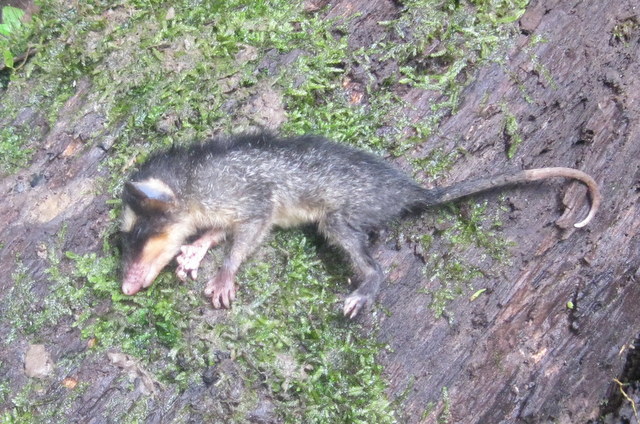
The Southern Four-eyed Opossum has grayish upper fur with darker underfur and darker coloration around the ears and face. Its underside is yellowish to whitish, with gray coloration along the sides, between the forearms, and on the lower neck and jaw.[1][2]
It has two spots above each eye that match the coloration of its underside. Its hairless tail is gray over half to two-thirds of its length and white toward the tip.[3][4]
Total length ranges from 230 to 620 mm, with an average of 487 mm. The tail measures between 170 and 320 mm, averaging 262 mm.[5][6]
Habitat
The Southern Four-eyed Opossum is endemic to the Atlantic Rainforest and occupies almost all habitat types within it. Recorded habitats include lowland forests, submontane forests, coastal scrub, and agricultural fields.[7][8][9]
The species occurs in southern Brazil, northeastern Argentina, and eastern Paraguay. Its range likely meets that of the common four-eyed opossum where the Atlantic Rainforest meets other forests in Brazil and Paraguay.[10][11]
Diet
The Southern Four-eyed Opossum is omnivorous and consumes fruits, flowers, seeds, invertebrates, carrion, and small vertebrates. Recorded foods include seeds, birds, mammals, reptiles, and various invertebrates.[12][13]
Birds and beetles are the most frequently recorded prey items. Both are included among its recorded foods.[13][14]
Behaviour
The Southern Four-eyed Opossum is primarily terrestrial and primarily nocturnal. It is also primarily solitary.[15][16][17]
Reproduction and life cycle
The Southern Four-eyed Opossum has approximately three to six young per litter. Litter size ranges from approximately three to six offspring.[18]
Similar species
The Southern Four-eyed Opossum was historically classified as a subspecies of the gray four-eyed opossum. It was considered a subspecies of that species in 1935.[19][20]
The common four-eyed opossum is a species whose range likely contacts that of the Southern Four-eyed Opossum in Brazil and Paraguay. This contact is expected where the Atlantic Rainforest meets other forests.[11][21]
Conservation
The Southern Four-eyed Opossum is recognized by the American Society of Mammalogists. It is not recognized by the IUCN.[22]
Classification of the Southern Four-eyed Opossum
| Kingdom | Animalia |
|---|---|
| Phylum | Chordata |
| Subphylum | Vertebrata |
| Infraphylum | Gnathostomata |
| Parvphylum | Osteichthyes |
| Megaclass | Tetrapoda |
| Class | Mammalia (Mammal) |
| Subclass | Theria |
| Infraclass | Metatheria |
| Order | Didelphimorphia (American Marsupials) |
| Family | Didelphidae (Opossoms) |
| Subfamily | Didelphinae |
| Tribe | Didelphini |
| Genus | Philander (Gray and Black Four-eyed Opossum) |
| Species | Philander quica (Temminck, 1824) |
Where the Southern Four-eyed Opossum is found
Checklists and occurrence records place Philander quica in 1 country across South America. GBIF holds 193 georeferenced records of it.
Countries
Regions and cities with the most records
- Espírito Santo, Brazil 56
- Rio de Janeiro, Brazil 20
- Castelo, Brazil 18
- Santa Teresa, Brazil 15
- São Paulo, Brazil 15
- Minas Gerais, Brazil 14
- Vargem Alta, Brazil 12
- Fundão, Brazil 10
- Santa Catarina, Brazil 8
- Paraná, Brazil 7
- Puerto Iguazú, Argentina 7
- Santa Maria de Jetibá, Brazil 5
- Acari, Brazil 4
- Botafogo, Brazil 4
- Cariacica, Brazil 4
- Catete, Brazil 4
- Cordovil, Brazil 4
- Estácio, Brazil 4
- Foz do Iguaçu, Brazil 4
- Ipanema, Brazil 4
- Leblon, Brazil 4
- Niterói, Brazil 4
- Presidente Franco, Paraguay 4
- Rio das Ostras, Brazil 4
- Rio de Janeiro, Brazil 4
- Rocinha, Brazil 4
- Santa Teresa, Brazil 4
- Vidigal, Brazil 4
- Vitória, Brazil 4
- Biritiba Mirim, Brazil 3
- Casimiro de Abreu, Brazil 3
- Natividade, Brazil 3
- Ouro Preto, Brazil 3
- Paraty, Brazil 3
- Porciúncula, Brazil 3
- Rio Grande do Sul, Brazil 3
Range as the checklists state it
South America
A number beside a place is its count of GBIF occurrence records. A place without a number comes from a checklist alone. Records show where a species has been observed or collected, which can include escapes and vagrants.
Common names
English
- Southern Four-eyed Opossum
- Southeastern Four-eyed Opossum
Names in 6 other languages
- Arabic
- أبوسوم جنوبي رباعي العيون
- Czech
- vačice šedohřbetá
- German
- Südöstliche Vieraugenbeutelratte
- Japanese
- ナントウヨツメオポッサム
- Portuguese
- cuíca-cinza-de-quatro-olhos, cuíca-verdadeira, gambá-cinza-de-quatro-olhos
- Spanish
- Comadreja de cuatro ojos
Synonyms
One other scientific name has been used for this species and is now treated as a synonym of Philander quica.
- Didelphis quica Temminck, 1824
Related species
-
 Gray Four-eyed OpossumPhilander opossum
-
 Northern Four-eyed OpossumPhilander vossi
-
 Common Four-eyed OpossumPhilander canus
-
 Anderson's Four-eyed OpossumPhilander andersoni
-
 Dark Four-eyed OpossumPhilander melanurus
- McIlhenny's Four-eyed OpossumPhilander mcilhennyi
- Pebas Four-eyed OpossumPhilander pebas
- Deltaic Four-eyed OpossumPhilander deltae
Compare
Questions and answers
What is the scientific name of the Southern Four-eyed Opossum?
The scientific name of the Southern Four-eyed Opossum is Philander quica. Written with its author, the full name is Philander quica (Temminck, 1824).
Which family does the Southern Four-eyed Opossum belong to?
Philander quica belongs to the family Didelphidae, in the order Didelphimorphia and the class Mammalia.
Where is the Southern Four-eyed Opossum found?
Checklists and occurrence records place Philander quica in 1 country: Brazil.
What other names does the Southern Four-eyed Opossum have?
Philander quica is also known in English as Southeastern Four-eyed Opossum.
Why is it called a four-eyed opossum?
It has two spots above each eye that match the coloration of its underside.[2][3]
What is the main diet of an opossum?
The Southern Four-eyed Opossum is omnivorous. Its diet includes fruits, flowers, seeds, invertebrates, carrion, and small vertebrates.[12]
What type of habitat do possums live in?
The Southern Four-eyed Opossum is endemic to the Atlantic Rainforest. It occupies lowland forests, submontane forests, coastal scrub, and agricultural fields.[7][8][9]
Are possums carnivores, herbivores, or omnivores?
The Southern Four-eyed Opossum is an omnivore. It consumes plant matter, invertebrates, carrion, and small vertebrates.[12]
Sources
Passages the profile rests on
- The species has grayish upper fur with darker underfur and darker coloration around the ears and face. Source passage: “The upper fur on this species is grayish, with darker underfur and darker near the ears and face.” — English Wikipedia
- The underside is yellowish to whitish, with gray coloration along the sides, between the forearms, and on the lower neck and jaw. Source passage: “The underside is yellowish to whitish, with some gray colors near the sides, between the forearms, and on the bottom of the neck and jaw.” — English Wikipedia
- The species has two spots above each eye that match the coloration of its underside. Source passage: “It has two spots above each eye that are the same color as the underside.” — English Wikipedia
- Its hairless tail is gray over half to two-thirds of its length and white toward the tip. Source passage: “The tail is bald, and gray for half to two-thirds of its length, then white on the distal half to distal third.” — English Wikipedia
- The species measures between 230 and 620 mm in total length, with an average of 487 mm. Source passage: “This species ranges in size from 230 mm (9.1 in) to 620 mm (24 in), averaging 487 mm (19.2 in).” — English Wikipedia
- Its tail measures between 170 and 320 mm, averaging 262 mm. Source passage: “The tail length averages 262 mm (10.3 in) of this length, ranging from 170 mm (6.7 in) to 320 mm (13 in).” — English Wikipedia
- The species is endemic to the Atlantic Rainforest. Source passage: “This species is endemic to the Atlantic Rainforest” — English Wikipedia
- It occupies almost all habitat types within the Atlantic Rainforest. Source passage: “where it occupies almost all habitats within the region.” — English Wikipedia
- Recorded habitats include lowland forests, submontane forests, coastal scrub, and agricultural fields. Source passage: “It has been recorded from lowland forests, submontane forests, costal scrub, and even agricultural fields.” — English Wikipedia
- The species occurs in southern Brazil, northeastern Argentina, and eastern Paraguay. Source passage: “This species is found in southern Brazil, northeastern Argentina, and eastern Paraguay.” — English Wikipedia
- Its range likely meets that of the common four-eyed opossum where the Atlantic Rainforest meets other forests in Brazil and Paraguay. Source passage: “Its range likely comes into contact with that of the common four-eyed opossum (P. canus) where the Atlantic Rainforest comes into contact with other forests, in Brazil and Paraguay.” — English Wikipedia
- The species is omnivorous and consumes fruits, flowers, seeds, invertebrates, carrion, and small vertebrates. Source passage: “Similar to its congeners, this species is a true omnivore, consuming fruits, flowers, seeds, invertebrates, carrion, and small vertebrates.” — English Wikipedia
- Recorded foods include seeds, birds, mammals, reptiles, and various invertebrates. Source passage: “This species specifically has been recorded feeding on seeds, birds, mammals, reptiles, and various invertebrates” — English Wikipedia
- Birds and beetles are the most frequently recorded prey items. Source passage: “with birds and beetles being the most common prey items.” — English Wikipedia
- The species is primarily terrestrial. Source passage: “This species is primarily terrestrial, nocturnal, and solitary.” — English Wikipedia
- The species is primarily nocturnal. Source passage: “This species is primarily terrestrial, nocturnal, and solitary.” — English Wikipedia
- The species is primarily solitary. Source passage: “This species is primarily terrestrial, nocturnal, and solitary.” — English Wikipedia
- The species has approximately three to six young per litter. Source passage: “Litters average roughly 3-6 young per litter.” — English Wikipedia
- The species was considered a subspecies of the gray four-eyed opossum in 1935. Source passage: “This species was considered a valid species until 1935, when the Brazilian zoologist Alípio de Miranda-Ribeiro would consider it a subspecies of the gray four-eyed opossum.” — English Wikipedia
- The species was historically classified as a subspecies of the gray four-eyed opossum. Source passage: “consider it a subspecies of the gray four-eyed opossum.” — English Wikipedia
- The common four-eyed opossum is a species whose range likely contacts that of Philander quica in Brazil and Paraguay. Source passage: “Its range likely comes into contact with that of the common four-eyed opossum (P. canus)” — English Wikipedia
- The species is recognized by the American Society of Mammalogists but is not recognized by the IUCN. Source passage: “This species is recognized by the American Society of Mammalogists, but not by the IUCN.” — English Wikipedia
Data
- Catalogue of Life, 2026-10-16 XR cc by
- Global Biodiversity Information Facility CC BY 4.0
- Wikidata CC0
- GeoNames CC BY 4.0
- Within the Catalogue of Life, this name comes from The Integrated Taxonomic Information System cc0
References
- Burgin, Connor J., Don E. Wilson, Russell A. Mittermeier, Anthony B. Rylands, et al. (2020). Illustrated Checklist of the Mammals of the World. Vol. 1. Monotremata to Rodentia.
This species in other databases
Page built on 27 November 2026. See how the catalog is made and all sources and licences.
Cite this page
ScientificNames.org. (2026). Philander quica (Southern Four-eyed Opossum). Retrieved November 27, 2026, from https://scientificnames.org/species/philander-quica
“Philander quica (Southern Four-eyed Opossum).” ScientificNames.org, 2026, scientificnames.org/species/philander-quica. Accessed 27 Nov. 2026.
ScientificNames.org. “Philander quica (Southern Four-eyed Opossum).” Accessed November 27, 2026. https://scientificnames.org/species/philander-quica.
@misc{scientificnames_philander_quica_southern_four_eyed_opossum,
  author = {{ScientificNames.org}},
  title = {Philander quica (Southern Four-eyed Opossum)},
  year = {2026},
  url = {https://scientificnames.org/species/philander-quica},
  note = {Accessed 2026-11-27}
}