Species · Mammals
Spectacled Porpoise Phocoena dioptrica
The scientific name of the Spectacled Porpoise is Phocoena dioptrica. It is a species of mammal in the family Phocoenidae (porpoise), order Cetacea. The name dates from 1912.
- Scientific name
- Phocoena dioptrica Lahille, 1912
- Common name
- Spectacled Porpoise
- Genus
- Phocoena
- Family
- Phocoenidae (Porpoise)
- Order
- Cetacea
- Class
- Mammalia
- Red List category
- LC Least Concern
- Environment
- marine
- Recorded in
- 7 countries
- Name status
- accepted in the Catalogue of Life

Overview
Phocoena dioptrica inhabits cold ocean waters in the Southern Hemisphere and is believed to have a circumpolar distribution around the Southern Ocean. It is distinguished by black patches around its eyes, a black dorsal region and a white belly.
Written 26 November 2026 from the sources listed below. Each statement was checked against the passage it cites; statements that could not be supported were removed.
Appearance
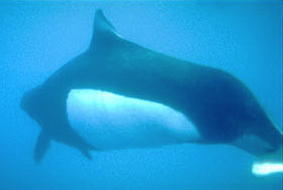
The Spectacled Porpoise has no beak. Its pectoral fins are small, rounded at the tips and positioned far forward on the body.[1][2]
The dorsal surface is blue-black and the ventral surface is pure white. A grey line extends from the corners of the mouth to the leading edges of the pectoral flippers.[3][4]
The lips are black, and the eyes are surrounded by black circles resembling spectacles. Adult males have dorsal fins that are substantially larger and more rounded than those of females.[5][6]
Young individuals may have a grey dorsal region and a lighter grey belly. The upper jaw has 18–23 teeth, while each side of the lower jaw has 16–19 teeth; the teeth have spade-shaped crowns.[7][8][9][10]
Female individuals have been recorded reaching 204 centimetres in length, while males have been recorded reaching 224 centimetres. The maximum recorded female weight is 85 kilograms, and a male specimen has been recorded weighing 110 kilograms.[11][12][13][14]
The largest individual reported in the Animal Diversity Web account weighed 115 kilograms.[15]
Habitat
The Spectacled Porpoise inhabits cold ocean waters in the Southern Hemisphere. It normally occurs near offshore islands but also inhabits the open ocean.[16][17]
Although primarily oceanic, the species has also been recorded in river systems in southern South America.[18]
Diet
The Spectacled Porpoise is thought to feed on fish, squid and crustaceans. Stomach contents have included anchovies of the genus Engraulis and stomatopods.[19][20][21][22]
Other recorded stomach contents include cephalopod beaks from the genus Sepia and a half-digested ornate cowfish.[23][24]
Behaviour
Spectacled Porpoises are generally solitary but have occasionally been observed in groups of two or three. The species is considered probably non-migratory.[25][26]
The species probably uses echolocation.[27]
Conservation
Incidental capture in fishing gear is considered the greatest likely human-caused threat to the species. The extent of incidental bycatch affecting the species is unknown.[28][29]
The total population size and connectivity of populations across the Southern Ocean are unknown.[30]
Uses
Spectacled Porpoises have been hunted by native peoples in South America for non-commercial purposes. The species may also be captured for use as bait in the crab fishing industry.[31][32]
Classification of the Spectacled Porpoise
| Kingdom | Animalia |
|---|---|
| Phylum | Chordata |
| Subphylum | Vertebrata |
| Infraphylum | Gnathostomata |
| Parvphylum | Osteichthyes |
| Megaclass | Tetrapoda |
| Class | Mammalia (Mammal) |
| Subclass | Theria |
| Infraclass | Eutheria |
| Order | Cetacea (Cetacean) |
| Suborder | Odontoceti (Toothed Whales) |
| Family | Phocoenidae (Porpoise) |
| Genus | Phocoena (Common Porpoises) |
| Species | Phocoena dioptrica Lahille, 1912 |
Where the Spectacled Porpoise is found
Checklists and occurrence records place Phocoena dioptrica in 7 countries. GBIF holds 84 georeferenced records of it.
Countries
- Antarctica 10
- Argentina 37
- Australia 15
- Brazil 3
- Chile 9
- French Southern Territories 4
- New Zealand 6
Regions and cities with the most records
Range as the checklists state it
Antarctica/Southern Ocean
Western Atlantic Ocean
A number beside a place is its count of GBIF occurrence records. A place without a number comes from a checklist alone. Records show where a species has been observed or collected, which can include escapes and vagrants.
Common names
English
- Spectacled Porpoise
- Spectacled Dolphin
Names in 17 other languages
- Arabic
- خنزير البحر أبو نظارة
- Chinese
- 黑眶鼠海豚
- Czech
- sviňucha jižní
- Finnish
- Silmälasipyöriäinen, valkovatsapyöriäinen
- French
- Marsouin à lunettes, marsouin de Lahille
- German
- Brillenschweinswal
- Greek
- Διοπτροφόρα Φώκαινα
- Hebrew
- פוקנה ממושקפת
- Hungarian
- Pápaszemes disznódelfin
- Italian
- Focena dagli occhiali
- Japanese
- メガネイルカ
- Norwegian
- brillenise
- Polish
- morświn okularowy
- Portuguese
- Golfinho-de-óculos, golfinho de oculos, marsopa, marsopa de oculos
- Russian
- Очковая морская свинья, антарктическая морская свинья
- Spanish
- marsopa anteojillo, marsopa de anteojos
- Turkish
- Gözlüklü musur, gözlüklü liman yunusu
Synonyms
7 other scientific names have been used for this species and are now treated as synonyms of Phocoena dioptrica.
- Australophocaena dioptrica (Lahille, 1912)
- Australophocaena dioptrica Barnes, 1985
- Australophocoena dioptrica (Lahille, 1912)
- Phocaena dioptrica Lahille, 1912
- Phocaena stornii Marelli, 1922
- Phocoena obtusata Phillipi, 1893
- Phocoena stornii Marelli, 1922
Related species
-
 VaquitaPhocoena sinus
-
 Harbour PorpoisePhocoena phocoena
-
 Burmeister's PorpoisePhocoena spinipinnis
-
 Yangtze Finless PorpoiseNeophocaena asiaeorientalis
-
 Dall's PorpoisePhocoenoides dalli
-
 Indo-Pacific Finless PorpoiseNeophocaena phocaenoides
Compare
Questions and answers
What is the scientific name of the Spectacled Porpoise?
The scientific name of the Spectacled Porpoise is Phocoena dioptrica. Written with its author, the full name is Phocoena dioptrica Lahille, 1912.
Which family does the Spectacled Porpoise belong to?
Phocoena dioptrica belongs to the family Phocoenidae, in the order Cetacea and the class Mammalia.
Where is the Spectacled Porpoise found?
Checklists and occurrence records place Phocoena dioptrica in 7 countries, including Argentina, Australia, Antarctica, Chile, New Zealand and French Southern Territories.
What is the conservation status of the Spectacled Porpoise?
The IUCN Red List category recorded for Phocoena dioptrica is Least Concern (LC).
What other names does the Spectacled Porpoise have?
Phocoena dioptrica is also known in English as Spectacled Dolphin.
Sources
Passages the profile rests on
- The spectacled porpoise has no beak. Source passage: “the spectacled porpoise has no beak.” — English Wikipedia
- Its pectoral fins are small, rounded at the tips, and positioned far forward on the body. Source passage: “It has small pectoral fins with rounded tips positioned far forward on the body” — English Wikipedia
- The dorsal surface is blue-black, while the ventral surface is pure white. Source passage: “The dorsal side is a blue-black color and the ventral side is pure white.” — animaldiversity.org
- A grey line extends from the corners of the mouth to the leading edges of the pectoral flippers. Source passage: “There is a gray line that goes from the corners of the mouth to the leading edge of the pectoral flippers” — animaldiversity.org
- Adult males have dorsal fins that are substantially larger and more rounded than those of females. Source passage: “the dorsal fins in males are much larger and more rounded than those of females.” — English Wikipedia
- The lips are black and the eyes are surrounded by black circles resembling spectacles. Source passage: “The lips are also black and the eyes are surrounded by black circles that look like glasses.” — animaldiversity.org
- Young individuals may have a grey dorsal region and a lighter grey belly. Source passage: “young animals may have a dorsal area that is grey rather than black, with a lighter grey on the belly” — English Wikipedia
- The upper jaw has 18–23 teeth. Source passage: “The teeth in the upper jaw number between 18 and 23” — animaldiversity.org
- Each side of the lower jaw has 16–19 teeth. Source passage: “the teeth in the lower jaw number between 16 and 19 on each side.” — animaldiversity.org
- Its teeth have spade-shaped crowns. Source passage: “The teeth have spade-shaped crowns” — animaldiversity.org
- Female individuals have been recorded reaching 204 centimetres in length. Source passage: “Records for female length range up to 204 centimetres (80 in)” — English Wikipedia
- Male individuals have been recorded reaching 224 centimetres in length. Source passage: “males may reach 224 centimetres (88 in)” — English Wikipedia
- The maximum recorded female weight is 85 kilograms. Source passage: “The maximum weight for a female was 85 kilograms (187 lb)” — English Wikipedia
- A male specimen has been recorded weighing 110 kilograms. Source passage: “while a male has been recorded at 110 kilograms (240 lb).” — English Wikipedia
- The largest individual reported in the Animal Diversity Web account weighed 115 kilograms. Source passage: “the largest individual found was 115 kilograms.” — animaldiversity.org
- The species inhabits cold ocean waters in the Southern Hemisphere. Source passage: “Spectacled porpoises prefer cold ocean waters of the southern hemisphere.” — animaldiversity.org
- Spectacled porpoises normally inhabit areas near offshore islands but also occur in the open ocean. Source passage: “They normally live near offshore islands but are sometimes found in the open ocean.” — animaldiversity.org
- Although primarily oceanic, the species has also been recorded in river systems in southern South America. Source passage: “They are an oceanic species, although there are records of them in river systems in the southernmost areas of South America.” — nhm.ac.uk
- The species is thought to feed on fish and squid. Source passage: “it is thought to forage on fish and squid.” — English Wikipedia
- Stomach contents have included anchovies of the genus Engraulis. Source passage: “included anchovy (Engraulis sp.)” — English Wikipedia
- Stomach contents have included stomatopods. Source passage: “included anchovy (Engraulis sp.), stomatopods” — English Wikipedia
- The species is thought to consume crustaceans as well as fish and squid. Source passage: “They are most likely similar to other porpoises, which eat fish , squid , and crustaceans .” — animaldiversity.org
- Stomach contents have included cephalopod beaks from the genus Sepia. Source passage: “cephalopod beaks (Sepia sp.)” — English Wikipedia
- A half-digested ornate cowfish has also been found in a specimen's stomach. Source passage: “and a half digested ornate cowfish (Aracana ornata).” — English Wikipedia
- Spectacled porpoises are generally solitary but have occasionally been observed in groups of two or three. Source passage: “They are probably solitary animals, but they have been seen in groups of two or three individuals.” — animaldiversity.org
- The species is considered probably non-migratory. Source passage: “They are probably not migratory.” — animaldiversity.org
- The species probably uses echolocation. Source passage: “they probably use echolocation as do other porpoises.” — animaldiversity.org
- Incidental capture in fishing gear is considered the greatest likely human-caused threat to the species. Source passage: “Bycatch and incidental capture are most likely the greatest anthropogenic threat to the spectacled porpoise.” — English Wikipedia
- The extent of incidental bycatch affecting the species is unknown. Source passage: “The extent of incidental bycatch is unknown” — English Wikipedia
- The total population size and connectivity of populations across the Southern Ocean are unknown. Source passage: “The population size and its inter-connectedness across the Southern Ocean is unknown.” — English Wikipedia
- Spectacled porpoises have been hunted by native peoples in South America for non-commercial purposes. Source passage: “Native people in South America hunt A. dioptrica , but not for commercial uses.” — animaldiversity.org
- The species may be captured for use as bait in the crab fishing industry. Source passage: “porpoises may be caught and used as bait for the crab fishery industry” — English Wikipedia
Data
- Catalogue of Life, 2026-10-16 XR cc by
- Global Biodiversity Information Facility CC BY 4.0
- Wikidata CC0
- GeoNames CC BY 4.0
- Wikimedia Commons per image; credit shown with each image
- Within the Catalogue of Life, this name comes from The Integrated Taxonomic Information System cc0
References
- Lahille, F. (1912). Nota preliminar sobre una nueva expecie de marsopa del Río de la Plata Phocoena diotrica. Annales del Museo Nacional de Historia Natural de Buenos Aires 23:271--278, pl. 6--9. where the name was published
- Hershkovitz, & Philip. (1966). Catalog of Living Whales. United States National Museum Bulletin, No. 246.
- Brownell, Robert L. Jr. (1975). Phocoena dioptrica. Mammalian Species, No. 66.
- Wilson, Don E., and DeeAnn M. Reeder, eds. (1993). Mammal Species of the World: A Taxonomic and Geographic Reference, 2nd Ed., 3rd Printing.
- Rice, Dale W. (1998). Marine Mammals of the World: Systematics and Distribution. Special Publications of the Society for Marine Mammals, No. 4.
- Wilson, Don E., and F. Russell Cole. (2000). Common Names of Mammals of the World.
- Mead, James G., and Robert L. Brownell, Jr. / Wilson, Don E., and DeeAnn M. Reeder, eds. (2005). Order Cetacea. Mammal Species of the World: A Taxonomic and Geographic Reference, 3rd Ed., Vol. 1.
- Würsig, Bernd, J. G. M. Thewissen, and Kit M. Kovacs, eds. (2018). Encyclopedia of Marine Mammals, 3rd Edition.
This species in other databases
- Catalogue of Life 4GK8D
- Wikidata Q749548
- iNaturalist 41444
- WoRMS urn:lsid:marinespecies.org:taxname:254971
Page built on 29 November 2026. See how the catalog is made and all sources and licences.
Cite this page
ScientificNames.org. (2026). Phocoena dioptrica (Spectacled Porpoise). Retrieved November 29, 2026, from https://scientificnames.org/species/phocoena-dioptrica
“Phocoena dioptrica (Spectacled Porpoise).” ScientificNames.org, 2026, scientificnames.org/species/phocoena-dioptrica. Accessed 29 Nov. 2026.
ScientificNames.org. “Phocoena dioptrica (Spectacled Porpoise).” Accessed November 29, 2026. https://scientificnames.org/species/phocoena-dioptrica.
@misc{scientificnames_phocoena_dioptrica_spectacled_porpoise,
  author = {{ScientificNames.org}},
  title = {Phocoena dioptrica (Spectacled Porpoise)},
  year = {2026},
  url = {https://scientificnames.org/species/phocoena-dioptrica},
  note = {Accessed 2026-11-29}
}