Species · Reptiles
Narrow Leaf-toed Gecko Phyllodactylus angustidigitus
The scientific name of the Narrow Leaf-toed Gecko is Phyllodactylus angustidigitus. It is a species of reptile in the family Phyllodactylidae (phyllodactylid geckos), order Squamata. The name dates from 1970.
- Scientific name
- Phyllodactylus angustidigitus Dixon & Huey, 1970
- Common name
- Narrow Leaf-toed Gecko
- Genus
- Phyllodactylus
- Family
- Phyllodactylidae (Phyllodactylid Geckos)
- Order
- Squamata
- Class
- Reptilia
- Red List category
- EN Endangered
- Recorded in
- 1 country
- Name status
- accepted in the Catalogue of Life
Overview
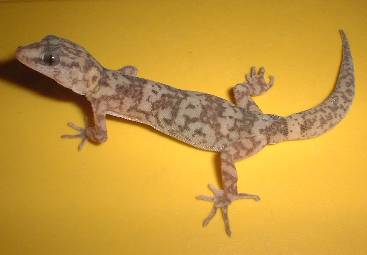
The Narrow Leaf-toed Gecko is a medium-sized gecko in the family Phyllodactylidae, order Squamata, class Reptilia. It is endemic to the Ica Region in southern Peru and is restricted to the Paracas National Reservation. It can be distinguished from Phyllodactylus gerrhopygus by its smaller and more numerous terminal lamellae on the fourth toe.
Written 27 November 2026 from the sources listed below. Each statement was checked against the passage it cites; statements that could not be supported were removed.
Appearance
The Narrow Leaf-toed Gecko is a medium-sized gecko. Its maximum snout-vent length is 57 mm.[1][2]
Habitat
The species inhabits sand dunes, rocky outcrops, and small hills in the Paracas desert. It is usually more abundant near the shore and is abundant along shelly and gravel beaches, but appears to avoid sandy beaches.[3][4][5][6]
Its known geographic distribution is restricted to the Paracas National Reservation. It occurs on La Vieja Island in Bahia Independencia and Sangayan Island west of the Paracas Peninsula.[7][8]
Diet
The species feeds on small invertebrates, including insects, crustaceans, and spiders.[9]
Reproduction and life cycle
Females of this species appear to lay only one egg.[10]
Similar species
The species most closely resembles Phyllodactylus gerrhopygus, which also occurs in southern Peru. It can be distinguished from that species by having smaller and more numerous terminal lamellae on the fourth toe.[11][12]
Classification of the Narrow Leaf-toed Gecko
| Kingdom | Animalia |
|---|---|
| Phylum | Chordata |
| Subphylum | Vertebrata |
| Infraphylum | Gnathostomata |
| Parvphylum | Osteichthyes |
| Megaclass | Tetrapoda |
| Class | Reptilia (Reptile) |
| Order | Squamata (Snakes) |
| Suborder | Gekkota |
| Family | Phyllodactylidae (Phyllodactylid Geckos) |
| Genus | Phyllodactylus (Leaf-toed Geckos) |
| Species | Phyllodactylus angustidigitus Dixon & Huey, 1970 |
Where the Narrow Leaf-toed Gecko is found
Checklists and occurrence records place Phyllodactylus angustidigitus in 1 country across South America. GBIF holds 292 georeferenced records of it.
Countries
Regions and cities with the most records
Range as the checklists state it
Peru (beaches of Paracas, Peninsula and associated islands)
A number beside a place is its count of GBIF occurrence records. A place without a number comes from a checklist alone. Records show where a species has been observed or collected, which can include escapes and vagrants.
Common names
English
- Narrow Leaf-toed Gecko
Related species
-
 Barbados Leaf-toed GeckoPhyllodactylus pulcher
-
 Baur's Leaf-toed GeckoPhyllodactylus baurii
- Aruba Leaf-toed GeckoPhyllodactylus julieni
-
 Peninsula Leaf-toed GeckoPhyllodactylus nocticolus
-
 Leaf-toed GeckoPhyllodactylus xanti
-
 Belize Leaf-toed GeckoPhyllodactylus insularis
- Colombian Leaf-toed GeckoPhyllodactylus transversalis
-
 Lane's Leaf-toed GeckoPhyllodactylus lanei
Compare
Questions and answers
What is the scientific name of the Narrow Leaf-toed Gecko?
The scientific name of the Narrow Leaf-toed Gecko is Phyllodactylus angustidigitus. Written with its author, the full name is Phyllodactylus angustidigitus Dixon & Huey, 1970.
Which family does the Narrow Leaf-toed Gecko belong to?
Phyllodactylus angustidigitus belongs to the family Phyllodactylidae, in the order Squamata and the class Reptilia.
Where is the Narrow Leaf-toed Gecko found?
Checklists and occurrence records place Phyllodactylus angustidigitus in 1 country: Peru.
What is the conservation status of the Narrow Leaf-toed Gecko?
The IUCN Red List category recorded for Phyllodactylus angustidigitus is Endangered (EN).
Sources
Passages the profile rests on
- The species is a medium-sized gecko. Source passage: “The narrow leaf-toed gecko (Phyllodactylus angustidigitus) is a medium-sized gecko” — English Wikipedia
- The maximum snout-vent length of this species is 57 mm. Source passage: “with a maximum snout-vent length of 57 mm.” — English Wikipedia
- The species inhabits sand dunes, rocky outcrops, and small hills in the Paracas desert. Source passage: “Phyllodactylus angustidigitus inhabits sand dunes, rocky outcrops, and small hills throughout the desert in Paracas” — English Wikipedia
- The species is usually more abundant near the shore. Source passage: “though it is usually more abundant near shore.” — English Wikipedia
- The species is abundant along shelly and gravel beaches. Source passage: “These geckos abound along shelly and gravel beaches” — English Wikipedia
- The species appears to avoid sandy beaches. Source passage: “and seem to avoid sandy beaches.” — English Wikipedia
- Its known geographic distribution is restricted to the Paracas National Reservation. Source passage: “its known geographical distribution is restricted to the Paracas National Reservation” — English Wikipedia
- The species occurs on La Vieja Island in Bahia Independencia and Sangayan Island west of the Paracas Peninsula. Source passage: “including two islands (La Vieja in the Bahia Independencia and Sangayan west of the Paracas Peninsula).” — English Wikipedia
- The species feeds on small invertebrates, including insects, crustaceans, and spiders. Source passage: “This gecko feeds on small invertebrates, including insects, crustaceans and spiders.” — English Wikipedia
- Females of this species appear to lay only one egg. Source passage: “Females appear to lay only one egg.” — English Wikipedia
- The species most closely resembles Phyllodactylus gerrhopygus, which also occurs in southern Peru. Source passage: “This gecko most closely resembles Phyllodactylus gerrhopygus (a species that also occurs in southern Peru)” — English Wikipedia
- It can be distinguished from Phyllodactylus gerrhopygus by having smaller and more numerous terminal lamellae on the fourth toe. Source passage: “from which it can be distinguished by smaller and more numerous terminal lamellae on the fourth toe.” — English Wikipedia
- The maximum snout-vent length of the species is 57 mm. Source passage: “is a medium-sized gecko with a maximum snout-vent length of 57 mm.” — inaturalist.org
Data
- Catalogue of Life, 2026-10-16 XR cc by
- Global Biodiversity Information Facility CC BY 4.0
- Wikidata CC0
- GeoNames CC BY 4.0
- Wikimedia Commons per image; credit shown with each image
- Within the Catalogue of Life, this name comes from The Reptile Database cc by
References
- Dixon, James R. & Huey, Raymond B. (1970). Systematics of the lizards of the Gekkonid genus Phyllodactylus on mainland South America. Contributions in Science, Los Angeles County Museum (192): 1-78.
- Huey, R. B. (1979). Parapatry and niche complementarity of Peruvian desert geckos (Phyllodactylus): the ambiguous role of competition. Oecologia (Berl.) 38: 249-259.
- Rösler, H. (2000). Kommentierte Liste der rezent, subrezent und fossil bekannten Geckotaxa (Reptilia: Gekkonomorpha). Gekkota 2: 28-153.
- Goldberg, Stephen R. (2016). Note on Reproduction of Phyllodactylus angustidigitus (Squamata: Gekkonidae) from Peru. Bull. Chicago Herp. Soc. 51(3): 45-46.
- Mendoza A, Pérez J, Alvarado E, Barrera D, Castillo E, Fernandez M, Milla J, Olivera D, Ramirez C, Santa Cruz R, Salazar E, Torres-Ccasani G, Aguilar-Puntriano C. (2023). Anfibios y reptiles del departamento de Ica con comentarios sobre su distribución. Revista Peruana de Biología 30(1): E23425 001- 014 (Marzo 2023).
- Sullivan, Kathryn A; Randy L Klabacka, Alessandro Catenazzi, José Pérez Z, Pablo J Venegas, Perry L Wood, Darren C Browne, Claudia Koch, Jeroen P van Leeuwen, Federico Valdez, Stuart V Nielsen, Aaron M Bauer, Jack W Sites, César Aguilar Puntriano, Eli Greenbaum, Tony Gamble. (2026). One if by land, two if by sea: molecular phylogeny and biogeography of the Neotropical leaf-toed geckos (Phyllodactylidae: Phyllodactylus). Zoological Journal of the Linnean Society, 206 (4): Zlag063.
This species in other databases
Page built on 28 November 2026. See how the catalog is made and all sources and licences.
Cite this page
ScientificNames.org. (2026). Phyllodactylus angustidigitus (Narrow Leaf-toed Gecko). Retrieved November 28, 2026, from https://scientificnames.org/species/phyllodactylus-angustidigitus
“Phyllodactylus angustidigitus (Narrow Leaf-toed Gecko).” ScientificNames.org, 2026, scientificnames.org/species/phyllodactylus-angustidigitus. Accessed 28 Nov. 2026.
ScientificNames.org. “Phyllodactylus angustidigitus (Narrow Leaf-toed Gecko).” Accessed November 28, 2026. https://scientificnames.org/species/phyllodactylus-angustidigitus.
@misc{scientificnames_phyllodactylus_angustidigitus_narrow_leaf_toed_gecko,
  author = {{ScientificNames.org}},
  title = {Phyllodactylus angustidigitus (Narrow Leaf-toed Gecko)},
  year = {2026},
  url = {https://scientificnames.org/species/phyllodactylus-angustidigitus},
  note = {Accessed 2026-11-28}
}