Species · Insects
Phyllonorycter apicinigrella
Phyllonorycter apicinigrella has no English name on record in the checklists used here. It is a species of insect in the family Gracillariidae (gracillariid), order Lepidoptera. The name dates from 1908.
- Scientific name
- Phyllonorycter apicinigrella (Braun, 1908)
- Genus
- Phyllonorycter
- Family
- Gracillariidae (Gracillariid)
- Order
- Lepidoptera
- Class
- Insecta
- Recorded in
- 2 countries
- Name status
- accepted in the Catalogue of Life
Overview
The species occurs along the western coast of the United States, from San Luis Obispo County in California north to British Columbia in Canada. Its larvae mine the leaves of willow plants in the genus Salix.
Written 27 November 2026 from the sources listed below. Each statement was checked against the passage it cites; statements that could not be supported were removed.
Habitat
The species occurs along the western coast of the United States, ranging from San Luis Obispo County in California north to British Columbia in Canada.[1]
Diet
The larvae feed on willow species belonging to the genus Salix, including Salix lasiandra and Salix sitchensis.[2]
Behaviour
Adults are active during May and from mid-June through mid-September.[3]
The larvae create mines within the leaves of their host plants.[4]
Reproduction and life cycle
The species produces either two or three generations annually.[5]
Appearance
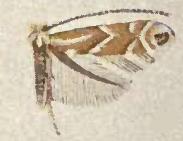
The adult moths have forewings measuring between 2.7 and 3.8 mm in length.[6][7]
Classification of Phyllonorycter apicinigrella
| Kingdom | Animalia |
|---|---|
| Phylum | Arthropoda |
| Subphylum | Hexapoda |
| Class | Insecta (Insect) |
| Order | Lepidoptera |
| Superfamily | Gracillarioidea |
| Family | Gracillariidae (Gracillariid) |
| Subfamily | Lithocolletinae |
| Genus | Phyllonorycter |
| Species | Phyllonorycter apicinigrella (Braun, 1908) |
Where Phyllonorycter apicinigrella is found
Checklists and occurrence records place Phyllonorycter apicinigrella in 2 countries across North America. GBIF holds 11 georeferenced records of it.
Countries
Regions and cities with the most records
- California, United States 9
- Alameda, United States 7
- Albany, United States 7
- Ashland, United States 7
- Bayview-Hunters Point, United States 7
- Berkeley, United States 7
- Castro Valley, United States 7
- Danville, United States 7
- El Cerrito, United States 7
- Hayward, United States 7
- Lafayette, United States 7
- Moraga, United States 7
- Orinda, United States 7
- San Leandro, United States 7
- San Lorenzo, United States 7
- San Ramon, United States 7
- Walnut Creek, United States 7
- British Columbia, Canada
- Washington, United States
Range as the checklists state it
CA, British Columbia
US, California
US, Washington
A number beside a place is its count of GBIF occurrence records. A place without a number comes from a checklist alone. Records show where a species has been observed or collected, which can include escapes and vagrants.
Related species
-
 Lime LeafminerPhyllonorycter issikii
-
 Willow MidgetPhyllonorycter salictella
-
 Scarce Oak MidgetPhyllonorycter kuhlweiniella
-
 Fiery Oak MidgetPhyllonorycter lautella
-
 Western MidgetPhyllonorycter muelleriella
-
 Large MidgetPhyllonorycter emberizaepenella
-
 London MidgetPhyllonorycter platani
-
 Broad-barred MidgetPhyllonorycter froelichiella
Compare
Questions and answers
What plants do the larvae feed on?
The larvae feed on willow species in the genus Salix, including Salix lasiandra and Salix sitchensis.[2]
When are adults active?
Adults are active during May and from mid-June through mid-September.[3]
How many generations does the species produce annually?
The species produces either two or three generations annually.[5]
Sources
Passages the profile rests on
- The species occurs along the western coast of the United States, ranging from San Luis Obispo County in California north to British Columbia in Canada. Source passage: “It is found along the western coast of the United States from San Luis Obispo County, California, north to British Columbia, Canada.” — English Wikipedia
- The larvae feed on willow species belonging to the genus Salix, including Salix lasiandra and Salix sitchensis. Source passage: “The larvae feed on Salix species, including Salix lasiandra and Salix sitchensis species.” — English Wikipedia
- Adults are active during May and from mid-June through mid-September. Source passage: “Adults are on wing in May and from mid-June to mid-September.” — English Wikipedia
- The larvae create mines within the leaves of their host plants. Source passage: “They mine the leaves of their host plant.” — English Wikipedia
- The species produces either two or three generations annually. Source passage: “There are either two or three generations per year.” — English Wikipedia
- The forewings measure between 2.7 and 3.8 mm in length. Source passage: “The length of the forewings is 2.7-3.8 mm.” — English Wikipedia
- The adult moths have forewings measuring between 2.7 and 3.8 mm in length. Source passage: “Length of forewing: 2.7-3.8 mm.” — repository.si.edu
Data
- Catalogue of Life, 2026-10-16 XR cc by
- Global Biodiversity Information Facility CC BY 4.0
- Wikidata CC0
- GeoNames CC BY 4.0
- Wikimedia Commons per image; credit shown with each image
- Within the Catalogue of Life, this name comes from Global Taxonomic Database of Gracillariidae cc by
References
- Braun, A. F. (1908). Revision of the North American species of the genus Lithocolletis Hübner. https://www.biodiversitylibrary.org/page/5306378 Link where the name was published
This species in other databases
Page built on 29 November 2026. See how the catalog is made and all sources and licences.
Cite this page
ScientificNames.org. (2026). Phyllonorycter apicinigrella. Retrieved November 29, 2026, from https://scientificnames.org/species/phyllonorycter-apicinigrella
“Phyllonorycter apicinigrella.” ScientificNames.org, 2026, scientificnames.org/species/phyllonorycter-apicinigrella. Accessed 29 Nov. 2026.
ScientificNames.org. “Phyllonorycter apicinigrella.” Accessed November 29, 2026. https://scientificnames.org/species/phyllonorycter-apicinigrella.
@misc{scientificnames_phyllonorycter_apicinigrella,
  author = {{ScientificNames.org}},
  title = {Phyllonorycter apicinigrella},
  year = {2026},
  url = {https://scientificnames.org/species/phyllonorycter-apicinigrella},
  note = {Accessed 2026-11-29}
}