Species · Insects
Viburnum Midget Phyllonorycter lantanella
The scientific name of the Viburnum Midget is Phyllonorycter lantanella. It is a species of insect in the family Gracillariidae (gracillariid), order Lepidoptera. The name dates from 1802.
- Scientific name
- Phyllonorycter lantanella (Schrank, 1802)
- Common name
- Viburnum Midget
- Genus
- Phyllonorycter
- Family
- Gracillariidae (Gracillariid)
- Order
- Lepidoptera
- Class
- Insecta
- Recorded in
- 11 countries
- Name status
- accepted in the Catalogue of Life
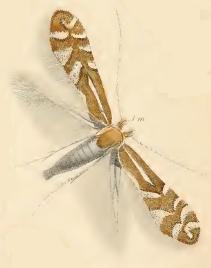
Overview
Phyllonorycter lantanella occurs throughout Europe, except in Scandinavia, Ireland and the Balkan Peninsula. Its larvae mine the leaves of their host plants while feeding.
Written 27 November 2026 from the sources listed below. Each statement was checked against the passage it cites; statements that could not be supported were removed.
Appearance
The adult moth has a wingspan of approximately 9 mm.[1]
Diet
The larvae feed on the leaves of wayfaring tree (Viburnum lantana), guelder rose (Viburnum opulus), laurestine (Viburnum tinus) and rowan (Sorbus aucuparia).[2]
Behaviour
The larvae mine the leaves of their host plants while feeding.[3]
Adults are active in May and August.[4]
Reproduction and life cycle
The species produces two generations annually.[5]
Classification of the Viburnum Midget
| Kingdom | Animalia |
|---|---|
| Phylum | Arthropoda |
| Subphylum | Hexapoda |
| Class | Insecta (Insect) |
| Order | Lepidoptera |
| Superfamily | Gracillarioidea |
| Family | Gracillariidae (Gracillariid) |
| Subfamily | Lithocolletinae |
| Genus | Phyllonorycter |
| Species | Phyllonorycter lantanella (Schrank, 1802) |
Where the Viburnum Midget is found
Checklists and occurrence records place Phyllonorycter lantanella in 11 countries across Europe. GBIF holds 699 georeferenced records of it.
Countries
- Aland Islands 26
- Austria 51
- Belgium 26
- Finland 19
- France 42
- Germany 85
- Italy 6
- Luxembourg 8
- Poland 12
- The Netherlands 234
- United Kingdom 190
Regions and cities with the most records
- England, United Kingdom 181
- Bergschenhoek, The Netherlands 87
- Berkel en Rodenrijs, The Netherlands 87
- Pijnacker, The Netherlands 83
- Rotterdam, The Netherlands 83
- Capelle aan den IJssel, The Netherlands 81
- Delft, The Netherlands 81
- Krimpen aan den IJssel, The Netherlands 80
- Schiedam, The Netherlands 72
- Vlaardingen, The Netherlands 68
- Maassluis, The Netherlands 67
- Barendrecht, The Netherlands 60
- Ridderkerk, The Netherlands 58
- Spijkenisse, The Netherlands 58
- Hoogvliet, The Netherlands 57
- Oud-Beijerland, The Netherlands 57
- Rhoon, The Netherlands 57
- Alblasserdam, The Netherlands 53
- Hendrik-Ido-Ambacht, The Netherlands 51
- Zwijndrecht, The Netherlands 47
- Papendrecht, The Netherlands 43
- Dordrecht, The Netherlands 40
- Waddinxveen, The Netherlands 40
- Huntingdon, United Kingdom 39
- Boskoop, The Netherlands 33
- Gouda, The Netherlands 33
- North Rhine-Westphalia, Germany 33
- Sliedrecht, The Netherlands 33
- Bodegraven, The Netherlands 29
- Gelderland, The Netherlands 28
- Saint Ives, United Kingdom 28
- Hauts-de-France, France 27
- Saint Neots, United Kingdom 22
- Bavaria, Germany 19
- Keynsham, United Kingdom 19
- Kingswood, United Kingdom 19
Range as the checklists state it
RU, European Part
FR, Corsica
IT, Sicily
A number beside a place is its count of GBIF occurrence records. A place without a number comes from a checklist alone. Records show where a species has been observed or collected, which can include escapes and vagrants.
Common names
English
- Viburnum Midget
Names in 8 other languages
- Dutch
- Sneeuwbalvouwmijnmot, Sneeuwbalvouwmot
- Finnish
- heisimiinakoi
- German
- Schneeball-Miniermotte
- Hungarian
- bangitarágó sátorosmoly
- Lithuanian
- Putininė keršoji kandelė
- Russian
- Моль-пестрянка калиновая
- Slovak
- ploskáčik kalinový
- Swedish
- olvonguldmal
Synonyms
7 other scientific names have been used for this species and are now treated as synonyms of Phyllonorycter lantanella.
- Lithocolletis elatella Zeller, 1846
- Lithocolletis lantanella (Schrank, 1802)
- Phyllonorycter elatella (Zeller, 1846)
- Tinea lantanella Schrank, 1802
- Phyllonorycter confertella (Zeller, 1846) misapplied
- Phyllonorycter heophagella (Zeller, 1846) misapplied
- Phyllonorycter lanthanella Mineo & Sinacori, 1998 misapplied
Related species
-
 Lime LeafminerPhyllonorycter issikii
-
 Willow MidgetPhyllonorycter salictella
-
 Scarce Oak MidgetPhyllonorycter kuhlweiniella
-
 Fiery Oak MidgetPhyllonorycter lautella
-
 Western MidgetPhyllonorycter muelleriella
-
 Large MidgetPhyllonorycter emberizaepenella
-
 London MidgetPhyllonorycter platani
-
 Broad-barred MidgetPhyllonorycter froelichiella
Compare
Questions and answers
What is the scientific name of the Viburnum Midget?
The scientific name of the Viburnum Midget is Phyllonorycter lantanella. Written with its author, the full name is Phyllonorycter lantanella (Schrank, 1802).
Which family does the Viburnum Midget belong to?
Phyllonorycter lantanella belongs to the family Gracillariidae, in the order Lepidoptera and the class Insecta.
Where is the Viburnum Midget found?
Checklists and occurrence records place Phyllonorycter lantanella in 11 countries, including The Netherlands, United Kingdom, Germany, Austria, France and Aland Islands.
Sources
Passages the profile rests on
- The adult moth has a wingspan of approximately 9 mm. Source passage: “The wingspan is about 9 mm.” — English Wikipedia
- The larvae feed on the leaves of wayfaring tree (Viburnum lantana), guelder rose (Viburnum opulus), laurestine (Viburnum tinus) and rowan (Sorbus aucuparia). Source passage: “The larvae feed on the wayfaring tree (Viburnum lantana), guelder rose (Viburnum opulus), laurestine (Viburnum tinus) and rowan (Sorbus aucuparia)” — English Wikipedia
- The larvae mine the leaves of their host plants while feeding. Source passage: “mining the leaves of their host plant.” — English Wikipedia
- Adults are active in May and August. Source passage: “adults on wing in May and again in August.” — English Wikipedia
- The species produces two generations annually. Source passage: “There are two generations per year” — English Wikipedia
Data
- Catalogue of Life, 2026-10-16 XR cc by
- Global Biodiversity Information Facility CC BY 4.0
- Wikidata CC0
- GeoNames CC BY 4.0
- Wikimedia Commons per image; credit shown with each image
- Within the Catalogue of Life, this name comes from Global Taxonomic Database of Gracillariidae cc by
References
- Schrank, F. V. P. (1802). Fauna Boica. Durchgedachte Geschichte der Baiern einheimischen und zahmen Thiere. Zweyter Band. where the name was published
This species in other databases
Page built on 29 November 2026. See how the catalog is made and all sources and licences.
Cite this page
ScientificNames.org. (2026). Phyllonorycter lantanella (Viburnum Midget). Retrieved November 29, 2026, from https://scientificnames.org/species/phyllonorycter-lantanella
“Phyllonorycter lantanella (Viburnum Midget).” ScientificNames.org, 2026, scientificnames.org/species/phyllonorycter-lantanella. Accessed 29 Nov. 2026.
ScientificNames.org. “Phyllonorycter lantanella (Viburnum Midget).” Accessed November 29, 2026. https://scientificnames.org/species/phyllonorycter-lantanella.
@misc{scientificnames_phyllonorycter_lantanella_viburnum_midget,
  author = {{ScientificNames.org}},
  title = {Phyllonorycter lantanella (Viburnum Midget)},
  year = {2026},
  url = {https://scientificnames.org/species/phyllonorycter-lantanella},
  note = {Accessed 2026-11-29}
}