Species · Insects
Striped Flea Beetle Phyllotreta striolata
The scientific name of the Striped Flea Beetle is Phyllotreta striolata. It is a species of insect in the family Chrysomelidae (leaf beetle), order Coleoptera. The name dates from 1801.
- Scientific name
- Phyllotreta striolata (Fabricius, 1801)
- Common name
- Striped Flea Beetle
- Genus
- Phyllotreta
- Family
- Chrysomelidae (Leaf Beetle)
- Order
- Coleoptera
- Class
- Insecta
- Recorded in
- 7 countries
- Name status
- accepted in the Catalogue of Life

Overview
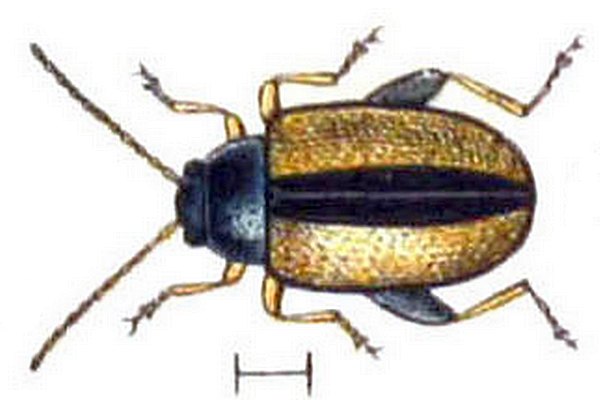
The species occurs in the eastern and Pacific regions of the United States, excluding much of the Rocky Mountain region, and also occurs in South Africa. The adult beetle is shiny black with a greenish tinge and a wavy amber line along each wing cover.
Written 26 November 2026 from the sources listed below. Each statement was checked against the passage it cites; statements that could not be supported were removed.
Appearance
The adult beetle is shiny black with a greenish tinge and has a wavy amber line along each wing cover. Its hind legs are thickened and enable it to jump when disturbed.[1][2]
The eggs are minute, white, and oval to elongate. The larva is white with a brown head and has three pairs of tiny legs near its head.[3][4]
Fully grown larvae measure 3.2 to 5.0 mm in length. The pupa is white and approximately the same size and shape as the adult.[5][6]
Habitat
The eggs, larvae, and pupae reside in soil, while adults live on the ground.[7]
The species occurs in the eastern and Pacific regions of the United States, excluding much of the Rocky Mountain region, and also occurs in South Africa. It has been reported in vegetable fields in southern China.[8][9]
The species is reported as a significant pest of Brassicaceae vegetables in Asia, North America, and Europe.[10]
Diet
Both adult and larval stages feed on Brassicaceae plants. Recorded host plants include Brassica pekinensis, Brassica juncea, Brassica rapa, Brassica napus, and Raphanus sativus.[11][12]
Adult beetles feed on host plant foliage, whereas larvae feed on the roots.[13]
Behaviour
Adult beetles chew small, round pits into the cotyledons and leaves of young plants. As damaged tissue dries and falls away, feeding can leave small shot holes in the foliage.[14][15]
The beetles overwinter among debris in and around agricultural fields. Adults emerge early in spring and attack seedlings and young plants.[16][17]
Reproduction and life cycle
Females lay eggs in the soil close to host plants, depositing them in small crevices gnawed into the base of host plant stems. Eggs hatch approximately ten days after deposition.[18][19][20]
Larvae feed for three or four weeks before pupating. The pupal stage lasts seven to ten days.[21][22]
Generations can occur continuously in warmer climates, with at least two generations recurring annually.[23]
Classification of the Striped Flea Beetle
| Kingdom | Animalia |
|---|---|
| Phylum | Arthropoda |
| Subphylum | Hexapoda |
| Class | Insecta (Insect) |
| Order | Coleoptera (Beetle) |
| Suborder | Polyphaga |
| Series | Cucujiformia |
| Superfamily | Chrysomeloidea |
| Family | Chrysomelidae (Leaf Beetle) |
| Subfamily | Galerucinae |
| Tribe | Alticini |
| Genus | Phyllotreta (Flea Beetles) |
| Species | Phyllotreta striolata (Fabricius, 1801) |
This name was added to the Catalogue of Life from a contributing dataset by automated merging and has not yet been reviewed by its editors.
Where the Striped Flea Beetle is found
Checklists and occurrence records place Phyllotreta striolata in 7 countries across Africa and North America. GBIF holds 4,130 georeferenced records of it.
Countries
Regions and cities with the most records
- Ontario, Canada 534
- Alberta, Canada 362
- Saskatchewan, Canada 325
- Manitoba, Canada 153
- Edmonton, Canada 116
- Sherwood Park, Canada 115
- Guelph, Canada 95
- St. Albert, Canada 89
- Gävleborg, Sweden 83
- Oslo, Norway 75
- Akershus, Norway 71
- Uppsala, Sweden 70
- Yorkton, Canada 69
- Stockholm, Sweden 65
- Skåne, Sweden 63
- Västra Götaland, Sweden 63
- Östergötland, Sweden 62
- Dalarna, Sweden 61
- Gangwon-do, South Korea 61
- Asker, Norway 57
- Fergus, Canada 56
- Gyeongsangbuk-do, South Korea 53
- Winnipeg, Canada 53
- Cambridge, Canada 52
- Grande Prairie, Canada 51
- Västmanland, Sweden 50
- Guangdong, China 46
- Horten, Norway 45
- Örebro, Sweden 44
- Moss, Norway 41
- Oslo, Norway 41
- Vestfold, Norway 41
- Kalmar, Sweden 40
- Steinbach, Canada 39
- Myyrmäki, Finland 38
- Gyeongsangnam-do, South Korea 37
37 more countries have a few records outside this range
These countries hold a few records of Phyllotreta striolata but lie outside the range the checklists give for it. Such records are often zoo or garden specimens, museum material or vagrants, so the species is not counted as occurring there.
- Aland Islands 6
- Austria 113
- Bangladesh 74
- Belarus 7
- Belgium 12
- Bulgaria 3
- Cambodia 7
- Czechia 4
- Denmark 3
- Estonia 155
- France 50
- Germany 162
- Hong Kong 19
- Hungary 4
- India 26
- Italy 6
- Japan 181
- Latvia 5
- Lithuania 15
- Luxembourg 8
- Macao 3
- Nepal 3
- New Caledonia 3
- Pakistan 215
- Poland 77
- Portugal 10
- Russia 53
- Slovenia 101
- Spain 3
- Switzerland 16
- Taiwan 60
- Thailand 6
- The Netherlands 114
- Turkey 4
- Ukraine 10
- United Kingdom 24
- Vietnam 35
Range as the checklists state it
Europe & Northern Asia (excluding China)
North America
Africa
A number beside a place is its count of GBIF occurrence records. A place without a number comes from a checklist alone. Records show where a species has been observed or collected, which can include escapes and vagrants.
Common names
English
- Striped Flea Beetle
Names in 11 other languages
- Chinese
- 黃曲條菜跳甲, 黃條葉蚤
- Finnish
- mutkajuovakirppa
- French
- Altise rayée du navet
- German
- Gestreifter Blattfloh
- Japanese
- キスジノミハムシ
- Korean
- 벼룩잎벌레
- Lithuanian
- Paprastoji kopūstinukė
- Norwegian Bokmål
- krokstripet nepejordloppe
- Russian
- Выемчатая полосатая блошка
- Swedish
- krokrandig jordloppa
- Thai
- ด้วงหมัดผักกาด
Synonyms
9 other scientific names have been used for this species and are now treated as synonyms of Phyllotreta striolata.
- Aphthona strigula Montrouzier, 1864
- Crioceris striolata Fabricius, 1803
- Crioceris striolata Illiger, 1803
- Crioceris vittata Fabricius, 1801
- Haltica sinuata Redtenbacher, 1849
- Phyllotetra vittata (Fabricius, 1801)
- Phyllotreta discedens Weise, 1888
- Phyllotreta sinuata (L. Redtenbacher, 1849)
- Phyllotreta vittata misapplied
Related species
-
 Phyllotreta cruciferae
-
 Small Turnip Flea BeetlePhyllotreta undulata
-
 Turnip Flea BeetlePhyllotreta nemorum
-
 Barley Flea BeetlePhyllotreta vittula
-
 Horseradish Flea BeetlePhyllotreta armoraciae
- Phyllotreta chalybeipennis
-
 Zimmerman's Flea BeetlePhyllotreta zimmermanni
- Phyllotreta liebecki
Compare
Questions and answers
What is the scientific name of the Striped Flea Beetle?
The scientific name of the Striped Flea Beetle is Phyllotreta striolata. Written with its author, the full name is Phyllotreta striolata (Fabricius, 1801).
Which family does the Striped Flea Beetle belong to?
Phyllotreta striolata belongs to the family Chrysomelidae, in the order Coleoptera and the class Insecta.
Where is the Striped Flea Beetle found?
Checklists and occurrence records place Phyllotreta striolata in 7 countries, including Canada, Sweden, South Korea, China, Finland and Norway.
What is the striped flea beetle?
Phyllotreta striolata (Fabricius, 1801), known as the Striped Flea Beetle, is an insect in the family Chrysomelidae, order Coleoptera, and class Insecta. The adult is shiny black with a greenish tinge and a wavy amber line along each wing cover.[1]
Sources
Passages the profile rests on
- The adult beetle is shiny black with a greenish tinge and has a wavy amber line along each wing cover. Source passage: “shiny black with a greenish tinge, 1.5 to 2.5 mm long, having a wavy amber line running the length of each elytron (wing cover).” — English Wikipedia
- The beetle has thickened hind legs that enable it to jump when disturbed. Source passage: “The hind legs are thickened, enabling the beetle to jump like a flea when disturbed.” — English Wikipedia
- The eggs are minute, white, and oval to elongate in shape. Source passage: “The minute, oval to elongate white eggs are laid in the soil close to the host plant.” — English Wikipedia
- The larva is white with a brown head and has three pairs of tiny legs near its head. Source passage: “The white, brown-headed larva, when fully grown, is 3.2 to 5.0 mm long. It has three pairs of tiny legs near its head.” — English Wikipedia
- Fully grown larvae measure 3.2 to 5.0 mm in length. Source passage: “when fully grown, is 3.2 to 5.0 mm long.” — English Wikipedia
- The pupa is white and approximately the same size and shape as the adult. Source passage: “The white pupa is approximately the same size and shape as the adult.” — English Wikipedia
- The immature stages, including eggs, larvae, and pupae, reside in soil, while adults live on the ground. Source passage: “The lifecycle of P. striolata includes immature stages (egg, larva, pupa) residing in soil and adults living on the ground” — pmc.ncbi.nlm.nih.gov
- The species is common in the eastern and Pacific regions of the United States, excluding much of the Rocky Mountain region, and also occurs in South Africa. Source passage: “common throughout the eastern and Pacific areas of the United States (though not in much of the Rocky Mountain region), as well as in South Africa.” — English Wikipedia
- The species has been reported in vegetable fields in southern China. Source passage: “In recent decades, P. striolata has been reported in vegetable fields in southern China” — pmc.ncbi.nlm.nih.gov
- The species is reported as a significant pest of Brassicaceae vegetables in Asia, North America, and Europe. Source passage: “The striped flea beetle, Phyllotreta striolata (Fabricius) (Coleoptera: Chrysomelidae), is a significant pest of Brassicaceae vegetables worldwide, particularly in Asia [1,2], North America [3,4], and Europe [5].” — pmc.ncbi.nlm.nih.gov
- Both adult and larval stages feed on Brassicaceae plants. Source passage: “The adults and larvae of P. striolata feed on the leaves and roots of Brassicaceae plants, respectively” — pmc.ncbi.nlm.nih.gov
- Recorded Brassicaceae host plants include Brassica pekinensis, Brassica juncea, Brassica rapa, Brassica napus, and Raphanus sativus. Source passage: “Brassicaceae hosts such as Brassica pekinensis, B. juncea, B. rapa, B. napus, and Raphanus sativus are frequently devoured” — pmc.ncbi.nlm.nih.gov
- Adult beetles feed on the foliage of host plants, whereas larvae feed on their roots. Source passage: “Although the larvae live in the soil, feeding on the roots of host plants, they are not significant pests. Rather, the primary damage is caused by adult beetles feeding on the foliage.” — English Wikipedia
- Adult beetles chew small, round pits into the cotyledons and leaves of young plants. Source passage: “beetles make small round pits in the cotyledons and leaves of young plants.” — English Wikipedia
- Adult feeding can leave small shot holes in plant foliage after damaged tissue dries and falls away. Source passage: “leaving small "shot holes" in the foliage.” — English Wikipedia
- The beetles overwinter among debris in and around agricultural fields. Source passage: “Striped flea beetles overwinter among debris in and around fields.” — English Wikipedia
- Adults emerge early in spring and attack seedlings and young plants. Source passage: “Emerging early in spring, they attack seedlings and young plants.” — English Wikipedia
- Females lay eggs in the soil close to host plants. Source passage: “The minute, oval to elongate white eggs are laid in the soil close to the host plant.” — English Wikipedia
- Eggs are deposited in small crevices gnawed into the base of host plant stems. Source passage: “Eggs are deposited in tiny crevices gnawed out of the base of host plant stems.” — English Wikipedia
- Eggs hatch approximately ten days after deposition. Source passage: “About ten days later, the grubs hatch from the eggs” — English Wikipedia
- Larvae feed for three or four weeks before pupating. Source passage: “After feeding for three or four weeks, the larvae pupate for seven to ten days.” — English Wikipedia
- The pupal stage lasts seven to ten days. Source passage: “the larvae pupate for seven to ten days.” — English Wikipedia
- Generations can occur continuously in warmer climates, with at least two generations recurring annually. Source passage: “Generations can be continual in warmer climates, recurring at least twice a year.” — English Wikipedia
Data
- Catalogue of Life, 2026-10-16 XR cc by
- Global Biodiversity Information Facility CC BY 4.0
- Wikidata CC0
- GeoNames CC BY 4.0
- Wikimedia Commons per image; credit shown with each image
- Within the Catalogue of Life, this name comes from The Integrated Taxonomic Information System cc0
References
- Riley, Edward G., Shawn M. Clark, and Terry N. Seeno. (2003). Catalog of the leaf beetles of America north of Mexico (Coleoptera: Megalopodidae, Orsodacnidae and Chrysomelidae, excluding Bruchinae). Coleopterists Society Special Publication No. 1.
This species in other databases
Page built on 27 November 2026. See how the catalog is made and all sources and licences.
Cite this page
ScientificNames.org. (2026). Phyllotreta striolata (Striped Flea Beetle). Retrieved November 27, 2026, from https://scientificnames.org/species/phyllotreta-striolata
“Phyllotreta striolata (Striped Flea Beetle).” ScientificNames.org, 2026, scientificnames.org/species/phyllotreta-striolata. Accessed 27 Nov. 2026.
ScientificNames.org. “Phyllotreta striolata (Striped Flea Beetle).” Accessed November 27, 2026. https://scientificnames.org/species/phyllotreta-striolata.
@misc{scientificnames_phyllotreta_striolata_striped_flea_beetle,
  author = {{ScientificNames.org}},
  title = {Phyllotreta striolata (Striped Flea Beetle)},
  year = {2026},
  url = {https://scientificnames.org/species/phyllotreta-striolata},
  note = {Accessed 2026-11-27}
}