Species · Flowering plants
Greater Burnet-saxifrage Pimpinella major
The scientific name of the Greater Burnet-saxifrage is Pimpinella major. It is a species of flowering plant in the family Apiaceae (umbellifer), order Apiales.
- Scientific name
- Pimpinella major (L.) Huds.
- Common name
- Greater Burnet-saxifrage
- Genus
- Pimpinella
- Family
- Apiaceae (Umbellifer)
- Order
- Apiales
- Class
- Magnoliopsida
- Recorded in
- 41 countries
- Name status
- accepted in the Catalogue of Life

Overview
The species grows in burned forests, forest clearings, herb-rich areas, meadows, waysides and wooded pastures. It has a hollow, deeply grooved stem, dark green leaves and flowers ranging from white to glowing rose or soft pink.
Written 26 November 2026 from the sources listed below. Each statement was checked against the passage it cites; statements that could not be supported were removed.
Appearance
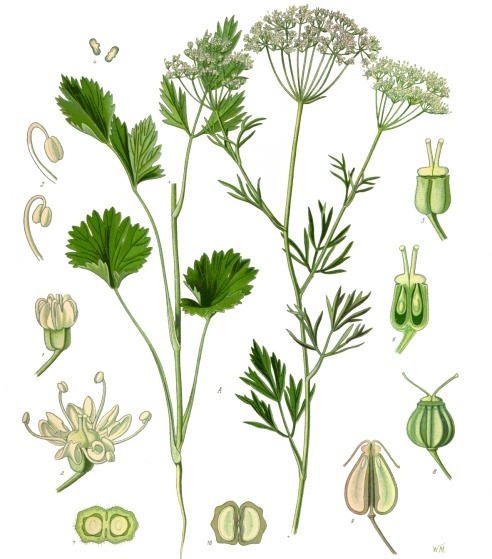
The plant has a hollow, deeply grooved stem that is mostly hairless, generally branched and leafy. Its dark green leaves are slightly glossy, ovate or oblong, short-stalked, feathery, deeply or slightly cut, and usually pointed.[1][2]
The basal leaves have petioles measuring 20–60 cm in length. The plant reaches an average height of 30–100 cm.[3][4]
The flowers are usually hermaphroditic and range in colour from white to glowing rose or soft pink. They are arranged in umbels with 11–16 stalks, and the inflorescences measure 50–60 mm in diameter.[5][6][7]
The plant produces ovoid fruits measuring 2–3 mm in length.[8]
Habitat
The species grows in burned forests and forest clearings, as well as in herb-rich areas, meadows, waysides and wooded pastures. It prefers nutrient-rich substrates and chalk and limestone soils.[9][10][11]
The species occurs at elevations ranging from sea level to 2,300 m.[12]
The species is widespread in Central Europe and the Caucasus. It is naturalized in North America.[13][14]
Reproduction and life cycle
The flowering period in the species' native habitat extends from June through August.[15]
Uses
The roots have been used in Austrian traditional medicine to prepare tisanes, milk-based preparations and herbal liqueurs. They have also been used traditionally to treat respiratory tract disorders, fever, infections, colds and influenza.[16][17]
Classification of the Greater Burnet-saxifrage
| Kingdom | Plantae |
|---|---|
| Subkingdom | Pteridobiotina |
| Phylum | Tracheophyta |
| Class | Magnoliopsida |
| Order | Apiales |
| Family | Apiaceae (Umbellifer) |
| Subfamily | Apioideae |
| Tribe | Pimpinelleae |
| Genus | Pimpinella (Burnet) |
| Species | Pimpinella major (L.) Huds. |
Where the Greater Burnet-saxifrage is found
Checklists and occurrence records place Pimpinella major in 41 countries across Europe and North America. GBIF holds 176,166 georeferenced records of it.
Countries where it is native or its origin is not stated
- Andorra 54
- Austria 19,674
- Belarus 15
- Belgium 14,171
- Bosnia and Herzegovina 3
- Bulgaria 10
- Croatia 4
- Czechia 2,126
- Denmark 348
- Estonia 474
- France 42,505
- Germany 33,233
- Greece 11
- Hungary 31
- Ireland 76
- Italy 1,180
- Kosovo
- Latvia 22
- Liechtenstein 202
- Lithuania 11
- Luxembourg 1,981
- Moldova
- Montenegro
- North Macedonia
- Norway 181
- Poland 3,596
- Portugal 44
- Romania 31
- Russia 262
- Serbia
- Slovakia 6,474
- Slovenia 103
- Spain 1,778
- Sweden 1,499
- Switzerland 17,971
- The Netherlands 7,408
- Ukraine 110
Countries where it has been introduced
Regions and cities with the most records
- Bavaria, Germany 22,179
- England, United Kingdom 19,914
- Upper Austria, Austria 14,429
- Auvergne-Rhône-Alpes, France 10,945
- Hauts-de-France, France 6,162
- Bourgogne-Franche-Comté, France 4,626
- Grand Est, France 4,472
- Maastricht, The Netherlands 4,271
- Bern, Switzerland 3,947
- Provence-Alpes-Côte d'Azur, France 3,830
- Riemst, Belgium 3,815
- Lanaken, Belgium 3,799
- Hoensbroek, The Netherlands 3,688
- Visé, Belgium 3,308
- Geleen, The Netherlands 3,228
- Brunssum, The Netherlands 3,131
- Limburg, The Netherlands 3,126
- Bilzen, Belgium 3,090
- Heerlen, The Netherlands 3,090
- Maasmechelen, Belgium 2,973
- Mechelen-aan-de-Maas, Belgium 2,920
- Sittard, The Netherlands 2,888
- Salzburg, Austria 2,664
- Hasselt, Belgium 2,616
- Diepenbeek, Belgium 2,556
- Genk, Belgium 2,490
- Tongeren, Belgium 2,480
- Kerkrade, The Netherlands 2,438
- Vaud, Switzerland 2,426
- Rotselaar, Belgium 2,364
- Sint-Truiden, Belgium 2,357
- Herent, Belgium 2,325
- Žilina Region, Slovakia 2,254
- Aachen, Germany 2,216
- Herzogenrath, Germany 2,180
- Blauwput, Belgium 2,166
3 more countries have a few records outside this range
These countries hold a few records of Pimpinella major but lie outside the range the checklists give for it. Such records are often zoo or garden specimens, museum material or vagrants, so the species is not counted as occurring there.
A number beside a place is its count of GBIF occurrence records. A place without a number comes from a checklist alone. Records show where a species has been observed or collected, which can include escapes and vagrants.
Common names
English
- Greater Burnet-saxifrage
- Great Burnet-saxifrage
- Hollow-stem Burnet-saxifrage
Names in 25 other languages
- Basque
- Gaitun handi
- Belarusian
- Бядрынец вялікі
- Bulgarian
- Едър анасон
- Chinese
- 大茴芹
- Croatian
- Bedrenika
- Czech
- bedrník větší
- Danish
- Stor pimpinelle
- Dutch
- Grote bevernel
- Estonian
- suur näär
- Finnish
- isopukinjuuri
- French
- grand boucage, grande pimpinelle
- German
- Große Bibernelle, Große Bibernelle i.w.S.
- Hungarian
- Nagy földitömjén
- Italian
- Tragoselino maggiore
- Lithuanian
- Didžioji ožiažolė
- Norwegian Bokmål
- stor gjeldkarve
- Polish
- Biedrzeniec wielki
- Russian
- Бедренец большой
- Serbian
- Бедринац велики
- Slovak
- bedrovník väčší
- Slovenian
- veliki bedrenec
- Swedish
- Lundanis, stor bockrot
- Turkish
- taş anasonu
- Ukrainian
- Бедринець великий
- Welsh
- Gwraiddiriog Mawr, Gwreiddiriog Mawr
Synonyms
One other scientific name has been used for this species and is now treated as a synonym of Pimpinella major.
- Pimpinella magna var. subcrenata Beck
Subspecies and varieties
- Pimpinella major subsp. major subspecies
- Pimpinella major subsp. rubra subspecies
- Pimpinella major var. major variety
Related species
-
 AnisePimpinella anisum
-
 Burnet-SaxifragePimpinella saxifraga
- Iberian Burnet SaxifragePimpinella villosa
- Diverse-leaf PimpinelPimpinella diversifolia
- Caucasian Burnet-saxifragePimpinella affinis
- Feather-Leaf PimpinelPimpinella acuminata
- Wild AniseedPimpinella afra
- Corymbed Burnet SaxifragePimpinella corymbosa
Compare
Questions and answers
What is the scientific name of the Greater Burnet-saxifrage?
The scientific name of the Greater Burnet-saxifrage is Pimpinella major. Written with its author, the full name is Pimpinella major (L.) Huds..
Which family does the Greater Burnet-saxifrage belong to?
Pimpinella major belongs to the family Apiaceae, in the order Apiales and the class Magnoliopsida.
Where is the Greater Burnet-saxifrage found?
Checklists and occurrence records place Pimpinella major in 41 countries, including France, Germany, Austria, Switzerland, Belgium and The Netherlands.
What other names does the Greater Burnet-saxifrage have?
Pimpinella major is also known in English as Great Burnet-saxifrage and Hollow-stem Burnet-saxifrage.
Sources
Passages the profile rests on
- The plant has a hollow, deeply grooved stem that is mostly hairless and generally branched and leafy. Source passage: “The stem is hollow, deeply grooved, mostly glabrous, and generally branched and leafy.” — English Wikipedia
- Its leaves are dark green, slightly glossy, ovate or oblong, short-stalked, feathery, deeply or slightly cut, and usually pointed. Source passage: “The leaves are dark green, slightly glossy, ovate or oblong, short-stalked, feathery, more or less deeply cut, and usually pointed.” — English Wikipedia
- The basal leaves have petioles measuring 20–60 cm in length. Source passage: “Basal leaves have a petiole 20–60 cm (8–20 in) long.” — English Wikipedia
- The plant reaches an average height of 30–100 cm. Source passage: “Pimpinella major reaches on average 30–100 cm (10–40 in) in height.” — English Wikipedia
- The flowers are usually hermaphroditic and range in colour from white to glowing rose or soft pink. Source passage: “The flowers, usually hermaphrodite, range from white to glowing rose or soft-pink” — English Wikipedia
- The flowers are arranged in umbels with 11–16 stalks. Source passage: “gathered in umbels with 11 to 16 stalks.” — English Wikipedia
- Its inflorescences measure 50–60 mm in diameter. Source passage: “The inflorescence has a diameter of 50–60 mm (2.0–2.4 in).” — English Wikipedia
- The plant produces ovoid fruits measuring 2–3 mm in length. Source passage: “The fruits are ovoid, 2–3 mm (0.08–0.1 in) long.” — English Wikipedia
- The species grows in burned forests and forest clearings. Source passage: “It grows in burned forests, clearings, herb-rich areas, meadows, waysides, and wooded pastures.” — English Wikipedia
- The species occurs in herb-rich areas, meadows, waysides, and wooded pastures. Source passage: “It grows in burned forests, clearings, herb-rich areas, meadows, waysides, and wooded pastures.” — English Wikipedia
- The species prefers nutrient-rich substrates and chalk and limestone soils. Source passage: “It prefers nutrient-rich substrate and chalk and limestone soils” — English Wikipedia
- The species occurs at elevations ranging from sea level to 2,300 m. Source passage: “at an altitude of 0–2,300 m (0–7,546 ft) above sea level.” — English Wikipedia
- The species is widespread in Central Europe and the Caucasus. Source passage: “Pimpinella major is widespread in central Europe and in the Caucasus” — English Wikipedia
- The species is naturalized in North America. Source passage: “it is naturalized in North America.” — English Wikipedia
- The flowering period in the species' native habitat extends from June through August. Source passage: “The flowering period extends from June to August in its native habitat.” — English Wikipedia
- The roots have been used in Austrian traditional medicine to prepare tisanes, milk-based preparations, and herbal liqueurs. Source passage: “The roots of Pimpinella major have been used internally in Austrian traditional medicine - as a tisane, in milk, or in herbal liqueurs” — English Wikipedia
- The roots have been used traditionally to treat respiratory tract disorders, fever, infections, colds, and influenza. Source passage: “for the treatment of disorders of the respiratory tract, fever, infections, colds, and influenza.” — English Wikipedia
Data
- Catalogue of Life, 2026-10-16 XR cc by
- Global Biodiversity Information Facility CC BY 4.0
- Wikidata CC0
- GeoNames CC BY 4.0
- Wikimedia Commons per image; credit shown with each image
- Within the Catalogue of Life, this name comes from Synonymic Checklists of the Vascular Plants of the World cc by
References
- (L.) Huds. where the name was published
This species in other databases
- Catalogue of Life 4HX4H
- Wikidata Q1548163
- iNaturalist 166879
- World Flora Online wfo-0000391450
- GRIN 315035
Page built on 28 November 2026. See how the catalog is made and all sources and licences.
Cite this page
ScientificNames.org. (2026). Pimpinella major (Greater Burnet-saxifrage). Retrieved November 28, 2026, from https://scientificnames.org/species/pimpinella-major
“Pimpinella major (Greater Burnet-saxifrage).” ScientificNames.org, 2026, scientificnames.org/species/pimpinella-major. Accessed 28 Nov. 2026.
ScientificNames.org. “Pimpinella major (Greater Burnet-saxifrage).” Accessed November 28, 2026. https://scientificnames.org/species/pimpinella-major.
@misc{scientificnames_pimpinella_major_greater_burnet_saxifrage,
  author = {{ScientificNames.org}},
  title = {Pimpinella major (Greater Burnet-saxifrage)},
  year = {2026},
  url = {https://scientificnames.org/species/pimpinella-major},
  note = {Accessed 2026-11-28}
}