Species · Conifers and allies
Bosnian Pine Pinus heldreichii
The scientific name of the Bosnian Pine is Pinus heldreichii. It is a species of gymnosperm in the family Pinaceae (pine family), order Pinales.
- Scientific name
- Pinus heldreichii H.Christ
- Common name
- Bosnian Pine
- Genus
- Pinus
- Family
- Pinaceae (Pine Family)
- Order
- Pinales
- Class
- Pinopsida
- Red List category
- LC Least Concern
- Recorded in
- 18 countries
- Name status
- accepted in the Catalogue of Life
Overview
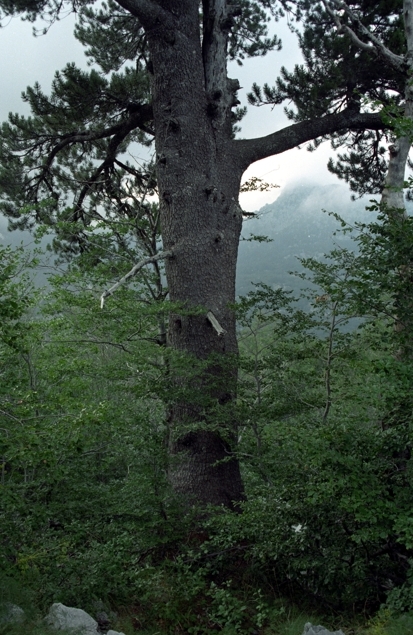
Bosnian Pine is an evergreen conifer in the family Pinaceae, order Pinales and class Pinopsida. It grows in mountainous areas of southeastern Europe and the southern Italian Peninsula, at elevations between 900 and 2,500 metres. Its mature bark develops hard plates resembling crocodile skin, and its needles grow in bundles of two.
Written 26 November 2026 from the sources listed below. Each statement was checked against the passage it cites; statements that could not be supported were removed.
Appearance
Young trees have smooth, pale-grey bark that develops into hard plates as the tree ages. The plates on mature trees resemble crocodile skin.[1][2]
The needles are stiff and sharp-pointed, arranged in bundles of two, and measure between 4.5 and 10 centimetres long and between 1.5 and 2 millimetres thick. They have persistent sheaths.[3][4][5][6][7]
The cones are initially dark blue-purple and turn brown when ripe. They have thin, fragile scales and measure between 5 and 9 centimetres long.[8][9][10]
The species has a neat, conical crown. Cultivated trees maintain a tight pyramidal form, particularly when young.[11][12]
Habitat
Bosnian Pine grows in mountainous regions of southeastern Europe and mountainous areas of the southern Italian Peninsula. Its distribution includes Bosnia and Herzegovina, Montenegro, southwestern Bulgaria, Albania, North Macedonia, Kosovo and northern Greece, as well as local occurrences in southern Italy.[13][14][15][16]
The species grows at elevations between 900 and 2,500 metres and reaches the alpine tree line in the regions where it occurs. It is adapted to dry, high-altitude sites.[17][18][19]
Behaviour
The needles remain on the tree for approximately six years.[20]
Bosnian Pine can withstand wind, ice and heavy snow. It is hardy to temperatures of at least minus 45 degrees Celsius and tolerates alkaline soil and drought.[21][22][23]
The species can tolerate sulphur dioxide, hydrogen fluoride, nitrogen dioxide and ozone pollution.[24]
Reproduction and life cycle
The cones mature approximately 16–18 months after pollination.[25]
The species produces seeds that are dispersed by wind. Its seeds measure 6–7 millimetres long and have wings measuring 2–2.5 centimetres long.[26][27][28]
Uses
Bosnian Pine is used for reforestation of extensive dry and high-altitude areas. It is also planted in southern Italy because it is less susceptible to pests than other pines.[29][30]
The species is cultivated as an ornamental tree in parks and large gardens. It is suitable for specimen planting and screening.[31][32]
Its aromatic wood is commonly used in the Balkans to make barrels for white wines. The wood contains the essential oils limonene and cembrene.[33][34]
Similar species
Bosnian Pine resembles Austrian pine at first glance. It is slower-growing than Austrian pine.[35][36]
Classification of the Bosnian Pine
| Kingdom | Plantae |
|---|---|
| Subkingdom | Pteridobiotina |
| Phylum | Tracheophyta |
| Class | Pinopsida (Conifer) |
| Subclass | Pinidae |
| Order | Pinales |
| Family | Pinaceae (Pine Family) |
| Genus | Pinus (Pine) |
| Species | Pinus heldreichii H.Christ |
Where the Bosnian Pine is found
Checklists and occurrence records place Pinus heldreichii in 18 countries. GBIF holds 913 georeferenced records of it.
Countries
- Albania 31
- Bosnia and Herzegovina 38
- Bulgaria 54
- Croatia 5
- France 4
- Germany 41
- Greece 72
- Hungary 3
- Italy 581
- Kosovo 12
- Latvia 7
- Montenegro 36
- North Macedonia 3
- Poland 7
- Russia 3
- Serbia 8
- Spain 3
- The Netherlands 5
Regions and cities with the most records
- Castrovillari, Italy 400
- Calabria, Italy 385
- Basilicate, Italy 185
- Blagoevgrad, Bulgaria 22
- Konjic, Bosnia and Herzegovina 12
- Mecklenburg-Vorpommern, Germany 10
- Baden-Wurttemberg, Germany 9
- Shkodër County, Albania 9
- Universitäts- und Hansestadt Greifswald, Germany 9
- Brandenburg, Germany 7
- Budva, Montenegro 6
- Cetinje, Montenegro 6
- Cetinje, Montenegro 6
- Donaueschingen, Germany 6
- Rottweil, Germany 6
- Trossingen, Germany 6
- Tuttlingen, Germany 6
- Villingen-Schwenningen, Germany 6
- Andrijevica, Montenegro 5
- Berat County, Albania 5
- Gryfino, Poland 5
- Herceg Novi, Montenegro 5
- Hesse, Germany 5
- Tearce, North Macedonia 5
- Bruchköbel, Germany 4
- Gelderland, The Netherlands 4
- Herceg Novi, Montenegro 4
- Berat, Albania 3
- Kateríni, Greece 3
- North Rhine-Westphalia, Germany 3
- Thuringia, Germany 3
- Tuscany, Italy 3
2 more countries have a few records outside this range
These countries hold a few records of Pinus heldreichii but lie outside the range the checklists give for it. Such records are often zoo or garden specimens, museum material or vagrants, so the species is not counted as occurring there.
A number beside a place is its count of GBIF occurrence records. A place without a number comes from a checklist alone. Records show where a species has been observed or collected, which can include escapes and vagrants.
Common names
English
- Bosnian Pine
- Balkan Pine
- Heldreich Pine
- Heldreich's Pine
- Graybark Pine
- Pale-bark Pine
- Snakeskin Pine
Names in 28 other languages
- Arabic
- صنوبر بوسني
- Bulgarian
- Черна мура
- Catalan
- Pi de Bòsnia
- Chinese
- 波斯尼亞松
- Croatian
- Munika
- Czech
- borovice Heldreichova
- Danish
- Slangebark-Fyr, panserfyr
- Dutch
- Bosnische den
- Esperanto
- Balkana pino
- Estonian
- Soomusmänd
- Finnish
- bosnianmänty
- French
- Pin de Bosnie, pin blanc de Bosnie
- German
- Lorica-Kiefer, Panzerkiefer, Schlangenhaut-Kiefer, Schlangenhautkiefer
- Greek
- Ρόμπολο
- Italian
- Pino loricato
- Japanese
- bosunia-matsu
- Lithuanian
- Baltažievė pušis
- Macedonian
- Муника
- Norwegian
- Ormehamfuru
- Norwegian Bokmål
- panserfuru
- Polish
- sosna bośniacka
- Russian
- Боснийская сосна, Сосна Гельдрейха
- Slovak
- Borovica pancierová, borovica Heldreichova
- Spanish
- Pino de los Balcanes
- Swedish
- ormskinnstall
- Turkish
- Zırhlı Çam
- koi
- Боснаись пожум
- udm
- Босниысь пужым
Synonyms
12 other scientific names have been used for this species and are now treated as synonyms of Pinus heldreichii.
- Pinus heldreichii f. vivipara Tucović & Stilinovic
- Pinus heldreichii subsp. leucodermis (Antoine) A.E.Murray
- Pinus heldreichii var. heldreichii
- Pinus heldreichii var. leucodermis (Antoine) Markgr. ex Fitschen
- Pinus heldreichii var. leucodermis H.Christ
- Pinus heldreichii var. pancicii Fukarek
- Pinus laricio var. heldreichii (H.Christ) Mast.
- Pinus laricio var. leucodermis (Antoine) H.Christ
- Pinus laricio var. pindica (Formánek) Mast.
- Pinus leucodermis Antoine
- Pinus nigra var. leucodermis (Antoine) Rehder
- Pinus pindica Formánek
Related species
-
 Scots PinePinus sylvestris
-
 Eastern White PinePinus strobus
-
 Great Basin Bristlecone PinePinus longaeva
-
 Italian Stone PinePinus pinea
-
 Ponderosa PinePinus ponderosa
-
 Loblolly PinePinus taeda
-
 Longleaf PinePinus palustris
-
 Lodgepole PinePinus contorta
Compare
Questions and answers
What is the scientific name of the Bosnian Pine?
The scientific name of the Bosnian Pine is Pinus heldreichii. Written with its author, the full name is Pinus heldreichii H.Christ.
Which family does the Bosnian Pine belong to?
Pinus heldreichii belongs to the family Pinaceae, in the order Pinales and the class Pinopsida.
Where is the Bosnian Pine found?
Checklists and occurrence records place Pinus heldreichii in 18 countries, including Italy, Greece, Bulgaria, Germany, Bosnia and Herzegovina and Montenegro.
What is the conservation status of the Bosnian Pine?
The IUCN Red List category recorded for Pinus heldreichii is Least Concern (LC).
What other names does the Bosnian Pine have?
Pinus heldreichii is also known in English as Balkan Pine, Heldreich Pine, Heldreich's Pine, Graybark Pine, Pale-bark Pine and Snakeskin Pine.
How big does a Bosnian Pine get?
Bosnian Pine can reach 25–35 metres in height, with a trunk diameter of up to 2 metres. Its spread is usually less than half its height. Cultivated trees typically reach about half the height of wild trees.[37][38][39][40]
What is the habitat of the pine tree?
Bosnian Pine grows in mountainous regions of southeastern Europe and the southern Italian Peninsula, at elevations between 900 and 2,500 metres. It is adapted to dry, high-altitude sites and reaches the alpine tree line in the regions where it grows.[13][14][17][18][19]
How fast do Bosnian pines grow?
Bosnian Pine is slower-growing than Austrian pine.[36]
Sources
Passages the profile rests on
- Young trees have smooth, pale-grey bark that develops into hard plates in older trees. Source passage: “The bark is smooth pale grey at first, becoming hard and tesselated into small hexagonal to rounded plates” — English Wikipedia
- The bark plates of mature trees resemble crocodile skin. Source passage: “somewhat reminiscent of crocodile skin” — English Wikipedia
- The species has needles arranged in bundles of two. Source passage: “with leaves ('needles') in fascicles (bundles) of two” — English Wikipedia
- Its needles are between 4.5 and 10 centimetres long. Source passage: “They are 4.5–10 centimetres” — English Wikipedia
- Its needles are between 1.5 and 2 millimetres thick. Source passage: “and 1.5–2 millimetres” — English Wikipedia
- The needles have persistent sheaths. Source passage: “with a persistent sheath” — English Wikipedia
- The species has stiff, sharp-pointed needles. Source passage: “has stiff, sharp-pointed needles only 2-3 inches long” — uaex.uada.edu
- The cones are initially dark blue-purple and turn brown when ripe. Source passage: “they are dark blue-purple before maturation, turning brown when ripe” — English Wikipedia
- The cones have thin, fragile scales. Source passage: “with thin, fragile scales” — English Wikipedia
- Its cones measure between 5 and 9 centimetres long. Source passage: “Cones are 5–9 cm (2–3+1⁄2 in) long” — English Wikipedia
- The species has a neat, conical crown. Source passage: “with a very neat, conical crown” — English Wikipedia
- Cultivated trees maintain a tight pyramidal form, particularly when young. Source passage: “trees maintaining a tight pyramidal form, especially while young.” — uaex.uada.edu
- The species grows in mountainous regions of southeastern Europe. Source passage: “native to mountainous regions of Southeast Europe” — English Wikipedia
- The species also occurs in mountainous areas of the southern Italian Peninsula. Source passage: “mountainous southern Italian Peninsula.” — English Wikipedia
- The species occurs in Bosnia and Herzegovina, Montenegro, southwestern Bulgaria, Albania, North Macedonia, Kosovo and northern Greece. Source passage: “the mountains of Bosnia and Herzegovina, Montenegro, southwestern Bulgaria, Albania, North Macedonia, Kosovo, northern Greece” — English Wikipedia
- The species also occurs locally in southern Italy. Source passage: “and locally in southern Italy” — English Wikipedia
- The species grows at elevations between 900 and 2,500 metres. Source passage: “growing at 900–2,500 m (3,000–8,200 ft) altitude.” — English Wikipedia
- The species reaches the alpine tree line in the regions where it grows. Source passage: “It reaches the alpine tree line in these areas.” — English Wikipedia
- The species is adapted to dry, high-altitude sites. Source passage: “a good colonist of dry high altitude sites.” — English Wikipedia
- The needles remain on the tree for approximately six years. Source passage: “Needles persist on the tree for six years.” — uaex.uada.edu
- The species can withstand wind, ice and heavy snow. Source passage: “able to withstand wind, ice and heavy snow.” — English Wikipedia
- The species is hardy to temperatures of at least minus 45 degrees Celsius. Source passage: “It is hardy down to at least −45 °C (−49 °F)” — English Wikipedia
- The species tolerates alkaline soil and has good drought tolerance. Source passage: “It tolerates alkaline soil and seems to have good drought tolerance.” — uaex.uada.edu
- The species can tolerate sulphur dioxide, hydrogen fluoride, nitrogen dioxide and ozone pollution. Source passage: “It is resistant to sulphur dioxide, hydrogen fluoride, nitrogen dioxide and ozone pollution” — English Wikipedia
- The cones mature approximately 16–18 months after pollination. Source passage: “turning brown when ripe about 16–18 months after pollination.” — English Wikipedia
- Its seeds measure 6–7 millimetres long. Source passage: “The 6–7 mm (1⁄4–9⁄32 in) long seeds” — English Wikipedia
- The seeds have wings measuring 2–2.5 centimetres long. Source passage: “have a 2–2.5 cm (3⁄4–1 in) wing” — English Wikipedia
- The species produces seeds that are dispersed by wind. Source passage: “seeds have a 2–2.5 cm (3⁄4–1 in) wing and are wind-dispersed.” — English Wikipedia
- The species is used for reforestation of extensive dry and high-altitude areas. Source passage: “These abilities makes it suitable for reforestation of extensive dry and high-altitude areas.” — English Wikipedia
- The species is planted in southern Italy because it is less susceptible to pests than other pines. Source passage: “In the south of Italy it is planted because it is less susceptible to pests than other pine species.” — English Wikipedia
- The species is cultivated as an ornamental tree in parks and large gardens. Source passage: “Bosnian pine is a popular ornamental tree in parks and large gardens” — English Wikipedia
- The species is suitable for specimen planting and screening. Source passage: “Bosnian pine is ideal for use as a specimen or for screening.” — uaex.uada.edu
- Its aromatic wood is commonly used in the Balkans to make barrels for white wines. Source passage: “thus is commonly utilised in the Balkans for making wine barrels for white wines.” — English Wikipedia
- The wood contains the essential oils limonene and cembrene. Source passage: “noticeably limonene and cembrene” — English Wikipedia
- The species resembles Austrian pine at first glance. Source passage: “at first glance resembles the strident Austrian pine (P. nigra)” — uaex.uada.edu
- The species is described as slower-growing than Austrian pine. Source passage: “but it is slower growing than that species” — uaex.uada.edu
- The species can reach 25–35 metres in height. Source passage: “up to 25–35 metres (82–115 feet) in height” — English Wikipedia
- The trunk can reach 2 metres in diameter. Source passage: “and 2 m (6+1⁄2 ft) in trunk diameter.” — English Wikipedia
- Cultivated trees typically reach about half the height of wild trees. Source passage: “but in cultivation are typically half that.” — uaex.uada.edu
- The species' spread is usually less than half its height. Source passage: “Their spread is usually less than half their height” — uaex.uada.edu
Data
- Catalogue of Life, 2026-10-16 XR cc by
- Global Biodiversity Information Facility CC BY 4.0
- Wikidata CC0
- GeoNames CC BY 4.0
- Wikimedia Commons per image; credit shown with each image
- Within the Catalogue of Life, this name comes from Pinopsida from WFO cc0
References
- Verh. Naturf. Ges. Basel 3(4): 549. 1863 Link where the name was published
- Conifer TEN record for Pinus heldreichii H.Christ Link
This species in other databases
- Catalogue of Life 4J287
- Wikidata Q460531
- iNaturalist 135783
- World Flora Online wfo-0000481393-2026-06
- GRIN 70507
Page built on 28 November 2026. See how the catalog is made and all sources and licences.
Cite this page
ScientificNames.org. (2026). Pinus heldreichii (Bosnian Pine). Retrieved November 28, 2026, from https://scientificnames.org/species/pinus-heldreichii
“Pinus heldreichii (Bosnian Pine).” ScientificNames.org, 2026, scientificnames.org/species/pinus-heldreichii. Accessed 28 Nov. 2026.
ScientificNames.org. “Pinus heldreichii (Bosnian Pine).” Accessed November 28, 2026. https://scientificnames.org/species/pinus-heldreichii.
@misc{scientificnames_pinus_heldreichii_bosnian_pine,
  author = {{ScientificNames.org}},
  title = {Pinus heldreichii (Bosnian Pine)},
  year = {2026},
  url = {https://scientificnames.org/species/pinus-heldreichii},
  note = {Accessed 2026-11-28}
}