Species · Conifers and allies
Merkus Pine Pinus merkusii
The scientific name of the Merkus Pine is Pinus merkusii. It is a species of gymnosperm in the family Pinaceae (pine family), order Pinales.
- Scientific name
- Pinus merkusii Jungh. & de Vriese
- Common name
- Merkus Pine
- Genus
- Pinus
- Family
- Pinaceae (Pine Family)
- Order
- Pinales
- Class
- Pinopsida
- Red List category
- VU Vulnerable
- Recorded in
- 10 countries
- Name status
- accepted in the Catalogue of Life
Overview
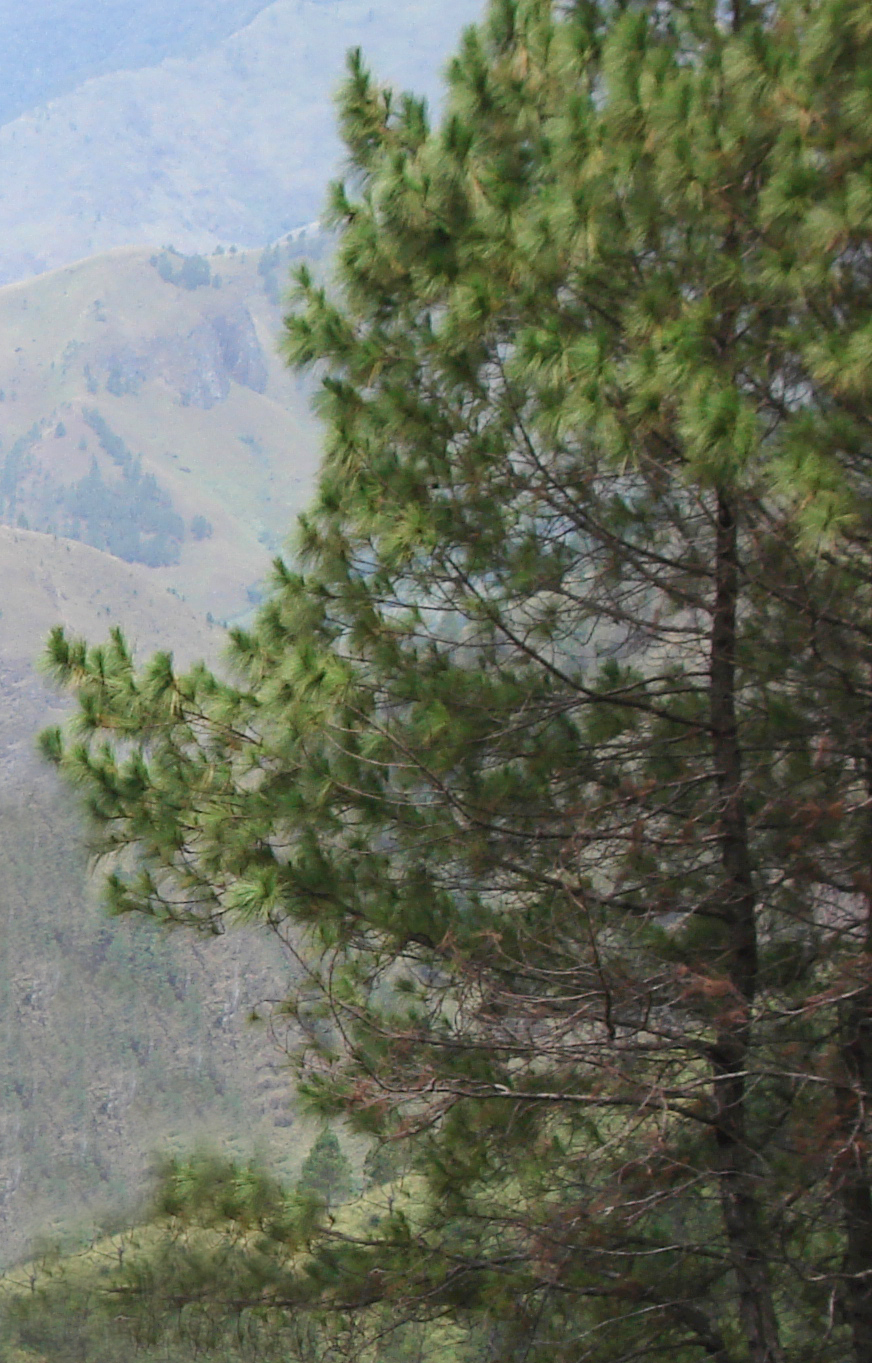
The Merkus pine is a conifer in the family Pinaceae and class Pinopsida. It occurs mainly in the mountains of northern Sumatra, Indonesia, with additional populations in central Sumatra, the Philippines, Cambodia and Vietnam. It is the only member of its genus that occurs naturally south of the Equator.
Written 26 November 2026 from the sources listed below. Each statement was checked against the passage it cites; statements that could not be supported were removed.
Appearance
The Merkus pine has orange-red bark that is thick and deeply fissured at the base of the trunk, becoming thin and flaky in the upper crown. Its leaves grow in pairs and consist of very slender, green to yellowish green needles.[1][2]
Its seed cones are initially green and ripen to a glossy red-brown colour. They are narrow and conical, measuring 5–8 cm long and approximately 2 cm wide at the base when closed, and open to a width of 4–5 cm when mature.[3][4][5]
The Merkus pine reaches heights of 25–45 metres, and its trunk can reach a diameter of 1 metre. Its needles measure 15–20 centimetres in length and less than 1 millimetre in thickness.[6][7][8]
Its seeds measure 5–6 millimetres in length and have wings measuring 15–20 millimetres in length.[9][10]
Habitat
The Merkus pine generally grows at elevations of 400–1,500 metres. It occasionally occurs at elevations as low as 90 metres and can grow at elevations up to 2,000 metres.[11][12][13]
The species occurs mainly in the mountains of northern Sumatra, Indonesia. Two outlying populations occur on Mount Kerinci and Mount Talang in central Sumatra.[14][15]
In the Philippines, the Merkus pine occurs on Mindoro and in the Zambales Mountains of western Luzon. Isolated populations also occur in Kirirom National Park in the Cardamom Mountains of Cambodia and Bidoup Núi Bà National Park on the Đà Lạt Plateau in Vietnam.[16][17][18]
The central Sumatran population occurs between 1° 40′ and 2° 06′ south latitude. It is the only natural occurrence of a Pinaceae member south of the Equator.[19][20]
Reproduction and life cycle
Mature cones open to release the seeds, which are dispersed by wind.[21][22]
Similar species
The Merkus pine is closely related to Tenasserim pine (Pinus latteri). Some botanists consider the two to be the same species.[23][24]
Tenasserim pine differs from the Merkus pine by having longer and thicker leaves, larger cones and thicker cone scales. Its cones often remain closed for some time after reaching maturity.[25][26][27]
The Merkus pine is also related to Mediterranean pines, including Aleppo pine and Turkish pine.[28]
Classification of the Merkus Pine
| Kingdom | Plantae |
|---|---|
| Subkingdom | Pteridobiotina |
| Phylum | Tracheophyta |
| Class | Pinopsida (Conifer) |
| Subclass | Pinidae |
| Order | Pinales |
| Family | Pinaceae (Pine Family) |
| Genus | Pinus (Pine) |
| Species | Pinus merkusii Jungh. & de Vriese |
Where the Merkus Pine is found
Checklists and occurrence records place Pinus merkusii in 10 countries. GBIF holds 346 georeferenced records of it.
Countries
- Cambodia 5
- China 23
- India 5
- Indonesia 154
- Laos 5
- Malaysia 11
- Myanmar 4
- Philippines 76
- Thailand 28
- Vietnam 35
Regions and cities with the most records
- Aceh, Indonesia 13
- Hainan, China 13
- Bali, Indonesia 7
- Bandung, Indonesia 7
- Yogyakarta, Indonesia 7
- Bogor, Indonesia 6
- Caringin, Indonesia 6
- Ciampea, Indonesia 6
- Jogonalan, Indonesia 6
- Melati, Indonesia 6
- Muntilan, Indonesia 6
- Sleman, Indonesia 6
- Ambarawa, Indonesia 5
- Cibinong, Indonesia 5
- Cileunyi, Indonesia 5
- Citeureup, Indonesia 5
- Loei, Thailand 5
- Pangururan, Indonesia 5
- Candi Prambanan, Indonesia 4
- Guangdong, China 4
- Klangenan, Indonesia 4
- Kuningan, Indonesia 4
- Palimanan, Indonesia 4
- Phu Kradueng, Thailand 4
- Plumbon, Indonesia 4
- Sumber, Indonesia 4
- Sumedang, Indonesia 4
- Weru, Indonesia 4
- Angat, Philippines 3
- Bagong Silang, Philippines 3
- Baliuag, Philippines 3
- Basuo, China 3
- Bocaue, Philippines 3
- Boyolali, Indonesia 3
- Bustos, Philippines 3
- Cianjur, Indonesia 3
3 more countries have a few records outside this range
These countries hold a few records of Pinus merkusii but lie outside the range the checklists give for it. Such records are often zoo or garden specimens, museum material or vagrants, so the species is not counted as occurring there.
A number beside a place is its count of GBIF occurrence records. A place without a number comes from a checklist alone. Records show where a species has been observed or collected, which can include escapes and vagrants.
Common names
English
- Merkus Pine
- Merkus's Pine
- Mindoro Pine
- Philippine Pine
- Sumatra Pine
- Sumatran Pine
- Tenasserim Pine
Names in 11 other languages
- Chinese
- nan ya song, 南亞松
- Dutch
- Sumatraanse den
- Finnish
- indonesianmänty
- French
- pin de Sumatra
- German
- Merkus Kiefer, Merkus' Kiefer
- Hebrew
- אורן מרקוס
- Indonesian
- Damar Batu, Damar Bunga, Uyam, tusam
- Japanese
- メルクシマツ
- Polish
- sosna Merkusa
- Slovak
- borovica Merkusova
- Thai
- สนสองใบ
Synonyms
5 other scientific names have been used for this species and are now treated as synonyms of Pinus merkusii.
- Pinus finlaysoniana Wall. ex Blume
- Pinus merkusii subsp. ustulata Businsky
- Pinus sumatrana Mirb.
- Pinus ustulata (Businsky) Businsky
- Pinus sumatrana Jungh. ambiguous synonym
Related species
-
 Scots PinePinus sylvestris
-
 Eastern White PinePinus strobus
-
 Great Basin Bristlecone PinePinus longaeva
-
 Italian Stone PinePinus pinea
-
 Ponderosa PinePinus ponderosa
-
 Loblolly PinePinus taeda
-
 Longleaf PinePinus palustris
-
 Lodgepole PinePinus contorta
Compare
Questions and answers
What is the scientific name of the Merkus Pine?
The scientific name of the Merkus Pine is Pinus merkusii. Written with its author, the full name is Pinus merkusii Jungh. & de Vriese.
Which family does the Merkus Pine belong to?
Pinus merkusii belongs to the family Pinaceae, in the order Pinales and the class Pinopsida.
Where is the Merkus Pine found?
Checklists and occurrence records place Pinus merkusii in 10 countries, including Indonesia, Philippines, Vietnam, Thailand, China and Malaysia.
What is the conservation status of the Merkus Pine?
The IUCN Red List category recorded for Pinus merkusii is Vulnerable (VU).
What other names does the Merkus Pine have?
Pinus merkusii is also known in English as Merkus's Pine, Mindoro Pine, Philippine Pine, Sumatra Pine, Sumatran Pine and Tenasserim Pine.
Sources
Passages the profile rests on
- Pinus merkusii has orange-red bark that is thick and deeply fissured at the base of the trunk and thin and flaky in the upper crown. Source passage: “The bark is orange-red, thick and deeply fissured at the base of the trunk, and thin and flaky in the upper crown.” — English Wikipedia
- Its leaves grow in pairs and are very slender, green to yellowish green needles. Source passage: “The leaves ('needles') are in pairs, very slender, 15–20 centimetres (6–8 inches) long and less than 1 mm (1⁄32 in) thick, green to yellowish green.” — English Wikipedia
- Its seed cones are initially green and ripen to a glossy red-brown colour. Source passage: “green at first, ripening glossy red-brown.” — English Wikipedia
- Its cones are narrow and conical, measuring 5–8 cm long and approximately 2 cm wide at the base when closed. Source passage: “The cones are narrow conic, 5–8 cm (2–3+1⁄4 in) long and 2 cm (3⁄4 in) broad at the base when closed” — English Wikipedia
- Mature cones open to a width of 4–5 cm. Source passage: “They open to 4–5 cm (1+1⁄2–2 in) broad at maturity” — English Wikipedia
- Pinus merkusii reaches heights of 25–45 metres. Source passage: “reaching 25–45 metres (80–150 feet) tall” — English Wikipedia
- Its trunk can reach a diameter of 1 metre. Source passage: “with a trunk diameter of up to 1 m (3 ft 3 in).” — English Wikipedia
- Its needles measure 15–20 centimetres in length and less than 1 millimetre in thickness. Source passage: “15–20 centimetres (6–8 inches) long and less than 1 mm (1⁄32 in) thick” — English Wikipedia
- Its seeds measure 5–6 millimetres in length. Source passage: “The seeds are 5–6 mm (3⁄16–1⁄4 in) long” — English Wikipedia
- Its seeds have wings measuring 15–20 millimetres in length. Source passage: “with a 15–20 mm (1⁄2–3⁄4 in) wing” — English Wikipedia
- Pinus merkusii generally grows at elevations of 400–1,500 metres. Source passage: “It generally occurs at moderate altitudes, mostly 400–1,500 m (1,300–4,900 ft)” — English Wikipedia
- The species occasionally occurs at elevations as low as 90 metres. Source passage: “but occasionally as low as 90 m (300 ft)” — English Wikipedia
- The species can occur at elevations up to 2,000 metres. Source passage: “and up to 2,000 m (6,600 ft).” — English Wikipedia
- The species occurs mainly in the mountains of northern Sumatra, Indonesia. Source passage: “mainly in Indonesia in the mountains of northern Sumatra” — English Wikipedia
- Two outlying populations occur on Mount Kerinci and Mount Talang in central Sumatra. Source passage: “with two outlying populations in central Sumatra on Mount Kerinci and Mount Talang” — English Wikipedia
- In the Philippines, Pinus merkusii occurs on Mindoro and in the Zambales Mountains of western Luzon. Source passage: “in the Philippines on Mindoro and in the Zambales Mountains on western Luzon.” — English Wikipedia
- An isolated population occurs in Kirirom National Park in the Cardamom Mountains of Cambodia. Source passage: “such as Kirirom National Park, on the Cardamom Mountains in Cambodia” — English Wikipedia
- An isolated population occurs in Bidoup Núi Bà National Park on the Đà Lạt Plateau in Vietnam. Source passage: “Bidoup Núi Bà National Park on the Đà Lạt Plateau in Vietnam.” — English Wikipedia
- The central Sumatran population occurs between 1° 40′ and 2° 06′ south latitude. Source passage: “between 1° 40′ and 2° 06′ S latitude” — English Wikipedia
- The central Sumatran population is the only natural occurrence of a Pinaceae member south of the Equator. Source passage: “is the only natural occurrence of any member of the Pinaceae south of the Equator.” — English Wikipedia
- Mature cones open to release the seeds. Source passage: “They open to 4–5 cm (1+1⁄2–2 in) broad at maturity to release the seeds.” — English Wikipedia
- The seeds of Pinus merkusii are dispersed by wind. Source passage: “and are wind-dispersed.” — English Wikipedia
- Pinus merkusii is closely related to Tenasserim pine (Pinus latteri). Source passage: “Pinus merkusii is closely related to the Tenasserim pine (P. latteri)” — English Wikipedia
- Some botanists consider Pinus merkusii and Pinus latteri to be the same species. Source passage: “some botanists treat the two as conspecific” — English Wikipedia
- Pinus latteri differs from Pinus merkusii by having longer and thicker leaves. Source passage: “P. latteri differs in longer (18–27 cm or 7–10+1⁄2 in) and stouter (over 1 mm or 1⁄32 in thick) leaves” — English Wikipedia
- Pinus latteri has larger cones with thicker scales than Pinus merkusii. Source passage: “and larger cones with thicker scales” — English Wikipedia
- Pinus latteri cones often remain closed for some time after reaching maturity. Source passage: “the cones often remaining closed for some time after maturity.” — English Wikipedia
- Pinus merkusii is also related to Mediterranean pines, including Aleppo pine and Turkish pine. Source passage: “It is also related to the group of Mediterranean pines including Aleppo pine and Turkish pine” — English Wikipedia
Data
- Catalogue of Life, 2026-10-16 XR cc by
- Global Biodiversity Information Facility CC BY 4.0
- Wikidata CC0
- GeoNames CC BY 4.0
- Wikimedia Commons per image; credit shown with each image
- Within the Catalogue of Life, this name comes from Pinopsida from WFO cc0
References
- Pl. Nov. Ind. Bat. 1: 5. (1845) where the name was published
- Conifer TEN record for Pinus merkusii Jungh. & de Vriese Link
This species in other databases
- Catalogue of Life 4J2BY
- Wikidata Q209326
- iNaturalist 135788
- World Flora Online wfo-0000482024-2026-06
- GRIN 28483
Page built on 29 November 2026. See how the catalog is made and all sources and licences.
Cite this page
ScientificNames.org. (2026). Pinus merkusii (Merkus Pine). Retrieved November 29, 2026, from https://scientificnames.org/species/pinus-merkusii
“Pinus merkusii (Merkus Pine).” ScientificNames.org, 2026, scientificnames.org/species/pinus-merkusii. Accessed 29 Nov. 2026.
ScientificNames.org. “Pinus merkusii (Merkus Pine).” Accessed November 29, 2026. https://scientificnames.org/species/pinus-merkusii.
@misc{scientificnames_pinus_merkusii_merkus_pine,
  author = {{ScientificNames.org}},
  title = {Pinus merkusii (Merkus Pine)},
  year = {2026},
  url = {https://scientificnames.org/species/pinus-merkusii},
  note = {Accessed 2026-11-29}
}