Species · Birds
Red-billed Parrot Pionus sordidus
The scientific name of the Red-billed Parrot is Pionus sordidus. It is a species of bird in the family Psittacidae (macaws), order Psittaciformes. The name dates from 1758.
- Scientific name
- Pionus sordidus (Linnaeus, 1758)
- Common name
- Red-billed Parrot
- Genus
- Pionus
- Family
- Psittacidae (Macaws)
- Order
- Psittaciformes
- Class
- Aves
- Red List category
- LC Least Concern
- Recorded in
- 5 countries
- Name status
- accepted in the Catalogue of Life

Overview
Pionus sordidus occurs in Bolivia, Colombia, Ecuador, Peru, and Venezuela. It has a red bill in all six recognized subspecies.
Written 26 November 2026 from the sources listed below. Each statement was checked against the passage it cites; statements that could not be supported were removed.
Appearance
The species has a red bill in all six recognized subspecies. Adults of the nominate subspecies have a dull green head with dull blue feather edges, bare grayish skin surrounding the eye, and an olive-green back, wings, and inner tail feathers with blue outer tail feathers.[1][2][3][4][5]
P. s. antelius is paler than the nominate subspecies and has little blue coloration on its breast. P. s. saturatus is darker than the nominate subspecies, while P. s. ponsi is darker than P. s. saturatus.[6][7][8]
P. s. corallinus is larger and greener than the nominate subspecies, with gray and blue tinges on its mantle and back. P. s. mindoensis resembles P. s. corallinus but is somewhat yellower.[9][10]
The species measures 27–29 cm in length and weighs approximately 272 g.[11][12]
Habitat
The Red-billed Parrot inhabits the interiors, clearings, and edges of humid to wet lowland and submontane evergreen and semi-deciduous forests. It also occupies cloud forests, secondary forests, gallery forests, and coffee plantations.[13][14]
The species is primarily found at elevations between 500 and 1,500 m, although its recorded elevational range extends from 100 to 2,400 m. It is described as a medium-sized parrot of mid-elevation cloud forest.[15][16][17]
Diet
The documented diet includes fruits and blossoms.[18]
Behaviour
The species makes some local seasonal movements in northern Venezuela. Its movements outside northern Venezuela are not known.[19][20]
Flight calls differ among the subspecies. P. s. sordidus and P. s. antelius produce a strident call described as kee-yak, while P. s. corallinus and P. s. mindoensis produce an upslurred crree call and a mellower crrah call.[21][22][23]
Reproduction and life cycle
The breeding season in Colombia extends from February through April and in Ecuador from January through May. April is included in the breeding season in Venezuela, and October is included in Bolivia.[24][25][26][27]
The species nests in holes in trees. The usual clutch size appears to be three eggs, and the incubation period is approximately 27 days.[28][29][30]
Young birds fledge approximately 12 weeks after hatching.[31]
Conservation
The Red-billed Parrot is classified as Least Concern by the IUCN. It has a very large geographic range, but its population size is unknown and its population is believed to be decreasing.[32][33][34]
The species is considered fairly common across most of its range, and no immediate threats have been identified. It persists in moderately disturbed habitats.[35][36][37]
Deforestation has caused local population declines in Colombia and Venezuela.[38]
Similar species
The Red-billed Parrot and the scaly-headed parrot are sister species.[39]
Classification of the Red-billed Parrot
| Kingdom | Animalia |
|---|---|
| Phylum | Chordata |
| Subphylum | Vertebrata |
| Infraphylum | Gnathostomata |
| Parvphylum | Osteichthyes |
| Megaclass | Tetrapoda |
| Class | Aves (Bird) |
| Order | Psittaciformes (Parrot) |
| Family | Psittacidae (Macaws) |
| Genus | Pionus (Pionuses) |
| Species | Pionus sordidus (Linnaeus, 1758) |
Where the Red-billed Parrot is found
Checklists and occurrence records place Pionus sordidus in 5 countries across South America. GBIF holds 28,306 georeferenced records of it.
Countries
Regions and cities with the most records
- Pichincha, Ecuador 14,326
- Napo, Ecuador 4,821
- Magdalena Department, Colombia 4,266
- Santa Marta, Colombia 1,165
- Zamora Chinchipe, Ecuador 622
- Carabobo, Venezuela 467
- Mariara, Venezuela 456
- El Limón, Venezuela 426
- Maracay, Venezuela 411
- Falcón, Venezuela 398
- San Martín Department, Peru 371
- San Joaquín, Venezuela 291
- Aragua, Venezuela 276
- Zamora, Ecuador 269
- Amazonas, Peru 257
- Morona-Santiago Province, Ecuador 256
- Imbabura, Ecuador 226
- La Paz Department, Bolivia 185
- Huila Department, Colombia 179
- Montalbán, Venezuela 175
- Bejuma, Venezuela 173
- Santa Cruz Department, Bolivia 172
- Cochabamba, Bolivia 145
- Morón, Venezuela 120
- Cesar Department, Colombia 112
- La Guajira Department, Colombia 94
- Cajamarca Department, Peru 93
- Monagas, Venezuela 90
- Santo Domingo de los Tsáchilas, Ecuador 90
- Vargas, Venezuela 70
- Chimborazo Province, Ecuador 66
- Ciénaga, Colombia 64
- Sucumbíos, Ecuador 57
- La Peca, Peru 49
- Palo Negro, Venezuela 44
- Tungurahua Province, Ecuador 43
Range as the checklists state it
South America
A number beside a place is its count of GBIF occurrence records. A place without a number comes from a checklist alone. Records show where a species has been observed or collected, which can include escapes and vagrants.
Common names
English
- Red-billed Parrot
Names in 27 other languages
- Arabic
- ببغاء أحمر المنقار
- Catalan
- lloro bec-roig
- Chinese
- 紅嘴鸚哥, 红嘴鹦哥
- Croatian
- crvenokljuna papiga
- Czech
- amazónek červenozobý
- Danish
- Rødnæbbet Pionus
- Dutch
- Roodsnavelmargrietje
- Esperanto
- ruĝbeka papago
- Estonian
- punanokk-papagoi
- Finnish
- punanokka-aratti
- French
- Pione à bec rouge
- German
- Dunenkopfpapagei
- Hungarian
- korallcsőrű papagáj, piroscsőrű papagáj
- Italian
- Pappagallo beccorosso
- Japanese
- ヨゴレインコ
- Lithuanian
- raudonsnapė raudonsturplė papūga
- Norwegian
- rødnebbpapegøye
- Polish
- piona koralodzioba
- Portuguese
- Maitaca-de-bico-vermelho, Maitaca-de-peito-vermelho, curica-de-bico-vermelho, papagaio-de-bico-vermelho
- Russian
- Красноклювый амазонет, Красноклювый красногузый попугай
- Serbian
- Crvenoobrazni pionus papagaj
- Slovak
- amazoňan červenozobý
- Spanish
- Loro piquirrojo, loro sórdido
- Swedish
- rödnäbbad papegoja
- Turkish
- Kırmızı Gagalı Papağan
- Ukrainian
- папуга-червоногуз зеленоголовий
- Welsh
- parot picoch
Synonyms
One other scientific name has been used for this species and is now treated as a synonym of Pionus sordidus.
- Psittacus sordidus Linnaeus, 1758
Subspecies and varieties
- Pionus sordidus antelius (Paler Red-billed Parrot) subspecies
- Pionus sordidus corallinus (Coral-billed Parrot) subspecies
- Pionus sordidus mindoensis (Ecuadorian Sordid Parrot) subspecies
- Pionus sordidus ponsi (Perijá Red-billed Parrot) subspecies
- Pionus sordidus saturatus (Columbian Sordid Parrot) subspecies
- Pionus sordidus sordidus subspecies
Related species
-
 Blue-headed ParrotPionus menstruus
-
 Scaly-headed ParrotPionus maximiliani
-
 Bronze-winged ParrotPionus chalcopterus
-
 White-crowned ParrotPionus senilis
-
 Dusky ParrotPionus fuscus
-
 Plum-crowned ParrotPionus tumultuosus
-
 White-capped ParrotPionus seniloides
-
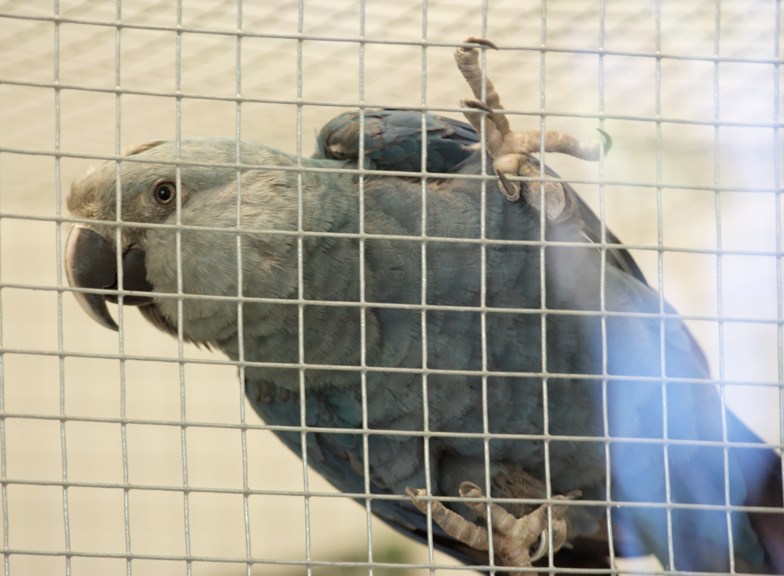 Spix's MacawCyanopsitta spixii
Compare
Questions and answers
What is the scientific name of the Red-billed Parrot?
The scientific name of the Red-billed Parrot is Pionus sordidus. Written with its author, the full name is Pionus sordidus (Linnaeus, 1758).
Which family does the Red-billed Parrot belong to?
Pionus sordidus belongs to the family Psittacidae, in the order Psittaciformes and the class Aves.
Where is the Red-billed Parrot found?
Checklists and occurrence records place Pionus sordidus in 5 countries: Ecuador, Colombia, Venezuela, Peru and Bolivia.
What is the conservation status of the Red-billed Parrot?
The IUCN Red List category recorded for Pionus sordidus is Least Concern (LC).
How big do Pionus parrots get?
The Red-billed Parrot measures 27–29 cm in length and weighs approximately 272 g.[11][12]
What is the diet of parrots?
The documented diet of the Red-billed Parrot includes fruits and blossoms.[18]
Sources
Passages the profile rests on
- The species has a red bill in all six recognized subspecies. Source passage: “All of the subspecies have the eponymous red bill.” — English Wikipedia
- Adults of the nominate subspecies have a dull green head with dull blue feather edges. Source passage: “Adults of the nominate subspecies P. s. sordidus have a dull green head whose feathers have dull blue edges;” — English Wikipedia
- The nominate subspecies has olive-green back, wings, and inner tail feathers, with blue outer tail feathers. Source passage: “Their back, wings, and inner tail feathers are olive green; their outer tail feathers are blue.” — English Wikipedia
- The nominate subspecies has bare grayish skin surrounding its eye. Source passage: “their eye is surrounded by bare grayish skin.” — English Wikipedia
- Six subspecies of the red-billed parrot are listed. Source passage: “The red-billed parrot has these six subspecies:” — English Wikipedia
- The subspecies P. s. antelius is paler than the nominate subspecies and has little blue coloration on its breast. Source passage: “Subspecies P. s. antelius is paler than the nominate and has very little blue on the breast.” — English Wikipedia
- The subspecies P. s. saturatus is darker than the nominate subspecies. Source passage: “P. s. saturatus is darker than the nominate” — English Wikipedia
- The subspecies P. s. ponsi is darker than P. s. saturatus. Source passage: “P. s. ponsi is darker than saturatus.” — English Wikipedia
- The subspecies P. s. corallinus is larger and greener than the nominate subspecies and has gray and blue tinges on its mantle and back. Source passage: “Subspecies P. s. corallinus is larger and greener than the nominate, and its mantle and back have gray and blue tinges.” — English Wikipedia
- The subspecies P. s. mindoensis resembles P. s. corallinus but is somewhat yellower. Source passage: “P. s. mindoensis is similar to corallinus but somewhat yellower.” — English Wikipedia
- The species measures 27–29 cm in length. Source passage: “The red-billed parrot is 27 to 29 cm (11 to 11 in) long” — English Wikipedia
- The species weighs approximately 272 g. Source passage: “weighs about 272 g (9.6 oz).” — English Wikipedia
- The species inhabits the interiors, clearings, and edges of humid to wet lowland and submontane evergreen and semi-deciduous forests. Source passage: “The red-billed parrot inhabits a variety of wooded landscapes including the interior, clearings, and edges of humid to wet lowland and submontane evergreen and semi-deciduous forests;” — English Wikipedia
- The species also occupies cloud forests, secondary forests, gallery forests, and coffee plantations. Source passage: “cloud-, secondary, and gallery forests; and coffee plantations.” — English Wikipedia
- The species is primarily found at elevations between 500 and 1,500 m. Source passage: “It is mostly found between 500 and 1,500 m (1,600 and 4,900 ft)” — English Wikipedia
- The species' recorded elevational range extends from 100 to 2,400 m. Source passage: “but ranges as low as 100 m (300 ft) and as high as 2,400 m (7,900 ft).” — English Wikipedia
- The species is described as a medium-sized parrot of mid-elevation cloud forest. Source passage: “Medium-sized parrot of mid-elevation cloud forest.” — ebird.org
- The species' documented diet includes fruits and blossoms. Source passage: “though the latter is known to include fruits and blossoms.” — English Wikipedia
- The species makes some local seasonal movements in northern Venezuela. Source passage: “The red-billed parrot makes some local seasonal movements in northern Venezuela” — English Wikipedia
- The species' movements outside northern Venezuela are not known. Source passage: “but its movements, if any, in the rest of its range are not known.” — English Wikipedia
- Flight calls differ among the species' subspecies. Source passage: “The red-billed parrot's flight calls appear to be different among the subspecies.” — English Wikipedia
- P. s. sordidus and P. s. antelius produce a strident flight call described as kee-yak. Source passage: “P. s. sordidus and P. s. antelius make "a strident "kee!-yak" ".” — English Wikipedia
- P. s. corallinus and P. s. mindoensis produce an upslurred crree call and a mellower crrah call. Source passage: “P. s. corallinus and P. s. mindoensis make "an upslurred "crree!" and a more mellow "crrah" ".” — English Wikipedia
- The breeding season in Colombia extends from February through April. Source passage: “It spans February to April in Colombia” — English Wikipedia
- The breeding season in Ecuador extends from January through May. Source passage: “and January to May in Ecuador;” — English Wikipedia
- April is included in the breeding season in Venezuela. Source passage: “in Venezuela it includes April” — English Wikipedia
- October is included in the breeding season in Bolivia. Source passage: “and in Bolivia includes October.” — English Wikipedia
- The species nests in holes in trees. Source passage: “It nests in holes in trees.” — English Wikipedia
- The usual clutch size appears to be three eggs. Source passage: “The clutch size appears to usually be three eggs.” — English Wikipedia
- The incubation period is approximately 27 days. Source passage: “The incubation period is about 27 days” — English Wikipedia
- Young birds fledge approximately 12 weeks after hatching. Source passage: “fledging occurs about 12 weeks after hatch.” — English Wikipedia
- The species is classified as Least Concern by the IUCN. Source passage: “The IUCN has assessed the red-billed parrot as being of Least Concern.” — English Wikipedia
- The species has a very large geographic range, but its population size is unknown. Source passage: “It has a very large range but its population size is not known” — English Wikipedia
- The species' population is believed to be decreasing. Source passage: “and is believed to be decreasing.” — English Wikipedia
- No immediate threats to the species have been identified. Source passage: “No immediate threats have been identified.” — English Wikipedia
- The species is considered fairly common across most of its range. Source passage: “It is considered fairly common in most of its range.” — English Wikipedia
- The species persists in moderately disturbed habitats. Source passage: “however, the species persists in moderately disturbed habitat.” — English Wikipedia
- Deforestation has caused local population declines in Colombia and Venezuela. Source passage: “Deforestation in Colombia and Venezuela has caused local declines.” — English Wikipedia
- The red-billed parrot and the scaly-headed parrot are sister species. Source passage: “The red-billed parrot and the scaly-headed parrot (P. maximiliani) are sister species.” — English Wikipedia
Data
- Catalogue of Life, 2026-10-16 XR cc by
- Global Biodiversity Information Facility CC BY 4.0
- Wikidata CC0
- GeoNames CC BY 4.0
- Wikimedia Commons per image; credit shown with each image
- Within the Catalogue of Life, this name comes from The Integrated Taxonomic Information System cc0
References
- Gill, Frank, & and Minturn Wright. (2006). Birds of the World: Recommended English Names.
- Dickinson, E. C., and L. Christidis, eds. (2014). The Howard and Moore Complete Checklist of the Birds of the World, 4th Edition, Vol. 2 Passerines.
This species in other databases
Page built on 29 November 2026. See how the catalog is made and all sources and licences.
Cite this page
ScientificNames.org. (2026). Pionus sordidus (Red-billed Parrot). Retrieved November 29, 2026, from https://scientificnames.org/species/pionus-sordidus
“Pionus sordidus (Red-billed Parrot).” ScientificNames.org, 2026, scientificnames.org/species/pionus-sordidus. Accessed 29 Nov. 2026.
ScientificNames.org. “Pionus sordidus (Red-billed Parrot).” Accessed November 29, 2026. https://scientificnames.org/species/pionus-sordidus.
@misc{scientificnames_pionus_sordidus_red_billed_parrot,
  author = {{ScientificNames.org}},
  title = {Pionus sordidus (Red-billed Parrot)},
  year = {2026},
  url = {https://scientificnames.org/species/pionus-sordidus},
  note = {Accessed 2026-11-29}
}