Species · Flowering plants
Black Pepper Piper nigrum
The scientific name of the Black Pepper is Piper nigrum. It is a species of flowering plant in the family Piperaceae (peppers), order Piperales.
- Scientific name
- Piper nigrum L.
- Common name
- Black Pepper
- Genus
- Piper
- Family
- Piperaceae (Peppers)
- Order
- Piperales
- Class
- Magnoliopsida
- Recorded in
- 61 countries
- Name status
- accepted in the Catalogue of Life
Overview
The species is indigenous to tropical evergreen forests along India's Malabar Coast and grows wild in India's Western Ghats.
Written 24 November 2026 from the sources listed below. Each statement was checked against the passage it cites; statements that could not be supported were removed.
Appearance
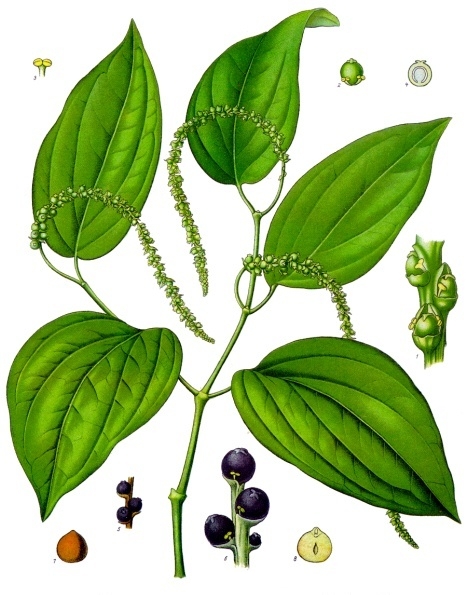
Black pepper is a perennial woody climbing vine. Its leaves are arranged alternately and have entire margins, and its small flowers grow along pendulous spikes.[1][2][3]
The plant produces dark red fruits when fully mature. Each fruit contains a single seed enclosed within a stone.[4][5]
The climbing vine can reach approximately 4 metres in height. Its leaves measure 5–10 cm in length and 3–6 cm in width, while mature fruits measure approximately 5 mm in diameter.[6][7][8]
Flower spikes initially measure 4–8 cm in length and may extend to 7–15 cm as the fruits mature. Each spike bears approximately 50 blossoms, and a single stem can bear approximately 20–30 fruiting spikes.[9][10][11]
Habitat
Black pepper is indigenous to tropical evergreen forests along India's Malabar Coast and grows wild in India's Western Ghats.[12][13]
The plant grows in moist, well-drained soil rich in organic matter that is neither excessively dry nor prone to flooding. It grows well in partial shade and regions with long rainy seasons and relatively high temperatures.[14][15]
The vines grow best at elevations below approximately 900 metres.[16]
Behaviour
Black pepper climbs supporting trees, poles, or trellises. The plant can climb to approximately 33 feet using its aerial roots.[17][18]
The vine readily develops roots where its trailing stems touch the ground.[19]
Reproduction and life cycle
Black pepper is propagated using stem cuttings approximately 40–50 cm long. The plants generally begin bearing fruit in their fourth or fifth year.[20][21]
The flowers develop into drupes containing a single seed.[22]
Uses
The dried fruits of Black pepper are widely used as a spice and food seasoning. Black, white, and green peppercorns from this species are used to flavour food.[23][24]
Black pepper is produced by boiling and drying harvested unripe fruits before grinding them. White pepper is produced by removing the dark outer wall of the peppercorn before grinding.[25][26]
The fruits have historically been used as traditional medicine. They have also been used as food flavouring and folk medicine since antiquity.[27][28]
The pungency of black pepper is primarily attributable to the chemical compound piperine. Black pepper contains approximately 4.6–9.7% piperine by mass.[29][30]
Black pepper accounted for approximately 20% of global spice trade. Global black peppercorn production reached 855,105 tonnes in 2023.[31][32]
Similar species
Piper caninum is identified as one of the Asian species most closely related to Black pepper.[33]
Classification of the Black Pepper
| Kingdom | Plantae |
|---|---|
| Subkingdom | Pteridobiotina |
| Phylum | Tracheophyta |
| Class | Magnoliopsida |
| Order | Piperales |
| Family | Piperaceae (Peppers) |
| Subfamily | Piperoideae |
| Genus | Piper (Pepper) |
| Species | Piper nigrum L. |
Where the Black Pepper is found
Checklists and occurrence records place Piper nigrum in 61 countries across Africa, Asia, North America, Oceania and South America. GBIF holds 2,345 georeferenced records of it.
Countries
- Afghanistan 21
- Bangladesh 3
- Belize
- Benin 33
- Bolivia 3
- Brazil 246
- Cambodia 18
- Cameroon 24
- China 70
- Colombia 13
- Comoros 4
- Cook Islands 5
- Costa Rica 48
- Democratic Republic of the Congo 21
- Dominica 6
- Dominican Republic 3
- Ecuador 7
- Ethiopia 5
- Fiji 2
- French Guiana 28
- French Polynesia 13
- Guadeloupe 11
- Guam
- Guinea 3
- Honduras 3
- India 657
- Indonesia 117
- Jamaica 6
- Japan 3
- Laos 3
- Madagascar 15
- Malawi 3
- Malaysia 84
- Maldives
- Martinique 16
- Mauritius 6
- Mayotte 9
- Mexico 17
- Micronesia 9
- Myanmar 6
- New Caledonia 4
- Nigeria 7
- Palau 4
- Papua New Guinea 7
- Philippines 116
- Puerto Rico 10
- Reunion 93
- Saint Vincent and the Grenadines 4
- Sao Tome and Principe 16
- Seychelles 23
- Singapore 14
- Sri Lanka 235
- Taiwan 10
- Tanzania 28
- Thailand 51
- Trinidad and Tobago 6
- United States 57
- Vanuatu 2
- Venezuela 3
- Vietnam 109
- Wallis and Futuna 5
Regions and cities with the most records
- Tamil Nadu, India 206
- Valparai, India 186
- Kerala, India 124
- Karnataka, India 56
- Nedumangād, India 39
- Pallichal, India 38
- Thiruvananthapuram, India 38
- Vattiyūrkāvu, India 38
- Neyyāttinkara, India 37
- Bunawan, Philippines 34
- Le Tampon, Reunion 23
- Saint-Louis, Reunion 20
- São Paulo, Brazil 20
- Saint-Denis, Reunion 19
- Saint-Pierre, Reunion 19
- Heredia Province, Costa Rica 17
- Kandy, Sri Lanka 17
- Maharashtra, India 17
- Campinas, Brazil 16
- Hortolândia, Brazil 16
- Paulínia, Brazil 16
- Valinhos, Brazil 16
- Yunnan, China 16
- Amazonas, Brazil 15
- Bahia, Brazil 14
- Pará, Brazil 14
- Plateau, Benin 14
- Saint-André, Reunion 14
- Vinhedo, Brazil 14
- Bayugan, Philippines 13
- Cayenne, French Guiana 13
- Hainan, China 13
- Gò Vấp, Vietnam 12
- Ho Chi Minh City, Vietnam 12
- Quận Ba, Vietnam 12
- Quận Bốn, Vietnam 12
4 more countries have a few records outside this range
These countries hold a few records of Piper nigrum but lie outside the range the checklists give for it. Such records are often zoo or garden specimens, museum material or vagrants, so the species is not counted as occurring there.
Range as the checklists state it
Guinea [c]; Benin [c]; Cameroon [c]; São Tomé [c]; Mauritius [c]; La Réunion [c]; Seychelles [c]; China [c] (Fujian [c], Guangdong [c], Guangxi [c], Yunnan [c]); Taiwan [c]; India (Arunachal Pradesh, Assam, Karnataka, Kerala, Maharashtra, Tamil Nadu, West Bengal); Lakshadweep Isl. [Laccadives] [c]; Maldives [c]; Sri Lanka [c]; Bangladesh [c]; Andaman Isl. [c]; Nicobar Isl. [c]; Myanmar [c]; Thailand [c]; Laos [c]; Cambodia [c]; Vietnam [c]; peninsular Malaysia [c]; Philippines [c]; Jawa [c]; Lesser Sunda Isl. [c]; Vanuatu [c]; Fiji [c]; Cook Isl. [c] (Rarotonga [c], Mangaia [c], Aitutaki [c], Mitiaro [c]); Society Isl. [c] (Tahiti [c], Raiatea [c]); Palau [c] (Babeldaob [c], Koror [c]); Guam [c]; Fed. States of Micronesia [c] (Pohnpei [c]); Mexico [c]; Belize [c]; Honduras [c]; Costa Rica [c]; Jamaica [c]; Guadeloupe [c]; Dominica [c]; Martinique [c]; St. Vincent [c]; Trinidad & Tobago [c]; Colombia [c]; Venezuela [c]; Brazil [c]
A number beside a place is its count of GBIF occurrence records. A place without a number comes from a checklist alone. Records show where a species has been observed or collected, which can include escapes and vagrants.
Common names
English
- Black Pepper
- Pepper
- White Pepper
Names in 9 other languages
- Chinese
- hu jiao, 白胡椒, 胡椒, 胡椒(黑胡椒)
- French
- poivre, poivre blanc, poivre noir
- German
- Pfeffer
- Italian
- pepe
- Japanese
- koshō
- Portuguese
- pimenta, pimenta-da-Índia, pimenta-do-reino
- Slovenian
- črni poper
- Spanish
- pimienta
- Swedish
- peppar
Synonyms
20 other scientific names have been used for this species and are now treated as synonyms of Piper nigrum.
- Muldera multinervis Miq.
- Muldera wightiana Miq.
- Piper colonum C.Presl
- Piper denudatum Opiz
- Piper glabrispica C.DC.
- Piper glyphicum Hoffmanns. ex Kunth
- Piper laxum Vahl
- Piper malabarense C.DC.
- Piper nigricans Willd. ex Link
- Piper nigrum var. hirtellosum Asokan Nair & Ravindran
- Piper nigrum var. mysorensis C.DC.
- Piper nigrum var. trioicum (Roxb.) C.DC.
- Piper rotundum Noronha
- Piper sivarajanii Karthik. & V.S.Kumar
- Piper trioicum Roxb.
- Piper velayudhanii E.S.S.Kumar & S.P.Mathew
- Rhyncholepis haeankeana Miq.
- Piper aromaticum Lam. ambiguous synonym
- Piper baccatum C.DC. ambiguous synonym
- Piper pseudonigrum Velay. & Amalraj ambiguous synonym
Related species
-
 BetelPiper betle
-
 Long PepperPiper longum
-
 CubebPiper cubeba
-
 Root Beer PlantPiper auritum
- Piper sarmentosum
-
Cabai JawaPiper retrofractum
-
 Bamboo PiperPiper aduncum
-
 PepperPiper guineense
Compare
Questions and answers
What is the scientific name of the Black Pepper?
The scientific name of the Black Pepper is Piper nigrum. Written with its author, the full name is Piper nigrum L..
Which family does the Black Pepper belong to?
Piper nigrum belongs to the family Piperaceae, in the order Piperales and the class Magnoliopsida.
Where is the Black Pepper found?
Checklists and occurrence records place Piper nigrum in 61 countries, including India, Brazil, Sri Lanka, Indonesia, Philippines and Vietnam.
What other names does the Black Pepper have?
Piper nigrum is also known in English as Pepper and White Pepper.
What is the Latin name for black pepper?
The Latin name is Piper nigrum L.[1]
What is the botanical name and family of pepper?
The botanical name is Piper nigrum L., and its family is Piperaceae.[1]
Where does Piper nigrum grow?
It is indigenous to tropical evergreen forests along India's Malabar Coast and grows wild in India's Western Ghats. It grows in moist, well-drained soil rich in organic matter, partial shade, and regions with long rainy seasons and relatively high temperatures.[12][13][14][15]
Can you eat Piper nigrum?
Yes. Its dried fruits are widely used as a spice and food seasoning, and its black, white, and green peppercorns are used to flavour food.[23][24]
What does black pepper look like in nature?
Black pepper is a perennial woody climbing vine with alternately arranged leaves and small flowers along pendulous spikes. Its mature fruits are dark red, and each contains a single seed enclosed within a stone.[1][4][5][2][3]
Is Piper nigrum the same as black pepper?
Yes. Piper nigrum L. is the species name of Black pepper.[1]
Sources
Passages the profile rests on
- Piper nigrum is a perennial woody climbing vine. Source passage: “The pepper plant is a perennial woody vine” — English Wikipedia
- The leaves are arranged alternately and have entire margins. Source passage: “The leaves are alternate, entire” — English Wikipedia
- The plant produces small flowers arranged along pendulous spikes. Source passage: “The flowers are small, produced on pendulous spikes” — English Wikipedia
- The plant produces dark red fruits when fully mature. Source passage: “The fruit is a drupe (stonefruit) which is about 5 mm (1⁄4 in) in diameter (fresh and fully mature), dark red” — English Wikipedia
- Each fruit contains a single seed enclosed within a stone. Source passage: “contains a stone which encloses a single pepper seed.” — English Wikipedia
- The climbing vine can reach approximately 4 metres in height. Source passage: “The pepper plant is a perennial woody vine growing up to 4 m (13 ft) in height” — English Wikipedia
- The leaves measure 5–10 cm in length and 3–6 cm in width. Source passage: “5 to 10 cm (2 to 4 in) long and 3 to 6 cm (1 to 2+1⁄2 in) across.” — English Wikipedia
- The mature fruit measures approximately 5 mm in diameter. Source passage: “about 5 mm (1⁄4 in) in diameter” — English Wikipedia
- The flower spikes initially measure 4–8 cm in length and may extend to 7–15 cm as the fruits mature. Source passage: “spikes 4 to 8 cm (1+1⁄2 to 3 in) long at the leaf nodes, the spikes lengthening up to 7 to 15 cm” — English Wikipedia
- A single stem can bear approximately 20–30 fruiting spikes. Source passage: “A single stem bears 20 to 30 fruiting spikes.” — English Wikipedia
- Each flower spike bears approximately 50 blossoms. Source passage: “with around 50 blossoms on each spike” — greenhouse.biology.indiana.edu
- The species is indigenous to tropical evergreen forests along India's Malabar Coast. Source passage: “Black pepper is indigenous to the tropical evergreen forests of the Malabar Coast in southwestern India” — English Wikipedia
- The species grows wild in India's Western Ghats. Source passage: “Wild pepper grows in the Western Ghats region of India.” — English Wikipedia
- The plant grows in moist, well-drained soil rich in organic matter that is neither excessively dry nor prone to flooding. Source passage: “Pepper grows in soil that is neither too dry nor susceptible to flooding, moist, well-drained, and rich in organic matter.” — English Wikipedia
- The plant grows well in partial shade and regions with long rainy seasons and relatively high temperatures. Source passage: “Piper nigrum requires partial shade and does well in locations with a long rainy season and fairly high temperatures.” — greenhouse.biology.indiana.edu
- The vines grow best at elevations below approximately 900 metres. Source passage: “The vines grow best under 900 m (3,000 ft) above sea level.” — English Wikipedia
- The plant can climb to approximately 33 feet using its aerial roots. Source passage: “Its aerial roots allow this woody vine to climb to a height of 33 feet.” — greenhouse.biology.indiana.edu
- The plant climbs supporting trees, poles, or trellises. Source passage: “growing up to 4 m (13 ft) in height on supporting trees, poles, or trellises.” — English Wikipedia
- The vine readily develops roots where its trailing stems touch the ground. Source passage: “It is a spreading vine, rooting readily where trailing stems touch the ground.” — English Wikipedia
- The plant is propagated using stem cuttings approximately 40–50 cm long. Source passage: “The plants are propagated by cuttings about 40 to 50 cm (16 to 20 in) long” — English Wikipedia
- The plants generally begin bearing fruit in their fourth or fifth year. Source passage: “The plants bear fruit from the fourth or fifth year” — English Wikipedia
- The flowers develop into drupes containing a single seed. Source passage: “producing drupes (simple fleshy fruit that usually contains a single seed)” — greenhouse.biology.indiana.edu
- The dried fruits of the species are widely used as a spice and food seasoning. Source passage: “cultivated for its fruit (the peppercorn), which is usually dried and used as a spice and seasoning.” — English Wikipedia
- Black, white, and green peppercorns from this species are used to flavour food. Source passage: “Black, white and green peppercorns all come from Piper nigrum and are popularly used as a hot and pungent spice for flavouring food.” — powo.science.kew.org
- Black pepper is produced by boiling and drying harvested unripe fruits before grinding them. Source passage: “The whole peppercorns are boiled in water and dried before being ground into black pepper.” — greenhouse.biology.indiana.edu
- White pepper is produced by removing the dark outer wall of the peppercorn before grinding. Source passage: “The dark outer wall (pericarp) of the peppercorn is removed before grinding to produce less pungent white pepper.” — greenhouse.biology.indiana.edu
- The fruits have historically been used as traditional medicine. Source passage: “Ground, dried, and cooked peppercorns have been used since antiquity, both for flavour and as a traditional medicine.” — English Wikipedia
- The fruits have been used as food flavouring and folk medicine since antiquity. Source passage: “fruit—called peppercorns—has been used since antiquity as a food flavoring and as a folk medicine.” — greenhouse.biology.indiana.edu
- The pungency of black pepper is primarily attributable to the chemical compound piperine. Source passage: “Its spiciness is due to the chemical compound piperine” — English Wikipedia
- Black pepper contains approximately 4.6–9.7% piperine by mass. Source passage: “Black pepper contains between 4.6 and 9.7% piperine by mass” — English Wikipedia
- Black pepper accounted for approximately 20% of global spice trade. Source passage: “Today, pepper accounts for one-fifth of the world's spice trade.” — English Wikipedia
- Global black peppercorn production reached 855,105 tonnes in 2023. Source passage: “In 2023, world production of black peppercorns was 855,105 tonnes” — English Wikipedia
- Piper caninum is identified as one of the Asian species most closely related to black pepper. Source passage: “Within the genus Piper, black pepper is most closely related to other Asian species such as P. caninum.” — English Wikipedia
Data
- Catalogue of Life, 2026-10-16 XR cc by
- Global Biodiversity Information Facility CC BY 4.0
- Wikidata CC0
- GeoNames CC BY 4.0
- Wikimedia Commons per image; credit shown with each image
- Within the Catalogue of Life, this name comes from Synonymic Checklists of the Vascular Plants of the World cc by
References
- L. (1753). Sp. Pl. [Linnaeus] 1: 28 (1753). where the name was published
This species in other databases
Page built on 24 November 2026. See how the catalog is made and all sources and licences.
Cite this page
ScientificNames.org. (2026). Piper nigrum (Black Pepper). Retrieved November 24, 2026, from https://scientificnames.org/species/piper-nigrum
“Piper nigrum (Black Pepper).” ScientificNames.org, 2026, scientificnames.org/species/piper-nigrum. Accessed 24 Nov. 2026.
ScientificNames.org. “Piper nigrum (Black Pepper).” Accessed November 24, 2026. https://scientificnames.org/species/piper-nigrum.
@misc{scientificnames_piper_nigrum_black_pepper,
  author = {{ScientificNames.org}},
  title = {Piper nigrum (Black Pepper)},
  year = {2026},
  url = {https://scientificnames.org/species/piper-nigrum},
  note = {Accessed 2026-11-24}
}