Species · Flowering plants
Sickleleaf Silk-grass Pityopsis falcata
The scientific name of the Sickleleaf Silk-grass is Pityopsis falcata. It is a species of flowering plant in the family Asteraceae (composite), order Asterales.
- Scientific name
- Pityopsis falcata (Pursh) Nutt.
- Common name
- Sickleleaf Silk-grass
- Genus
- Pityopsis
- Family
- Asteraceae (Composite)
- Order
- Asterales
- Class
- Magnoliopsida
- Recorded in
- 1 country
- Name status
- accepted in the Catalogue of Life

Overview
Sickleleaf Silk-grass is an herbaceous perennial plant. It grows in open coastal areas on sandy glacial till, within a native range extending from Cape Cod to the New Jersey Pine Barrens. It is the northernmost species in its genus.
Written 27 November 2026 from the sources listed below. Each statement was checked against the passage it cites; statements that could not be supported were removed.
Appearance
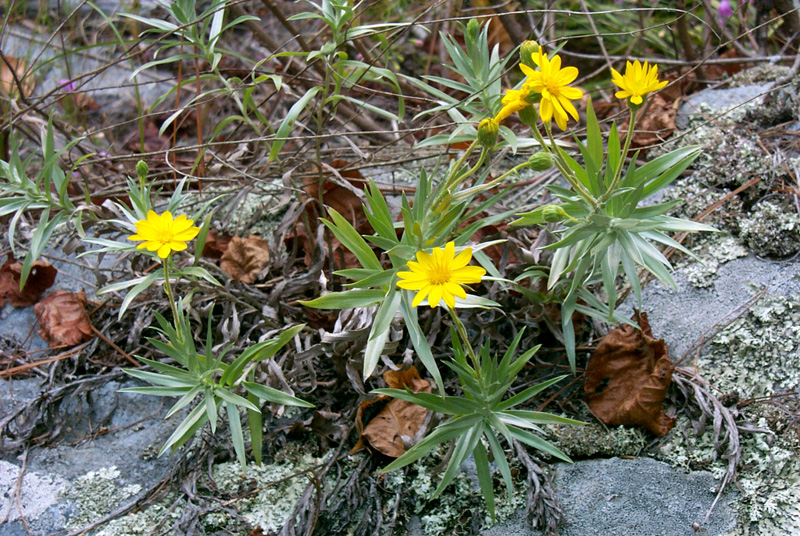
The plant grows in dense clumps formed by fibrous roots and rhizomes. Its erect stems may be branched and occasionally reddish-brown, with longitudinal striations and long silky hairs.[1][2]
The basal leaves are shorter than the stem leaves and usually wither before flowering. The sessile stem leaves are hairy, sickle-shaped, and often folded along the midvein.[3][4]
Its flowerheads are arranged in corymbiform clusters and have bell-shaped involucres measuring 5–8 mm. Each flowerhead contains 9–15 yellow ray florets and 30–60 disc florets.[5][6][7][8]
The plant reaches 10–40 cm in height. Its flower stalks measure 1–4 cm in length, and a plant usually bears 4–10 flowerheads, although it may bear as many as 25.[9][10][11]
Habitat
The species grows in open coastal areas on sandy glacial till. This sandy glacial till habitat was deposited along the front of the Wisconsin Glaciation.[12][13]
Behaviour
The species flowers throughout summer and fall. Its fruits are dispersed by wind.[14][15]
Reproduction and life cycle
The plant produces fusiform cypselae as fruits. Its fruits measure 3–4 mm in length and have pappi measuring 4–6 mm.[16][17][18]
The fruit pappi facilitate wind dispersal. Schinia tuberculum is a major pollinator in locations where both species occur.[19][20]
Similar species
Pityopsis ruthii is considered the closest relative of Pityopsis falcata.[21]
Conservation
The species is classified as critically imperiled in Connecticut (S1) and imperiled in Rhode Island (S2). It is classified as vulnerable in New Jersey and New York (S3), and vulnerable to apparently secure in Massachusetts (S3S4).[22][23][24][25]
Potential threats include coastal development, increased recreational pressure, sea-level rise, coastal erosion, and invasive species. Their impacts may be negligible because of the species' high local abundance and apparent tolerance of moderate disturbance.[26][27]
The species has been observed colonizing cleared habitats near roads and utility corridors. It is recorded as confirmed in the Brookhaven National Laboratory plant inventory.[28][29]
Classification of the Sickleleaf Silk-grass
| Kingdom | Plantae |
|---|---|
| Subkingdom | Pteridobiotina |
| Phylum | Tracheophyta |
| Class | Magnoliopsida |
| Order | Asterales |
| Family | Asteraceae (Composite) |
| Subfamily | Asteroideae |
| Tribe | Astereae |
| Subtribe | Chrysopsidinae |
| Genus | Pityopsis (Grass-leaved Golden-aster) |
| Species | Pityopsis falcata (Pursh) Nutt. |
Where the Sickleleaf Silk-grass is found
Checklists and occurrence records place Pityopsis falcata in 1 country across North America. GBIF holds 2,433 georeferenced records of it.
Countries
Regions and cities with the most records
- Massachusetts, United States 1,124
- New York, United States 354
- Holbrook, United States 173
- Medford, United States 169
- Yarmouth, United States 168
- Farmingville, United States 167
- Ronkonkoma, United States 166
- Coram, United States 165
- Holtsville, United States 161
- Lake Ronkonkoma, United States 160
- Centereach, United States 158
- Selden, United States 154
- East Patchogue, United States 151
- Smithtown, United States 151
- Hauppauge, United States 150
- New Jersey, United States 148
- Central Islip, United States 144
- Kings Park, United States 141
- East Setauket, United States 139
- Setauket-East Setauket, United States 139
- Barnstable, United States 138
- Commack, United States 132
- Sayville, United States 130
- Brentwood, United States 123
- Shirley, United States 108
- Mastic, United States 70
- Lakewood, United States 60
- Brick, United States 53
- Toms River, United States 50
- Rhode Island, United States 48
- Islip, United States 46
- Warwick, United States 46
- Duxbury, United States 45
- Cranston, United States 44
- West Warwick, United States 42
- Middleborough, United States 39
Range as the checklists state it
USA (Connecticut, Florida, Massachusetts, New Jersey, New York, Rhode Island)
A number beside a place is its count of GBIF occurrence records. A place without a number comes from a checklist alone. Records show where a species has been observed or collected, which can include escapes and vagrants.
Common names
English
- Sickleleaf Silk-grass
- New England Golden-aster
- Sickle-leaf Golden-aster
- Sickle-leaved Golden-aster
- Sickle-leaved Silkgrass
- Sickleleaf Silkgrass
Names in 1 other language
- French
- pityopsis falciforme
Synonyms
5 other scientific names have been used for this species and are now treated as synonyms of Pityopsis falcata.
- Chrysopsis falcata (Pursh) Elliott
- Diplogon falcatum (Pursh) Kuntze
- Heterotheca falcata (Pursh) V.L.Harms
- Inula falcata Pursh
- Inula mariana var. falcata (Pursh) Nutt.
Related species
-
 Narrowleaf SilkgrassPityopsis graminifolia
-
 Ruth's GoldenasterPityopsis ruthii
-
 Pineland SilkgrassPityopsis aspera
- Grassleaf GoldasterPityopsis oligantha
- Sandhill Golden AsterPityopsis pinifolia
- Zigzag SilkgrassPityopsis flexuosa
- Tracy's SilkgrassPityopsis tracyi
- Broad-leaved GoldenasterPityopsis latifolia
Compare
Questions and answers
What is the scientific name of the Sickleleaf Silk-grass?
The scientific name of the Sickleleaf Silk-grass is Pityopsis falcata. Written with its author, the full name is Pityopsis falcata (Pursh) Nutt..
Which family does the Sickleleaf Silk-grass belong to?
Pityopsis falcata belongs to the family Asteraceae, in the order Asterales and the class Magnoliopsida.
Where is the Sickleleaf Silk-grass found?
Checklists and occurrence records place Pityopsis falcata in 1 country: United States.
What other names does the Sickleleaf Silk-grass have?
Pityopsis falcata is also known in English as New England Golden-aster, Sickle-leaf Golden-aster, Sickle-leaved Golden-aster, Sickle-leaved Silkgrass and Sickleleaf Silkgrass.
Sources
Passages the profile rests on
- The plant grows in dense clumps formed by fibrous roots and rhizomes. Source passage: “It is characteristically caespitose, arising from a dense mass of fibrous roots and rhizomes.” — English Wikipedia
- Its erect stems may be branched and occasionally reddish-brown, with longitudinal striations and long silky hairs. Source passage: “The erect stems are sometimes branched, occasionally reddish-brown in color, striated, and covered in long silky hairs.” — English Wikipedia
- The basal leaves are shorter than the stem leaves and usually wither before flowering. Source passage: “The basal leaves usually wither by the time the plant flowers, and are shorter than the cauline leaves.” — English Wikipedia
- Its sessile stem leaves are hairy, sickle-shaped, and often folded along the midvein. Source passage: “The sessile cauline leaves are covered in trichomes, falcate in shape (giving the species its epithet falcata), and often folded along the midvein.” — English Wikipedia
- Its flowerheads are arranged in corymbiform clusters. Source passage: “The flowerheads, usually 4-10 but upwards up 25 per plant, are arranged in corymbiform arrays.” — English Wikipedia
- The flowerheads have bell-shaped involucres measuring 5–8 mm. Source passage: “The involucres are bell-shaped, 5-8 mm.” — English Wikipedia
- Each flowerhead contains 9–15 yellow ray florets. Source passage: “There are 9-15 yellow ray florets and 30-60 disc florets.” — English Wikipedia
- Each flowerhead contains 30–60 disc florets. Source passage: “There are 9-15 yellow ray florets and 30-60 disc florets.” — English Wikipedia
- The plant reaches 10–40 cm in height. Source passage: “P. falcata is an herbaceous perennial that reaches 10-40 cm in height.” — English Wikipedia
- Its flower stalks measure 1–4 cm in length. Source passage: “The peduncles are 1-4 cm long, have sparse bracts, and are covered in fine white woolly hair.” — English Wikipedia
- A plant usually bears 4–10 flowerheads, although it may bear as many as 25. Source passage: “The flowerheads, usually 4-10 but upwards up 25 per plant, are arranged in corymbiform arrays.” — English Wikipedia
- The species grows in open coastal areas on sandy glacial till. Source passage: “It is often locally abundant, growing in open areas on sandy glacial till” — English Wikipedia
- Its sandy glacial till habitat was deposited along the front of the Wisconsin Glaciation. Source passage: “on sandy glacial till that was deposited along the front of the Wisconsin Glaciation.” — English Wikipedia
- The species flowers throughout summer and fall. Source passage: “P. falcata blooms throughout the summer and fall.” — English Wikipedia
- Its fruits are dispersed by wind. Source passage: “They are wind-dispersed, with pappi 4-6 mm long.” — English Wikipedia
- Its fruits measure 3–4 mm in length. Source passage: “The fruits are fusiform cypselae, 3-4 mm in length.” — English Wikipedia
- Its fruit pappi measure 4–6 mm in length. Source passage: “They are wind-dispersed, with pappi 4-6 mm long.” — English Wikipedia
- The plant produces fusiform cypselae as fruits. Source passage: “The fruits are fusiform cypselae, 3-4 mm in length.” — English Wikipedia
- Its fruits have pappi that facilitate wind dispersal. Source passage: “They are wind-dispersed, with pappi 4-6 mm long.” — English Wikipedia
- Schinia tuberculum is a major pollinator of the species in locations where both occur. Source passage: “Where they co-occur, Schinia tuberculum, the golden aster flower moth, is a major pollinator of P. falcata.” — English Wikipedia
- Pityopsis ruthii is considered the closest relative of Pityopsis falcata. Source passage: “The most recent phylogenetic analyses indicate that it is most closely related to P. ruthii, with the two being considered sister species.” — English Wikipedia
- Pityopsis falcata is classified as critically imperiled in Connecticut (S1). Source passage: “P. falcata is listed as critically imperiled (S1) in Connecticut” — English Wikipedia
- Pityopsis falcata is classified as imperiled in Rhode Island (S2). Source passage: “imperiled (S2) in Rhode Island” — English Wikipedia
- Pityopsis falcata is classified as vulnerable in New Jersey and New York (S3). Source passage: “vulnerable (S3) in New Jersey and New York” — English Wikipedia
- Pityopsis falcata is classified as vulnerable to apparently secure in Massachusetts (S3S4). Source passage: “vulnerable to apparently secure (S3S4) in Massachusetts.” — English Wikipedia
- Potential threats to the species include coastal development, increased recreational pressure, sea-level rise, coastal erosion, and invasive species. Source passage: “P. falcata is potentially threatened by development, increased pressure from human recreation, sea level rise, coastal erosion, and invasive species.” — English Wikipedia
- The potential impacts of these threats may be negligible because of the species' high local abundance and apparent tolerance of moderate disturbance. Source passage: “the species' high local abundance and apparent tolerance of moderate disturbance.” — English Wikipedia
- The species has been observed colonizing cleared habitats near roads and utility corridors. Source passage: “having been observed colonizing cleared habitats near roads and utility corridors.” — English Wikipedia
- The species is recorded as confirmed in the Brookhaven National Laboratory plant inventory. Source passage: “Sickleleaf silk-grass, Pityopsis falcata, R, Confirmed.” — bnl.gov
Data
- Catalogue of Life, 2026-10-16 XR cc by
- Global Biodiversity Information Facility CC BY 4.0
- Wikidata CC0
- GeoNames CC BY 4.0
- Wikimedia Commons per image; credit shown with each image
- Within the Catalogue of Life, this name comes from Synonymic Checklists of the Vascular Plants of the World cc by
References
- Nutt. (1840). Trans. Amer. Philos. Soc., n. s. 7: 318 (1840). where the name was published
This species in other databases
- Catalogue of Life 6VLTR
- Wikidata Q15593889
- iNaturalist 166937
- World Flora Online wfo-0000041047
- GRIN 479070
Page built on 28 November 2026. See how the catalog is made and all sources and licences.
Cite this page
ScientificNames.org. (2026). Pityopsis falcata (Sickleleaf Silk-grass). Retrieved November 28, 2026, from https://scientificnames.org/species/pityopsis-falcata
“Pityopsis falcata (Sickleleaf Silk-grass).” ScientificNames.org, 2026, scientificnames.org/species/pityopsis-falcata. Accessed 28 Nov. 2026.
ScientificNames.org. “Pityopsis falcata (Sickleleaf Silk-grass).” Accessed November 28, 2026. https://scientificnames.org/species/pityopsis-falcata.
@misc{scientificnames_pityopsis_falcata_sickleleaf_silk_grass,
  author = {{ScientificNames.org}},
  title = {Pityopsis falcata (Sickleleaf Silk-grass)},
  year = {2026},
  url = {https://scientificnames.org/species/pityopsis-falcata},
  note = {Accessed 2026-11-28}
}