Species · Amphibians
Ornate Burrowing Frog Platyplectrum ornatum
The scientific name of the Ornate Burrowing Frog is Platyplectrum ornatum. It is a species of amphibian in the family Limnodynastidae (australian ground frogs), order Anura. The name dates from 1842.
- Scientific name
- Platyplectrum ornatum (Gray, 1842)
- Common name
- Ornate Burrowing Frog
- Genus
- Platyplectrum
- Family
- Limnodynastidae (Australian Ground Frogs)
- Order
- Anura
- Class
- Amphibia
- Red List category
- LC Least Concern
- Recorded in
- 1 country
- Name status
- accepted in the Catalogue of Life

Overview
Platyplectrum ornatum inhabits wet sclerophyll forests in coastal areas, woodlands in more arid regions, open woodlands and grasslands in Australia. It is distinguished by its burrowing behaviour, red-tipped dorsal warts and butterfly-shaped marking behind its eyes.
Written 26 November 2026 from the sources listed below. Each statement was checked against the passage it cites; statements that could not be supported were removed.
Appearance
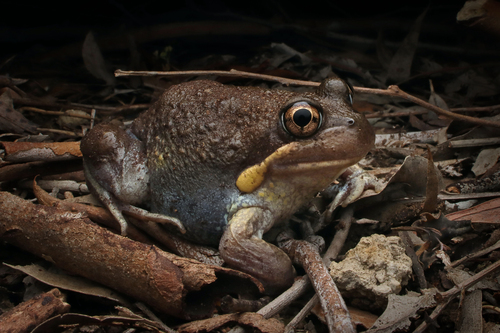
The Ornate Burrowing Frog has a relatively small, stubby body. Its coloration ranges from grey through brown to yellow, and its dorsal pattern varies considerably among individuals.[1][2][3]
A butterfly-shaped marking usually occurs behind its eyes, and its dorsal surface is generally covered in red-tipped warts. Skin folds occur toward the front of its body.[4][5][6]
Its limbs have darker barred or spotted markings. Its toes are slightly webbed, whereas its fingers lack webbing.[7][8]
Adults grow to a maximum length of 50 mm. Tadpoles can reach 50 mm in length but commonly reach only 36 mm.[9][10]
Habitat
The Ornate Burrowing Frog inhabits wet sclerophyll forests in coastal areas and woodlands in more arid regions. Its habitat also includes open woodlands and grasslands.[11][12][13]
It breeds in still water bodies, including dams, puddles and flooded grassland.[14]
Behaviour
The Ornate Burrowing Frog burrows into the ground using its feet. Enlarged tubercles on its feet assist it in scraping away soil.[15][16]
It is usually observed after heavy rain during spring or summer. Males call while floating in still water, producing a short, nasal sound repeated slowly.[17][18][19]
Reproduction and life cycle
Breeding occurs only following heavy rainfall, and the species breeds throughout the wet season. It can lay up to 1,600 eggs in a small, dome-shaped foam mass.[20][21][22]
The foam egg mass soon collapses into a single floating layer of eggs and jelly. Tadpoles can complete metamorphosis as early as eleven days after fertilization.[23][24]
Similar species
The Ornate Burrowing Frog closely resembles Spencer's burrowing frog (Platyplectrum spenceri) and some members of the genus Neobatrachus. Reduced toe webbing and its mating call distinguish it from Spencer's burrowing frog and similar Neobatrachus species.[25][26][27]
Classification of the Ornate Burrowing Frog
| Kingdom | Animalia |
|---|---|
| Phylum | Chordata |
| Subphylum | Vertebrata |
| Infraphylum | Gnathostomata |
| Parvphylum | Osteichthyes |
| Megaclass | Tetrapoda |
| Class | Amphibia (Amphibians) |
| Order | Anura (Frogs) |
| Superfamily | Myobatrachoidea |
| Family | Limnodynastidae (Australian Ground Frogs) |
| Genus | Platyplectrum (Australian Burrowing Frogs) |
| Species | Platyplectrum ornatum (Gray, 1842) |
Where the Ornate Burrowing Frog is found
Checklists and occurrence records place Platyplectrum ornatum in 1 country. GBIF holds 26,452 georeferenced records of it.
Countries
Regions and cities with the most records
- Queensland, Australia 15,661
- New South Wales, Australia 4,651
- Northern Territory, Australia 3,278
- Western Australia, Australia 2,254
- Rockhampton, Australia 874
- Townsville, Australia 874
- Logan City, Australia 812
- Palmerston, Australia 468
- Brisbane, Australia 439
- Capalaba, Australia 285
- Bundaberg, Australia 269
- Narangba, Australia 209
- Maryborough, Australia 201
- Gladstone, Australia 173
- Cairns, Australia 157
- Hervey Bay, Australia 144
- Toowoomba, Australia 139
- Gympie, Australia 112
- Mackay, Australia 105
- Maitland, Australia 95
- Newcastle, Australia 86
- Grafton, Australia 85
- Darwin, Australia 81
- Warwick, Australia 59
- Cessnock, Australia 54
- Gold Coast, Australia 46
- Mount Isa, Australia 36
- Tamworth, Australia 35
- Alice Springs, Australia 30
- Coffs Harbour, Australia 22
- Armidale, Australia 21
- Dubbo, Australia 21
- Muswellbrook, Australia 20
- Caloundra, Australia 15
- Central Coast, Australia 9
- Sunshine Coast, Australia 7
A number beside a place is its count of GBIF occurrence records. A place without a number comes from a checklist alone. Records show where a species has been observed or collected, which can include escapes and vagrants.
Common names
English
- Ornate Burrowing Frog
- Ornate Frog
Names in 2 other languages
- Czech
- paropucha vzorkovaná
- Japanese
- ヒラバチガエル
Synonyms
11 other scientific names have been used for this species and are now treated as synonyms of Platyplectrum ornatum.
- Borborocoetes ornatus (Gray, 1842)
- Discoglossus ornatus Gray, 1842
- Limnodynastes ornatus (Gray, 1842)
- Opisthodon frauenfeldi Steindachner, 1867
- Opisthodon marmoratus (Günther, 1863)
- Opisthodon occidentalis (Cope, 1866)
- Opisthodon ornatus (Gray, 1842)
- Perialia ornata (Gray, 1842)
- Platyplectron ornatus (Gray, 1842)
- Platyplectrum marmoratum Günther, 1863
- Platyplectrum occidentale Cope, 1866
Related species
-
 Spencer's Burrowing FrogPlatyplectrum spenceri
- Fletcher’s FrogPlatyplectrum fletcheri
- Wokan Cannibal FrogPlatyplectrum melanopyga
- Morobe Cannibal FrogPlatyplectrum aganoposis
- Arfak Cannibal FrogPlatyplectrum platyceps
-
 Eastern Banjo FrogLimnodynastes dumerilii
-
 Striped Marsh FrogLimnodynastes peronii
-
 Giant Burrowing FrogHeleioporus australiacus
Compare
Questions and answers
What is the scientific name of the Ornate Burrowing Frog?
The scientific name of the Ornate Burrowing Frog is Platyplectrum ornatum. Written with its author, the full name is Platyplectrum ornatum (Gray, 1842).
Which family does the Ornate Burrowing Frog belong to?
Platyplectrum ornatum belongs to the family Limnodynastidae, in the order Anura and the class Amphibia.
Where is the Ornate Burrowing Frog found?
Checklists and occurrence records place Platyplectrum ornatum in 1 country: Australia.
What is the conservation status of the Ornate Burrowing Frog?
The IUCN Red List category recorded for Platyplectrum ornatum is Least Concern (LC).
What other names does the Ornate Burrowing Frog have?
Platyplectrum ornatum is also known in English as Ornate Frog.
Sources
Passages the profile rests on
- The species has a relatively small, stubby body. Source passage: “This frog is a relatively small and stubby species” — English Wikipedia
- Its coloration ranges from grey through brown to yellow. Source passage: “It ranges in colour from grey to brown to yellow” — English Wikipedia
- Its dorsal pattern varies considerably among individuals. Source passage: “the dorsal surface patterns vary greatly between specimens.” — English Wikipedia
- A butterfly-shaped marking usually occurs behind its eyes. Source passage: “There is usually a butterfly-shaped patch behind the eyes.” — English Wikipedia
- Its dorsal surface is generally covered in red-tipped warts. Source passage: “The dorsum is generally covered with red-tipped warts” — English Wikipedia
- Skin folds occur toward the front of its body. Source passage: “skin folds are present towards the head.” — English Wikipedia
- Its limbs have darker barred or spotted markings. Source passage: “The legs and arms are barred or spotted with darker markings.” — English Wikipedia
- Its toes are slightly webbed, whereas its fingers lack webbing. Source passage: “Toes have a slight webbing, while fingers have none.” — English Wikipedia
- Adults grow to a maximum length of 50 mm. Source passage: “growing no larger than 50 mm.” — English Wikipedia
- Its tadpoles can reach 50 mm in length but commonly reach only 36 mm. Source passage: “Tadpoles reach 50mm but commonly only reach 36 mm in length.” — English Wikipedia
- The species inhabits wet sclerophyll forests in coastal areas. Source passage: “It occurs in both wet sclerophyll forest in coastal areas” — English Wikipedia
- The species also inhabits woodlands in more arid regions. Source passage: “and in woodland in more arid regions.” — English Wikipedia
- Its habitat includes open woodlands and grasslands. Source passage: “Open woodlands and grasslands, including areas subject to” — museum.wa.gov.au
- The species breeds in still water bodies including dams, puddles and flooded grassland. Source passage: “still water bodies such as dams, puddles and flooded grassland.” — English Wikipedia
- The species burrows into the ground using its feet. Source passage: “It burrows feet first” — English Wikipedia
- Enlarged tubercles on its feet assist it in scraping away soil. Source passage: “enlarged tubercles on the frogs feet help them in scraping out soil.” — English Wikipedia
- The species is usually observed after heavy rain during spring or summer. Source passage: “This species is usually only seen after heavy rain during spring or summer.” — English Wikipedia
- Males call while floating in still water. Source passage: “Males call while floating in still water bodies” — English Wikipedia
- Its call is a short, nasal sound repeated slowly. Source passage: “The call is a short, nasal "unk" repeated slowly.” — English Wikipedia
- Breeding occurs only following heavy rainfall. Source passage: “Breeding occurs only after heavy rain.” — English Wikipedia
- The species can lay up to 1,600 eggs in a small, dome-shaped foam mass. Source passage: “Up to 1600 eggs are deposited in a small, dome shaped foam mass” — English Wikipedia
- The species breeds throughout the wet season. Source passage: “Breeds throughout the wet season.” — museum.wa.gov.au
- The foam egg mass soon collapses into a single floating layer of eggs and jelly. Source passage: “that soon collapses into a single floating film layer of eggs and jelly.” — English Wikipedia
- Tadpoles can complete metamorphosis as early as eleven days after fertilization. Source passage: “which can occur just eleven days after the eggs were fertilized.” — English Wikipedia
- The species closely resembles Spencer's burrowing frog (Platyplectrum spenceri). Source passage: “This species looks very similar to Spencer's burrowing frog, Platyplectrum spenceri” — English Wikipedia
- The species also resembles some members of the genus Neobatrachus. Source passage: “and some Neobatrachus species.” — English Wikipedia
- Reduced toe webbing and its mating call distinguish the species from Spencer's burrowing frog and similar Neobatrachus species. Source passage: “It is distinguished from all of these species by the reduced webbing and mating call.” — English Wikipedia
Data
- Catalogue of Life, 2026-10-16 XR cc by
- Global Biodiversity Information Facility CC BY 4.0
- Wikidata CC0
- GeoNames CC BY 4.0
- Wikimedia Commons per image; credit shown with each image
- Within the Catalogue of Life, this name comes from The Integrated Taxonomic Information System cc0
This species in other databases
Page built on 28 November 2026. See how the catalog is made and all sources and licences.
Cite this page
ScientificNames.org. (2026). Platyplectrum ornatum (Ornate Burrowing Frog). Retrieved November 28, 2026, from https://scientificnames.org/species/platyplectrum-ornatum
“Platyplectrum ornatum (Ornate Burrowing Frog).” ScientificNames.org, 2026, scientificnames.org/species/platyplectrum-ornatum. Accessed 28 Nov. 2026.
ScientificNames.org. “Platyplectrum ornatum (Ornate Burrowing Frog).” Accessed November 28, 2026. https://scientificnames.org/species/platyplectrum-ornatum.
@misc{scientificnames_platyplectrum_ornatum_ornate_burrowing_frog,
  author = {{ScientificNames.org}},
  title = {Platyplectrum ornatum (Ornate Burrowing Frog)},
  year = {2026},
  url = {https://scientificnames.org/species/platyplectrum-ornatum},
  note = {Accessed 2026-11-28}
}