Species · Flowering plants
Cape Leadwort Plumbago auriculata
The scientific name of the Cape Leadwort is Plumbago auriculata. It is a species of flowering plant in the family Plumbaginaceae (leadwort family), order Caryophyllales.
- Scientific name
- Plumbago auriculata Lam.
- Common name
- Cape Leadwort
- Genus
- Plumbago
- Family
- Plumbaginaceae (Leadwort Family)
- Order
- Caryophyllales
- Class
- Magnoliopsida
- Recorded in
- 85 countries
- Name status
- accepted in the Catalogue of Life

Overview
Plumbago auriculata is native to South Africa and Mozambique. It has glossy green, alternately arranged leaves and flowers that can be pale blue, blue or violet.
Written 26 November 2026 from the sources listed below. Each statement was checked against the passage it cites; statements that could not be supported were removed.
Appearance
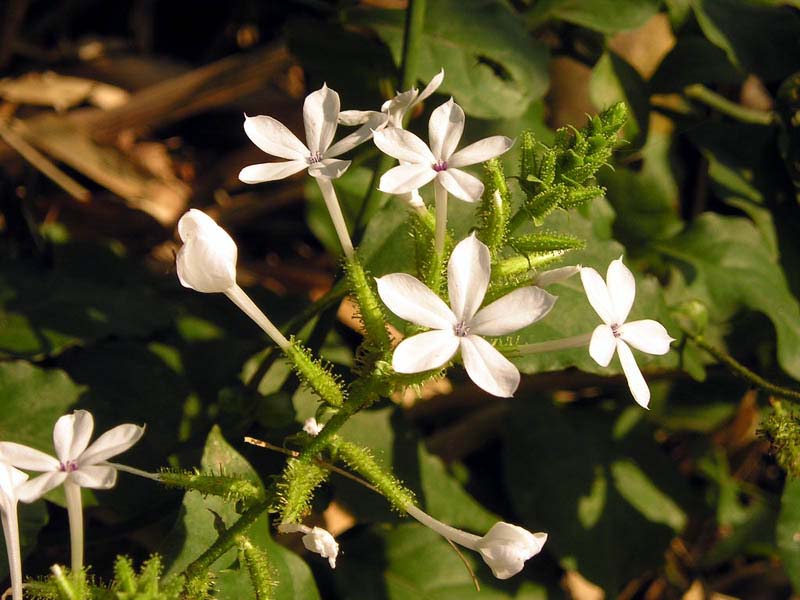
Cape leadwort is an evergreen shrub often cultivated as a climbing plant. Its stems are long, thin and climbing, and its leaves are glossy green with reticulate venation arranged alternately along the stems.[1][2][3][4][5]
In natural conditions, the shrub can reach 6 metres in height and 3 metres in width. Its leaves measure between 2 and 5 centimetres in length.[6][7][8]
Its flowers have five petal-like lobes and can be pale blue, blue or violet. The flower corolla measures approximately 2 centimetres across, and the flowers are arranged in corymb-like racemes.[9][10][11][12]
The flowers are complete, bisexual and regularly symmetrical. Their sepals and petals are connate, the pistil is adnate, and the ovary is superior.[13][14][15][16][17]
The flowers have basal placentation, one locule and five carpels.[18]
A white-flowered variation is recorded as Plumbago auriculata var. alba. A deep-blue-flowered cultivar is recorded as Plumbago auriculata 'Royal Cape'.[19][20]
The specific epithet auriculata means 'with ears' and refers to the shape of the leaves.[21]
Habitat
In temperate climates, it can be cultivated outdoors in frost-free locations. Where outdoor frost-free conditions are unavailable in temperate regions, it can be cultivated under glass.[22][23]
The species requires well-aerated soil and prefers acidic soil.[24]
Diet
The leaves provide food for caterpillars of the hummingbird hawk-moth.[25]
Behaviour
The flowers attract visits from various butterfly species. The sticky sepals can trap small animals, including houseflies.[26][27]
Reproduction and life cycle
Cape leadwort can reproduce sexually through seeds. It can also be propagated asexually through cuttings taken in summer.[28][29]
The species flowers mainly during summer but can flower throughout the year under suitable conditions.[30]
Uses
Both the species and its white-flowered form Plumbago auriculata f. alba have received the Royal Horticultural Society's Award of Garden Merit.[31]
Classification of the Cape Leadwort
| Kingdom | Plantae |
|---|---|
| Subkingdom | Pteridobiotina |
| Phylum | Tracheophyta |
| Class | Magnoliopsida |
| Order | Caryophyllales |
| Family | Plumbaginaceae (Leadwort Family) |
| Tribe | Plumbagineae |
| Genus | Plumbago (Leadworts) |
| Species | Plumbago auriculata Lam. |
Where the Cape Leadwort is found
Checklists and occurrence records place Plumbago auriculata in 85 countries across Africa, Asia, Europe, North America, Oceania and South America. GBIF holds 15,830 georeferenced records of it.
Countries where it is native or its origin is not stated
- Algeria 5
- Australia 418
- Burundi 4
- China 122
- Democratic Republic of the Congo 5
- Egypt 11
- Eswatini 3
- Ethiopia 21
- France 334
- Ghana 3
- Hong Kong 115
- Indonesia 12
- Iraq 4
- Ivory Coast 4
- Japan 20
- Jordan 3
- Kenya 21
- Lebanon 4
- Madagascar 6
- Malaysia 42
- Mayotte 5
- Morocco 71
- Mozambique 19
- Namibia 12
- Nigeria 6
- Philippines 96
- Reunion 119
- Rwanda 5
- Saint Helena 5
- Sao Tome and Principe 3
- Senegal 10
- Singapore 51
- Somalia 3
- South Africa 4,377
- Tanzania 11
- Thailand 32
- Tunisia 11
- Zimbabwe 5
Countries where it has been introduced
- Bangladesh 4
- Barbados 27
- Benin 7
- Bolivia 10
- Bonaire, Saint Eustatius and Saba 10
- Brazil 434
- Burkina Faso
- Cameroon 26
- Colombia 146
- Costa Rica 31
- Cuba 24
- Dominica 11
- Ecuador 23
- El Salvador 25
- Fiji
- Gambia
- Greece 839
- Guadeloupe 73
- Guam 1
- Guatemala 59
- Honduras 21
- India 310
- Italy 2,457
- Libya 1
- Martinique 41
- Mauritius 38
- Mexico 403
- Montserrat 1
- Myanmar 1
- Nepal 2
- New Caledonia 7
- Nicaragua 8
- Niue 2
- Pakistan 10
- Panama 50
- Peru 88
- Portugal 337
- Puerto Rico 129
- Seychelles 14
- Spain 1,062
- Sri Lanka 32
- Taiwan 2
- Tonga
- Trinidad and Tobago 21
- United States 2,983
- Venezuela 46
- Vietnam 16
Regions and cities with the most records
- Eastern Cape, South Africa 2,388
- Florida, United States 1,379
- Texas, United States 947
- Western Cape, South Africa 917
- Grahamstown, South Africa 470
- Rondebosch, South Africa 437
- KwaZulu-Natal, South Africa 429
- Retreat, South Africa 413
- Catalonia, Spain 407
- Tuscany, Italy 406
- Cape Town, South Africa 400
- Sicily, Italy 394
- Muizenberg, South Africa 376
- Lazio, Italy 343
- Liguria, Italy 339
- Cerdanyola del Vallès, Spain 319
- Sant Cugat del Vallès, Spain 318
- Molins de Rei, Spain 317
- Santa Coloma de Gramenet, Spain 317
- Rubí, Spain 315
- Llefià, Spain 314
- Sant Adrià de Besòs, Spain 314
- Sant Vicenç dels Horts, Spain 314
- Gavà, Spain 312
- Barcelona, Spain 311
- Sant Andreu de la Barca, Spain 310
- Sant Boi de Llobregat, Spain 308
- Sant Feliu de Llobregat, Spain 307
- Sant Just Desvern, Spain 307
- Esplugues de Llobregat, Spain 306
- L'Hospitalet de Llobregat, Spain 305
- Sant Joan Despí, Spain 305
- Cornellà de Llobregat, Spain 304
- El Prat de Llobregat, Spain 304
- Viladecans, Spain 303
- Montcada i Reixac, Spain 288
37 more countries have a few records outside this range
These countries hold a few records of Plumbago auriculata but lie outside the range the checklists give for it. Such records are often zoo or garden specimens, museum material or vagrants, so the species is not counted as occurring there.
- Antigua and Barbuda 6
- Argentina 59
- Bahamas 5
- Belize 3
- Bermuda 8
- British Virgin Islands 3
- Canada 3
- Cayman Islands 3
- Chile 79
- Croatia 14
- Cyprus 20
- Denmark 6
- Dominican Republic 79
- French Guiana 5
- French Polynesia 15
- Germany 21
- Gibraltar 10
- Grenada 7
- Haiti 6
- Jamaica 54
- Malta 47
- Monaco 7
- Montenegro 5
- New Zealand 53
- Paraguay 7
- Poland 3
- Saint Kitts and Nevis 4
- Saint Lucia 4
- Saint Martin 11
- Saint Vincent and the Grenadines 5
- Sint Maarten 6
- Sweden 9
- Switzerland 5
- The Netherlands 3
- Turks and Caicos Islands 8
- U.S. Virgin Islands 36
- Uruguay 6
Range as the checklists state it
Portugal [I]; Spain [I]; Baleares [I]; Italy [I]; Crete [I]; Libya [I]; Canary Isl. [I] (Gran Canaria [I], Tenerife [I], La Gomera [I]); Gambia [I]; Burkina Faso [I]; Benin [I]; Cameroon [I]; São Tomé [I]; Mozambique; South Africa (Gauteng, Mpulamanga, Free State, KwaZulu-Natal, W-Cape Prov., E-Cape Prov.); St. Helena [I]; Mauritius [I]; La Réunion [I]; Rodrigues [I]; Seychelles [I]; Taiwan [I]; Pakistan [I]; Nepal [I]; India [I]; Sri Lanka [I]; Bangladesh [I]; Myanmar [I]; Vietnam [I]; Philippines [c]; Jawa [I]; New Caledonia [I]; Tonga [I]; Niue [I]; Fiji [I]; Society Isl. [I] (Tahiti [I]); Guam [I]; Hawaii [I] (East Maui [I]); USA [I] (California [I], Florida [I], Louisiana [I]); Mexico [I]; Guatemala [I]; El Salvador [I]; Honduras [I]; Nicaragua [I]; Costa Rica [I]; Panama [I]; Cuba [I]; Hispaniola [I]; Puerto Rico [I]; Virgin Isl. [I] (Guana [I], St. Croix [I], Tortola [I]); St. Martin/St. Maarten [I]; Saba [I]; Antigua [I]; Montserrat [I]; Guadeloupe [I]; Dominica [I]; Martinique [I]; St. Lucia [I]; Barbados [I]; Trinidad & Tobago [I]; Colombia [I]; Isla Margarita [I]; Venezuela [I]; Ecuador [I]; Peru [I]; Bolivia [I]; Brazil [I]
A number beside a place is its count of GBIF occurrence records. A place without a number comes from a checklist alone. Records show where a species has been observed or collected, which can include escapes and vagrants.
Common names
English
- Cape Leadwort
- Quaker
- Quaker Blossom
- Plumbago
Names in 5 other languages
- Dutch
- Mannentrouw
- Norwegian Bokmål
- blyrot
- Portuguese
- bela-emília, dentelária-do-cabo, jasmim-do-cabo
- Spanish
- azulina, celestina, jasmín azul, malacara
- Swedish
- blyblomma
Synonyms
9 other scientific names have been used for this species and are now treated as synonyms of Plumbago auriculata.
- Plumbagidium auriculatum (Lam.) Spach
- Plumbago alba Pasq.
- Plumbago auriculata f. alba (Pasq.) T.H.Peng
- Plumbago auriculata f. auriculata
- Plumbago capensis f. alba Carrière
- Plumbago capensis var. alba Hort. ex Carrière
- Plumbago capensis var. alba (Carrière) Pynaert
- Plumbago grandiflora Ten.
- Plumbago capensis Thunb. ambiguous synonym
Related species
-
 Ceylon LeadwortPlumbago zeylanica
-
 Indian LeadwortPlumbago indica
-
 Common LeadwortPlumbago europaea
- Iguana's TailPlumbago pulchella
- Chilean PlumbagoPlumbago caerulea
-
 Brandberg PlumbagoPlumbago wissii
-
 Brandberg PlumbagoPlumbago tristis
- Plumbago aphylla
Compare
Questions and answers
What is the scientific name of the Cape Leadwort?
The scientific name of the Cape Leadwort is Plumbago auriculata. Written with its author, the full name is Plumbago auriculata Lam..
Which family does the Cape Leadwort belong to?
Plumbago auriculata belongs to the family Plumbaginaceae, in the order Caryophyllales and the class Magnoliopsida.
Where is the Cape Leadwort found?
Checklists and occurrence records place Plumbago auriculata in 85 countries, including South Africa, Australia, France, China, Reunion and Hong Kong.
What other names does the Cape Leadwort have?
Plumbago auriculata is also known in English as Quaker, Quaker Blossom and Plumbago.
Sources
Passages the profile rests on
- Plumbago auriculata is an evergreen shrub that is often cultivated as a climbing plant. Source passage: “Plumbago auriculata is an evergreen shrub, often grown as a climber” — English Wikipedia
- Its leaves are glossy green. Source passage: “The leaves are a glossy green” — English Wikipedia
- Its leaves have a reticulate venation pattern. Source passage: “leaf venation - reticulate.” — English Wikipedia
- Its leaves are arranged alternately along the stems. Source passage: “The leaves alternate” — English Wikipedia
- Its stems are long, thin, and climbing. Source passage: “The stems are long, thin, and climbing.” — English Wikipedia
- In natural conditions, the shrub can reach 6 metres in height and 3 metres in width. Source passage: “ascending rapidly to 6 m (20 ft) tall by 3 m (10 ft) wide in nature” — English Wikipedia
- Its leaves can reach 5 centimetres in length. Source passage: “The leaves are a glossy green and grow to 5 cm (2 in) long.” — English Wikipedia
- Its leaves are described as measuring between 2 and 5 centimetres. Source passage: “The leaves alternate and are 2–5 cm.” — English Wikipedia
- Its flowers have five petal-like lobes. Source passage: “The corolla with five petal-like lobes” — English Wikipedia
- Its flowers can be pale blue, blue, or violet. Source passage: “can be pale blue, blue or violet in color.” — English Wikipedia
- Its flowers are arranged in corymb-like racemes. Source passage: “are arranged in corymb-like racemes.” — English Wikipedia
- Its flower corolla measures approximately 2 centimetres across. Source passage: “The corolla with five petal-like lobes is about 2 cm wide” — English Wikipedia
- Its flowers are complete and bisexual. Source passage: “The flowers are complete and bisexual” — English Wikipedia
- Its sepals and petals are connate. Source passage: “The sepals and petals are connate” — English Wikipedia
- Its pistil is adnate. Source passage: “while the pistil is adnate.” — English Wikipedia
- Its flowers have a superior ovary. Source passage: “The ovary of the flower is superior” — English Wikipedia
- Its flowers have regular symmetry. Source passage: “the flower has regular symmetry.” — English Wikipedia
- Its flowers have basal placentation, one locule, and five carpels. Source passage: “It has basal placentation, with 1 locule and 5 carpels.” — English Wikipedia
- A white-flowered variation of the species is recorded as Plumbago auriculata var. alba. Source passage: “There also variations with white (P. auriculata var. alba)” — English Wikipedia
- A deep-blue-flowered cultivar is recorded under the name Plumbago auriculata 'Royal Cape'. Source passage: “or deep blue (P. auriculata 'Royal Cape') flowers.” — English Wikipedia
- The specific epithet auriculata means 'with ears' and refers to the shape of the leaves. Source passage: “The specific epithet auriculata means "with ears", referring to the shape of the leaves.” — English Wikipedia
- In temperate climates, the species can be cultivated outdoors in frost-free locations. Source passage: “In temperate regions, it may be grown outside in frost free areas” — English Wikipedia
- Where outdoor frost-free conditions are unavailable in temperate regions, the species can be cultivated under glass. Source passage: “otherwise under glass.” — English Wikipedia
- The species requires well-aerated soil and prefers acidic soil. Source passage: “It needs well-aerated soil and light and prefers acidic soil.” — English Wikipedia
- The leaves provide food for caterpillars of the hummingbird hawk-moth. Source passage: “Their leaves serve as food for the caterpillar of the hummingbird hawk-moth.” — English Wikipedia
- The flowers attract visits from various butterfly species. Source passage: “It is visited by various butterflies.” — English Wikipedia
- The sticky sepals can trap small animals, including houseflies. Source passage: “the sticky sepals sometimes catch animals up to the size of a housefly.” — English Wikipedia
- The species can reproduce sexually through seeds. Source passage: “Plumbago auriculata can be propagated sexually by seeds” — English Wikipedia
- The species can also be propagated asexually through cuttings taken in summer. Source passage: “and asexually by cutting in summer.” — English Wikipedia
- The species flowers mainly during summer but can flower throughout the year under suitable conditions. Source passage: “It flowers mostly in the summer, but in the right conditions it can bloom year-round.” — English Wikipedia
- Both the species and its white-flowered form Plumbago auriculata f. alba have received the Royal Horticultural Society's Award of Garden Merit. Source passage: “The species and the white-flowered form P. auriculata f. alba have both gained the Royal Horticultural Society's Award of Garden Merit.” — English Wikipedia
Data
- Catalogue of Life, 2026-10-16 XR cc by
- Global Biodiversity Information Facility CC BY 4.0
- Wikidata CC0
- GeoNames CC BY 4.0
- Wikimedia Commons per image; credit shown with each image
- Within the Catalogue of Life, this name comes from Synonymic Checklists of the Vascular Plants of the World cc by
References
- Lam. (1786). Encycl. [J.Lamarck et al.] 2: 270 (1786). where the name was published
This species in other databases
Page built on 28 November 2026. See how the catalog is made and all sources and licences.
Cite this page
ScientificNames.org. (2026). Plumbago auriculata (Cape Leadwort). Retrieved November 28, 2026, from https://scientificnames.org/species/plumbago-auriculata
“Plumbago auriculata (Cape Leadwort).” ScientificNames.org, 2026, scientificnames.org/species/plumbago-auriculata. Accessed 28 Nov. 2026.
ScientificNames.org. “Plumbago auriculata (Cape Leadwort).” Accessed November 28, 2026. https://scientificnames.org/species/plumbago-auriculata.
@misc{scientificnames_plumbago_auriculata_cape_leadwort,
  author = {{ScientificNames.org}},
  title = {Plumbago auriculata (Cape Leadwort)},
  year = {2026},
  url = {https://scientificnames.org/species/plumbago-auriculata},
  note = {Accessed 2026-11-28}
}