Species · Spiders and other arachnids
Ivory Ornamental Tarantula Poecilotheria subfusca
The scientific name of the Ivory Ornamental Tarantula is Poecilotheria subfusca. It is a species of arachnid in the family Theraphosidae (tarantulas), order Araneae. The name dates from 1895.
- Scientific name
- Poecilotheria subfusca Pocock, 1895
- Common name
- Ivory Ornamental Tarantula
- Genus
- Poecilotheria
- Family
- Theraphosidae (Tarantulas)
- Order
- Araneae
- Class
- Arachnida
- Recorded in
- 1 country
- Name status
- accepted in the Catalogue of Life

Overview
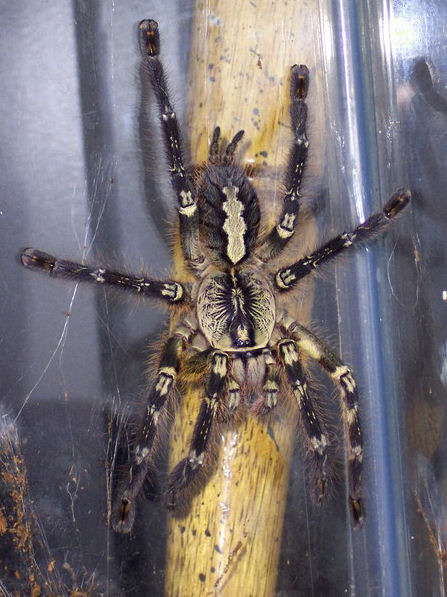
The ivory ornamental tarantula (Poecilotheria subfusca) is endemic to Sri Lanka. It occurs in the wet zone of the central highlands of Sri Lanka, including two geographically separate regions. It is distinguished by contrasting pale white or grey markings against a dark background.
Written 26 November 2026 from the sources listed below. Each statement was checked against the passage it cites; statements that could not be supported were removed.
Appearance
The species has a large, dark opisthosoma with a folium pattern of three linked dark spots extending halfway down its length. The female carapace is dark brown dorsally, with pale margins arranged in a starburst-like pattern.[1][2]
The female chelicerae are creamy in color. Her ventral body surface is pale brown with darker maxillae.[3][4]
Males are generally paler than females, with subdued dorsal markings and metallic brown legs.[5]
Adult females have a body length of 8–9 cm, while adult males have a body length of approximately 6–7 cm. Adult females typically have a diagonal leg span of approximately 15–20 cm.[6][7][8]
Habitat
The species is strictly arboreal and inhabits forested regions of Sri Lanka. It occurs in both lowland and montane forest habitats.[9][10]
It occupies mature trees and favors natural cavities, hollows, fissures beneath loose bark, and occasionally abandoned rot holes or woodpecker cavities. It is associated with old-growth and well-established secondary forests.[11][12]
Highland populations inhabit cooler, humid montane regions at higher elevations, while lowland populations inhabit warmer forest zones at lower elevations.[13][14]
Highland populations are associated with temperatures of approximately 18–22 °C and high humidity. Lowland populations occur in environments commonly ranging from 24 to 29 °C.[15][16]
Individuals rely on consistent canopy cover, high ambient humidity, and minimal disturbance.[17]
Behaviour
The species constructs a silken retreat inside tree cavities and uses nearby bark surfaces as ambush sites for prey.[18][19]
It is primarily nocturnal and remains concealed during daylight hours. It is highly agile and reactive, with the ability to move rapidly in vertical and lateral directions.[20][21]
When disturbed, individuals typically retreat quickly into tree cavities but may bite if provoked. Threatened individuals may expose their legs and ventral surfaces as a visual warning.[22][23]
The species is capable of rapid jumping and multidirectional movement. Adult specimens are reported to be more defensive and reactive than juveniles.[24][25]
The species lacks urticating hairs and relies primarily on venom for defense.[26]
The species has been documented in a possible mutualistic association with the frog Ramanella nagaoi. It may share tree holes with frogs that contain eggs or juveniles of either species, and the spider may deter predators in this association.[27][28][29]
Conservation
The species is listed as Endangered under the U.S. Endangered Species Act. It is also included in Appendix II of CITES.[30][31]
Deforestation, logging, agricultural expansion, and forest fragmentation in Sri Lanka are identified as primary threats. Removing old-growth forest disproportionately affects population viability because the species depends on mature trees with suitable cavities.[32][33]
Collection for the international pet trade has contributed to population pressure.[34]
Classification of the Ivory Ornamental Tarantula
| Kingdom | Animalia |
|---|---|
| Phylum | Arthropoda |
| Subphylum | Chelicerata |
| Class | Arachnida (Arachnid) |
| Order | Araneae (Spider) |
| Family | Theraphosidae (Tarantulas) |
| Genus | Poecilotheria (Tiger Spiders) |
| Species | Poecilotheria subfusca Pocock, 1895 |
Where the Ivory Ornamental Tarantula is found
Checklists and occurrence records place Poecilotheria subfusca in 1 country across Asia. GBIF holds 41 georeferenced records of it.
Countries
Regions and cities with the most records
Range as the checklists state it
Sri Lanka
A number beside a place is its count of GBIF occurrence records. A place without a number comes from a checklist alone. Records show where a species has been observed or collected, which can include escapes and vagrants.
Common names
English
- Ivory Ornamental Tarantula
Names in 1 other language
- Czech
- sklípkan nahnědlý
Synonyms
2 other scientific names have been used for this species and are now treated as synonyms of Poecilotheria subfusca.
- Poecilotheria bara Chamberlin, 1917
- Poecilotheria uniformis Strand, 1913
Related species
-
 Gooty Sapphire Ornamental TarantulaPoecilotheria metallica
-
 Indian Ornamental TarantulaPoecilotheria regalis
-
 Fringed Ornamental TarantulaPoecilotheria ornata
-
 Red Slate OrnamentalPoecilotheria rufilata
-
 Rameshwaram OrnamentalPoecilotheria hanumavilasumica
-
 Sri Lankan Ornamental TarantulaPoecilotheria fasciata
- Tiger Ornamental TarantulaPoecilotheria tigrinawesseli
-
 Salem Ornamental TarantulaPoecilotheria formosa
Compare
Questions and answers
What is the scientific name of the Ivory Ornamental Tarantula?
The scientific name of the Ivory Ornamental Tarantula is Poecilotheria subfusca. Written with its author, the full name is Poecilotheria subfusca Pocock, 1895.
Which family does the Ivory Ornamental Tarantula belong to?
Poecilotheria subfusca belongs to the family Theraphosidae, in the order Araneae and the class Arachnida.
Where is the Ivory Ornamental Tarantula found?
Checklists and occurrence records place Poecilotheria subfusca in 1 country: Sri Lanka.
Sources
Passages the profile rests on
- The species has a large, dark opisthosoma with a folium pattern of three linked dark spots extending halfway down its length. Source passage: “its large, dark opisthosoma and a folium pattern consisting of three linked dark spots that extend halfway down the opisthosoma.” — English Wikipedia
- The female carapace is dark brown dorsally with pale margins arranged in a starburst-like pattern. Source passage: “The female carapace is dorsally dark brown with pale margins, forming a starburst-like pattern.” — English Wikipedia
- The female chelicerae are creamy in color. Source passage: “The chelicerae are creamy in color.” — English Wikipedia
- The female's ventral body surface is pale brown with darker maxillae. Source passage: “Ventrally, the body is pale brown with darker maxillae.” — English Wikipedia
- Males are generally paler than females and have subdued dorsal markings and metallic brown legs. Source passage: “Males are generally paler, with subdued dorsal markings and metallic brown coloration on the legs.” — English Wikipedia
- Adult females have a body length of 8–9 cm. Source passage: “The female is larger than the male, with a body length of 8–9 cm” — English Wikipedia
- Adult males have a body length of approximately 6–7 cm. Source passage: “while males measure approximately 6–7 cm.” — English Wikipedia
- Adult females typically have a diagonal leg span of approximately 15–20 cm. Source passage: “Adult females typically reach a diagonal leg span of approximately 15–20 cm” — English Wikipedia
- The species is strictly arboreal and inhabits forested regions of Sri Lanka. Source passage: “Poecilotheria subfusca is a strictly arboreal species inhabiting forested regions of Sri Lanka.” — English Wikipedia
- The species occurs in both lowland and montane forest habitats. Source passage: “Both lowland and montane forest habitats are utilized.” — English Wikipedia
- It occupies mature trees and favors natural cavities, hollows, fissures beneath loose bark, and occasionally abandoned rot holes or woodpecker cavities. Source passage: “It occupies mature trees, favoring natural cavities, hollows, fissures beneath loose bark, and occasionally abandoned rot holes or woodpecker cavities.” — English Wikipedia
- The species is associated with old-growth and well-established secondary forests. Source passage: “The species shows a strong association with old-growth or well-established secondary forest” — English Wikipedia
- Highland populations inhabit cooler, humid montane regions at higher elevations. Source passage: “Highland populations occur in cooler, humid montane regions at higher elevations” — English Wikipedia
- Lowland populations inhabit warmer forest zones at lower elevations. Source passage: “whereas lowland populations inhabit warmer forest zones at lower elevations.” — English Wikipedia
- Highland populations are associated with temperatures of approximately 18–22 °C and high humidity. Source passage: “Highland populations are associated with cooler conditions, typically ranging from approximately 18–22 °C, with high humidity.” — English Wikipedia
- Lowland populations occur in environments commonly ranging from 24 to 29 °C. Source passage: “Lowland populations occur in warmer environments, commonly between 24 and 29 °C.” — English Wikipedia
- Individuals rely on consistent canopy cover, high ambient humidity, and minimal disturbance. Source passage: “individuals rely on consistent canopy cover, high ambient humidity, and minimal disturbance.” — English Wikipedia
- The species constructs a silken retreat inside tree cavities. Source passage: “The spider constructs a silken retreat within tree cavities” — English Wikipedia
- It uses nearby bark surfaces as ambush sites for prey. Source passage: “and uses nearby bark surfaces as ambush sites for prey.” — English Wikipedia
- The species is primarily nocturnal and remains concealed during daylight hours. Source passage: “Activity is primarily nocturnal, with individuals remaining concealed during daylight hours.” — English Wikipedia
- The species is highly agile and reactive, capable of rapid vertical and lateral movement. Source passage: “P. subfusca is highly agile and reactive, capable of rapid vertical and lateral movement.” — English Wikipedia
- When disturbed, individuals typically retreat quickly into tree cavities but may bite if provoked. Source passage: “When disturbed, it typically retreats quickly into tree cavities, but may bite if provoked.” — English Wikipedia
- Threatened individuals may expose their legs and ventral surfaces as a visual warning. Source passage: “When threatened, individuals may expose the legs and ventral surfaces, displaying high-contrast banding” — English Wikipedia
- Adult specimens are reported to be more defensive and reactive than juveniles. Source passage: “Adult specimens are reported to be more defensive and reactive, with a higher likelihood of biting when threatened.” — English Wikipedia
- The species is capable of rapid jumping and multidirectional movement. Source passage: “It is also capable of rapid jumping and multidirectional movement” — English Wikipedia
- The species lacks urticating hairs and relies primarily on venom for defense. Source passage: “lacking urticating hairs and relying primarily on venom for defense.” — English Wikipedia
- The species has been documented in a possible mutualistic association with the frog Ramanella nagaoi. Source passage: “The species has been documented in a possible mutualistic association with frogs such as Ramanella nagaoi” — English Wikipedia
- The species may share tree holes with frogs that contain eggs or juveniles of either species. Source passage: “sharing tree holes that may contain eggs or juveniles of either species.” — English Wikipedia
- The spider may deter predators in its association with frogs. Source passage: “The spider may deter predators” — English Wikipedia
- The species is listed as Endangered under the U.S. Endangered Species Act. Source passage: “Poecilotheria subfusca is listed as Endangered under the U.S. Endangered Species Act” — English Wikipedia
- The species is included in Appendix II of CITES. Source passage: “and is included in Appendix II of CITES.” — English Wikipedia
- Deforestation, logging, agricultural expansion, and forest fragmentation in Sri Lanka are identified as primary threats. Source passage: “The primary threat to the species is habitat loss caused by deforestation, logging, agricultural expansion, and forest fragmentation in Sri Lanka.” — English Wikipedia
- Removing old-growth forest disproportionately affects population viability because the species depends on mature trees with suitable cavities. Source passage: “Because the species depends on mature trees with suitable cavities, the removal of old-growth forest has a disproportionate impact on population viability.” — English Wikipedia
- Collection for the international pet trade has contributed to population pressure. Source passage: “Collection for the international pet trade has also contributed to population pressure” — English Wikipedia
Data
- Catalogue of Life, 2026-10-16 XR cc by
- Global Biodiversity Information Facility CC BY 4.0
- Wikidata CC0
- GeoNames CC BY 4.0
- Wikimedia Commons per image; credit shown with each image
- Within the Catalogue of Life, this name comes from The World Spider Catalog cc by
References
- Pocock, R. I. (1895a). On a new and natural grouping of some of the Oriental genera of Mygalomorphae, with descriptions of new genera and species. Annals and Magazine of Natural History (6) 15(86): 165-184, pl. 10. doi: <a href="https://doi.org/10.1080/00222939508677863" target="_blank">10.1080/00222939508677863 Link where the name was published
This species in other databases
Page built on 29 November 2026. See how the catalog is made and all sources and licences.
Cite this page
ScientificNames.org. (2026). Poecilotheria subfusca (Ivory Ornamental Tarantula). Retrieved November 29, 2026, from https://scientificnames.org/species/poecilotheria-subfusca
“Poecilotheria subfusca (Ivory Ornamental Tarantula).” ScientificNames.org, 2026, scientificnames.org/species/poecilotheria-subfusca. Accessed 29 Nov. 2026.
ScientificNames.org. “Poecilotheria subfusca (Ivory Ornamental Tarantula).” Accessed November 29, 2026. https://scientificnames.org/species/poecilotheria-subfusca.
@misc{scientificnames_poecilotheria_subfusca_ivory_ornamental_tarantula,
  author = {{ScientificNames.org}},
  title = {Poecilotheria subfusca (Ivory Ornamental Tarantula)},
  year = {2026},
  url = {https://scientificnames.org/species/poecilotheria-subfusca},
  note = {Accessed 2026-11-29}
}