Species · Flowering plants
Tuberose Polianthes tuberosa
The scientific name of the Tuberose is Polianthes tuberosa. It is a species of flowering plant in the family Asparagaceae (asparagus family), order Asparagales.
- Scientific name
- Polianthes tuberosa L.
- Common name
- Tuberose
- Genus
- Polianthes
- Family
- Asparagaceae (Asparagus Family)
- Order
- Asparagales
- Class
- Liliopsida
- Recorded in
- 32 countries
- Name status
- accepted in the Catalogue of Life
Overview
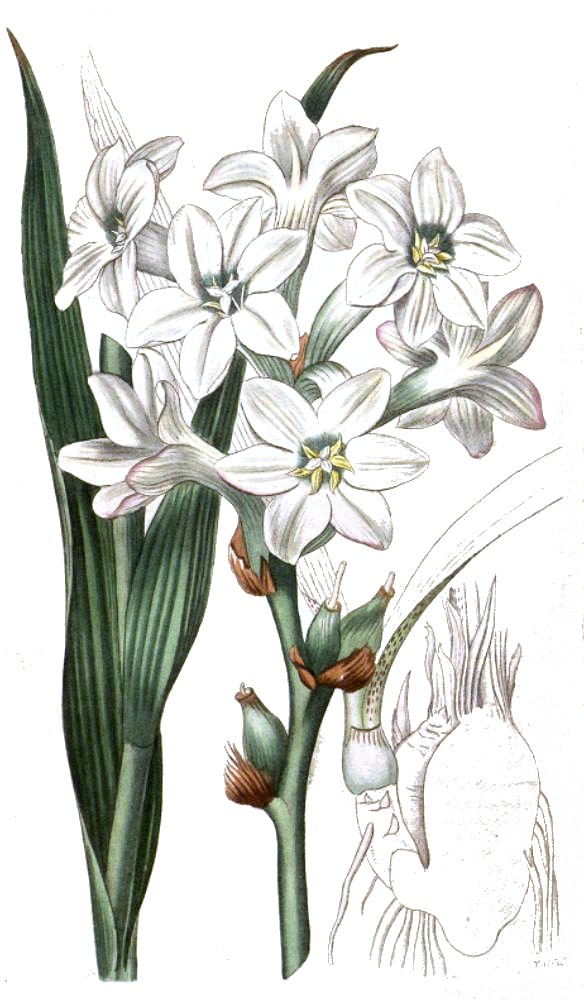
Tuberose (Polianthes tuberosa L.) is a herbaceous bulbous flowering plant in the family Asparagaceae. The species is believed to be native to central and southern Mexico and is currently cultivated in many tropical and temperate countries. It produces fragrant, waxy, glistening white tubular flowers in terminal clusters.
Written 26 November 2026 from the sources listed below. Each statement was checked against the passage it cites; statements that could not be supported were removed.
Appearance
The plant produces terminal clusters of fragrant white tubular flowers. The flowers are somewhat fleshy, waxy and glistening white, with six flaring segments at the tip.[1][2][3][4]
Each flower contains six stamens and a three-part stigma. The flower tube can reach approximately 6 cm in length.[5][6]
The flowering spike can reach approximately 1 m in height. The flowering stem bears eight to ten smaller stem leaves.[7][8]
Habitat
Tuberose grows in productive, well-drained garden soil in sunny locations.[9]
Behaviour
The plant's stems emerge during hot summer weather.[10]
Uses
Extracts from the plant are used as fragrance notes in perfumery. The flower has been distilled for perfumery since the 17th century.[11][12]
Tuberose flowers are used in Indonesian cooking and are among the main flowers used to make leis in Hawaii.[13][14]
The plant was historically popular as a florist cut flower during the Victorian era. Its flowers were formerly used extensively in funerary floral arrangements.[15][16]
Conservation
Tuberose is no longer found growing wild, probably because it was domesticated by the Aztecs. The species has been cultivated for so long that it no longer occurs naturally in the wild.[17][18]
Botanists describe the cultivated plant as a cultigen. It is the only species in the genus Polianthes reported as being in commercial cultivation.[19][20]
Classification of the Tuberose
| Kingdom | Plantae |
|---|---|
| Subkingdom | Pteridobiotina |
| Phylum | Tracheophyta |
| Class | Liliopsida |
| Order | Asparagales |
| Family | Asparagaceae (Asparagus Family) |
| Genus | Polianthes |
| Species | Polianthes tuberosa L. |
Where the Tuberose is found
Checklists and occurrence records place Polianthes tuberosa in 32 countries across Africa, Asia, North America, Oceania and South America. GBIF holds 219 georeferenced records of it.
Countries where it is native or its origin is not stated
- Brazil 15
- China 26
- Colombia 3
- Ecuador 5
- Guadeloupe 3
- Hong Kong 5
- India 13
- Indonesia 3
- Japan 4
- Martinique 3
- Myanmar 3
- New Caledonia 4
- Philippines 9
- Sri Lanka 4
- United States 32
- Vietnam 4
Countries where it has been introduced
- Belize 1
- Cuba
- Dominican Republic 6
- El Salvador 5
- French Polynesia 8
- Guatemala
- Haiti
- Honduras 2
- Mexico 44
- Nicaragua 4
- Panama 1
- Peru 8
- Puerto Rico 4
- Rwanda
- Seychelles
- Turkey
Regions and cities with the most records
- Chongqing, China 10
- Conglin, China 10
- Daguan, China 10
- Nanchuan, China 10
- Nanping, China 10
- Xinglong, China 10
- Benito Juarez, Mexico 7
- Coyoacán, Mexico 7
- Emiliano Zapata, Mexico 7
- Iztacalco, Mexico 7
- Iztapalapa, Mexico 7
- Los Reyes Acaquilpan, Mexico 7
- Magdalena Contreras, Mexico 7
- San Miguel Ajusco, Mexico 7
- San Miguel Topilejo, Mexico 7
- Tlalpan, Mexico 7
- Tláhuac, Mexico 7
- Xochimilco, Mexico 7
- Veracruz, Mexico 6
- Ciudad Nezahualcoyotl, Mexico 5
- Cuauhtémoc, Mexico 5
- Mexico City, Mexico 5
- Miguel Hidalgo, Mexico 5
- Azcapotzalco, Mexico 4
- Ba Dinh, Vietnam 4
- Bạch Mai, Vietnam 4
- Bắc Từ Liêm, Vietnam 4
- Campeche, Mexico 4
- Campo Grande, Brazil 4
- Chetumal, Mexico 4
- Columbia, United States 4
- Cầu Diễn, Vietnam 4
- Cầu Giấy, Vietnam 4
- Cổ Lóa, Vietnam 4
- Cửa Nam, Vietnam 4
- Delegación Cuajimalpa de Morelos, Mexico 4
2 more countries have a few records outside this range
These countries hold a few records of Polianthes tuberosa but lie outside the range the checklists give for it. Such records are often zoo or garden specimens, museum material or vagrants, so the species is not counted as occurring there.
A number beside a place is its count of GBIF occurrence records. A place without a number comes from a checklist alone. Records show where a species has been observed or collected, which can include escapes and vagrants.
Common names
English
- Tuberose
Names in 16 other languages
- Armenian
- Բրաբիոն
- Chinese
- 晚香玉
- Finnish
- tuberosa
- French
- Tubéreuse
- Hawaiian
- kupaloke
- Hindi
- रजनीगंधा
- Indonesian
- Sedap malam
- Japanese
- チューベローズ, 月下香
- Lithuanian
- Kvapnioji tuberoza
- Polish
- tuberoza bulwiasta
- Russian
- Тубероза
- Slovak
- agáva nočná
- Spanish
- Amole, Nardo, vara de San José
- Thai
- ซ่อนกลิ่น
- Turkish
- Tutya Çiçeği
- pau
- iakorang
Synonyms
8 other scientific names have been used for this species and are now treated as synonyms of Polianthes tuberosa.
- Agave amica (Medik.) Thiede & Govaerts
- Agave polianthes Thiede & Eggli
- Polianthes gracilis Link
- Polianthes tuberosa f. plena Moldenke
- Polianthes tuberosa var. gracilis (Link) Beurl.
- Tuberosa amica Medik.
- Agave tuberosa (L.) Thiede & Eggli ambiguous synonym
- Crinum angustifolium Houtt. ambiguous synonym
Questions and answers
What is the scientific name of the Tuberose?
The scientific name of the Tuberose is Polianthes tuberosa. Written with its author, the full name is Polianthes tuberosa L..
Which family does the Tuberose belong to?
Polianthes tuberosa belongs to the family Asparagaceae, in the order Asparagales and the class Liliopsida.
Where is the Tuberose found?
Checklists and occurrence records place Polianthes tuberosa in 32 countries, including United States, China, Brazil, India, Philippines and Ecuador.
What is another name for tuberose?
Tuberose is the English name recorded for Polianthes tuberosa L.[21][22]
What is the botanical name and family of tuberose?
Its botanical name is Polianthes tuberosa L., and it belongs to the family Asparagaceae.[23][24]
Sources
Passages the profile rests on
- The plant produces pure white, waxy, strongly fragrant tubular flowers. Source passage: “with pure white waxy flowers. The flowers are tubular” — English Wikipedia
- Each flower has six flaring segments at its tip. Source passage: “separating into six flaring segments (tepals) at the end” — English Wikipedia
- The plant produces terminal clusters of fragrant white tubular flowers. Source passage: “produce a terminal cluster of fragrant, white tubular flowers” — uaex.uada.edu
- The flowers are somewhat fleshy and glistening white. Source passage: “The blossoms are glistening white and somewhat fleshy” — uaex.uada.edu
- Each flower contains six stamens and a three-part stigma. Source passage: “There are six stamens, inserted into the tube of the flower, and a three-part stigma.” — English Wikipedia
- The flower tube can reach approximately 6 cm in length. Source passage: “with a tube up to 2.5 in (6 cm) long” — English Wikipedia
- The flowering spike can reach approximately 1 m in height. Source passage: “The inflorescence is a spike, reaching up to 3 ft (1 m) high” — English Wikipedia
- The flowering stem bears eight to ten smaller stem leaves. Source passage: “contains from 8 to 10 smaller stem leaves that clasp the stem.” — uaex.uada.edu
- The plant grows in productive, well-drained garden soil in sunny locations. Source passage: “They are best when planted in a productive, well-drained garden soil in a sunny situation.” — uaex.uada.edu
- Its stems emerge during hot summer weather. Source passage: “The stems shoot up in the heat of summer” — uaex.uada.edu
- Extracts from the plant are used as fragrance notes in perfumery. Source passage: “extracts of which are used as a note in perfumery.” — English Wikipedia
- The flower has been distilled for perfumery since the 17th century. Source passage: “The overwhelming fragrance of the tuberose has been distilled for use in perfumery since the 17th century” — English Wikipedia
- Tuberose flowers are used in Indonesian cooking. Source passage: “In Indonesia, tuberose flowers are also used in cooking.” — English Wikipedia
- Tuberose flowers are among the main flowers used to make leis in Hawaii. Source passage: “In Hawaii, they are one of the main flowers used in the construction of leis.” — English Wikipedia
- The plant was historically popular as a florist cut flower during the Victorian era. Source passage: “Tuberoses were popular as a florist cut flower during the Victorian era” — uaex.uada.edu
- Tuberose flowers were formerly used extensively in funerary floral arrangements. Source passage: “because they were so heavily used in floral funerary arrangements.” — uaex.uada.edu
- The plant is no longer found growing wild, probably because it was domesticated by the Aztecs. Source passage: “It is no longer found in the wild, probably as a result of being domesticated by the Aztecs.” — English Wikipedia
- The species has been cultivated for so long that it no longer occurs naturally in the wild. Source passage: “it has been in cultivation so long it, like corn, does not occur in the wild state.” — uaex.uada.edu
- Botanists describe the cultivated plant as a cultigen. Source passage: “It is what botanists call a "cultigen" - a plant that does not occur naturally in the wild.” — uaex.uada.edu
- The plant is the only species in the genus Polianthes reported as being in commercial cultivation. Source passage: “Polianthes tuberosa is the only one of the species in genus Polianthes in commercial cultivation.” — English Wikipedia
- The common name derives through French from the Latin word tuberosa, referring to a swollen or tuberous root system. Source passage: “The common name derives from the Latin tuberosa through French tubéreuse, meaning swollen or tuberous in reference to its root system.” — English Wikipedia
- The name tuberose refers to the plant's technical root-system description. Source passage: “The "tuber-ose" name refers to the technical description of the root system” — uaex.uada.edu
- The plant is herbaceous and grows from underground tubers or tuberous roots. Source passage: “The tuberose is herbaceous, growing from underground tubers or tuberous roots.” — English Wikipedia
- The plant is classified as an herbaceous bulbous plant. Source passage: “Tuberose is an herbaceous bulbous plant of the century plant family.” — uaex.uada.edu
- The species is believed to be native to central and southern Mexico. Source passage: “The tuberose is believed to be native to central and southern Mexico.” — English Wikipedia
- The species is currently cultivated in many tropical and temperate countries. Source passage: “It is currently grown in many tropical and temperate countries.” — English Wikipedia
Data
- Catalogue of Life, 2026-10-16 XR cc by
- Global Biodiversity Information Facility CC BY 4.0
- Wikidata CC0
- GeoNames CC BY 4.0
- Wikimedia Commons per image; credit shown with each image
- Within the Catalogue of Life, this name comes from The World Checklist of Vascular Plants (WCVP) cc by
References
- Sp. Pl.: 316 (1753) where the name was published
This species in other databases
- Catalogue of Life 4KXR4
- Wikidata Q17270998
- iNaturalist 290891
- World Flora Online wfo-0000727127-2026-06
- GRIN 29184
Page built on 28 November 2026. See how the catalog is made and all sources and licences.
Cite this page
ScientificNames.org. (2026). Polianthes tuberosa (Tuberose). Retrieved November 28, 2026, from https://scientificnames.org/species/polianthes-tuberosa
“Polianthes tuberosa (Tuberose).” ScientificNames.org, 2026, scientificnames.org/species/polianthes-tuberosa. Accessed 28 Nov. 2026.
ScientificNames.org. “Polianthes tuberosa (Tuberose).” Accessed November 28, 2026. https://scientificnames.org/species/polianthes-tuberosa.
@misc{scientificnames_polianthes_tuberosa_tuberose,
  author = {{ScientificNames.org}},
  title = {Polianthes tuberosa (Tuberose)},
  year = {2026},
  url = {https://scientificnames.org/species/polianthes-tuberosa},
  note = {Accessed 2026-11-28}
}