Species · Insects
Eglin Uplands Scarab Polyphylla (Polyphylla) pubescens
The scientific name of the Eglin Uplands Scarab is Polyphylla (Polyphylla) pubescens. It is a species of insect in the family Scarabaeidae (dung beetles), order Coleoptera. The name dates from 1939.
- Scientific name
- Polyphylla (Polyphylla) pubescens Cartwright, 1939
- Common name
- Eglin Uplands Scarab
- Genus
- Polyphylla
- Family
- Scarabaeidae (Dung Beetles)
- Order
- Coleoptera
- Class
- Insecta
- Recorded in
- 1 country
- Name status
- accepted in the Catalogue of Life
Overview
Polyphylla pubescens, the Eglin uplands scarab beetle, is a species of beetle of the family Scarabaeidae. It is found in Florida, where it is only known from the area inland on or near Eglin Airforce Base.
Classification of the Eglin Uplands Scarab
| Kingdom | Animalia |
|---|---|
| Phylum | Arthropoda |
| Subphylum | Hexapoda |
| Class | Insecta (Insect) |
| Order | Coleoptera (Beetle) |
| Suborder | Polyphaga |
| Series | Staphyliniformia |
| Superfamily | Scarabaeoidea |
| Family | Scarabaeidae (Dung Beetles) |
| Subfamily | Melolonthinae |
| Tribe | Melolonthini |
| Subtribe | Melolonthina |
| Genus | Polyphylla (Lined June Beetles) |
| Subgenus | Polyphylla (Polyphylla) |
| Species | Polyphylla (Polyphylla) pubescens Cartwright, 1939 |
Where the Eglin Uplands Scarab is found
Checklists and occurrence records place Polyphylla (Polyphylla) pubescens in 1 country. GBIF holds 22 georeferenced records of it.
Countries
Regions and cities with the most records
Range as the checklists state it
Nearctic(USA:Florida)
A number beside a place is its count of GBIF occurrence records. A place without a number comes from a checklist alone. Records show where a species has been observed or collected, which can include escapes and vagrants.
Common names
English
- Eglin Uplands Scarab
- Eglin Uplands Scarab Beetle
- Wooly Gulf Dune Scarab
Related species
-
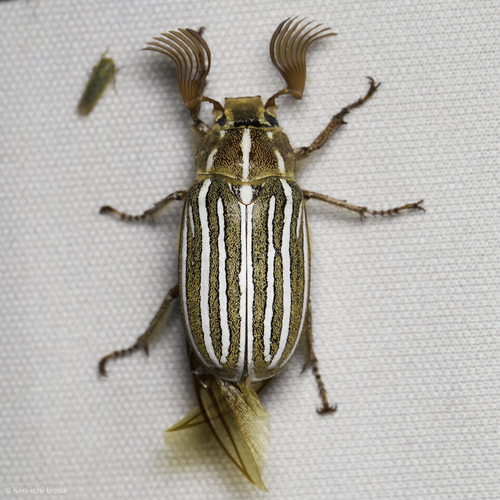 Ten-lined June BeetlePolyphylla (Polyphylla) decemlineata
-
 Pine ChaferPolyphylla (Polyphylla) fullo
- Long-haired ChaferPolyphylla (Polyphylla) crinita
- Polyphylla (Polyphylla) olivieri
- Mt. Hermon June BeetlePolyphylla (Polyphylla) barbata
- Smallpox ChaferPolyphylla (Polyphylla) variolosa
- Death Valley June BeetlePolyphylla (Polyphylla) erratica
- Polyphylla (Polyphylla) occidentalis
Compare
Questions and answers
What is the scientific name of the Eglin Uplands Scarab?
The scientific name of the Eglin Uplands Scarab is Polyphylla (Polyphylla) pubescens. Written with its author, the full name is Polyphylla (Polyphylla) pubescens Cartwright, 1939.
Which family does the Eglin Uplands Scarab belong to?
Polyphylla (Polyphylla) pubescens belongs to the family Scarabaeidae, in the order Coleoptera and the class Insecta.
Where is the Eglin Uplands Scarab found?
Checklists and occurrence records place Polyphylla (Polyphylla) pubescens in 1 country: United States.
What other names does the Eglin Uplands Scarab have?
Polyphylla (Polyphylla) pubescens is also known in English as Eglin Uplands Scarab Beetle and Wooly Gulf Dune Scarab.
Sources
Data
- Catalogue of Life, 2026-10-16 XR cc by
- Global Biodiversity Information Facility CC BY 4.0
- Wikidata CC0
- English Wikipedia CC BY-SA 4.0
- GeoNames CC BY 4.0
- Within the Catalogue of Life, this name comes from World Scarabaeidae Database cc by
References
- Cartwright, O. L. (1939). Eleven new american coleoptera (Scarabaeidae, Cicindelidae). Annals of the Entomological Society of America. Columbus 32(2):353-364. https://doi.org/10.1093/aesa/32.2.353 Link where the name was published
This species in other databases
Page built on 25 November 2026. See how the catalog is made and all sources and licences.
Cite this page
ScientificNames.org. (2026). Polyphylla (Polyphylla) pubescens (Eglin Uplands Scarab). Retrieved November 25, 2026, from https://scientificnames.org/species/polyphylla-polyphylla-pubescens
“Polyphylla (Polyphylla) pubescens (Eglin Uplands Scarab).” ScientificNames.org, 2026, scientificnames.org/species/polyphylla-polyphylla-pubescens. Accessed 25 Nov. 2026.
ScientificNames.org. “Polyphylla (Polyphylla) pubescens (Eglin Uplands Scarab).” Accessed November 25, 2026. https://scientificnames.org/species/polyphylla-polyphylla-pubescens.
@misc{scientificnames_polyphylla_polyphylla_pubescens_eglin_uplands_scarab,
  author = {{ScientificNames.org}},
  title = {Polyphylla (Polyphylla) pubescens (Eglin Uplands Scarab)},
  year = {2026},
  url = {https://scientificnames.org/species/polyphylla-polyphylla-pubescens},
  note = {Accessed 2026-11-25}
}