Species · Molluscs
Channeled Apple Snail Pomacea canaliculata
The scientific name of the Channeled Apple Snail is Pomacea canaliculata. It is a species of mollusc in the family Ampullariidae (apple snail), order Architaenioglossa. The name dates from 1822.
- Scientific name
- Pomacea canaliculata (Lamarck, 1822)
- Common name
- Channeled Apple Snail
- Genus
- Pomacea
- Family
- Ampullariidae (Apple Snail)
- Order
- Architaenioglossa
- Class
- Gastropoda
- Red List category
- LC Least Concern
- Environment
- freshwater
- Recorded in
- 29 countries
- Name status
- accepted in the Catalogue of Life

Overview
Pomacea canaliculata inhabits freshwater lakes, rivers, ponds, swamps, watercourses, wetlands, and agricultural areas.
Written 24 November 2026 from the sources listed below. Each statement was checked against the passage it cites; statements that could not be supported were removed.
Appearance
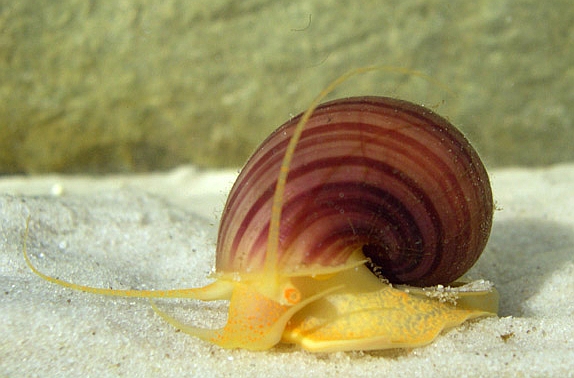
The shell is relatively thick, globose, dextrally coiled, and characterized by a low spire. It is smooth, with fine axial growth lines and occasional growth arrests, and typically displays variable bands of brown, black, and yellowish-tan.[1][2][3]
The shell aperture is large and oval-shaped, with males having a rounder aperture than females. The operculum is moderately thick, corneous, concentric, and ranges from light to dark brown; it completely seals the shell aperture.[4][5][6]
The body ranges in color from yellow to brown and nearly black. Adult females are larger overall than adult males.[7][8]
The shell typically measures 40–60 mm in height and 45–75 mm in width, although it can reach 150 mm in length. Adult shells range from 35 to 165 mm in length.[9][10][11]
Habitat
The species inhabits freshwater lakes, rivers, ponds, swamps, watercourses, wetlands, and agricultural areas. It is restricted to fresh and oligohaline waters in warm-temperate to tropical climates.[12][13][14]
The species tolerates salinities of up to approximately 8 PSU.[15]
Diet
The species consumes floating and submerged higher plants, detritus, and animal matter. Younger individuals primarily consume algae and detritus, whereas older individuals shift toward higher plants.[16][17]
Behaviour
The species is amphibious and possesses both a pulmonary sac and gills. It leaves the water at night to search for fresh vegetation and hides near the water surface during the day.[18][19]
When environmental conditions are harsh, individuals bury themselves in mud and reduce their metabolism.[20]
Reproduction and life cycle
The species is not hermaphroditic and requires male and female individuals for reproduction. It reaches sexual maturity at approximately 2.5 cm in diameter.[21][22]
Copulation can last between 10 and 20 hours. Adult females lay eggs on emergent vegetation at night and may also use rocks and artificial surfaces.[23][24]
Eggs are attached to objects above the water surface, and incubation takes approximately one to two weeks. Adults provide no parental care after laying their eggs.[25][26][27]
Conservation
The species is ranked among the world's 100 worst invasive alien species. It negatively affects native aquatic vegetation and competes with native snails for food in freshwater ecosystems.[28][29]
Uses
The species is consumed as food in China and Thailand. It is also traded as an ornamental animal for freshwater aquaria.[30][31]
The species has been used in some Japanese rice fields to control weeds.[32]
Similar species
Pomacea maculata is a closely similar species with which Pomacea canaliculata has frequently been confused. Genetic methods can help distinguish the two species.[33][34]
Classification of the Channeled Apple Snail
| Kingdom | Animalia |
|---|---|
| Phylum | Mollusca |
| Class | Gastropoda (Gastropod) |
| Subclass | Caenogastropoda |
| Order | Architaenioglossa |
| Superfamily | Ampullarioidea |
| Family | Ampullariidae (Apple Snail) |
| Subfamily | Pomaceinae |
| Genus | Pomacea (Apple Snail) |
| Species | Pomacea canaliculata (Lamarck, 1822) |
Where the Channeled Apple Snail is found
Checklists and occurrence records place Pomacea canaliculata in 29 countries. GBIF holds 7,796 georeferenced records of it.
Countries
- Argentina 992
- Bermuda 7
- Bolivia 53
- Brazil 439
- Chile 18
- China 3,085
- Colombia 33
- Cuba 7
- Dominican Republic 19
- Ecuador 127
- Guatemala 4
- Hong Kong 7
- Indonesia 56
- Japan 420
- Malaysia 95
- Mexico 13
- Myanmar 8
- Panama 3
- Paraguay 35
- Peru 35
- Philippines 50
- Singapore 11
- South Korea 363
- Taiwan 542
- Thailand 28
- Trinidad and Tobago 4
- United States 1,103
- Uruguay 223
- Vietnam 16
Regions and cities with the most records
- California, United States 468
- El Cajon, United States 312
- La Mesa, United States 312
- Buenos Aires, Argentina 293
- Santee, United States 293
- Poway, United States 286
- Chula Vista, United States 238
- National City, United States 238
- San Diego, United States 217
- Taiwan, Taiwan 201
- Arizona, United States 192
- Gyeongsangnam-do, South Korea 190
- Hawaii, United States 174
- Florida, United States 151
- Rio Grande do Sul, Brazil 151
- Phoenix, United States 130
- Scottsdale, United States 130
- Tempe, United States 127
- Tempe Junction, United States 126
- East Los Angeles, United States 110
- Huntington Park, United States 110
- Los Angeles, United States 110
- Mesa, United States 109
- Buenos Aires, Argentina 108
- Lynwood, United States 102
- Yilan, Taiwan 102
- Burbank, United States 99
- Florence-Graham, United States 98
- South Gate, United States 98
- Hawthorne, United States 95
- Avellaneda, Argentina 92
- Glendale, United States 92
- Lanús, Argentina 92
- Remedios de Escalada de San Martín, Argentina 92
- Inglewood, United States 91
- Sarandí, Argentina 90
7 more countries have a few records outside this range
These countries hold a few records of Pomacea canaliculata but lie outside the range the checklists give for it. Such records are often zoo or garden specimens, museum material or vagrants, so the species is not counted as occurring there.
A number beside a place is its count of GBIF occurrence records. A place without a number comes from a checklist alone. Records show where a species has been observed or collected, which can include escapes and vagrants.
Common names
English
- Channeled Apple Snail
- Apple Snail
- Channeled Applesnail
- Golden Apple Snail
- Golden Applesnail
- Golden Kuhol Snail
Names in 14 other languages
- Arabic
- حلزون التفاح الذهبي
- Catalan
- Caragol poma
- Chinese
- 小管福寿螺, 福壽螺
- French
- Escargot-pomme
- German
- Gefurchte Apfelschnecke
- Indonesian
- Keong Mas
- Japanese
- ジャンボタニシ, スクミリンゴガイ
- Korean
- 왕우렁이
- Portuguese
- Aruá
- Russian
- Помацея канальчатая
- Spanish
- caracol manzana
- Tagalog
- kuhol
- Thai
- หอยเชอรี่, หอยเชอร์รีสีทอง
- Vietnamese
- Ốc bươu vàng
Synonyms
8 other scientific names have been used for this species and are now treated as synonyms of Pomacea canaliculata.
- Ampullaria australis A. d'Orbigny, 1835
- Ampullaria dorbignyana R. A. Philippi, 1852
- Ampullaria figulina Spix, 1827
- Ampullaria gualtieri A. d'Orbigny, 1835
- Ampullaria hanleyi Reeve, 1856
- Pomacea (Pomacea) canaliculata (Lamarck, 1822)
- Pomacea canaliculata chaquensis Hylton Scott, 1948
- Ampullaria canaliculata Lamarck, 1822 ambiguous synonym
Related species
-
 Golden Mystery SnailPomacea bridgesii
- Island Apple SnailPomacea maculata
-
 Mystery SnailPomacea diffusa
-
 Cuba ApplesnailPomacea paludosa
- Black ConchPomacea urceus
- Maya ApplesnailPomacea flagellata
- Apple SnailPomacea glauca
- Titan ApplesnailPomacea haustrum
Compare
Questions and answers
What is the scientific name of the Channeled Apple Snail?
The scientific name of the Channeled Apple Snail is Pomacea canaliculata. Written with its author, the full name is Pomacea canaliculata (Lamarck, 1822).
Which family does the Channeled Apple Snail belong to?
Pomacea canaliculata belongs to the family Ampullariidae, in the order Architaenioglossa and the class Gastropoda.
Where is the Channeled Apple Snail found?
Checklists and occurrence records place Pomacea canaliculata in 29 countries, including China, United States, Argentina, Taiwan, Brazil and Japan.
What is the conservation status of the Channeled Apple Snail?
The IUCN Red List category recorded for Pomacea canaliculata is Least Concern (LC).
What other names does the Channeled Apple Snail have?
Pomacea canaliculata is also known in English as Apple Snail, Channeled Applesnail, Golden Apple Snail, Golden Applesnail and Golden Kuhol Snail.
Why are apple snails a problem?
The Channeled Apple Snail negatively affects native aquatic vegetation and competes with native snails for food in freshwater ecosystems. It can also prey on adults, newborn individuals, and egg masses of other freshwater snails. Interactions with the species reduced the fecundity of Physa acuta and Biomphalaria peregrina in the reported study.[28][29][35][36]
Sources
Passages the profile rests on
- The shell is globular and typically displays variable bands of brown, black, and yellowish-tan. Source passage: “Normal coloration typically includes bands of brown, black, and yellowish-tan; color patterns are extremely variable.” — English Wikipedia
- The shell is relatively thick, dextrally coiled, globose, and characterized by a low spire. Source passage: “Pomacea canaliculata (Channeled Apple Snail) has a relatively thick, dextrally coiled and globose shell with a low spire.” — invasions.si.edu
- The shell is smooth and has fine axial growth lines and occasional growth arrests. Source passage: “The shell is smooth, with fine axial growth lines and occasional growth arrests.” — invasions.si.edu
- The shell aperture is large and oval-shaped, with males having a rounder aperture than females. Source passage: “The aperture is large and oval shaped with males having a rounder aperture than females.” — animaldiversity.org
- The operculum is moderately thick, corneous, concentric, and ranges from light to dark brown. Source passage: “The operculum is moderately thick, corneous, concentric and light to dark brown in color.” — animaldiversity.org
- The operculum completely seals the shell aperture. Source passage: “The operculum is corneous (horn-like) in texture and completely seals the aperture.” — invasions.si.edu
- Adult females are larger overall than adult males. Source passage: “However, females in the adult stage are overall larger than males.” — animaldiversity.org
- The snail's body ranges in color from yellow to brown and nearly black. Source passage: “The body of the snail can vary in color from yellow to brown and almost black.” — animaldiversity.org
- The shell can reach 150 mm in length. Source passage: “The size of the shell is up to 150 millimetres (6 in) in length.” — English Wikipedia
- The shell typically measures 40–60 mm in height and 45–75 mm in width, although it can reach 150 mm in length. Source passage: “The shell of this snail is globular, from 40-60 mm high and 45-75 mm wide, but can reach 150 mm in length.” — animaldiversity.org
- Adult shells range from 35 to 165 mm in length. Source passage: “Adult shells range from 35 to 165 mm, and are highly variable in color” — invasions.si.edu
- The species inhabits freshwater lakes, rivers, ponds, and swamps. Source passage: “This species lives in freshwater lake, river, pond and swamp habitats” — English Wikipedia
- The species occupies freshwater lakes, watercourses, wetlands, and agricultural areas. Source passage: “This species is found in a variety of freshwater areas such as lakes, water courses, wetlands and agricultural areas.” — animaldiversity.org
- The species is restricted to fresh and oligohaline waters in warm-temperate to tropical climates. Source passage: “Pomacea canaliculata is limited to fresh and oligohaline waters in warm-temperate to tropical climates.” — invasions.si.edu
- The species tolerates salinities of up to approximately 8 PSU. Source passage: “The upper experimental salinity limit was is ~8 PSU” — invasions.si.edu
- The species consumes floating and submerged higher plants, detritus, and animal matter. Source passage: “feeding on vegetal (primarily macrophytophagous, feeding on floating or submersed higher plants), detrital, and animal matter.” — English Wikipedia
- Younger individuals primarily consume algae and detritus, whereas older individuals shift toward higher plants. Source passage: “with younger smaller individuals feeding on algae and detritus, and older, bigger (15 millimetres (19⁄32 in) and above) individuals later shifting to higher plants.” — English Wikipedia
- The species leaves the water at night to search for fresh vegetation and hides near the water surface during the day. Source passage: “The snail leaves the water for land in search of fresh vegetation at night, and remains hidden near the surface of water during the day.” — animaldiversity.org
- The species is amphibious and possesses both a pulmonary sac and gills. Source passage: “Apple Snails are obligate air-breathers and have a pulmonary sac as well as a gill, and are amphibious in their habits” — invasions.si.edu
- When environmental conditions are harsh, individuals bury themselves in mud and reduce their metabolism. Source passage: “When not reproducing because of harsh environmental conditions the channeled apple snails bury themselves in mud and decrease their metabolism while waiting for conditions to improve.” — animaldiversity.org
- The species reaches sexual maturity at approximately 2.5 cm in diameter. Source passage: “Pomacea canaliculata becomes sexually mature when 2.5 cm in diameter.” — animaldiversity.org
- The species is not hermaphroditic and requires male and female individuals for reproduction. Source passage: “Unlike most other snails, P. canaliculata is not hermaphroditic.” — animaldiversity.org
- Adult females lay eggs on emergent vegetation at night and may also use rocks and artificial surfaces. Source passage: “Adult females oviposit on emergent vegetation at night, but will also lay their eggs on rocks and manmade surfaces like boats.” — English Wikipedia
- Copulation can last between 10 and 20 hours. Source passage: “Intercourse can last 10-20 hours (and males fast during this time)” — animaldiversity.org
- Eggs are attached to objects above the water surface. Source passage: “Eggs are reddish in color and loosely attached to each other, and are attached to an object above surface.” — animaldiversity.org
- Egg incubation takes approximately one to two weeks. Source passage: “Eggs incubate from one to two weeks” — animaldiversity.org
- Adults provide no parental care after laying their eggs. Source passage: “There is no parental care by adult channeled apple snails after eggs are laid.” — animaldiversity.org
- The species is ranked among the world's 100 worst invasive alien species. Source passage: “This species is considered to be in the top 100 of the "World's Worst Invasive Alien Species".” — English Wikipedia
- The species negatively affects native aquatic vegetation and competes with native snails for food in freshwater ecosystems. Source passage: “In wetlands and natural freshwater systems they compete with native snails for food and cause destruction of native aquatic vegetation.” — animaldiversity.org
- The species is consumed as food in China and Thailand. Source passage: “However, they are cooked and eaten in parts of Asia such as China and Thailand.” — animaldiversity.org
- The species is traded as an ornamental animal for freshwater aquaria. Source passage: “It is a part of the ornamental pet trade for freshwater aquaria.” — English Wikipedia
- The species has been used in some Japanese rice fields to control weeds. Source passage: “In some paddy fields in Japan, P. canaliculata is used to control weeds by allowing the snail to eat them.” — English Wikipedia
- Pomacea maculata is a closely similar species with which P. canaliculata has frequently been confused. Source passage: “The two species are very similar, and were once treated as synonyms, and are still frquently misidentified.” — invasions.si.edu
- Genetic methods can help distinguish P. canaliculata from P. maculata. Source passage: “Genetic methods are useful in separating the two species” — invasions.si.edu
- The species can prey on adults, newborn individuals, and egg masses of other freshwater snails. Source passage: “On the other hand, it has been shown that P. canaliculata is also able to prey on adults, newborn, and egg masses of other snails” — pmc.ncbi.nlm.nih.gov
- Interactions with P. canaliculata reduced the fecundity of Physa acuta and Biomphalaria peregrina in the reported study. Source passage: “Fecundity was reduced in P. acuta and B. peregrina by combined contact and distant effects” — pmc.ncbi.nlm.nih.gov
- The species' native distribution includes Argentina, Bolivia, Paraguay, Uruguay, and Brazil. Source passage: “The native distribution of P. canaliculata is basically tropical and subtropical, including Argentina, Bolivia, Paraguay, Uruguay, and Brazil.” — English Wikipedia
Data
- Catalogue of Life, 2026-10-16 XR cc by
- Global Biodiversity Information Facility CC BY 4.0
- Wikidata CC0
- GeoNames CC BY 4.0
- Wikimedia Commons per image; credit shown with each image
- Within the Catalogue of Life, this name comes from World Register of Marine Species cc by
References
- Lamarck JPBA de M. 1822. Histoire naturelle des Animaux sans Vertebres 7. Verdiere, Paris; 711 pp. where the name was published
This species in other databases
Page built on 24 November 2026. See how the catalog is made and all sources and licences.
Cite this page
ScientificNames.org. (2026). Pomacea canaliculata (Channeled Apple Snail). Retrieved November 24, 2026, from https://scientificnames.org/species/pomacea-canaliculata
“Pomacea canaliculata (Channeled Apple Snail).” ScientificNames.org, 2026, scientificnames.org/species/pomacea-canaliculata. Accessed 24 Nov. 2026.
ScientificNames.org. “Pomacea canaliculata (Channeled Apple Snail).” Accessed November 24, 2026. https://scientificnames.org/species/pomacea-canaliculata.
@misc{scientificnames_pomacea_canaliculata_channeled_apple_snail,
  author = {{ScientificNames.org}},
  title = {Pomacea canaliculata (Channeled Apple Snail)},
  year = {2026},
  url = {https://scientificnames.org/species/pomacea-canaliculata},
  note = {Accessed 2026-11-24}
}