Species · Birds
Allen's Gallinule Porphyrio alleni
The scientific name of the Allen's Gallinule is Porphyrio alleni. It is a species of bird in the family Rallidae (rail), order Gruiformes. The name dates from 1842.
- Scientific name
- Porphyrio alleni Thomson, 1842
- Common name
- Allen's Gallinule
- Genus
- Porphyrio
- Family
- Rallidae (Rail)
- Order
- Gruiformes
- Class
- Aves
- Red List category
- LC Least Concern
- Environment
- freshwater, terrestrial
- Recorded in
- 39 countries
- Name status
- accepted in the Catalogue of Life

Overview
Porphyrio alleni occurs year-round in marshes and lakes in Sub-Saharan Africa. It has a short red bill, a greenish back, purple upperparts, red legs and long toes.
Written 26 November 2026 from the sources listed below. Each statement was checked against the passage it cites; statements that could not be supported were removed.
Appearance
Allen's Gallinule has a short red bill, a greenish back and purple upperparts. Its legs are red, its toes are long, and its short tail is white with a dark central bar on the underside.[1][2][3]
Diet
Allen's Gallinule has an omnivorous diet that mainly consists of insects and aquatic animals. Its diet also includes flowers.[4][5][6]
Behaviour
Individuals nod their heads while swimming. When feeding, they probe mud or shallow water with their bills and also locate food visually.[7][8][9]
Allen's Gallinule is particularly secretive during the breeding season, when individuals are more often heard than seen. It is noisy during this period, producing a sharp, nasal pruk call.[10][11][12][13]
The species undertakes seasonal movements as a partial migrant. Individuals can be easier to observe during migration or wintering.[14][15]
Reproduction and life cycle
Allen's Gallinule builds floating nests in marshes and swamps.[16]
Classification of the Allen's Gallinule
| Kingdom | Animalia |
|---|---|
| Phylum | Chordata |
| Subphylum | Vertebrata |
| Infraphylum | Gnathostomata |
| Parvphylum | Osteichthyes |
| Megaclass | Tetrapoda |
| Class | Aves (Bird) |
| Order | Gruiformes (Rails) |
| Family | Rallidae (Rail) |
| Genus | Porphyrio (Swamphen) |
| Species | Porphyrio alleni Thomson, 1842 |
Where the Allen's Gallinule is found
Checklists and occurrence records place Porphyrio alleni in 39 countries across Africa. GBIF holds 6,643 georeferenced records of it.
Countries
- Angola 52
- Benin 146
- Botswana 460
- Burkina Faso 87
- Cameroon 56
- Chad 17
- Democratic Republic of the Congo 94
- Ethiopia 120
- Gabon 19
- Gambia 166
- Ghana 247
- Guinea 13
- Guinea-Bissau 7
- Ivory Coast 252
- Kenya 613
- Liberia 45
- Madagascar 281
- Malawi 158
- Mali 8
- Mauritania 8
- Mayotte 32
- Morocco 3
- Mozambique 80
- Namibia 459
- Niger 16
- Nigeria 264
- Republic of the Congo 19
- Rwanda 11
- Sao Tome and Principe 16
- Senegal 291
- Sierra Leone 7
- South Africa 1,389
- South Sudan 5
- Sudan 3
- Tanzania 218
- Togo 33
- Uganda 181
- Zambia 428
- Zimbabwe 339
Regions and cities with the most records
- Limpopo, South Africa 646
- North-West, Botswana 355
- Jomvu, Kenya 322
- Mombasa, Kenya 322
- Mombasa County, Kenya 322
- Mtwapa, Kenya 322
- Mazeras, Kenya 320
- Southern Province, Zambia 302
- Mookgophong, South Africa 290
- Saint-Louis, Senegal 285
- Livingstone, Zambia 281
- Victoria Falls, Zimbabwe 264
- KwaZulu-Natal, South Africa 246
- Zambezi Region, Namibia 217
- Western, Ghana 200
- Mpumalanga, South Africa 189
- Comoé District, Ivory Coast 172
- Takoradi, Ghana 172
- Grand-Bassam, Ivory Coast 171
- Sekondi-Takoradi, Ghana 171
- Bonoua, Ivory Coast 168
- North West, South Africa 145
- Sekondi, Ghana 137
- Matabeleland North, Zimbabwe 127
- Western, Gambia 118
- Gunjur, Gambia 116
- Sanyang, Gambia 110
- Baringo, Kenya 106
- Oyo State, Nigeria 102
- Western Cape, South Africa 101
- Awasa, Ethiopia 96
- Saint-Louis, Senegal 93
- Ibadan, Nigeria 91
- Kilifi County, Kenya 91
- Vaalbank, South Africa 87
- Centre, Burkina Faso 82
9 more countries have a few records outside this range
These countries hold a few records of Porphyrio alleni but lie outside the range the checklists give for it. Such records are often zoo or garden specimens, museum material or vagrants, so the species is not counted as occurring there.
Range as the checklists state it
Africa
A number beside a place is its count of GBIF occurrence records. A place without a number comes from a checklist alone. Records show where a species has been observed or collected, which can include escapes and vagrants.
Common names
English
- Allen's Gallinule
- African Purple Gallinule
- Lesser Gallinule
Names in 36 other languages
- Afrikaans
- Kleinkoningriethaan
- Arabic
- دجاجة السلطان ألن, سحنون ألن
- Breton
- Douryar-Allen
- Bulgarian
- Султанка на Алън
- Catalan
- polla blava d'Allen
- Chinese
- 小青水雞, 辉青水鸡
- Czech
- slípka Allenova, slípka modročelá
- Danish
- Lille Sultanhøne
- Dutch
- Afrikaans purperhoen
- Esperanto
- eta porfirio, malgranda porfirio
- Estonian
- aafrika sultantait
- Finnish
- kurnuliejukana
- French
- Poule sultane d'Allen, Talève d'Allen, Talève d’Allen
- German
- Bronze-Sultanshuhn, Bronzesultanshuhn
- Greek
- Αφρικανική Πορφυροπουλάδα, Αφρικανική νερόκοτα
- Hebrew
- פורפיריה אפריקנית, פורפירית אלן
- Hungarian
- afrikai szultántyúk
- Icelandic
- Reyrhæna
- Irish
- Cearcóg ailín
- Italian
- Gallinella minore, Pollo sultano di Allen
- Japanese
- アフリカムラサキバン
- Latvian
- mazā sultānvistiņa
- Lithuanian
- mažoji sultonvištė
- Malagasy
- Talevakely
- Northern Sami
- Afrihkásultánvuonccis
- Norwegian
- afrikapurpurhøne
- Polish
- sułtanka afrykańska
- Portuguese
- Frango-d'água-africano, caimão-de-allen, camão-pequeno
- Russian
- Бронзовая султанка
- Serbian
- Afrička barska kokica
- Slovak
- sultánka belasočelá
- Slovenian
- mala sultanka
- Spanish
- Calamoncillo africano, Pollona Africana
- Swedish
- mindre sultanhöna
- Turkish
- Küçük Sazhorozu
- Ukrainian
- султанка африканська
Synonyms
7 other scientific names have been used for this species and are now treated as synonyms of Porphyrio alleni.
- Gallinula alleni Thomson, TRH, 1842
- Gallinula porphyrio Hartlaub, KJG, 1855
- Porphyrio brehmii Guirao, DA, 1857
- Porphyrio minutus Heuglin, MT, 1863
- Porphyrula alleni (Thomson, 1842)
- Porphyrula alleni alleni Cramp & Simmons (1977-1994)
- Porphyrula alleni alleni Dowsett & Forbes-Watson (1993)
Related species
-
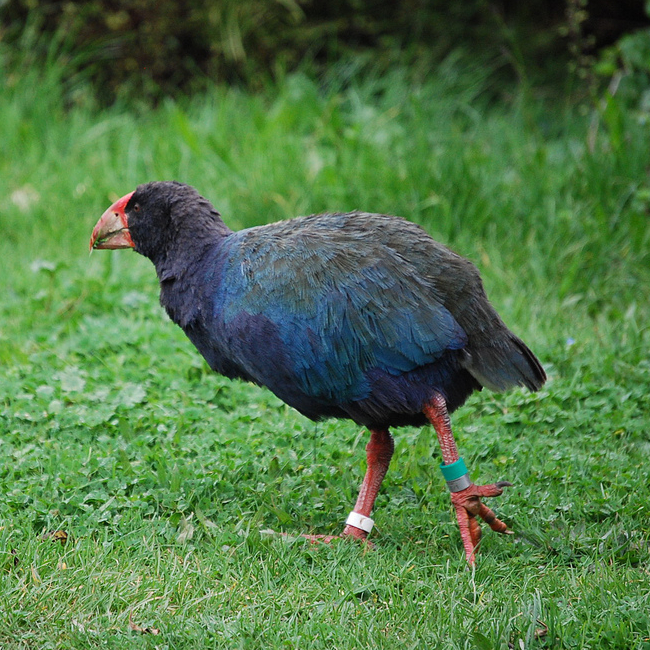 TakahēPorphyrio hochstetteri
-
 Australasian SwamphenPorphyrio melanotus
-
 American Purple GallinulePorphyrio martinica
-
 Western SwamphenPorphyrio porphyrio
-
 Grey-headed SwamphenPorphyrio poliocephalus
-
 North Island TakahēPorphyrio mantelli
-
 African SwamphenPorphyrio madagascariensis
-
 White SwamphenPorphyrio albus
Compare
Questions and answers
What is the scientific name of the Allen's Gallinule?
The scientific name of the Allen's Gallinule is Porphyrio alleni. Written with its author, the full name is Porphyrio alleni Thomson, 1842.
Which family does the Allen's Gallinule belong to?
Porphyrio alleni belongs to the family Rallidae, in the order Gruiformes and the class Aves.
Where is the Allen's Gallinule found?
Checklists and occurrence records place Porphyrio alleni in 39 countries, including South Africa, Kenya, Botswana, Namibia, Zambia and Zimbabwe.
What is the conservation status of the Allen's Gallinule?
The IUCN Red List category recorded for Porphyrio alleni is Least Concern (LC).
What other names does the Allen's Gallinule have?
Porphyrio alleni is also known in English as African Purple Gallinule and Lesser Gallinule.
Sources
Passages the profile rests on
- The species has a short red bill, a greenish back, and purple upperparts. Source passage: “The Allen's gallinule has a short red bill, greenish back and purple upperparts.” — English Wikipedia
- Its legs are red and its toes are long. Source passage: “They have red legs with long toes” — English Wikipedia
- Its short tail is white with a dark central bar on the underside. Source passage: “a short tail which is white with a dark central bar underneath.” — English Wikipedia
- The species has an omnivorous diet. Source passage: “The species is omnivorous” — datazone.birdlife.org
- Its diet includes flowers. Source passage: “its diet consisting of the flowers and” — datazone.birdlife.org
- The species mainly consumes insects and aquatic animals. Source passage: “They mainly eat insects and aquatic animals.” — English Wikipedia
- Individuals nod their heads while swimming. Source passage: “They nod their heads as they swim.” — English Wikipedia
- The species probes mud or shallow water with its bill when feeding. Source passage: “These birds probe with their bill in mud or shallow water” — English Wikipedia
- Individuals also locate food visually. Source passage: “also picking up food by sight.” — English Wikipedia
- The species is particularly secretive during the breeding season. Source passage: “Allen's gallinules are very secretive in the breeding season” — English Wikipedia
- During breeding, individuals are more often heard than seen. Source passage: “and are mostly heard rather than seen.” — English Wikipedia
- The species is noisy during the breeding season. Source passage: “They are then rather noisy birds” — English Wikipedia
- Its call is a sharp, nasal pruk. Source passage: “with a sharp nasal pruk call.” — English Wikipedia
- The species undertakes seasonal movements as a partial migrant. Source passage: “This species is partially migratory, undertaking seasonal movements.” — English Wikipedia
- Individuals can be easier to observe during migration or wintering. Source passage: “They can be easier to see on migration or when wintering.” — English Wikipedia
- The species builds floating nests in marshes and swamps. Source passage: “They build a floating nest in marshes and swamps” — English Wikipedia
Data
- Catalogue of Life, 2026-10-16 XR cc by
- Global Biodiversity Information Facility CC BY 4.0
- Wikidata CC0
- GeoNames CC BY 4.0
- Wikimedia Commons per image; credit shown with each image
- Within the Catalogue of Life, this name comes from The Integrated Taxonomic Information System cc0
References
- Thomson, T. R. H. (1842) Description of a new species of Genetta, and two species of birds from Western Africa. Annals and Magazine of Natural History, Series 1, 10 (64), 203 - 205. https: // doi. org / 10.1080 / 03745484209445224 where the name was published
- Peters, & James Lee. (1934). Check-List of Birds of the World, Vol. 2.
- Taylor, & Barry. (1988). Rails: A Guide to the Rails, Crakes, Gallinules and Coots of the World.
- Gill, Frank, & and Minturn Wright. (2006). Birds of the World: Recommended English Names.
- Dickinson, E. C., and J. V. Remsen Jr., eds. (2013). The Howard and Moore Complete Checklist of the Birds of the World, 4th Edition, Vol. 1 Non-Passerines.
This species in other databases
- Catalogue of Life 4LZ54
- Wikidata Q746632
- iNaturalist 522
- WoRMS urn:lsid:marinespecies.org:taxname:567855
- Avibase allgal1
Page built on 29 November 2026. See how the catalog is made and all sources and licences.
Cite this page
ScientificNames.org. (2026). Porphyrio alleni (Allen's Gallinule). Retrieved November 29, 2026, from https://scientificnames.org/species/porphyrio-alleni
“Porphyrio alleni (Allen's Gallinule).” ScientificNames.org, 2026, scientificnames.org/species/porphyrio-alleni. Accessed 29 Nov. 2026.
ScientificNames.org. “Porphyrio alleni (Allen's Gallinule).” Accessed November 29, 2026. https://scientificnames.org/species/porphyrio-alleni.
@misc{scientificnames_porphyrio_alleni_allens_gallinule,
  author = {{ScientificNames.org}},
  title = {Porphyrio alleni (Allen's Gallinule)},
  year = {2026},
  url = {https://scientificnames.org/species/porphyrio-alleni},
  note = {Accessed 2026-11-29}
}