Species · Mammals
Thomas's Langur Presbytis thomasi
The scientific name of the Thomas's Langur is Presbytis thomasi. It is a species of mammal in the family Cercopithecidae (old world monkey), order Primates. The name dates from 1893.
- Scientific name
- Presbytis thomasi (Collett, 1893)
- Common name
- Thomas's Langur
- Genus
- Presbytis
- Family
- Cercopithecidae (Old World Monkey)
- Order
- Primates
- Class
- Mammalia
- Red List category
- VU Vulnerable
- Recorded in
- 1 country
- Name status
- accepted in the Catalogue of Life

Overview
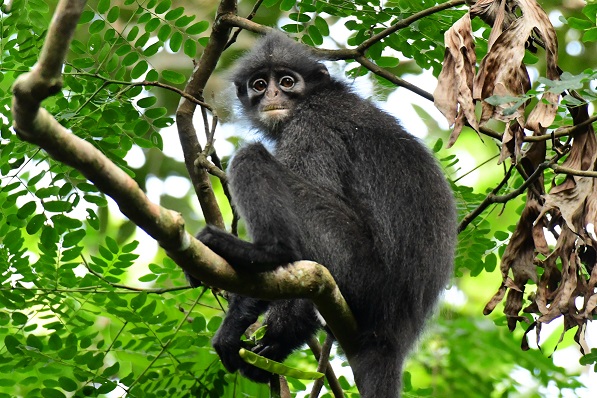
Thomas's Langur is a primate belonging to the family Cercopithecidae. It is endemic to northern Sumatra, Indonesia, where it occurs in Gunung Leuser National Park. It is distinguished by a raised head crown resembling a mohawk, with a white front and a dark grey stripe.
Written 26 November 2026 from the sources listed below. Each statement was checked against the passage it cites; statements that could not be supported were removed.
Appearance
Thomas's Langur has hair on its head that rises into a crown resembling a mohawk. The crown is white at the front and has a dark grey stripe running down it.[1][2]
It has two tufts of fur extending from either side of its face. Its belly is cream-colored, its back is grey, and its eyes are amber with grey outlines.[3][4][5]
Juveniles have creamy white fur.[6]
Habitat
Thomas's Langur is endemic to northern Sumatra, Indonesia. Its natural habitat consists of subtropical or tropical dry forests.[7][8]
The species does not occur south or east of Lake Toba or the Alas and Wampu rivers. Its geographic range is fairly limited.[9][10]
It occurs in Gunung Leuser National Park, including substantial populations at Ketambe and Bukit Lawang.[11]
Diet
Thomas's Langur primarily feeds on leaves. Its diet also includes fruit, flowers, toadstools and snails.[12][13]
The species generally eats unripe fruit with high pH levels. It drinks water collected in tree holes and from small pools.[14][15]
Behaviour
Thomas's Langur disperses seeds and pollinates flowers of plants that it consumes.[16]
Thomas's Langurs become habituated to tourists visiting Gunung Leuser National Park.[17]
Conservation
Thomas's Langur is threatened by habitat loss. Ongoing deforestation in the Leuser and Ulu Massen Ecosystems threatens the species with extinction.[18][19]
The IUCN classifies Thomas's Langur as Vulnerable. Its population has declined by thirty percent over the last few decades.[20][21]
The species is protected under Indonesian law and listed under CITES Appendix II.[22]
Habitat erosion caused by human activity brings the species into conflict with people and leads it into croplands. Langurs entering croplands are affected by the illegal pet trade.[23][24]
Farmers consider the species a pest and kill large numbers using firearms.[25]
People feed Thomas's Langurs and other primates in Gunung Leuser National Park despite such feeding being discouraged and prohibited. Feeding the langurs in the park has negative consequences for wildlife and people.[26][27]
Uses
Parts of Thomas's Langurs are sold for medicinal purposes.[28]
Classification of the Thomas's Langur
| Kingdom | Animalia |
|---|---|
| Phylum | Chordata |
| Subphylum | Vertebrata |
| Infraphylum | Gnathostomata |
| Parvphylum | Osteichthyes |
| Megaclass | Tetrapoda |
| Class | Mammalia (Mammal) |
| Subclass | Theria |
| Infraclass | Eutheria |
| Order | Primates (Primate) |
| Suborder | Haplorrhini |
| Infraorder | Simiiformes |
| Superfamily | Cercopithecoidea |
| Family | Cercopithecidae (Old World Monkey) |
| Subfamily | Colobinae (Colobines) |
| Tribe | Presbytini (Asian Colobines) |
| Genus | Presbytis (Surilis) |
| Species | Presbytis thomasi (Collett, 1893) |
Where the Thomas's Langur is found
Checklists and occurrence records place Presbytis thomasi in 1 country across Asia. GBIF holds 541 georeferenced records of it.
Countries
Regions and cities with the most records
Range as the checklists state it
Southern Asia
A number beside a place is its count of GBIF occurrence records. A place without a number comes from a checklist alone. Records show where a species has been observed or collected, which can include escapes and vagrants.
Common names
English
- Thomas's Langur
- North Sumatran Leaf Monkey
- Sumatran Grizzled Langur
- Thomas S Langur
- Thomas' Langur
- Thomas's Leaf Monkey
- Thomas’s Langur
Names in 15 other languages
- Arabic
- لنغور توماس
- Chinese
- 托馬斯氏葉猴
- Czech
- hulman ebenový
- Dutch
- Thomaslangoer
- Finnish
- sumatransureli
- French
- Semnopithèque De Thomas
- German
- Thomas-Langur
- Greek
- Λανγκούρ της Βόρειας Σουμάτρας
- Indonesian
- Kedih
- Italian
- Presbite di Thomas
- Japanese
- トーマスリーフモンキー
- Polish
- langur posiwiały
- Portuguese
- Surili-grisalho-de-Sumatra
- Russian
- Лангур Томаса
- Spanish
- Langur De Thomas, Surili del Norte de Sumatra
Synonyms
3 other scientific names have been used for this species and are now treated as synonyms of Presbytis thomasi.
- Presbytis nubilus Miller, 1942
- Presbytis thomasi nubilus Miller, 1942
- Semnopithecus thomasi Collett, 1893
Related species
-
 Raffles' Banded LangurPresbytis femoralis
-
 Miller's LangurPresbytis canicrus
-
 Javan SuriliPresbytis comata
-
 Maroon Leaf MonkeyPresbytis rubicunda
-
 White-thighed SuriliPresbytis siamensis
-
 Sarawak SuriliPresbytis chrysomelas
- Mentawai LangurPresbytis potenziani
-
 Black-crested Sumatran LangurPresbytis melalophos
Compare
Questions and answers
What is the scientific name of the Thomas's Langur?
The scientific name of the Thomas's Langur is Presbytis thomasi. Written with its author, the full name is Presbytis thomasi (Collett, 1893).
Which family does the Thomas's Langur belong to?
Presbytis thomasi belongs to the family Cercopithecidae, in the order Primates and the class Mammalia.
Where is the Thomas's Langur found?
Checklists and occurrence records place Presbytis thomasi in 1 country: Indonesia.
What is the conservation status of the Thomas's Langur?
The IUCN Red List category recorded for Presbytis thomasi is Vulnerable (VU).
What other names does the Thomas's Langur have?
Presbytis thomasi is also known in English as North Sumatran Leaf Monkey, Sumatran Grizzled Langur, Thomas S Langur, Thomas' Langur, Thomas's Leaf Monkey and Thomas’s Langur.
Sources
Passages the profile rests on
- The hair on its head rises into a crown resembling a mohawk. Source passage: “The hair on the top of the head rises in a crown, resembling a mohawk;” — English Wikipedia
- Its head crown is white at the front and has a dark grey stripe running down it. Source passage: “this crown is white at the front with a dark grey stripe running down.” — English Wikipedia
- It has two tufts of fur extending from either side of its face. Source passage: “Two tufts of fur extend on either side of its face.” — English Wikipedia
- Its belly is cream-colored and its back is grey. Source passage: “The belly is cream colored and the back of the animal is grey.” — English Wikipedia
- Its eyes are amber with grey outlines. Source passage: “It has amber eyes with grey outlines around the eyes.” — English Wikipedia
- Juveniles have creamy white fur. Source passage: “Juveniles have creamy white fur.” — English Wikipedia
- Thomas's langur is endemic to northern Sumatra, Indonesia. Source passage: “It is endemic to northern Sumatra, Indonesia” — English Wikipedia
- Its natural habitat consists of subtropical or tropical dry forests. Source passage: “Its natural habitat is subtropical or tropical dry forests.” — English Wikipedia
- The species does not occur south or east of Lake Toba or the Alas and Wampu rivers. Source passage: “not living to the south and east of Lake Toba and the Alas and Wampu rivers.” — English Wikipedia
- The geographic range of Thomas's langur is fairly limited. Source passage: “However, its geographic range is fairly limited.” — animaldiversity.org
- The species occurs in Gunung Leuser National Park, including substantial populations at Ketambe and Bukit Lawang. Source passage: “It can be found in Gunung Leuser National Park, where substantial populations exist in Ketambe and Bukit Lawang.” — English Wikipedia
- Thomas's langur primarily feeds on leaves. Source passage: “Although primarily folivorous, Thomas's langur also eats fruit” — English Wikipedia
- Its diet also includes fruit, flowers, toadstools and snails. Source passage: “also eats fruit, flowers, and occasionally toadstools and snails.” — English Wikipedia
- The species generally eats unripe fruit with high pH levels. Source passage: “which is usually unripe and with high pH levels” — English Wikipedia
- Thomas's langur drinks water collected in tree holes and from small pools. Source passage: “also drinks from holes in trees where water collects or from small pools.” — English Wikipedia
- The species disperses seeds and pollinates flowers of plants that it consumes. Source passage: “Thomas's langur disperses seeds and pollinates flowers of plants that they eat.” — English Wikipedia
- Thomas's langurs become habituated to tourists visiting Gunung Leuser National Park. Source passage: “Thomas's langur is becoming habituated to tourists who visit Gunung Leuser National Park.” — English Wikipedia
- Thomas's langur is threatened by habitat loss. Source passage: “It is threatened by habitat loss.” — English Wikipedia
- Ongoing deforestation in the Leuser and Ulu Massen Ecosystems threatens the species with extinction. Source passage: “Due to the ongoing deforestation of the Leuser and Ulu Massen Ecosystems in Northern Sumatra, Thomas's langur is threatened with extinction.” — English Wikipedia
- The IUCN classifies Thomas's langur as Vulnerable. Source passage: “and as Vulnerable by the IUCN.” — English Wikipedia
- Its population has declined by thirty percent over the last few decades. Source passage: “the population of Thomas's langur has declined by thirty percent in the last few decades.” — English Wikipedia
- The species is protected under Indonesian law and listed under CITES Appendix II. Source passage: “It is protected by Indonesian Law under Cites Appendix II” — English Wikipedia
- Habitat erosion caused by human activity brings the species into conflict with people and leads it into croplands. Source passage: “As its habitat continues to erode due to human activity, it comes into conflict with people, moving into croplands” — English Wikipedia
- Thomas's langurs entering croplands are affected by the illegal pet trade. Source passage: “where it becomes victim of the illegal pet trade” — English Wikipedia
- Farmers consider the species a pest and kill large numbers using firearms. Source passage: “is seen as a pest by farmers, who cull them in large numbers with firearms.” — English Wikipedia
- People feed Thomas's langurs and other primates in Gunung Leuser National Park despite such feeding being discouraged and prohibited. Source passage: “Though discouraged and prohibited, humans feed Thomas's langurs and other primates in the park” — English Wikipedia
- Feeding the langurs in the park has negative consequences for wildlife and people. Source passage: “causing negative consequences for wildlife and people.” — English Wikipedia
- Parts of Thomas's langurs are sold for medicinal purposes. Source passage: “Thomas's langur is also dismembered and its parts sold for medicine.” — English Wikipedia
Data
- Catalogue of Life, 2026-10-16 XR cc by
- Global Biodiversity Information Facility CC BY 4.0
- Wikidata CC0
- GeoNames CC BY 4.0
- Wikimedia Commons per image; credit shown with each image
- Within the Catalogue of Life, this name comes from The Integrated Taxonomic Information System cc0
References
- Proc. Zool. Soc. Lond. vol.1892 p.613 where the name was published
- Wilson, Don E., and DeeAnn M. Reeder, eds. (1993). Mammal Species of the World: A Taxonomic and Geographic Reference, 2nd Ed., 3rd Printing.
- Wilson, Don E., and F. Russell Cole. (2000). Common Names of Mammals of the World.
- Wilson, Don E., and DeeAnn M. Reeder, eds. (2005). Mammal Species of the World: A Taxonomic and Geographic Reference, 3rd Ed., Vol. 1.
- Mittermeier, Rusell A., Anthony B. Rylands, and Don E. Wilson, eds. (2013). Handbook of the Mammals of the World. Volume 3. Primates.
This species in other databases
Page built on 27 November 2026. See how the catalog is made and all sources and licences.
Cite this page
ScientificNames.org. (2026). Presbytis thomasi (Thomas's Langur). Retrieved November 27, 2026, from https://scientificnames.org/species/presbytis-thomasi
“Presbytis thomasi (Thomas's Langur).” ScientificNames.org, 2026, scientificnames.org/species/presbytis-thomasi. Accessed 27 Nov. 2026.
ScientificNames.org. “Presbytis thomasi (Thomas's Langur).” Accessed November 27, 2026. https://scientificnames.org/species/presbytis-thomasi.
@misc{scientificnames_presbytis_thomasi_thomass_langur,
  author = {{ScientificNames.org}},
  title = {Presbytis thomasi (Thomas's Langur)},
  year = {2026},
  url = {https://scientificnames.org/species/presbytis-thomasi},
  note = {Accessed 2026-11-27}
}