Species · Insects
Cromwell Chafer Beetle Prodontria lewisi
The scientific name of the Cromwell Chafer Beetle is Prodontria lewisi. It is a species of insect in the family Scarabaeidae (dung beetles), order Coleoptera. The name dates from 1904.
- Scientific name
- Prodontria lewisi Broun, 1904
- Common name
- Cromwell Chafer Beetle
- Genus
- Prodontria
- Family
- Scarabaeidae (Dung Beetles)
- Order
- Coleoptera
- Class
- Insecta
- Red List category
- CR Critically Endangered
- Recorded in
- 1 country
- Name status
- accepted in the Catalogue of Life
Overview
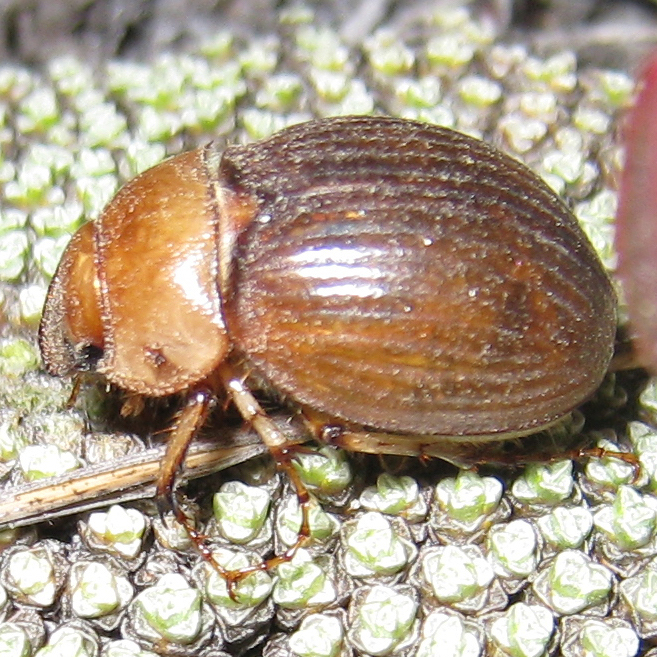
The Cromwell Chafer Beetle (Prodontria lewisi Broun, 1904) is an insect in the family Scarabaeidae, order Coleoptera and class Insecta. It lives in low sand dunes on the Cromwell river terrace known as Cromwell shallow sand. The species is flightless and adapted to burrowing in inland sand dunes.
Written 26 November 2026 from the sources listed below. Each statement was checked against the passage it cites; statements that could not be supported were removed.
Appearance
The beetle has pale reddish-brown wing cases that are strongly convex and marked by deep grooves running lengthwise.[1]
Females have longer and wider bodies than males. Males have longer hind feet and tibiae than females.[2][3]
Habitat
The species inhabits low sand dunes on the Cromwell river terrace known as Cromwell shallow sand. The dunes were formed from loess originally deposited by the Clutha River.[4][5]
The beetles live underground and are adapted to burrowing in inland sand dunes.[6][7]
Diet
Larvae feed on plant roots while buried in sand. Adult beetles feed on lichens and plants.[8][9]
Adult beetles feed primarily on speedwell (Veronica arvensis), sheep's sorrel (Rumex acetosella), and cushion plant (Raoulia australis).[10]
Behaviour
The species is flightless. Adult beetles emerge for several hours on humid nights during spring and summer.[11][12]
Adult emergence coincides with feeding and mating. Males emerge earlier in the year than females on average.[13][14]
Reproduction and life cycle
The larval stage lasts at least one year.[15]
Conservation
The species is naturally restricted to Central Otago, New Zealand. Its entire natural range was probably no larger than 500 hectares.[16][17]
The species is currently restricted to an 81-hectare nature reserve between Bannockburn and Cromwell. Surveys indicate that the beetles occupy only 12% of the habitat available within the reserve.[18][19]
The Cromwell Chafer Beetle Nature Reserve was established in 1983. At the time of its establishment, it was the world's only protected area created exclusively for an invertebrate.[20][21]
The species was classified as Critically Endangered on the IUCN Red List in 1996. Its Department of Conservation status is Nationally Endangered.[22][23]
Introduced predators are among the principal threats to the species. Introduced hedgehogs and little owls prey on the beetle, while European earwigs are a possible predator.[24][25]
The introduced Australian redback spider is a predator of particular concern. Redback spiders established themselves in Central Otago during the 1980s.[26][27]
Redback spiders shelter in rabbit holes within the reserve and may kill hundreds of chafer beetles annually. The Department of Conservation controls rabbits and destroys rabbit burrows in the reserve.[28][29]
An annual population survey is conducted jointly by DOC and AgResearch. The survey examines 670 sand core samples for beetle larvae, and the number of individuals detected is usually very low.[30][31][32]
The population was estimated at approximately 3,000 individuals in 2012.[33]
Construction of the Clyde Dam in 1979 and the subsequent formation of Lake Dunstan destroyed much of the beetle's original habitat. A population north of Cromwell was destroyed when a nine-hole golf course was expanded to 18 holes.[34][35]
Beetles were captured and relocated from an undeveloped block in Cromwell during 1975–76 before the land was cleared for housing.[36]
Classification of the Cromwell Chafer Beetle
| Kingdom | Animalia |
|---|---|
| Phylum | Arthropoda |
| Subphylum | Hexapoda |
| Class | Insecta (Insect) |
| Order | Coleoptera (Beetle) |
| Suborder | Polyphaga |
| Series | Staphyliniformia |
| Superfamily | Scarabaeoidea |
| Family | Scarabaeidae (Dung Beetles) |
| Subfamily | Sericoidinae |
| Tribe | Liparetrini |
| Genus | Prodontria |
| Species | Prodontria lewisi Broun, 1904 |
Where the Cromwell Chafer Beetle is found
Checklists and occurrence records place Prodontria lewisi in 1 country across Oceania. GBIF holds 8 georeferenced records of it.
Countries
Regions and cities with the most records
Range as the checklists state it
Australian(New Zealand)
A number beside a place is its count of GBIF occurrence records. A place without a number comes from a checklist alone. Records show where a species has been observed or collected, which can include escapes and vagrants.
Common names
English
- Cromwell Chafer Beetle
- Cromwell Chafer
Related species
-
 Prodontria longitarsis
- Alexandra ChaferProdontria modesta
- Prodontria capito
- Prodontria grandis
- Prodontria jenniferae
- Prodontria matagouriae
- Prodontria minuta
- Prodontria montis
Compare
Questions and answers
What is the scientific name of the Cromwell Chafer Beetle?
The scientific name of the Cromwell Chafer Beetle is Prodontria lewisi. Written with its author, the full name is Prodontria lewisi Broun, 1904.
Which family does the Cromwell Chafer Beetle belong to?
Prodontria lewisi belongs to the family Scarabaeidae, in the order Coleoptera and the class Insecta.
Where is the Cromwell Chafer Beetle found?
Checklists and occurrence records place Prodontria lewisi in 1 country: New Zealand.
What is the conservation status of the Cromwell Chafer Beetle?
The IUCN Red List category recorded for Prodontria lewisi is Critically Endangered (CR).
What other names does the Cromwell Chafer Beetle have?
Prodontria lewisi is also known in English as Cromwell Chafer.
Where are chafer beetles found?
The Cromwell Chafer Beetle is naturally restricted to Central Otago, New Zealand. It currently occurs in an 81-hectare nature reserve between Bannockburn and Cromwell, where it inhabits low sand dunes on the Cromwell river terrace known as Cromwell shallow sand.[4][16][18]
Sources
Passages the profile rests on
- The beetle has pale reddish-brown wing cases that are strongly convex and marked by deep grooves running lengthwise. Source passage: “This large beetle has pale reddish-brown elytra which are strongly convex and with deep groves passing along their length.” — English Wikipedia
- Females have longer and wider bodies than males. Source passage: “Females are longer and wider than males” — English Wikipedia
- Males have longer hind feet and tibiae than females. Source passage: “males have a longer hind foot and tibia.” — English Wikipedia
- The species inhabits low sand dunes on the Cromwell river terrace known as Cromwell shallow sand. Source passage: “The habitat of this beetle is an area of low sand dunes on the Cromwell river terrace, known as the "Cromwell shallow sand".” — English Wikipedia
- The sand dunes in its habitat were formed from loess originally deposited by the Clutha River. Source passage: “The dunes are formed by loess originally deposited by the Clutha River.” — English Wikipedia
- The beetles live underground. Source passage: “The beetles live underground.” — English Wikipedia
- The species is adapted to burrowing in inland sand dunes. Source passage: “As P. lewisii seems to be adapted to burrowing in these inland dunes” — English Wikipedia
- Larvae feed on plant roots while buried in sand. Source passage: “living buried in the sand and feeding on plant roots.” — English Wikipedia
- Adult beetles feed on lichens and plants. Source passage: “Adults emerge on humid nights on spring and summer for a few hours to feed on lichens and plants” — English Wikipedia
- Adult beetles feed primarily on speedwell (Veronica arvensis), sheep's sorrel (Rumex acetosella), and cushion plant (Raoulia australis). Source passage: “mostly speedwell (Veronica arvensis), sheep's sorrel (Rumex acetosella), and cushion plant (Raoulia australis)” — English Wikipedia
- The species is flightless. Source passage: “is a species of flightless beetle in the family Scarabaeidae.” — English Wikipedia
- Adult beetles emerge for several hours on humid nights during spring and summer. Source passage: “Adults emerge on humid nights on spring and summer for a few hours” — English Wikipedia
- Adult emergence coincides with feeding and mating. Source passage: “to feed on lichens and plants – mostly speedwell (Veronica arvensis), sheep's sorrel (Rumex acetosella), and cushion plant (Raoulia australis) – and to mate.” — English Wikipedia
- Males emerge earlier in the year than females on average. Source passage: “Males emerge slightly earlier in the year than females, on average.” — English Wikipedia
- The larval stage lasts at least one year. Source passage: “They spend at least one year as larvae” — English Wikipedia
- The species is naturally restricted to Central Otago, New Zealand. Source passage: “It is found in just one spot in Central Otago, New Zealand” — English Wikipedia
- The species' entire natural range was probably no larger than 500 hectares. Source passage: “its entire natural range was probably never more than 500 hectares.” — English Wikipedia
- The species is currently restricted to an 81-hectare nature reserve between Bannockburn and Cromwell. Source passage: “The species is currently restricted to an 81 hectare nature reserve, between Bannockburn and Cromwell.” — English Wikipedia
- Surveys indicate that the beetles occupy only 12% of the habitat available within the reserve. Source passage: “Regular surveys of the beetle suggest they are only using 12% of the habitat available in the reserve.” — English Wikipedia
- The Cromwell Chafer Beetle Nature Reserve was established in 1983. Source passage: “in 1983 it was gazetted as the Cromwell Chafer Beetle Nature Reserve” — English Wikipedia
- The reserve was the world's only protected area created exclusively for an invertebrate at the time of its establishment. Source passage: “at the time, the only reserve in the world created solely for an invertebrate.” — English Wikipedia
- The species was classified as Critically Endangered on the IUCN Red List in 1996. Source passage: “In 1996, after years of being classed as Vulnerable, the Cromwell chafer was declared Critically Endangered on the IUCN Red List.” — English Wikipedia
- The species has a Department of Conservation status of Nationally Endangered. Source passage: “It currently has the Department of Conservation status Nationally Endangered.” — English Wikipedia
- Introduced predators are currently among the principal threats to the species. Source passage: “The main threats to the Cromwell chafer were formerly habitat destruction, but now are introduced predators.” — English Wikipedia
- Introduced hedgehogs and little owls prey on the beetle, while European earwigs are a possible predator. Source passage: “The beetle is preyed on by introduced hedgehogs, little owls, and possibly European earwigs.” — English Wikipedia
- The introduced Australian redback spider is a predator of particular concern for this species. Source passage: “Recently, the species of most concern has been the introduced Australian redback spider” — English Wikipedia
- Australian redback spiders established themselves in Central Otago during the 1980s. Source passage: “which became established in Central Otago in the 1980s.” — English Wikipedia
- Redback spiders shelter in rabbit holes within the reserve and may kill hundreds of chafer beetles annually. Source passage: “Redback spiders shelter in rabbit holes in the reserve, and may kill hundreds of chafer beetles a year.” — English Wikipedia
- The Department of Conservation controls rabbits and destroys rabbit burrows in the reserve. Source passage: “The Department of Conservation are controlling rabbits and destroying rabbit burrows in the reserve.” — English Wikipedia
- An annual population survey is conducted jointly by DOC and AgResearch. Source passage: “There is an annual survey of Cromwell chafer numbers – on "Cromwell chafer beetle day" – by DOC and Agresearch” — English Wikipedia
- The annual survey examines 670 sand core samples for beetle larvae. Source passage: “conducted by taking 670 core samples of sand in the reserve and checking them for beetle larvae.” — English Wikipedia
- The number of individuals detected during annual surveys is usually very low. Source passage: “Numbers found are usually very low, just a few individuals per survey.” — English Wikipedia
- The population was estimated at approximately 3,000 individuals in 2012. Source passage: “The population of Cromwell chafers was estimated to be approximately 3000 individuals in 2012.” — English Wikipedia
- Construction of the Clyde Dam in 1979 and the subsequent formation of Lake Dunstan destroyed much of the beetle's original habitat. Source passage: “Much of the rest of the beetle's original 500-hectare range was destroyed by the construction of the Clyde Dam in 1979 and the subsequent formation of Lake Dunstan.” — English Wikipedia
- A population north of Cromwell was destroyed when a nine-hole golf course was expanded to 18 holes. Source passage: “that population was destroyed when the course was expanded to 18 holes.” — English Wikipedia
- Beetles were captured and relocated from an undeveloped block in Cromwell during 1975–76 before the land was cleared for housing. Source passage: “two residents used pitfall traps to catch and relocate the beetles from this block over 1975–76, before it was levelled for housing.” — English Wikipedia
Data
- Catalogue of Life, 2026-10-16 XR cc by
- Global Biodiversity Information Facility CC BY 4.0
- Wikidata CC0
- GeoNames CC BY 4.0
- Wikimedia Commons per image; credit shown with each image
- Within the Catalogue of Life, this name comes from World Scarabaeidae Database cc by
References
- Broun, T. (1904). VIII. Descriptions of new Genera and Species of New Zealand Coleoptera. The Annals and Magazine of Natural History, Including Zoology, Botany and Geology, London 7(14):41-59. https://doi.org/10.1080/03745480409442966 Link where the name was published
This species in other databases
Page built on 29 November 2026. See how the catalog is made and all sources and licences.
Cite this page
ScientificNames.org. (2026). Prodontria lewisi (Cromwell Chafer Beetle). Retrieved November 29, 2026, from https://scientificnames.org/species/prodontria-lewisi
“Prodontria lewisi (Cromwell Chafer Beetle).” ScientificNames.org, 2026, scientificnames.org/species/prodontria-lewisi. Accessed 29 Nov. 2026.
ScientificNames.org. “Prodontria lewisi (Cromwell Chafer Beetle).” Accessed November 29, 2026. https://scientificnames.org/species/prodontria-lewisi.
@misc{scientificnames_prodontria_lewisi_cromwell_chafer_beetle,
  author = {{ScientificNames.org}},
  title = {Prodontria lewisi (Cromwell Chafer Beetle)},
  year = {2026},
  url = {https://scientificnames.org/species/prodontria-lewisi},
  note = {Accessed 2026-11-29}
}