Species · Birds · Extinct
Tahiti Sandpiper Prosobonia leucoptera
The scientific name of the Tahiti Sandpiper is Prosobonia leucoptera. It is an extinct species of bird in the family Scolopacidae (sandpiper), order Charadriiformes. The name dates from 1789.
- Scientific name
- Prosobonia leucoptera (J. F. Gmelin, 1789)
- Common name
- Tahiti Sandpiper
- Genus
- Prosobonia
- Family
- Scolopacidae (Sandpiper)
- Order
- Charadriiformes
- Class
- Aves
- Red List category
- EX Extinct
- Name status
- accepted in the Catalogue of Life

Overview
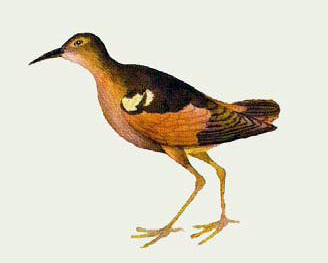
The Tahiti Sandpiper is an extinct bird that became extinct sometime before 1819. It was endemic to Tahiti in the Society Islands of French Polynesia. It measured approximately 18 cm in length and had predominantly sooty-brown plumage with a crescent-shaped white patch on its upper wing.
Written 26 November 2026 from the sources listed below. Each statement was checked against the passage it cites; statements that could not be supported were removed.
Habitat
The Tahiti Sandpiper is believed to have occurred near small streams.[1]
Appearance
The Tahiti Sandpiper measured approximately 18 cm in length. Its underparts were brown, while its upperparts were darker, and its wing had a white patch.[2][3]
The head, sides of the head, neck, back, and wings were predominantly sooty brown, with darker coloration on the back and wings. The lores, rump, and underside were rusty in color, and the wing coverts had some rusty-colored edging.[4][5][6]
A small white patch was present behind and above the eye, and a narrow, pale rusty ring surrounded the eye. The iris was very dark brown.[7][8][9]
The upper wing had a crescent-shaped white patch formed by the tertiary coverts. This patch was smaller on the underside of the wing, which was dusky brown with paler edges on the coverts.[10][11][12]
The flight feathers had paler inner surfaces. The bird had ten primary feathers and twelve tail feathers.[13][14]
The central tail feathers were sooty brown with rusty tips, while the outer tail feathers were rusty with sooty-brown barring.[15][16]
The bill was blackish, pointed, thin, and short, with a slightly paler lower mandible. The legs were pale straw-colored with a greenish hue.[17][18]
Conservation
The Tahiti Sandpiper is extinct. The species became extinct sometime before 1819.[19][20]
Classification of the Tahiti Sandpiper
| Kingdom | Animalia |
|---|---|
| Phylum | Chordata |
| Subphylum | Vertebrata |
| Infraphylum | Gnathostomata |
| Parvphylum | Osteichthyes |
| Megaclass | Tetrapoda |
| Class | Aves (Bird) |
| Order | Charadriiformes (Auks) |
| Family | Scolopacidae (Sandpiper) |
| Genus | Prosobonia (Polynesian Sandpiper) |
| Species | Prosobonia leucoptera (J. F. Gmelin, 1789) |
Where the Tahiti Sandpiper is found
Checklists place Prosobonia leucoptera in Oceania.
Range as the checklists state it
Oceania
A number beside a place is its count of GBIF occurrence records. A place without a number comes from a checklist alone. Records show where a species has been observed or collected, which can include escapes and vagrants.
Common names
English
- Tahiti Sandpiper
- Tahitian Sandpiper
- White-winged Sandpiper
Names in 26 other languages
- Catalan
- xivita de l'illa Moorea
- Chinese
- 大溪地矶鹬, 大溪地鷸
- Croatian
- tahitska prutka
- Czech
- vodoušek bělobrvý
- Danish
- Tahitiklire
- Dutch
- Tahitistrandloper
- Esperanto
- tahitia tringo
- Estonian
- tahiti tilder
- Finnish
- tahitinsirri
- French
- Bécasseau à ailes blanches, Bécasson à ailes blanches, Chevalier à ailes blanches
- German
- Gesellschaftsläufer, Tahiti-Südseeläufer, Weißflügel-Wasserläufer
- Hungarian
- fehérszárnyú cankó
- Italian
- Piro piro di Tahiti
- Japanese
- タヒチシギ
- Lithuanian
- taitinis tilvikas
- Norwegian
- tahitisnipe
- Polish
- brodźczyk białoskrzydły
- Portuguese
- maçarico-do-tahiti, maçarico-do-taiti, pilrito-do-taiti
- Russian
- Таитянский атолльник, Таитянский песочник
- Serbian
- Sprutka sa Tahitija
- Slovak
- pobrežník bielokrídly
- Spanish
- Andarríos aliblanco, Andarríos de Tahití
- Swedish
- tahitisnäppa
- Turkish
- Tahiti Kumkuşu
- Ukrainian
- куліга білокрила
- tah
- Titi
Synonyms
3 other scientific names have been used for this species and are now treated as synonyms of Prosobonia leucoptera.
- Prosobonia cancellata leucoptera Gmelin, JF, 1789
- Tringa leucoptera J. F. Gmelin, 1789
- Tringa pyrrhetraea Lichtenstein, MHC, 1844
Related species
-
 Tuamotu SandpiperProsobonia parvirostris
-
 Christmas SandpiperProsobonia cancellata
-
 Moorea SandpiperProsobonia ellisi
- Henderson SandpiperProsobonia sauli
-
 American WoodcockScolopax minor
-
 Bar-tailed GodwitLimosa lapponica
-
 SanderlingCalidris alba
-
 Eskimo CurlewNumenius borealis
Compare
Questions and answers
What is the scientific name of the Tahiti Sandpiper?
The scientific name of the Tahiti Sandpiper is Prosobonia leucoptera. Written with its author, the full name is Prosobonia leucoptera (J. F. Gmelin, 1789).
Which family does the Tahiti Sandpiper belong to?
Prosobonia leucoptera belongs to the family Scolopacidae, in the order Charadriiformes and the class Aves.
What is the conservation status of the Tahiti Sandpiper?
The IUCN Red List category recorded for Prosobonia leucoptera is Extinct (EX).
What other names does the Tahiti Sandpiper have?
Prosobonia leucoptera is also known in English as Tahitian Sandpiper and White-winged Sandpiper.
Sources
Passages the profile rests on
- The Tahiti Sandpiper is believed to have occurred near small streams. Source passage: “The Tahiti and Moorea Sandpipers are believed to have occurred near small streams.” — English Wikipedia
- The Tahiti Sandpiper measured approximately 18 cm in length. Source passage: “A small (some 18 cm long), plain-colored sandpiper” — English Wikipedia
- The species had brown underparts, darker upperparts, and a white patch on its wing. Source passage: “brown below, darker above, with a white wing patch.” — English Wikipedia
- The head, sides of the head, neck, back, and wings were predominantly sooty brown, with darker coloration on the back and wings. Source passage: “Top and sides of head and neck to wings and back sooty brown, darker on back and wings.” — English Wikipedia
- The lores, rump, and underside were rusty in color. Source passage: “Lores, rump and underside rusty.” — English Wikipedia
- The wing coverts had some rusty-colored edging. Source passage: “Wing coverts with some rusty edging.” — English Wikipedia
- The bird had a small white patch behind and above its eye. Source passage: “A small white patch behind and above the eye.” — English Wikipedia
- The bird had a narrow, pale rusty ring around its eye. Source passage: “A slim pale rusty ring around the eye.” — English Wikipedia
- The iris was very dark brown. Source passage: “Iris a very dark brown.” — English Wikipedia
- The underside of the wing was dusky brown, with paler edges on the coverts. Source passage: “Underside of wing dusky brown with paler edges to coverts.” — English Wikipedia
- The upper wing had a crescent-shaped white patch formed by the tertiary coverts. Source passage: “A crescent-shaped white patch formed by tertiary coverts” — English Wikipedia
- The white crescent-shaped wing patch was smaller on the underside of the wing. Source passage: “smaller on the underside of the wing.” — English Wikipedia
- The flight feathers had paler inner surfaces. Source passage: “Remiges with paler inner surfaces.” — English Wikipedia
- The species had ten primary feathers and twelve tail feathers. Source passage: “Ten primaries, twelve rectrices.” — English Wikipedia
- The central tail feathers were sooty brown with rusty tips. Source passage: “Central tail feathers sooty brown with rusty tips;” — English Wikipedia
- The outer tail feathers were rusty with sooty-brown barring. Source passage: “outer ones rusty with sooty brown barring.” — English Wikipedia
- The bill was blackish, pointed, thin, and short, with a slightly paler lower mandible. Source passage: “Bill blackish, lower mandible slightly paler, pointed, thin and short” — English Wikipedia
- The legs were pale straw-colored with a greenish hue. Source passage: “Legs greenish-hued pale straw color.” — English Wikipedia
- The Tahiti Sandpiper is extinct. Source passage: “The Tahiti sandpiper or Tahitian sandpiper (Prosobonia leucoptera) is an extinct member of the large wader family Scolopacidae” — English Wikipedia
- The species became extinct sometime before 1819. Source passage: “until its extinction sometime before 1819.” — English Wikipedia
Data
- Catalogue of Life, 2026-10-16 XR cc by
- Wikidata CC0
- Wikimedia Commons per image; credit shown with each image
- Within the Catalogue of Life, this name comes from The Integrated Taxonomic Information System cc0
References
- Gill, Frank, & and Minturn Wright. (2006). Birds of the World: Recommended English Names.
- Dickinson, E. C., and J. V. Remsen Jr., eds. (2013). The Howard and Moore Complete Checklist of the Birds of the World, 4th Edition, Vol. 1 Non-Passerines.
This species in other databases
Page built on 27 November 2026. See how the catalog is made and all sources and licences.
Cite this page
ScientificNames.org. (2026). Prosobonia leucoptera (Tahiti Sandpiper). Retrieved November 27, 2026, from https://scientificnames.org/species/prosobonia-leucoptera
“Prosobonia leucoptera (Tahiti Sandpiper).” ScientificNames.org, 2026, scientificnames.org/species/prosobonia-leucoptera. Accessed 27 Nov. 2026.
ScientificNames.org. “Prosobonia leucoptera (Tahiti Sandpiper).” Accessed November 27, 2026. https://scientificnames.org/species/prosobonia-leucoptera.
@misc{scientificnames_prosobonia_leucoptera_tahiti_sandpiper,
  author = {{ScientificNames.org}},
  title = {Prosobonia leucoptera (Tahiti Sandpiper)},
  year = {2026},
  url = {https://scientificnames.org/species/prosobonia-leucoptera},
  note = {Accessed 2026-11-27}
}