Species · Insects
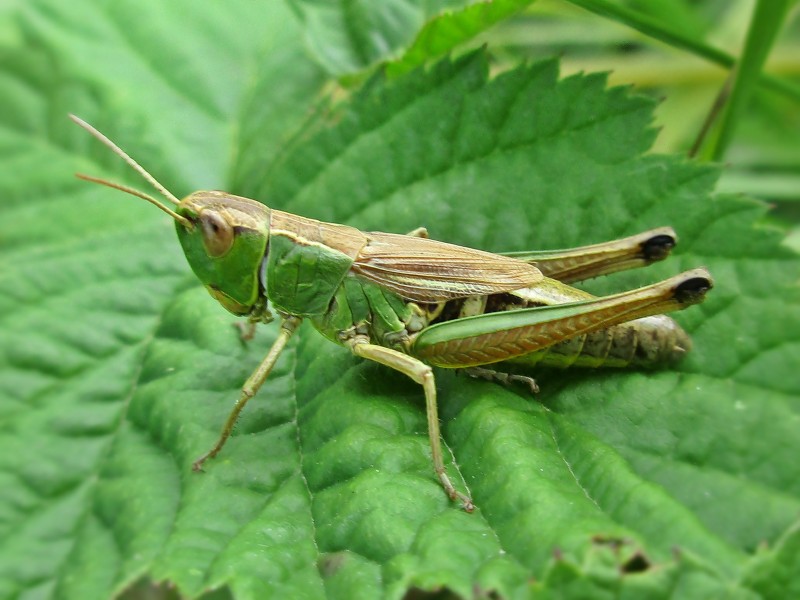
Water-meadow Grasshopper Pseudochorthippus montanus
The scientific name of the Water-meadow Grasshopper is Pseudochorthippus montanus. It is a species of insect in the family Acrididae (grasshoppers), order Orthoptera. The name dates from 1825.
- Scientific name
- Pseudochorthippus montanus (Charpentier, 1825)
- Common name
- Water-meadow Grasshopper
- Genus
- Pseudochorthippus
- Family
- Acrididae (Grasshoppers)
- Order
- Orthoptera
- Class
- Insecta
- Environment
- terrestrial
- Recorded in
- 29 countries
- Name status
- accepted in the Catalogue of Life

Overview
Pseudochorthippus montanus occurs across the Palearctic region, from Western Europe to the Kamchatka Peninsula in Asia. It commonly has green coloration, dark knees, shortened wings, and slightly curved pronotal keels.
Written 27 November 2026 from the sources listed below. Each statement was checked against the passage it cites; statements that could not be supported were removed.
Appearance
The Water-meadow Grasshopper commonly has green coloration with a brown back or an entirely green body. It has dark knees, shortened wings, slightly curved pronotal keels, and a relatively sturdy build.[1][2][3]
Habitat
The Water-meadow Grasshopper inhabits wet to moist environments with low or medium-height vegetation. Its habitats include wet meadows, lake margins, river margins, and high and low moors.[4][5]
It avoids tall vegetation in habitats such as wet fallows, sedge beds, and reedbeds. In the Alps, it occupies elevations between 370 and 2,480 metres and prefers colline and montane zones.[6][7][8]
Diet
The Water-meadow Grasshopper feeds on purple moor-grass (Molinia caerulea), common reed (Phragmites australis), and black bog-rush (Schoenus nigricans). In laboratory conditions, it prefers grasses over Carex sedges.[9][10][11][12]
Behaviour
Male songs consist of phrases lasting 2–4.5 seconds, followed by pauses lasting 4–7 seconds. Each verse contains 12–22 syllables.[13][14]
Reproduction and life cycle
Females produce six to seven egg pods, each containing approximately seven eggs. They deposit their eggs in soil or sedge root mats.[15][16]
The eggs are sensitive to drought. Inadequate moisture during embryonic development reduces nymph size and increases mortality.[17]
Nymphs develop through five stages. Males become ready to mate between four and twelve days after their final moult.[18][19]
Males can mate multiple times per day. Individual mating events last approximately 26 minutes.[20][21]
Conservation
In Switzerland, the Water-meadow Grasshopper is classified as vulnerable. In Austria, it is listed as near threatened.[22][23]
Habitat loss caused by river straightening, drainage, groundwater lowering, and agricultural conversion of wetlands is the primary threat. Afforestation and abandonment of wet meadows and low moors also threaten populations by increasing their isolation.[24][25]
Conservation measures include restoring natural groundwater levels in river valleys. Habitat management through one or two annual mowings or extensive grazing is recommended.[26][27]
Classification of the Water-meadow Grasshopper
| Kingdom | Animalia |
|---|---|
| Phylum | Arthropoda |
| Subphylum | Hexapoda |
| Class | Insecta (Insect) |
| Order | Orthoptera |
| Suborder | Caelifera (Grasshoppers) |
| Infraorder | Acrididea |
| Superfamily | Acridoidea |
| Family | Acrididae (Grasshoppers) |
| Subfamily | Gomphocerinae |
| Tribe | Gomphocerini |
| Genus | Pseudochorthippus |
| Species | Pseudochorthippus montanus (Charpentier, 1825) |
Where the Water-meadow Grasshopper is found
Checklists and occurrence records place Pseudochorthippus montanus in 29 countries across Asia and Europe. GBIF holds 37,026 georeferenced records of it.
Countries
- Austria 1,372
- Belgium 839
- Bulgaria
- China
- Czechia 46
- Estonia 200
- Finland 61
- France 3,722
- Germany 1,498
- Hungary 15
- Italy 11
- Kazakhstan
- Latvia
- Liechtenstein 42
- Lithuania 3
- Luxembourg 128
- Mongolia 7
- North Korea
- Norway 130
- Poland 1,148
- Romania 17
- Russia 156
- Slovakia 45
- South Korea
- Spain 5
- Sweden 213
- Switzerland 23,554
- The Netherlands 3,802
- Ukraine 12
Regions and cities with the most records
- Horgen, Switzerland 7,474
- Einsiedeln, Switzerland 6,434
- Rapperswil, Switzerland 6,232
- Jona, Switzerland 6,015
- Baar, Switzerland 5,805
- Zug, Switzerland 5,642
- Uster, Switzerland 5,430
- Cham, Switzerland 5,275
- Zurich, Switzerland 5,130
- Schwyz, Switzerland 4,976
- Wetzikon, Switzerland 4,762
- Adliswil, Switzerland 4,664
- Dübendorf, Switzerland 3,206
- Zürich, Switzerland 2,935
- Bern, Switzerland 2,879
- Herisau, Switzerland 2,605
- Luzern, Switzerland 2,532
- Zug, Switzerland 2,265
- Emmen, Switzerland 2,166
- Kriens, Switzerland 2,139
- Seen (Kreis 3), Switzerland 1,975
- Gossau, Switzerland 1,945
- Stadt Winterthur (Kreis 1), Switzerland 1,858
- Opfikon, Switzerland 1,840
- La Chaux-de-Fonds, Switzerland 1,817
- Kloten, Switzerland 1,787
- Thun, Switzerland 1,653
- Neuchâtel, Switzerland 1,630
- Steffisburg, Switzerland 1,608
- Neuchâtel, Switzerland 1,586
- Vaud, Switzerland 1,501
- Littau, Switzerland 1,458
- Schwyz, Switzerland 1,444
- Winterthur, Switzerland 1,419
- Lucerne, Switzerland 1,348
- Bourgogne-Franche-Comté, France 1,281
1 more country has a few records outside this range
These countries hold a few records of Pseudochorthippus montanus but lie outside the range the checklists give for it. Such records are often zoo or garden specimens, museum material or vagrants, so the species is not counted as occurring there.
A number beside a place is its count of GBIF occurrence records. A place without a number comes from a checklist alone. Records show where a species has been observed or collected, which can include escapes and vagrants.
Common names
English
- Water-meadow Grasshopper
- Water-meadow Grasshhopper
Names in 15 other languages
- Czech
- saranče vlhkomilná
- Dutch
- Zompsprinkhaan
- Estonian
- Soo-rohutirts
- Finnish
- nevaheinäsirkka
- French
- Criquet palustre, Le Criquet palustre
- German
- Sumpfgrashüpfer
- Hungarian
- lápréti sáska
- Korean
- 긴수염애메뚜기
- Lithuanian
- Pelkinis skėriukas
- Norwegian Bokmål
- myrgresshoppe
- Norwegian Nynorsk
- myrgrashoppe
- Polish
- Konik długopokładełkowy
- Russian
- Конёк лесной северный
- Slovak
- koník močiarny
- Swedish
- myrgräshoppa
Synonyms
8 other scientific names have been used for this species and are now treated as synonyms of Pseudochorthippus montanus.
- Chorthippus (Chorthippus) montanus (Charpentier, 1825)
- Chorthippus montanus Miram, 1931
- Chorthippus montanus Ermakova, 2011
- Chorthippus montanus montanus (Charpentier, 1825)
- Chorthippus parallelus var. montanus (Charpentier, 1825)
- Gryllus montanus Charpentier, 1825
- Stenobothrus (Chorthippus) longicornis Jacobson, 1905
- Chorthippus montanus (Charpentier, 1825) ambiguous synonym
Subspecies and varieties
- Chorthippus montanus fennoscandicus subspecies
- Pseudochorthippus montanus montanus subspecies
Related species
-
 Meadow GrasshopperPseudochorthippus parallelus
-
 Marsh Meadow GrasshopperPseudochorthippus curtipennis
- Pseudochorthippus geminus
- Pseudochorthippus iliensis
- Slovakian GrasshopperPseudochorthippus smardai
- Pseudochorthippus turanicus
-
 Desert LocustSchistocerca gregaria
-
 Australian Plague LocustChortoicetes terminifera
Compare
Questions and answers
What is the scientific name of the Water-meadow Grasshopper?
The scientific name of the Water-meadow Grasshopper is Pseudochorthippus montanus. Written with its author, the full name is Pseudochorthippus montanus (Charpentier, 1825).
Which family does the Water-meadow Grasshopper belong to?
Pseudochorthippus montanus belongs to the family Acrididae, in the order Orthoptera and the class Insecta.
Where is the Water-meadow Grasshopper found?
Checklists and occurrence records place Pseudochorthippus montanus in 29 countries, including Switzerland, The Netherlands, France, Germany, Austria and Poland.
What other names does the Water-meadow Grasshopper have?
Pseudochorthippus montanus is also known in English as Water-meadow Grasshhopper.
What is the habitat and diet of a grasshopper?
The Water-meadow Grasshopper inhabits wet to moist environments with low or medium-height vegetation, including wet meadows, lake margins, river margins, and high and low moors. It feeds on purple moor-grass, common reed, and black bog-rush.[4][5][9][10][11]
Sources
Passages the profile rests on
- The species commonly has green coloration with a brown back or an entirely green body. Source passage: “common forms including green morphs with brown backs or entirely green bodies.” — English Wikipedia
- The species has dark knees, shortened wings, and slightly curved pronotal keels. Source passage: “distinguished from other Chorthippus species by their dark knees, shortened wings, and slightly curved pronotal keels.” — English Wikipedia
- The species has a relatively sturdy build and a wing spot positioned at least 2.5 mm from the wing tip. Source passage: “has a slightly sturdier build, with a wing spot located at least 2.5 mm from the wing tip” — English Wikipedia
- The species inhabits wet to moist environments with low or medium-height vegetation. Source passage: “This species thrives in wet to moist habitats with low to medium-height vegetation” — English Wikipedia
- Its habitats include wet meadows, lake margins, river margins, and high and low moors. Source passage: “such as wet meadows, lake and river margins, and high and low moors.” — English Wikipedia
- The species avoids tall vegetation in habitats such as wet fallows, sedge beds, and reedbeds. Source passage: “It avoids tall vegetation like wet fallows, sedge beds, or reedbeds.” — English Wikipedia
- In the Alps, the species occupies elevations between 370 and 2,480 metres. Source passage: “In the Alps, it occurs between 370 and 2,480 meters” — English Wikipedia
- The species prefers colline and montane zones in the Alps. Source passage: “preferring colline and montane zones.” — English Wikipedia
- The species feeds on purple moor-grass (Molinia caerulea). Source passage: “It feeds on plants such as purple moor-grass (Molinia caerulea)” — English Wikipedia
- The species feeds on common reed (Phragmites australis). Source passage: “common reed (Phragmites australis)” — English Wikipedia
- The species feeds on black bog-rush (Schoenus nigricans). Source passage: “black bog-rush (Schoenus nigricans)” — English Wikipedia
- In laboratory conditions, the species prefers grasses over Carex sedges. Source passage: “In laboratory settings, it prefers grasses over sedges like Carex.” — English Wikipedia
- Male songs consist of phrases lasting 2–4.5 seconds, followed by pauses lasting 4–7 seconds. Source passage: “2–4.5-second "shr-shr-shr" phrases, followed by 4–7-second pauses” — English Wikipedia
- Each male song verse contains 12–22 syllables. Source passage: “with each verse containing 12–22 syllables.” — English Wikipedia
- Females produce six to seven egg pods, each containing approximately seven eggs. Source passage: “Females lay 6–7 egg pods, each containing about 7 eggs” — English Wikipedia
- Females deposit their eggs in soil or sedge root mats. Source passage: “Eggs are laid in soil or sedge root mats” — English Wikipedia
- The eggs are sensitive to drought, and inadequate moisture during embryonic development reduces nymph size and increases mortality. Source passage: “The eggs are sensitive to drought, and insufficient moisture during embryonic development reduces nymph size and increases mortality.” — English Wikipedia
- Nymphs develop through five stages. Source passage: “nymphs develop relatively quickly through five stages.” — English Wikipedia
- Males become ready to mate between four and twelve days after their final moult. Source passage: “Males are mating-ready 4–12 days after molting to adulthood” — English Wikipedia
- Males can mate multiple times per day. Source passage: “can mate multiple times daily” — English Wikipedia
- Individual mating events last approximately 26 minutes. Source passage: “Mating lasts about 26 minutes.” — English Wikipedia
- In Switzerland, the species is classified as vulnerable. Source passage: “In Switzerland, it is classified as "vulnerable" (VU)” — English Wikipedia
- In Austria, the species is listed as near threatened. Source passage: “and in Austria, it is listed as "near threatened" (NT).” — English Wikipedia
- Habitat loss caused by river straightening, drainage, groundwater lowering, and agricultural conversion of wetlands is identified as the primary threat. Source passage: “Habitat loss from river straightening, drainage, groundwater lowering, and agricultural conversion of wetlands is the primary threat.” — English Wikipedia
- Afforestation and abandonment of wet meadows and low moors threaten populations by increasing their isolation. Source passage: “Afforestation and abandonment of wet meadows and low moors further endanger populations, increasing isolation risks.” — English Wikipedia
- Conservation measures include restoring natural groundwater levels in river valleys. Source passage: “restoring natural groundwater levels in river valleys” — English Wikipedia
- Habitat management through one or two annual mowings or extensive grazing is recommended. Source passage: “managing habitats through one or two annual mowings or extensive grazing.” — English Wikipedia
Data
- Catalogue of Life, 2026-10-16 XR cc by
- Global Biodiversity Information Facility CC BY 4.0
- Wikidata CC0
- GeoNames CC BY 4.0
- Wikimedia Commons per image; credit shown with each image
- Within the Catalogue of Life, this name comes from Orthoptera Species File cc by
References
- von Charpentier, T. (1825) De Orthopteris Europaeis. In Horae entomologicae, adjectis tabulis novem coloratis. Apud A. Gosohorsky, Wroclaw. pp. 61–181. [255 pp.] where the name was published
This species in other databases
Page built on 27 November 2026. See how the catalog is made and all sources and licences.
Cite this page
ScientificNames.org. (2026). Pseudochorthippus montanus (Water-meadow Grasshopper). Retrieved November 27, 2026, from https://scientificnames.org/species/pseudochorthippus-montanus
“Pseudochorthippus montanus (Water-meadow Grasshopper).” ScientificNames.org, 2026, scientificnames.org/species/pseudochorthippus-montanus. Accessed 27 Nov. 2026.
ScientificNames.org. “Pseudochorthippus montanus (Water-meadow Grasshopper).” Accessed November 27, 2026. https://scientificnames.org/species/pseudochorthippus-montanus.
@misc{scientificnames_pseudochorthippus_montanus_water_meadow_grasshopper,
  author = {{ScientificNames.org}},
  title = {Pseudochorthippus montanus (Water-meadow Grasshopper)},
  year = {2026},
  url = {https://scientificnames.org/species/pseudochorthippus-montanus},
  note = {Accessed 2026-11-27}
}