Species · Birds
Grey-hooded Parakeet Psilopsiagon aymara
The scientific name of the Grey-hooded Parakeet is Psilopsiagon aymara. It is a species of bird in the family Psittacidae (macaws), order Psittaciformes. The name dates from 1841.
- Scientific name
- Psilopsiagon aymara (d'Orbigny, 1841)
- Common name
- Grey-hooded Parakeet
- Genus
- Psilopsiagon
- Family
- Psittacidae (Macaws)
- Order
- Psittaciformes
- Class
- Aves
- Red List category
- LC Least Concern
- Recorded in
- 3 countries
- Name status
- accepted in the Catalogue of Life

Overview
Psilopsiagon aymara occurs in northwestern Argentina and Bolivia, inhabiting arid shrubby and wooded habitats, including high-altitude shrubland. It has green upperparts, a brownish-grey forehead and crown, whitish-grey underparts, and a long, narrow, pointed tail.
Written 26 November 2026 from the sources listed below. Each statement was checked against the passage it cites; statements that could not be supported were removed.
Appearance
The species has green upperparts and greenish-yellow flanks and underwing coverts. Its forehead and crown are brownish-grey, while its chin, throat and breast are whitish-grey; the breast may have a bluish tinge along its sides.[1][2][3]
Its belly is green with a bluish tinge. Its long, narrow, pointed tail has a green upper surface and a grey underside.[4][5]
The beak is flesh-coloured, the iris is brown, and the legs and feet are brownish-grey. Males often have a more vivid grey breast than females, while immature individuals have shorter tails than adults.[6][7][8][9]
The species reaches approximately 20 cm in length.[10]
Habitat
The Grey-hooded Parakeet inhabits subtropical or tropical high-altitude shrubland and arid shrubby or wooded habitats, including wooded ravines. It also occurs in dense shrubby areas near villages or agricultural land.[11][12][13]
Its recorded altitudinal range extends from approximately 1,800 to 4,000 metres.[14]
Its distribution includes northwestern Argentina and Bolivia, the eastern Andes of Bolivia and northern Argentina, and the Sierras de Córdoba.[15][16]
Behaviour
The species is gregarious and forms flocks containing approximately twenty individuals. Multiple flocks sometimes gather at watering places.[17][18]
Its flocks travel through the countryside in rapid, low, undulating flight. Individuals sometimes rest on branches or among shrubs and small trees.[19][20]
The species produces twittering and warbling sounds resembling those of a barn swallow.[21]
Diet
The Grey-hooded Parakeet consumes grass seeds and seeds from plants in the aster family. It forages on the ground for fallen seeds and fruits.[22][23][24]
Reproduction and life cycle
Breeding takes place in November. The species nests in holes excavated in earth banks, as well as in crevices and holes in cacti.[25][26][27]
The species sometimes nests in ruined buildings. Several nests may occur together in semi-colonial groups.[28][29]
Clutches usually contain four or five eggs.[30]
Conservation
The species is described as fairly common and has an extensive geographic range. No particular threats to the species are known, and its population is believed to be stable.[31][32][33]
The Grey-hooded Parakeet is classified as Least Concern by the International Union for Conservation of Nature.[34]
Classification of the Grey-hooded Parakeet
| Kingdom | Animalia |
|---|---|
| Phylum | Chordata |
| Subphylum | Vertebrata |
| Infraphylum | Gnathostomata |
| Parvphylum | Osteichthyes |
| Megaclass | Tetrapoda |
| Class | Aves (Bird) |
| Order | Psittaciformes (Parrot) |
| Family | Psittacidae (Macaws) |
| Genus | Psilopsiagon (Southern Montane Parakeets) |
| Species | Psilopsiagon aymara (d'Orbigny, 1841) |
Where the Grey-hooded Parakeet is found
Checklists and occurrence records place Psilopsiagon aymara in 3 countries across South America. GBIF holds 8,382 georeferenced records of it.
Countries
Regions and cities with the most records
- Cordoba, Argentina 1,459
- Cochabamba, Bolivia 996
- Salta, Argentina 994
- Jujuy, Argentina 848
- San Luis, Argentina 833
- Mendoza, Argentina 779
- Colcapirhua, Bolivia 673
- Quillacollo, Bolivia 671
- Tiquipaya, Bolivia 669
- La Paz Department, Bolivia 665
- Vinto, Bolivia 623
- Achocalla, Bolivia 584
- Tucuman, Argentina 518
- La Paz, Bolivia 486
- Cochabamba, Bolivia 390
- Chuquisaca Department, Bolivia 327
- Cafayate, Argentina 322
- Sipe Sipe, Bolivia 279
- Villazón, Bolivia 233
- Sucre, Bolivia 218
- San Juan, Argentina 216
- Sacaba, Bolivia 191
- La Falda, Argentina 179
- Catamarca, Argentina 161
- Santa Cruz Department, Bolivia 143
- Mendoza, Argentina 129
- Luján de Cuyo, Argentina 120
- Cosquín, Argentina 119
- Potosí Department, Bolivia 109
- Villa Carlos Paz, Argentina 100
- Perdriel, Argentina 96
- Unquillo, Argentina 90
- La Rioja, Argentina 79
- Tarija Department, Bolivia 77
- San Luis, Argentina 70
- Punata, Bolivia 57
Range as the checklists state it
South America
A number beside a place is its count of GBIF occurrence records. A place without a number comes from a checklist alone. Records show where a species has been observed or collected, which can include escapes and vagrants.
Common names
English
- Grey-hooded Parakeet
- Gray-hooded Parakeet
Names in 25 other languages
- Catalan
- cotorreta encaputxada
- Chinese
- 灰頭鸚哥, 灰顶鹦哥
- Croatian
- sivokapa papigica
- Czech
- aymara šedoprsý, papoušíček šedoprsý
- Danish
- Aymaraparakit
- Dutch
- Aymaraparkiet
- Esperanto
- grizkapuĉa papageto
- Estonian
- karbus-mägipapagoi
- Finnish
- harmaa-aratti
- French
- Toui aymara
- German
- Aymarasittich
- Hungarian
- ajmara papagáj, aymara-papagáj
- Italian
- Parrocchetto cappuccino
- Japanese
- ユウギリインコ
- Lithuanian
- rudagalvė storasnapė papūga
- Norwegian
- aymaraparakitt
- Polish
- stokówka ciemnogłowa
- Portuguese
- periquito-aimara, periquito-da-serra, periquito-serrano
- Russian
- Бурошапочный толстоклювый попугай, Сероголовый калита
- Serbian
- Ajmara papagaj
- Slovak
- papagájik sivohlavý
- Spanish
- Catita aimará, Catita serrana grande
- Swedish
- sierraparakit
- Turkish
- Aymara Papağanı
- Ukrainian
- папуга буроголовий
Synonyms
8 other scientific names have been used for this species and are now treated as synonyms of Psilopsiagon aymara.
- Amoropsittaca aymara (d'Orbigny, 1841)
- Arara aymara d'Orbigny, 1841
- Bolborhynchus aymara (d'Orbigny, 1841)
- Bolborhynchus aymara BirdLife International (2004)
- Bolborhynchus aymara Sibley & Monroe (1990, 1993)
- Bolborhynchus aymara Stotz et al. (1996)
- Psittacus aguava Schlegel, H, 1864
- Psittacus murinoides Schlegel, H, 1864
Related species
-
 Mountain ParakeetPsilopsiagon aurifrons
-
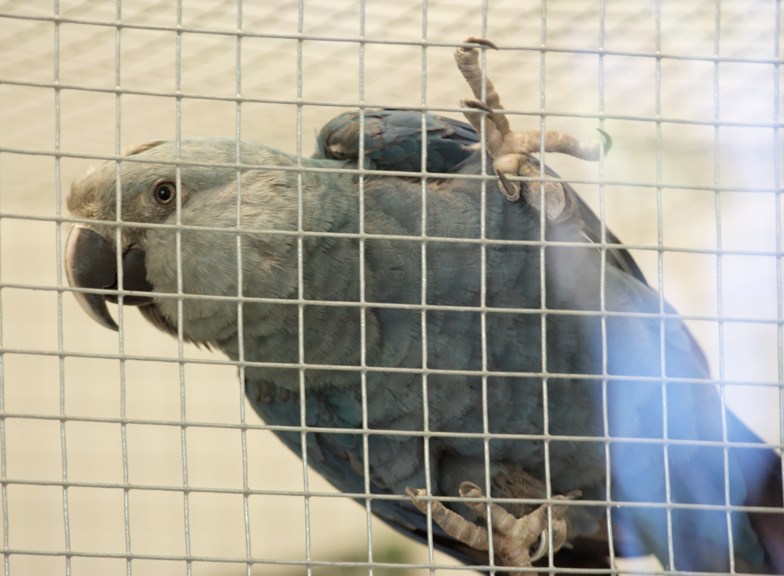 Spix's MacawCyanopsitta spixii
-
 Grey ParrotPsittacus erithacus
-
 Scarlet MacawAra macao
-
 Hyacinth MacawAnodorhynchus hyacinthinus
-
 Blue-and-yellow MacawAra ararauna
-
 Sun ConureAratinga solstitialis
-
 Green ParakeetPsittacara holochlorus
Compare
Questions and answers
What is the scientific name of the Grey-hooded Parakeet?
The scientific name of the Grey-hooded Parakeet is Psilopsiagon aymara. Written with its author, the full name is Psilopsiagon aymara (d'Orbigny, 1841).
Which family does the Grey-hooded Parakeet belong to?
Psilopsiagon aymara belongs to the family Psittacidae, in the order Psittaciformes and the class Aves.
Where is the Grey-hooded Parakeet found?
Checklists and occurrence records place Psilopsiagon aymara in 3 countries: Argentina, Bolivia and Chile.
What is the conservation status of the Grey-hooded Parakeet?
The IUCN Red List category recorded for Psilopsiagon aymara is Least Concern (LC).
What other names does the Grey-hooded Parakeet have?
Psilopsiagon aymara is also known in English as Gray-hooded Parakeet.
Sources
Passages the profile rests on
- The species has green upperparts and greenish-yellow flanks and underwing coverts. Source passage: “The upper parts are green and the flanks and underwing coverts are greenish-yellow.” — English Wikipedia
- Its forehead and crown are brownish-grey, while its chin, throat and breast are whitish-grey. Source passage: “The forehead and crown are brownish-grey, and the chin, throat and breast are whitish-grey” — English Wikipedia
- The breast may have a bluish tinge along its sides. Source passage: “sometimes with a bluish tinge at the side of the breast.” — English Wikipedia
- Its belly is green with a bluish tinge. Source passage: “The belly is green with a bluish tinge.” — English Wikipedia
- Its long, narrow, pointed tail has a green upper surface and a grey underside. Source passage: “The upper side of the long, narrow, pointed tail is green and the underside is grey.” — English Wikipedia
- Its beak is flesh-coloured and its iris is brown. Source passage: “The beak is flesh-coloured, the iris is brown” — English Wikipedia
- Its legs and feet are brownish-grey. Source passage: “the legs and feet are brownish-grey.” — English Wikipedia
- Males often have a more vivid grey breast than females. Source passage: “the male often has a more vivid grey breast” — English Wikipedia
- Immature individuals have shorter tails than adults. Source passage: “immature birds have shorter tails.” — English Wikipedia
- The species reaches approximately 20 cm in length. Source passage: “growing to a length of about 20 cm (8 in).” — English Wikipedia
- The species inhabits subtropical or tropical high-altitude shrubland. Source passage: “Its natural habitat is subtropical or tropical high-altitude shrubland.” — English Wikipedia
- It occurs in arid shrubby or wooded habitats, including wooded ravines. Source passage: “It is a bird of arid shrubby or wooded habitats, wooded ravines” — English Wikipedia
- It also inhabits dense shrubby areas near villages or agricultural land. Source passage: “dense shrubby areas near villages or agricultural land.” — English Wikipedia
- Its recorded altitudinal range extends from approximately 1,800 to 4,000 metres. Source passage: “Its altitudinal range is from about 1,800 to 4,000 m (6,000 to 13,000 ft).” — English Wikipedia
- The species occurs in northwestern Argentina and Bolivia. Source passage: “It is found in northwestern Argentina and Bolivia.” — English Wikipedia
- Its native range includes the eastern Andes of Bolivia and northern Argentina, as well as the Sierras de Córdoba. Source passage: “The grey-hooded parakeet is native to the eastern Andes of Bolivia and northern Argentina, as well as the sierras de Córdoba.” — English Wikipedia
- The species is gregarious and forms flocks containing approximately twenty individuals. Source passage: “forming small flocks of about twenty birds” — English Wikipedia
- Multiple flocks sometimes gather at watering places. Source passage: “several of which groups may gather together at watering places.” — English Wikipedia
- Its flocks travel through the countryside in rapid, low, undulating flight. Source passage: “The flocks roam the countryside in rapid low, undulating flight” — English Wikipedia
- Individuals sometimes rest on branches or among shrubs and small trees. Source passage: “sometimes resting on top of or among the branches of shrubs and small trees” — English Wikipedia
- The species produces twittering and warbling sounds resembling those of a barn swallow. Source passage: “making twittering and warbling sounds rather similar to those made by a barn swallow.” — English Wikipedia
- The species consumes grass seeds. Source passage: “consuming grass seeds” — English Wikipedia
- Its diet includes seeds from plants in the aster family. Source passage: “seeds of plants in the aster family” — English Wikipedia
- It forages on the ground for fallen seeds and fruits. Source passage: “also foraging on the ground for fallen seeds and fruits.” — English Wikipedia
- Breeding takes place in November. Source passage: “Breeding takes place in November.” — English Wikipedia
- The species nests in holes excavated in earth banks. Source passage: “The nest is situated in a hole excavated in an earth bank” — English Wikipedia
- Nesting sites also include crevices and holes in cacti. Source passage: “in a crevice, in a hole in a cactus” — English Wikipedia
- The species sometimes nests in ruined buildings. Source passage: “or sometimes in a ruined building.” — English Wikipedia
- Several nests may occur together in semi-colonial groups. Source passage: “Several nests are sometimes grouped together semi-colonially.” — English Wikipedia
- Clutches usually contain four or five eggs. Source passage: “Clutches are usually of four or five eggs.” — English Wikipedia
- The species is described as fairly common and has an extensive geographic range. Source passage: “is a fairly common bird and has a very extensive range.” — English Wikipedia
- No particular threats to the species are known. Source passage: “No particular threats to this bird are known” — English Wikipedia
- Its population is believed to be stable. Source passage: “the population is believed to be stable.” — English Wikipedia
- The species is classified as Least Concern by the International Union for Conservation of Nature. Source passage: “assessed its conservation status as being of "least concern".” — English Wikipedia
Data
- Catalogue of Life, 2026-10-16 XR cc by
- Global Biodiversity Information Facility CC BY 4.0
- Wikidata CC0
- GeoNames CC BY 4.0
- Wikimedia Commons per image; credit shown with each image
- Within the Catalogue of Life, this name comes from The Integrated Taxonomic Information System cc0
References
- Gill, Frank, & and Minturn Wright. (2006). Birds of the World: Recommended English Names.
- Dickinson, E. C., and L. Christidis, eds. (2014). The Howard and Moore Complete Checklist of the Birds of the World, 4th Edition, Vol. 2 Passerines.
- Dickinson, Edward C. (2019). Correction to the date of publication of the name of the Gray-hooded Parakeet Psilopsiagon aymara (d’Orbigny, 1839). Zoological Bibliography, Vol. 5, No. 8.
This species in other databases
Page built on 27 November 2026. See how the catalog is made and all sources and licences.
Cite this page
ScientificNames.org. (2026). Psilopsiagon aymara (Grey-hooded Parakeet). Retrieved November 27, 2026, from https://scientificnames.org/species/psilopsiagon-aymara
“Psilopsiagon aymara (Grey-hooded Parakeet).” ScientificNames.org, 2026, scientificnames.org/species/psilopsiagon-aymara. Accessed 27 Nov. 2026.
ScientificNames.org. “Psilopsiagon aymara (Grey-hooded Parakeet).” Accessed November 27, 2026. https://scientificnames.org/species/psilopsiagon-aymara.
@misc{scientificnames_psilopsiagon_aymara_grey_hooded_parakeet,
  author = {{ScientificNames.org}},
  title = {Psilopsiagon aymara (Grey-hooded Parakeet)},
  year = {2026},
  url = {https://scientificnames.org/species/psilopsiagon-aymara},
  note = {Accessed 2026-11-27}
}