Species · Birds
Erckel's Spurfowl Pternistis erckelii
The scientific name of the Erckel's Spurfowl is Pternistis erckelii. It is a species of bird in the family Phasianidae (quail), order Galliformes. The name dates from 1835.
- Scientific name
- Pternistis erckelii (Rüppell, 1835)
- Common name
- Erckel's Spurfowl
- Genus
- Pternistis
- Family
- Phasianidae (Quail)
- Order
- Galliformes
- Class
- Aves
- Red List category
- LC Least Concern
- Recorded in
- 4 countries
- Name status
- accepted in the Catalogue of Life

Overview
Pternistis erckelii has a black face and bill, a chestnut-colored crown and nape, yellow legs, white ear coverts, and a white streak behind the eye.
Written 26 November 2026 from the sources listed below. Each statement was checked against the passage it cites; statements that could not be supported were removed.
Uses
Erckel's Spurfowl was introduced to Hawaiʻi in 1957 for use as a gamebird.[1][2]
Similar species
The Djibouti spurfowl was identified as the species' closest relative in a phylogenetic study published in 2019.[3]
Appearance
Both sexes have similar plumage, with chestnut-colored stripes covering the upper and lower body. The species has brown plumage with white streaky spots, chestnut-colored crown feathers, and a white throat.[4][5]
The species has a black face and bill, a chestnut-colored crown and nape, and yellow legs. White ear coverts and a single white streak behind the eye are distinguishing facial features.[6][7]
Diet
Erckel's Spurfowl eats berries, seeds, shoots, and insects.[8]
Behaviour
Individuals may hunt alone or in pairs, and the species is frequently inactive. It scares easily and hides from view.[9][10][11]
When threatened, the species runs uphill and generally escapes by running rather than flying.[12][13]
The species produces territorial calls consisting of 15 to 20 notes, delivered from clifftops and large rocks. It also produces a loud laughing cackle, particularly in the morning.[14][15][16]
Reproduction and life cycle
Egg laying takes place during the rainy season, from April through November, depending on location. In Ethiopia, eggs are laid in May and from September through November, while in Sudan they are laid in April and May.[17][18][19]
Conservation
Erckel's Spurfowl is classified as Least Concern by the International Union for Conservation of Nature. Its estimated geographic range is 580,000 km², and its exact population size is unknown.[20][21][22]
Classification of the Erckel's Spurfowl
| Kingdom | Animalia |
|---|---|
| Phylum | Chordata |
| Subphylum | Vertebrata |
| Infraphylum | Gnathostomata |
| Parvphylum | Osteichthyes |
| Megaclass | Tetrapoda |
| Class | Aves (Bird) |
| Order | Galliformes (Fowls) |
| Family | Phasianidae (Quail) |
| Genus | Pternistis (African Spurfowl) |
| Species | Pternistis erckelii (Rüppell, 1835) |
Where the Erckel's Spurfowl is found
Checklists and occurrence records place Pternistis erckelii in 4 countries across Africa and Oceania. GBIF holds 18,984 georeferenced records of it.
Countries
Regions and cities with the most records
- Hawaii, United States 18,098
- Amhara, Ethiopia 457
- Schofield Barracks, United States 451
- Schofield-Wheeler, United States 286
- Wahiawā-Whitmore, United States 284
- Fichē, Ethiopia 281
- Wahiawā, United States 271
- Oromiya, Ethiopia 212
- Mililani Town, United States 202
- Mililani Mauka, United States 181
- Makakilo-Makaīwa Hills-Kunia, United States 175
- Makakilo, United States 173
- Mililani Mauka / Launani Valley, United States 170
- Makakilo City, United States 167
- Makakilo / Kapolei / Honokai Hale, United States 163
- Waipahu, United States 155
- ʻEwa Gentry-West Loch, United States 129
- Kapolei, United States 123
- Kapolei Villages, United States 123
- ‘Ewa Gentry, United States 122
- Pearl City, United States 111
- ‘Ewa Beach, United States 93
- Joint Base Pearl Harbor Hickam, United States 89
- ʻEwa Beach-Iroquois Point, United States 87
- Aliamanu / Salt Lakes / Foster Village, United States 80
- Lalibela, Ethiopia 42
- Burayu, Ethiopia 40
- Addis Ababa, Ethiopia 39
- Addis Ababa, Ethiopia 32
- Debark’, Ethiopia 28
- Bishoftu, Ethiopia 22
- Debre Birhan, Ethiopia 22
- Hilo, United States 17
- Koolauloa, United States 14
- Debub, Eritrea 13
- Tigray, Ethiopia 13
Range as the checklists state it
Oceania
Africa
A number beside a place is its count of GBIF occurrence records. A place without a number comes from a checklist alone. Records show where a species has been observed or collected, which can include escapes and vagrants.
Common names
English
- Erckel's Spurfowl
- ERSP
- Erckel's Francolin
Names in 31 other languages
- Arabic
- دراج يركيل
- Breton
- Frankolin Erckel
- Catalan
- francolí d'Erckel
- Chinese
- 棕頂鷓鴣, 棕顶鹧鸪
- Croatian
- riđokapa jarebica
- Czech
- frankolín Erckelův
- Danish
- Rødehavs Bjergfrankolin, Rødehavs-bjergfrankolin
- Dutch
- Erckels Frankolijn
- Esperanto
- sudana frankolino
- Estonian
- suurfrankoliin (suur-frankoliinkana)
- Finnish
- sudaninfrankoliini
- French
- Francolin d'Erckel, Francolin d’Erckel, Pterniste d'Erckel
- German
- Erckelfrankolin
- Hungarian
- erckel-frankolin, koronás frankolin
- Icelandic
- Gaddhæna
- Irish
- Francóilín earcail
- Italian
- Francolino di Erckel
- Japanese
- クロガオシャコ
- Lithuanian
- sudaninis frankolinas
- Northern Sami
- Stuorafrankoliidna
- Norwegian
- storfrankolin
- Polish
- szponiastonóg brązowogłowy
- Portuguese
- francolim-de-erckel, francolim-de-sobrancelha-preta, francolim-de-sobrancelhas-pretas
- Russian
- Суданский турач, Суданский франколин
- Serbian
- Etiopski frankolin
- Slovak
- frankolínec čiapočkatý
- Slovenian
- eritrejski frankolin
- Spanish
- Francolín de Erckel
- Swedish
- rostkronad sporrhöna
- Turkish
- Erckel Turacı
- Ukrainian
- турач суданський
Synonyms
6 other scientific names have been used for this species and are now treated as synonyms of Pternistis erckelii.
- Francolinus erckeli pentoni Mackworth-Praed, CW, 1920
- Francolinus erckelii (Rüppell, 1835)
- Francolinus erckelii erkelii Rüppell, WPES, 1835
- Perdix erckelii Rüppell, 1835
- Pternistis erckelii erckelii Rüppell, WPES, 1835
- Pternistis erckelii pentoni Mackworth-Praed, CW, 1920
Related species
-
 Cape SpurfowlPternistis capensis
-
 Red-necked SpurfowlPternistis afer
-
 Natal SpurfowlPternistis natalensis
-
 Yellow-necked SpurfowlPternistis leucoscepus
-
 Red-billed SpurfowlPternistis adspersus
-
 Djibouti SpurfowlPternistis ochropectus
-
 Handsome SpurfowlPternistis nobilis
-
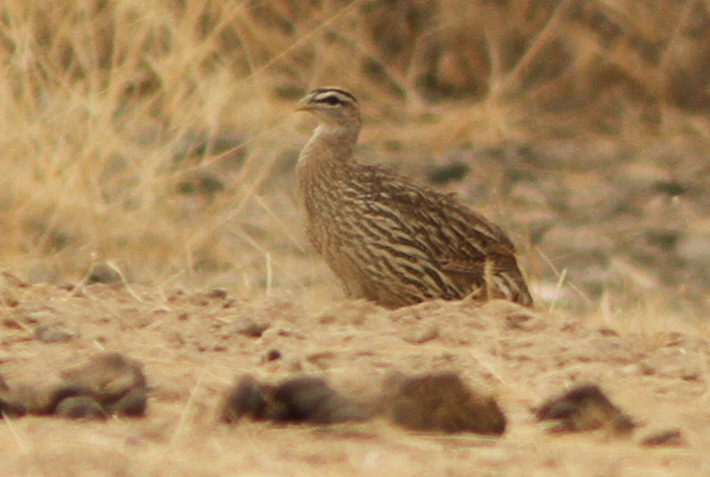 Double-spurred SpurfowlPternistis bicalcaratus
Compare
Questions and answers
What is the scientific name of the Erckel's Spurfowl?
The scientific name of the Erckel's Spurfowl is Pternistis erckelii. Written with its author, the full name is Pternistis erckelii (Rüppell, 1835).
Which family does the Erckel's Spurfowl belong to?
Pternistis erckelii belongs to the family Phasianidae, in the order Galliformes and the class Aves.
Where is the Erckel's Spurfowl found?
Checklists and occurrence records place Pternistis erckelii in 4 countries: United States, Ethiopia, Eritrea and Sudan.
What is the conservation status of the Erckel's Spurfowl?
The IUCN Red List category recorded for Pternistis erckelii is Least Concern (LC).
What other names does the Erckel's Spurfowl have?
Pternistis erckelii is also known in English as ERSP and Erckel's Francolin.
What do spurfowl eat?
Erckel's Spurfowl eats berries, seeds, shoots, and insects.[8]
What does Francolin eat?
Erckel's Spurfowl eats berries, seeds, shoots, and insects.[8]
Sources
Passages the profile rests on
- The species was introduced to Hawaiʻi in 1957 as a gamebird. Source passage: “the Erckel’s spurfowl was introduced to Hawaiʻi in 1957 as a gamebird.” — hawaiibirdingtrails.hawaii.gov
- The species was introduced to Hawaiʻi for use as a gamebird. Source passage: “introduced to Hawaiʻi in 1957 as a gamebird.” — hawaiibirdingtrails.hawaii.gov
- A phylogenetic study published in 2019 identified the Djibouti spurfowl as the species' closest relative. Source passage: “A phylogenetic study published in 2019 found that Erckel's spurfowl was most closely related to the Djibouti spurfowl.” — English Wikipedia
- Both sexes have similar plumage, with chestnut-colored stripes covering the upper and lower body. Source passage: “Males and females have similar plumage. The body is covered with stripes of chestnut-color, on its upperside and underside.” — English Wikipedia
- The species has brown plumage with white streaky spots, chestnut-colored crown feathers, and a white throat. Source passage: “they are brown with white streaky spots and distinct chestnut colored feathers on the top of their head with a white throat.” — hawaiibirdingtrails.hawaii.gov
- The species has a black face and bill, a chestnut-colored crown and nape, and yellow legs. Source passage: “It has a black face and bill, a chestnut-colored head top and back of neck, and yellow legs.” — English Wikipedia
- White ear coverts and a single white streak behind the eye are distinguishing facial features. Source passage: “It has white ear coverts and a single streak of white behind its eye.” — English Wikipedia
- The species eats berries, seeds, shoots, and insects. Source passage: “Its diet consists of plants, such as berries, seeds, and shoots, as well as insects.” — English Wikipedia
- Individuals may hunt alone or in pairs. Source passage: “Erckel's spurfowl can hunt alone or in pairs” — English Wikipedia
- The species is frequently inactive. Source passage: “It is frequently inactive” — English Wikipedia
- The species scares easily and hides from view. Source passage: “they scare easily and hide from view” — hawaiibirdingtrails.hawaii.gov
- When threatened, the species runs uphill. Source passage: “if threatened it runs up a hill.” — English Wikipedia
- The species generally escapes by running rather than flying. Source passage: “prefer running away rather than flushing.” — hawaiibirdingtrails.hawaii.gov
- The species produces territorial calls consisting of 15 to 20 notes. Source passage: “territorial calls, which consist of 15–20 notes” — English Wikipedia
- Territorial calls are delivered from clifftops and large rocks. Source passage: “are made from clifftops and large rocks.” — English Wikipedia
- The species produces a loud laughing cackle, particularly in the morning. Source passage: “Listen for their loud laughing cackle, especially in the morning.” — hawaiibirdingtrails.hawaii.gov
- Egg laying takes place during the rainy season, from April through November, depending on location. Source passage: “Eggs are laid during the rainy season from April to November, with the exact time depending on the location” — English Wikipedia
- In Ethiopia, eggs are laid in May and from September through November. Source passage: “they are laid in May and September to November in Ethiopia” — English Wikipedia
- In Sudan, eggs are laid in April and May. Source passage: “while they are laid in April and May in Sudan.” — English Wikipedia
- The species is classified as Least Concern by the International Union for Conservation of Nature. Source passage: “causing it to be listed as a species of least concern by the International Union for Conservation of Nature.” — English Wikipedia
- The species has an estimated geographic range of 580,000 km². Source passage: “an estimated range of 580,000 km2 (220,000 sq mi)” — English Wikipedia
- The exact population size of the species is unknown. Source passage: “Although its exact population is unknown” — English Wikipedia
Data
- Catalogue of Life, 2026-10-16 XR cc by
- Global Biodiversity Information Facility CC BY 4.0
- Wikidata CC0
- GeoNames CC BY 4.0
- Wikimedia Commons per image; credit shown with each image
- Within the Catalogue of Life, this name comes from The Integrated Taxonomic Information System cc0
References
- Dickinson, E. C., and J. V. Remsen Jr., eds. (2013). The Howard and Moore Complete Checklist of the Birds of the World, 4th Edition, Vol. 1 Non-Passerines.
This species in other databases
Page built on 27 November 2026. See how the catalog is made and all sources and licences.
Cite this page
ScientificNames.org. (2026). Pternistis erckelii (Erckel's Spurfowl). Retrieved November 27, 2026, from https://scientificnames.org/species/pternistis-erckelii
“Pternistis erckelii (Erckel's Spurfowl).” ScientificNames.org, 2026, scientificnames.org/species/pternistis-erckelii. Accessed 27 Nov. 2026.
ScientificNames.org. “Pternistis erckelii (Erckel's Spurfowl).” Accessed November 27, 2026. https://scientificnames.org/species/pternistis-erckelii.
@misc{scientificnames_pternistis_erckelii_erckels_spurfowl,
  author = {{ScientificNames.org}},
  title = {Pternistis erckelii (Erckel's Spurfowl)},
  year = {2026},
  url = {https://scientificnames.org/species/pternistis-erckelii},
  note = {Accessed 2026-11-27}
}