Species · Fishes
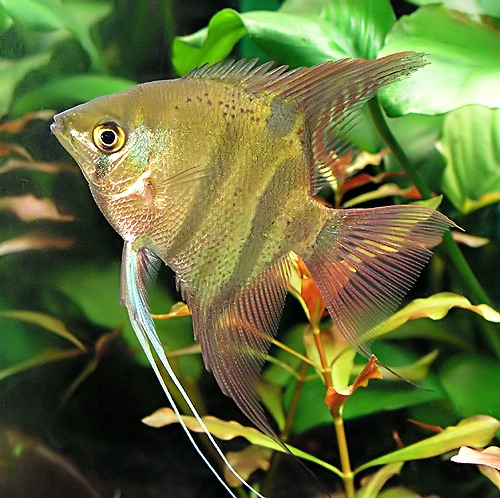
Angelfish Pterophyllum scalare
The scientific name of the Angelfish is Pterophyllum scalare. It is a species of fish in the family Cichlidae (cichlid), order Cichliformes. The name dates from 1823.
- Scientific name
- Pterophyllum scalare (Schultze, 1823)
- Common name
- Angelfish
- Genus
- Pterophyllum
- Family
- Cichlidae (Cichlid)
- Order
- Cichliformes
- Class
- Teleostei
- Red List category
- LC Least Concern
- Environment
- freshwater
- Recorded in
- 6 countries
- Name status
- accepted in the Catalogue of Life

Overview
The angelfish inhabits swamps and flooded areas with dense vegetation in the Amazon Basin in Peru, Colombia, and Brazil.
Written 26 November 2026 from the sources listed below. Each statement was checked against the passage it cites; statements that could not be supported were removed.
Appearance
The Orinoco form is reported to have the same size and shape as the other described form.[1]
Habitat
The angelfish inhabits swamps and flooded areas with dense vegetation. Its natural habitat includes clear or silty waters.[2][3]
Its native waters have a reported pH range of approximately 6.0 to 7.0 and general hardness ranging from 3 to 10 °dH. Reported water temperatures range from 26 to 30 °C.[4][5][6]
Diet
The angelfish feeds on fish fry and juvenile fish. Its natural diet also includes young and mature shrimps, crabs, prawns, various worms, and mosquito larvae.[7][8][9]
The species opportunistically captures small floating insects that fall onto the water surface. In captivity, it accepts frozen, freeze-dried, and live foods.[10][11]
Tubifex worms and fruit flies are reported to provide substantial protein and nutrients that promote growth. Feeding experiments have tested live earthworms, dried Tubifex, dried Gammarus, and prepared granulated feed.[12][13]
Using artificial diets as the sole food source is commonly associated with lower growth and survival rates in this species.[14]
Behaviour
The angelfish accepts artificial diets in captivity.[15]
Reproduction and life cycle
A predominantly live-food diet is reported to improve reproductive performance. In a feeding experiment, live earthworms significantly increased gonadosomatic index, fecundity, and hatchability.[16][17]
Fish receiving live earthworms produced more spawned eggs and hatched larvae than the other feeding groups. The reproductive parameters were measured between days 60 and 90 of the experiment.[18][19]
Prepared granulated feed was associated with increased larval length. The numbers of dead and deformed fry were lower in fish fed prepared granulated feed and live earthworms, although differences between experimental groups were not statistically significant.[20][21]
Uses
The angelfish is frequently kept in captivity and commonly traded in the aquarium industry. It is popular among aquarium enthusiasts worldwide.[22][23]
Similar species
An Orinoco form of Pterophyllum scalare is described as similar and capable of cross-breeding.[24]
Classification of the Angelfish
| Kingdom | Animalia |
|---|---|
| Phylum | Chordata |
| Subphylum | Vertebrata |
| Infraphylum | Gnathostomata |
| Parvphylum | Osteichthyes |
| Gigaclass | Actinopterygii |
| Superclass | Actinopteri |
| Class | Teleostei (Teleost) |
| Order | Cichliformes |
| Family | Cichlidae (Cichlid) |
| Subfamily | Cichlinae |
| Genus | Pterophyllum (Angelfishes) |
| Species | Pterophyllum scalare (Schultze, 1823) |
Where the Angelfish is found
Checklists and occurrence records place Pterophyllum scalare in 6 countries. GBIF holds 643 georeferenced records of it.
Countries
Regions and cities with the most records
- Amazonas, Brazil 180
- Loreto, Peru 99
- Pará, Brazil 69
- Manaus, Brazil 58
- Careiro da Várzea, Brazil 56
- Iquitos, Peru 40
- San Juan, Peru 40
- Amazonas Department, Colombia 25
- Santarém, Brazil 20
- Leticia, Colombia 19
- Tabatinga, Brazil 19
- Amapá, Brazil 17
- Tefé, Brazil 15
- Iranduba, Brazil 14
- Alvarães, Brazil 10
- Pucallpa, Peru 10
- Roraima, Brazil 10
- San Fernando, Peru 10
- Ucayali, Peru 10
- Belterra, Brazil 8
- Benjamin Constant, Brazil 8
- Boa Vista, Brazil 6
- Parintins, Brazil 6
- Porto de Moz, Brazil 6
- Careiro, Brazil 5
- Laranjal do Jari, Brazil 4
- Upper Demerara-Berbice, Guyana 4
- Vichada Department, Colombia 4
- Atalaia do Norte, Brazil 3
- Manacapuru, Brazil 3
- Manaquiri, Brazil 3
- Para District, Suriname 3
- Pengerang, Malaysia 3
7 more countries have a few records outside this range
These countries hold a few records of Pterophyllum scalare but lie outside the range the checklists give for it. Such records are often zoo or garden specimens, museum material or vagrants, so the species is not counted as occurring there.
A number beside a place is its count of GBIF occurrence records. A place without a number comes from a checklist alone. Records show where a species has been observed or collected, which can include escapes and vagrants.
Common names
English
- Angelfish
- Black Angelfish
- Freshwater Angelfish
- Lesser Angelfish
Names in 2 other languages
- French
- Poisson ange
- Portuguese
- Acará bandeira
Synonyms
7 other scientific names have been used for this species and are now treated as synonyms of Pterophyllum scalare.
- Platax scalaris Cuvier, 1831
- Plataxoides dumerilii Castelnau, 1855
- Pterophillum eimekei Ahl, 1928
- Pterophyllum dumerilii (Castelnau, 1855)
- Pterophyllum eimekei Ahl, 1928
- Pterophyllum scalare (Lichtenstein, 1823)
- Zeus scalaris Schultze, 1823
Related species
-
 Altum AngelfishPterophyllum altum
-
 Leopold's AngelfishPterophyllum leopoldi
-
 OscarAstronotus ocellatus
-
 Nile TilapiaOreochromis niloticus
-
 Green ChromideEtroplus suratensis
-
 Convict CichlidAmatitlania nigrofasciata
-
 Ram CichlidMikrogeophagus ramirezi
-
 Mozambique TilapiaOreochromis mossambicus
Compare
Questions and answers
What is the scientific name of the Angelfish?
The scientific name of the Angelfish is Pterophyllum scalare. Written with its author, the full name is Pterophyllum scalare (Schultze, 1823).
Which family does the Angelfish belong to?
Pterophyllum scalare belongs to the family Cichlidae, in the order Cichliformes and the class Teleostei.
Where is the Angelfish found?
Checklists and occurrence records place Pterophyllum scalare in 6 countries: Brazil, Peru, Colombia, Guyana, Suriname and French Guiana.
What is the conservation status of the Angelfish?
The IUCN Red List category recorded for Pterophyllum scalare is Least Concern (LC).
What other names does the Angelfish have?
Pterophyllum scalare is also known in English as Black Angelfish, Freshwater Angelfish and Lesser Angelfish.
Sources
Passages the profile rests on
- The Orinoco form of this species is reported to have the same size and shape as the other form described. Source passage: “They are of the same size and shape” — English Wikipedia
- The species inhabits swamps and flooded areas with dense vegetation. Source passage: “It is found in swamps or flooded grounds where vegetation is dense” — English Wikipedia
- Its natural habitat includes waters that are either clear or silty. Source passage: “the water is either clear or silty.” — English Wikipedia
- Its native waters have a reported pH range of approximately 6.0 to 7.0. Source passage: “a neutral pH of 7.0 down to near 6.0” — English Wikipedia
- The reported general hardness of its native waters ranges from 3 to 10 °dH. Source passage: “a general water hardness (gH) range of 3 to 10 °dH” — English Wikipedia
- Its native waters have reported temperatures between 26 and 30 °C. Source passage: “water temperature ranging from 26 to 30 °C (75 to 86 °F).” — English Wikipedia
- The species feeds on fish fry and juvenile fish. Source passage: “they feed on tiny fish fry and younger, juvenile fishes” — English Wikipedia
- Its natural diet includes young and mature shrimps, crabs, and prawns. Source passage: “young and mature shrimps, crabs, prawns” — English Wikipedia
- The species consumes various worms and mosquito larvae. Source passage: “various worms, mosquito larvae” — English Wikipedia
- The species opportunistically captures small floating insects that fall onto the water surface. Source passage: “they will opportunistically catch any smaller-sized floating insects that have fallen onto the surface of the water.” — English Wikipedia
- In captivity, the species accepts frozen, freeze-dried, and live foods. Source passage: “They readily feed on different types of frozen, freeze-dried and live foods” — English Wikipedia
- Tubifex worms and fruit flies are reported to provide substantial protein and nutrients that promote growth. Source passage: “the tubifex worms and fruit flies are high in protein and nutrients, resulting in highly significant growth.” — English Wikipedia
- A feeding experiment tested live earthworms, dried Tubifex, dried Gammarus, and prepared granulated feed. Source passage: “including live earth worm (LEW), dried Tubifex (DT), dried Gammarus (DG) and prepared granulated feed (PGF)” — pmc.ncbi.nlm.nih.gov
- Using artificial diets as the sole food source is commonly associated with lower growth and survival rates in this species. Source passage: “lower growth and survival rates of P. scalare are commonly obtained when such diets are used as the sole feed.” — pmc.ncbi.nlm.nih.gov
- The species accepts artificial diets in captivity. Source passage: “Although it is known that the angelfish accepts artificial diets” — pmc.ncbi.nlm.nih.gov
- A predominantly live-food diet is reported to improve reproductive performance in this species. Source passage: “A predominantly live food diet also provides nutrients for better reproductive performance.” — English Wikipedia
- A feeding experiment found that live earthworms significantly increased gonadosomatic index, fecundity, and hatchability. Source passage: “The significant increase in the gonadosomatic index (GSI), fecundity and hatchability brought about by the LEW” — pmc.ncbi.nlm.nih.gov
- Fish receiving live earthworms produced more spawned eggs and hatched larvae than the other feeding groups. Source passage: “by the higher number of spawned eggs and hatched larvae.” — pmc.ncbi.nlm.nih.gov
- The feeding study measured reproductive parameters between days 60 and 90 of the experiment. Source passage: “Reproductive parameters were measured between days 60 and 90.” — pmc.ncbi.nlm.nih.gov
- Prepared granulated feed was associated with increased larval length in the feeding experiment. Source passage: “length of larvae was enhanced in this group” — pmc.ncbi.nlm.nih.gov
- The numbers of dead and deformed fry were lower in fish fed prepared granulated feed and live earthworms, although differences between experimental groups were not statistically significant. Source passage: “The numbers of dead and deformed fry were lower in the fish fed with PGF and LEW, but there was no significant difference among experimental groups.” — pmc.ncbi.nlm.nih.gov
- The species is frequently kept in captivity and is commonly traded in the aquarium industry. Source passage: “This is the species of angelfish most frequently found in the aquarium trade.” — English Wikipedia
- The species is popular among aquarium enthusiasts worldwide. Source passage: “Angelfish is very popular among aquarists all over the world.” — pmc.ncbi.nlm.nih.gov
- An Orinoco form of Pterophyllum scalare is described as similar and capable of cross-breeding. Source passage: “A similar (cross-breeding possible) P. scalare exists in the Rio Orinoco.” — English Wikipedia
Data
- Catalogue of Life, 2026-10-16 XR cc by
- Global Biodiversity Information Facility CC BY 4.0
- Wikidata CC0
- GeoNames CC BY 4.0
- Wikimedia Commons per image; credit shown with each image
- Within the Catalogue of Life, this name comes from World Register of Marine Species cc by
References
- Lichtenstein, 1823 where the name was published
This species in other databases
Page built on 26 November 2026. See how the catalog is made and all sources and licences.
Cite this page
ScientificNames.org. (2026). Pterophyllum scalare (Angelfish). Retrieved November 26, 2026, from https://scientificnames.org/species/pterophyllum-scalare
“Pterophyllum scalare (Angelfish).” ScientificNames.org, 2026, scientificnames.org/species/pterophyllum-scalare. Accessed 26 Nov. 2026.
ScientificNames.org. “Pterophyllum scalare (Angelfish).” Accessed November 26, 2026. https://scientificnames.org/species/pterophyllum-scalare.
@misc{scientificnames_pterophyllum_scalare_angelfish,
  author = {{ScientificNames.org}},
  title = {Pterophyllum scalare (Angelfish)},
  year = {2026},
  url = {https://scientificnames.org/species/pterophyllum-scalare},
  note = {Accessed 2026-11-26}
}