Species · Flowering plants
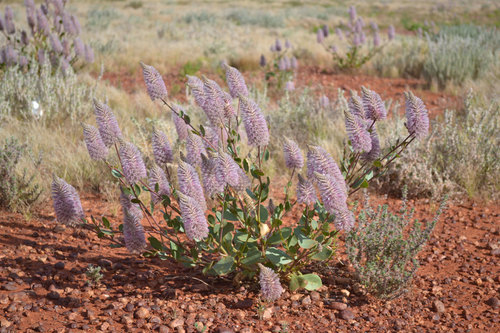
Pussy Tails Ptilotus spathulatus
The scientific name of the Pussy Tails is Ptilotus spathulatus. It is a species of flowering plant in the family Amaranthaceae (amaranth family), order Caryophyllales.
- Scientific name
- Ptilotus spathulatus (R.Br.) Poir.
- Common name
- Pussy Tails
- Genus
- Ptilotus
- Family
- Amaranthaceae (Amaranth Family)
- Order
- Caryophyllales
- Class
- Magnoliopsida
- Recorded in
- 1 country
- Name status
- accepted in the Catalogue of Life
Overview
Ptilotus spathulatus, commonly known as pussytails, cats paws or possumtails, is a species of flowering plant in the Amaranthaceae family and is endemic to Australia.
Classification of the Pussy Tails
| Kingdom | Plantae |
|---|---|
| Subkingdom | Pteridobiotina |
| Phylum | Tracheophyta |
| Class | Magnoliopsida |
| Order | Caryophyllales |
| Family | Amaranthaceae (Amaranth Family) |
| Subfamily | Amaranthoideae |
| Tribe | Aerveae |
| Genus | Ptilotus (Fox Tails) |
| Species | Ptilotus spathulatus (R.Br.) Poir. |
Where the Pussy Tails is found
Checklists and occurrence records place Ptilotus spathulatus in 1 country across Oceania. GBIF holds 5,088 georeferenced records of it.
Countries
Regions and cities with the most records
- South Australia, Australia 2,532
- Victoria, Australia 1,135
- New South Wales, Australia 536
- Western Australia, Australia 463
- Tasmania, Australia 249
- Adelaide, Australia 117
- Adelaide Hills, Australia 81
- Hobart, Australia 79
- Melbourne, Australia 79
- Geelong, Australia 12
- Ballarat, Australia 3
- Bendigo, Australia 3
Range as the checklists state it
Australia (Western Australia, South Australia, New South Wales, Victoria)
A number beside a place is its count of GBIF occurrence records. A place without a number comes from a checklist alone. Records show where a species has been observed or collected, which can include escapes and vagrants.
Common names
English
- Pussy Tails
- Spoon-leaved Pussy Tails
Synonyms
3 other scientific names have been used for this species and are now treated as synonyms of Ptilotus spathulatus.
- Ptilotus spathulatus f. angustatus Benl
- Trichinium mucronatum Nees
- Trichinium spathulatum R.Br.
Related species
-
 Pink Mulla MullaPtilotus exaltatus
- Regal-foxtailPtilotus nobilis
- CottonbushPtilotus obovatus
- Pom PomPtilotus manglesii
- Prince of Wales FeatherPtilotus polystachyus
- Ptilotus senarius
- FeatherheadsPtilotus macrocephalus
- Royal Mulla MullaPtilotus rotundifolius
Compare
Questions and answers
What is the scientific name of the Pussy Tails?
The scientific name of the Pussy Tails is Ptilotus spathulatus. Written with its author, the full name is Ptilotus spathulatus (R.Br.) Poir..
Which family does the Pussy Tails belong to?
Ptilotus spathulatus belongs to the family Amaranthaceae, in the order Caryophyllales and the class Magnoliopsida.
Where is the Pussy Tails found?
Checklists and occurrence records place Ptilotus spathulatus in 1 country: Australia.
What other names does the Pussy Tails have?
Ptilotus spathulatus is also known in English as Spoon-leaved Pussy Tails.
Sources
Data
- Catalogue of Life, 2026-10-16 XR cc by
- Global Biodiversity Information Facility CC BY 4.0
- Wikidata CC0
- English Wikipedia CC BY-SA 4.0
- GeoNames CC BY 4.0
- Within the Catalogue of Life, this name comes from Synonymic Checklists of the Vascular Plants of the World cc by
References
- Poir. (1816). Encycl. [J.Lamarck et al.], Suppl. 4: 620 (1816). where the name was published
This species in other databases
- Catalogue of Life 4Q8QC
- Wikidata Q15553522
- iNaturalist 202124
- World Flora Online wfo-0001263022
- GRIN 315185
Page built on 26 November 2026. See how the catalog is made and all sources and licences.
Cite this page
ScientificNames.org. (2026). Ptilotus spathulatus (Pussy Tails). Retrieved November 26, 2026, from https://scientificnames.org/species/ptilotus-spathulatus
“Ptilotus spathulatus (Pussy Tails).” ScientificNames.org, 2026, scientificnames.org/species/ptilotus-spathulatus. Accessed 26 Nov. 2026.
ScientificNames.org. “Ptilotus spathulatus (Pussy Tails).” Accessed November 26, 2026. https://scientificnames.org/species/ptilotus-spathulatus.
@misc{scientificnames_ptilotus_spathulatus_pussy_tails,
  author = {{ScientificNames.org}},
  title = {Ptilotus spathulatus (Pussy Tails)},
  year = {2026},
  url = {https://scientificnames.org/species/ptilotus-spathulatus},
  note = {Accessed 2026-11-26}
}