Species · Birds
Yelkouan Shearwater Puffinus yelkouan
The scientific name of the Yelkouan Shearwater is Puffinus yelkouan. It is a species of bird in the family Procellariidae (fulmars), order Procellariiformes. The name dates from 1827.
- Scientific name
- Puffinus yelkouan (Acerbi, 1827)
- Common name
- Yelkouan Shearwater
- Genus
- Puffinus
- Family
- Procellariidae (Fulmars)
- Order
- Procellariiformes
- Class
- Aves
- Red List category
- VU Vulnerable
- Environment
- marine, terrestrial
- Recorded in
- 25 countries
- Name status
- accepted in the Catalogue of Life

Overview
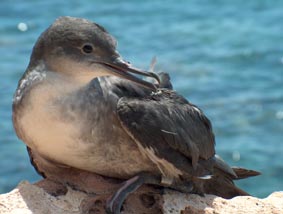
Puffinus yelkouan breeds on islands and coastal cliffs in the eastern and central Mediterranean, and most individuals spend the winter in the Mediterranean Sea. It has dark brown upperparts, paler undersides and a characteristic side-to-side gliding flight.
Written 26 November 2026 from the sources listed below. Each statement was checked against the passage it cites; statements that could not be supported were removed.
Appearance
The Yelkouan Shearwater has dark brown upperparts and paler undersides. Its plumage pattern is more contrasting than that of the Balearic Shearwater.[1][2]
The species measures 30–35 cm in length and has a wingspan of 70–84 cm.[3][4]
Habitat
The species breeds on islands and coastal cliffs in the eastern and central Mediterranean. It nests mainly on rocky coastal islands, offshore islands and islets.[5][6]
The species nests in burrows.[7]
Diet
The Yelkouan Shearwater feeds on fish and molluscs.[8]
Behaviour
The species flies with a characteristic side-to-side gliding motion on stiff wings, using relatively few wingbeats. Breeding colonies produce loud cackling calls at night.[9][10]
The species is gregarious and can gather in large numbers, particularly during autumn. It follows fishing vessels when discarded fish offal is thrown overboard.[11][12]
The birds visit their nesting burrows only at night to reduce predation by large gulls.[13]
Many individuals migrate seasonally to the Black Sea, while some young individuals travel to the Greek island of Lemnos.[14][15]
Most individuals spend the winter in the Mediterranean Sea. Small numbers enter the Atlantic Ocean in late summer.[16][17]
Reproduction and life cycle
The species breeds in colonies on Mediterranean islands and coastal cliffs, using burrows as nesting sites.[18][19]
Some remaining colonies experience low breeding success.[20]
The surrounding waters of Lemnos provide young birds with areas to practise finding food and identifying suitable feeding grounds.[21]
Conservation
The Yelkouan Shearwater is classified as Vulnerable on the IUCN Red List. It was uplisted to Near Threatened in 2008 and Vulnerable in 2012.[22][23]
The species has lost nine colonies over the past 60 years.[24]
Human exploitation historically included hunting the species for eggs, meat and chick fat. The species was also historically used as fish bait.[25][26]
Unregulated tourism and illegal construction contribute to habitat degradation on Lemnos. The Lemnos Seascape Restoration Project aims to reduce seabird bycatch and remove invasive alien species.[27][28]
Similar species
The Yelkouan Shearwater closely resembles the Atlantic Manx Shearwater. It overlaps in winter distribution with the Balearic Shearwater, which is described as brown above and dirty white below.[29][30][31]
The Yelkouan Shearwater and Balearic Shearwater have been recorded breeding together in a mixed colony on Menorca.[32]
A 2021 molecular phylogenetic study found very little genetic difference between the Yelkouan and Balearic Shearwaters.[33]
Classification of the Yelkouan Shearwater
| Kingdom | Animalia |
|---|---|
| Phylum | Chordata |
| Subphylum | Vertebrata |
| Infraphylum | Gnathostomata |
| Parvphylum | Osteichthyes |
| Megaclass | Tetrapoda |
| Class | Aves (Bird) |
| Order | Procellariiformes (Petrels) |
| Family | Procellariidae (Fulmars) |
| Genus | Puffinus (Small Shearwaters) |
| Species | Puffinus yelkouan (Acerbi, 1827) |
Where the Yelkouan Shearwater is found
Checklists and occurrence records place Puffinus yelkouan in 25 countries. GBIF holds 30,295 georeferenced records of it.
Countries
- Albania 27
- Bulgaria 608
- Croatia 479
- Cyprus 144
- France 9,489
- Georgia 325
- Gibraltar 15
- Greece 3,302
- Isle of Man 14
- Israel 923
- Italy 4,014
- Lebanon 17
- Malta 197
- Monaco 6
- Montenegro 15
- Portugal 71
- Romania 108
- Russia 135
- Slovenia 37
- Spain 3,827
- Sweden 3
- Switzerland 3
- Turkey 6,008
- Ukraine 413
- United Kingdom 115
Regions and cities with the most records
- Çubuklu, Turkey 3,632
- Üsküdar, Turkey 3,159
- Şişli, Turkey 3,127
- Sultangazi, Turkey 2,962
- Ümraniye, Turkey 2,852
- Istanbul, Turkey 2,769
- Fatih, Turkey 2,749
- Ataşehir, Turkey 2,695
- Zekeriya, Turkey 2,684
- Esenler, Turkey 2,623
- Zeytinburnu, Turkey 2,528
- Bağcılar, Turkey 2,493
- Istanbul, Turkey 2,468
- Maltepe, Turkey 2,457
- Bahçelievler, Turkey 2,384
- Provence-Alpes-Côte d'Azur, France 2,234
- Sancaktepe, Turkey 2,139
- Küçükçekmece, Turkey 1,446
- Hyères, France 1,415
- La Crau, France 1,265
- Başakşehir, Turkey 1,216
- La Valette-du-Var, France 1,153
- La Garde, France 1,141
- Catalonia, Spain 1,002
- Occitanie, France 954
- Marseille 09, France 826
- Balearic Islands, Spain 825
- Marseille 07, France 810
- Marseille 10, France 807
- Marseille 08, France 806
- Marseille 02, France 801
- Marseille 06, France 797
- Marseille 05, France 795
- Marseille, France 783
- Marseille 01, France 781
- Marseille 04, France 781
5 more countries have a few records outside this range
These countries hold a few records of Puffinus yelkouan but lie outside the range the checklists give for it. Such records are often zoo or garden specimens, museum material or vagrants, so the species is not counted as occurring there.
Range as the checklists state it
Europe & Northern Asia (excluding China)
A number beside a place is its count of GBIF occurrence records. A place without a number comes from a checklist alone. Records show where a species has been observed or collected, which can include escapes and vagrants.
Common names
English
- Yelkouan Shearwater
- Levantine Shearwater
- Mediterranean Shearwater
Names in 42 other languages
- Albanian
- lajmëtari i vogël i fortunes
- Arabic
- جلم ماء البحر المتوسط, جلم ماء بحر الأبيض المتوسط
- Asturian
- pardiella mediterránea
- Basque
- Gabai mediterranearra, Gabai mediterraneo
- Breton
- Tort yelkouan
- Bulgarian
- Обикновен буревестник, Средиземноморски буревестник
- Catalan
- Baldriga mediterrànea, baldriga mediterrània
- Chinese
- 地中海鸌, 地中海鹱, 葉庫安鸌
- Croatian
- gregula
- Czech
- buřňák středomořský
- Danish
- Middelhavs-skråpe, Middelhavsskråpe, Ægæerskråpe
- Dutch
- Ostmediterrane vale pijlstormvogel, Yelkouanpijlstormvogel
- Esperanto
- mediteranea pufino
- Estonian
- vahemere tormilind
- Finnish
- idänpikkuliitäjä, idänpikkuliitäjä (levantinliitäjä)
- French
- Puffin de Méditerranée, Puffin yelkouan
- German
- Levantinesturmtaucher, Mittelmeer-Sturmtaucher, Mittelmeersturmtaucher
- Greek
- Μύχος, Μύχος (της Μεσογείου), Μύχος της Μεσογείου
- Hebrew
- יסעור מצוי
- Hungarian
- bukdosó vészmadár
- Icelandic
- Stormskrofa
- Irish
- Cánóg mheánmhuirí
- Italian
- Berta minore, berta minore mediterranea
- Japanese
- チチュウカイミズナギドリ
- Latvian
- Vidusjūras vētrasputns
- Lithuanian
- viduržeminė audronaša
- Macedonian
- Медитерански буравесник, мал завој
- Northern Sami
- Gaskamearasaddi
- Norwegian
- Middelhavslire
- Persian
- کبوتر دریایی شام
- Polish
- burzyk śródziemnomorski
- Portuguese
- Fura-bucho do Mediterrâneo, Pardela-de-yelkouan, fura-bucho-do-mediterrâneo, pardela-do-mediterrâneo
- Romanian
- Ielcovan estic, pufin, pufinul yelkouan
- Russian
- Левантский буревестник, буревестник левантский
- Serbian
- Mali zovoj
- Slovak
- víchrovník hnedastý
- Slovenian
- sredozemski viharnik
- Spanish
- Pardela mediterránea
- Swedish
- medelhavslira
- Turkish
- yelkovan
- Ukrainian
- буревісник східний
- Welsh
- Adar Drycin Môr y Canoldir, aderyn drycin Môr y Canoldir
Synonyms
3 other scientific names have been used for this species and are now treated as synonyms of Puffinus yelkouan.
- Procellaria yelkouan Acerbi, 1827
- Puffinus puffinus yelkouan (Acerbi, 1827)
- Puffinus yelkouan yelkouan (Acerbi, 1827)
Related species
-
 Manx ShearwaterPuffinus puffinus
-
 Balearic ShearwaterPuffinus mauretanicus
-
 Sargasso ShearwaterPuffinus lherminieri
-
 Newell's ShearwaterPuffinus newelli
-
 Christmas ShearwaterPuffinus nativitatis
-
 Hutton's ShearwaterPuffinus huttoni
-
 Little ShearwaterPuffinus assimilis
-
 Tropical ShearwaterPuffinus bailloni
Compare
Questions and answers
What is the scientific name of the Yelkouan Shearwater?
The scientific name of the Yelkouan Shearwater is Puffinus yelkouan. Written with its author, the full name is Puffinus yelkouan (Acerbi, 1827).
Which family does the Yelkouan Shearwater belong to?
Puffinus yelkouan belongs to the family Procellariidae, in the order Procellariiformes and the class Aves.
Where is the Yelkouan Shearwater found?
Checklists and occurrence records place Puffinus yelkouan in 25 countries, including France, Turkey, Italy, Spain, Greece and Israel.
What is the conservation status of the Yelkouan Shearwater?
The IUCN Red List category recorded for Puffinus yelkouan is Vulnerable (VU).
What other names does the Yelkouan Shearwater have?
Puffinus yelkouan is also known in English as Levantine Shearwater and Mediterranean Shearwater.
Sources
Passages the profile rests on
- The Yelkouan Shearwater has dark brown upperparts and paler undersides. Source passage: “the dark upperparts and paler undersides are alternately exposed” — English Wikipedia
- The species has a more contrasting plumage pattern than the Balearic Shearwater. Source passage: “The yelkouan shearwater has a more contrasted appearance than the Balearic shearwater” — English Wikipedia
- The Yelkouan Shearwater measures 30–35 cm in length. Source passage: “30–35 cm (12–14 in) in length” — English Wikipedia
- The species has a wingspan of 70–84 cm. Source passage: “a wingspan of 70–84 cm (28–33 in)” — English Wikipedia
- The species breeds on islands and coastal cliffs in the eastern and central Mediterranean. Source passage: “Yelkouan shearwaters breed on islands and coastal cliffs in the eastern and central Mediterranean.” — English Wikipedia
- The species nests mainly on rocky coastal islands, offshore islands and islets. Source passage: “nests mainly on rocky coastal and offshore islands and islets” — birdlife.org
- The species nests in burrows. Source passage: “This species nests in burrows which are only visited at night to avoid predation by large gulls.” — English Wikipedia
- The Yelkouan Shearwater feeds on fish and molluscs. Source passage: “The yelkouan shearwater feeds on fish and molluscs.” — English Wikipedia
- The species flies with a characteristic side-to-side gliding motion on stiff wings and relatively few wingbeats. Source passage: “dipping from side to side on stiff wings with few wingbeats” — English Wikipedia
- Breeding colonies produce loud cackling calls at night. Source passage: “at night the breeding colonies are alive with raucous cackling calls” — English Wikipedia
- The species is gregarious and can gather in large numbers, particularly during autumn. Source passage: “This is a gregarious species, which can be seen in large numbers from boats or headlands, especially in autumn.” — English Wikipedia
- The species follows fishing vessels when discarded fish offal is being thrown overboard. Source passage: “It follows fishing ships when offal is being thrown.” — English Wikipedia
- The birds visit their nesting burrows only at night to reduce predation by large gulls. Source passage: “which are only visited at night to avoid predation by large gulls.” — English Wikipedia
- Many individuals migrate seasonally to the Black Sea. Source passage: “Many Yealkouan Shearwaters seasonally migrate to the Black Sea” — birdlife.org
- Some young individuals travel to the Greek island of Lemnos. Source passage: “Some of the young birds, however, take a different route, which leads them to the island of Lemnos, in Greece.” — birdlife.org
- Most individuals spend the winter in the Mediterranean Sea. Source passage: “Most winter in that sea” — English Wikipedia
- Small numbers of individuals enter the Atlantic Ocean in late summer. Source passage: “small numbers enter the Atlantic in late summer.” — English Wikipedia
- The species breeds in colonies on Mediterranean islands and coastal cliffs. Source passage: “Yelkouan shearwaters breed on islands and coastal cliffs in the eastern and central Mediterranean.” — English Wikipedia
- The species uses burrows as nesting sites. Source passage: “This species nests in burrows” — English Wikipedia
- Some remaining colonies experience low breeding success. Source passage: “many of those remaining experience alarmingly low breeding success and adult survival rates.” — birdlife.org
- The surrounding waters of Lemnos provide young birds with areas to practise finding food and identifying suitable feeding grounds. Source passage: “providing a safe training ground to learn to find food, identify suitable feeding areas” — birdlife.org
- The species is classified as Vulnerable on the IUCN Red List. Source passage: “Currently listed as Vulnerable on the IUCN Red List” — birdlife.org
- The species was uplisted to Near Threatened in 2008 and Vulnerable in 2012. Source passage: “it was uplisted to near threatened status in 2008 and vulnerable in 2012.” — English Wikipedia
- The species has lost nine colonies over the past 60 years. Source passage: “Over the past 60 years, nine colonies have vanished” — birdlife.org
- Human exploitation historically included hunting the species for eggs, meat and chick fat. Source passage: “hunted for its eggs, meat, and chick fat” — birdlife.org
- The species was historically used as fish bait. Source passage: “and even used as fish bait.” — birdlife.org
- Unregulated tourism and illegal construction contribute to habitat degradation on Lemnos. Source passage: “including unregulated touristic activities, illegal construction and a recent increase in tourism.” — birdlife.org
- The Lemnos Seascape Restoration Project aims to reduce seabird bycatch and remove invasive alien species. Source passage: “restore endangered wildlife, such as seabirds, by reducing bycatch, and remove invasive alien species” — birdlife.org
- The Yelkouan Shearwater closely resembles the Atlantic Manx Shearwater. Source passage: “It is very similar to the black-and-white Manx shearwater of the Atlantic” — English Wikipedia
- The Yelkouan Shearwater overlaps in winter distribution with the Balearic Shearwater. Source passage: “with which its winter range overlaps” — English Wikipedia
- The Balearic Shearwater is described as brown above and dirty white below. Source passage: “the latter species is brown above and dirty white below.” — English Wikipedia
- The Yelkouan Shearwater and Balearic Shearwater have been recorded breeding together in a mixed colony on Menorca. Source passage: “at least one mixed breeding colony of the yelkouan and the Balearic shearwaters exists on Menorca.” — English Wikipedia
- A 2021 molecular phylogenetic study found very little genetic difference between the Yelkouan and Balearic Shearwaters. Source passage: “A molecular phylogenetic study published in 2021 found very little genetic difference between the yelkouan shearwater and the Balearic shearwater” — English Wikipedia
Data
- Catalogue of Life, 2026-10-16 XR cc by
- Global Biodiversity Information Facility CC BY 4.0
- Wikidata CC0
- GeoNames CC BY 4.0
- Wikimedia Commons per image; credit shown with each image
- iNaturalist per image; credit shown with each image
- Within the Catalogue of Life, this name comes from The Integrated Taxonomic Information System cc0
References
- Gill, Frank, & and Minturn Wright. (2006). Birds of the World: Recommended English Names.
This species in other databases
- Catalogue of Life 4QFY7
- Wikidata Q511566
- iNaturalist 4109
- WoRMS urn:lsid:marinespecies.org:taxname:137204
- Avibase levshe1
Page built on 29 November 2026. See how the catalog is made and all sources and licences.
Cite this page
ScientificNames.org. (2026). Puffinus yelkouan (Yelkouan Shearwater). Retrieved November 29, 2026, from https://scientificnames.org/species/puffinus-yelkouan
“Puffinus yelkouan (Yelkouan Shearwater).” ScientificNames.org, 2026, scientificnames.org/species/puffinus-yelkouan. Accessed 29 Nov. 2026.
ScientificNames.org. “Puffinus yelkouan (Yelkouan Shearwater).” Accessed November 29, 2026. https://scientificnames.org/species/puffinus-yelkouan.
@misc{scientificnames_puffinus_yelkouan_yelkouan_shearwater,
  author = {{ScientificNames.org}},
  title = {Puffinus yelkouan (Yelkouan Shearwater)},
  year = {2026},
  url = {https://scientificnames.org/species/puffinus-yelkouan},
  note = {Accessed 2026-11-29}
}