Species · Birds
Orange-cheeked Parrot Pyrilia barrabandi
The scientific name of the Orange-cheeked Parrot is Pyrilia barrabandi. It is a species of bird in the family Psittacidae (macaws), order Psittaciformes. The name dates from 1820.
- Scientific name
- Pyrilia barrabandi (Kuhl, 1820)
- Common name
- Orange-cheeked Parrot
- Genus
- Pyrilia
- Family
- Psittacidae (Macaws)
- Order
- Psittaciformes
- Class
- Aves
- Red List category
- LC Least Concern
- Recorded in
- 6 countries
- Name status
- accepted in the Catalogue of Life

Overview
The Orange-cheeked Parrot is a medium-sized parrot of lowland rainforest. It inhabits humid lowland forests in the Amazon Basin. Its black head, white eye patch, and orange cheek form a unique combination.
Written 26 November 2026 from the sources listed below. Each statement was checked against the passage it cites; statements that could not be supported were removed.
Appearance
The Orange-cheeked Parrot measures approximately 25 cm in length and weighs between 165 and 190 g.[1][2]
Adults have a black head and cheeks colored orange to yellow. A distinctive white eye-ring surrounds a brown eye, and the adult bill is gray to black.[3][4][5]
Adults have an olive-colored throat and breast, yellow thighs, and blue wing tips and tail tips.[6][7][8]
The aurantiigena subspecies has deep orange cheeks, thighs, and wing-coverts.[9]
Juveniles have a brown crown and an olive forehead, nape, cheeks, and chin.[10]
Habitat
The Orange-cheeked Parrot inhabits humid lowland forests in the Amazon Basin. It occurs in lowland terra firme forest at elevations up to 400 m.[11][12]
It also inhabits forest edges and partly disturbed forests. It occurs uncommonly in várzea forest stands.[13][14]
Diet
The Orange-cheeked Parrot feeds on seeds, fruit, and wasp larvae found in galls. It forages high in the forest canopy or immediately below it.[15][16]
It consumes clay-bank soil to neutralize acids in its food.[17]
Behaviour
The Orange-cheeked Parrot is active during the early morning. It is commonly observed alone, in pairs, or in groups of up to ten individuals at clay banks.[18][19]
It produces distinctive reedy, slurred calls while flying and guttural alarm calls.[20][21]
Reproduction and life cycle
The breeding season is possibly September to October.[22]
Conservation
The Orange-cheeked Parrot is classified as Least Concern on the IUCN Red List. It was most recently assessed in 2021.[23][24]
The species is naturally rare throughout its range. Increasing deforestation in the Amazon threatens it through habitat loss.[25][26]
Its population is likely to decline by 25–30% as habitat is lost.[27]
Uses
The Orange-cheeked Parrot is occasionally kept as a pet in Brazil.[28]
Classification of the Orange-cheeked Parrot
| Kingdom | Animalia |
|---|---|
| Phylum | Chordata |
| Subphylum | Vertebrata |
| Infraphylum | Gnathostomata |
| Parvphylum | Osteichthyes |
| Megaclass | Tetrapoda |
| Class | Aves (Bird) |
| Order | Psittaciformes (Parrot) |
| Family | Psittacidae (Macaws) |
| Genus | Pyrilia (Brown-chested Parrots) |
| Species | Pyrilia barrabandi (Kuhl, 1820) |
Where the Orange-cheeked Parrot is found
Checklists and occurrence records place Pyrilia barrabandi in 6 countries across South America. GBIF holds 10,315 georeferenced records of it.
Countries
Regions and cities with the most records
- Madre de Dios, Peru 2,855
- Orellana Province, Ecuador 1,554
- Loreto, Peru 906
- Mato Grosso, Brazil 889
- Vaupés, Colombia 827
- Sucumbíos, Ecuador 683
- Mitú, Colombia 680
- Amazonas, Brazil 670
- Guainía Department, Colombia 293
- Amazonas Department, Colombia 286
- Tambopata, Peru 281
- Rondônia, Brazil 276
- Leticia, Colombia 170
- Tabatinga, Brazil 160
- Putumayo Department, Colombia 149
- Novo Airão, Brazil 145
- Puerto Maldonado, Peru 141
- Acre, Brazil 108
- Pastaza Province, Ecuador 105
- Caquetá, Colombia 95
- Amazonas, Venezuela 79
- Meta Department, Colombia 78
- Guaviare Department, Colombia 75
- Manacapuru, Brazil 44
- Pando, Bolivia 39
- Napo, Ecuador 36
- Puerto Asís, Colombia 35
- Puerto Leguízamo, Colombia 34
- Porto Velho, Brazil 33
- Ucayali, Peru 33
- Puerto Francisco de Orellana, Ecuador 26
- Morona-Santiago Province, Ecuador 25
- La Paz Department, Bolivia 24
- Requena, Peru 24
- Atalaia do Norte, Brazil 23
- Cauca Department, Colombia 23
1 more country has a few records outside this range
These countries hold a few records of Pyrilia barrabandi but lie outside the range the checklists give for it. Such records are often zoo or garden specimens, museum material or vagrants, so the species is not counted as occurring there.
Range as the checklists state it
South America
A number beside a place is its count of GBIF occurrence records. A place without a number comes from a checklist alone. Records show where a species has been observed or collected, which can include escapes and vagrants.
Common names
English
- Orange-cheeked Parrot
Names in 26 other languages
- Arabic
- ببغاء برتقالي الخد
- Catalan
- lloro de galtes daurades
- Chinese
- 橙頰鸚哥, 橙颊鹦哥
- Croatian
- plamenoramena papiga
- Czech
- amazónek zlatolící
- Danish
- Orangekindet Pragtpapegøje
- Dutch
- Barrabands Papegaai
- Esperanto
- orvanga papago
- Estonian
- kuldpõsk-selvapapagoi
- Finnish
- kultaposkiaratti
- French
- Caïque de Barraband
- German
- Goldwangenpapagei
- Hungarian
- aranyarcú papagáj, narancsarcú papagáj
- Italian
- Pappagallo guancearancio
- Japanese
- キンホオインコ
- Lithuanian
- geltonskruostė puošnioji papūga
- Norwegian
- oransjekinnpapegøye
- Polish
- barwinka złotolica
- Portuguese
- curica-de-bochecha-laranja, papagaio-de-faces-laranja
- Russian
- Желтощёкий лорито, Златощёкий украшенный попугай
- Serbian
- Pirilija papagaj sa narandžastim obrazima
- Slovak
- amazoňan zlatolíci
- Spanish
- Lorito carinaranja
- Swedish
- barrabandpapegoja, orangekindad papegoja
- Turkish
- Barraband Papağanı
- Ukrainian
- каїка жовтощокий
Synonyms
6 other scientific names have been used for this species and are now treated as synonyms of Pyrilia barrabandi.
- Caica barrabandi Kuhl, H, 1820
- Gypopsitta barrabandi (Kuhl, 1820)
- Pionopsitta barrabandi (Kuhl, 1820)
- Polytelis barrabandi Kuhl, H, 1820
- Psittacus barrabandi Kuhl, 1820
- Psittacus barrabandi Swainson, WJ, 1821
Subspecies and varieties
- Pyrilia barrabandi aurantiigena (Brazilian Barraband's Parrot) subspecies
- Pyrilia barrabandi barrabandi subspecies
Related species
-
 Bald ParrotPyrilia aurantiocephala
-
 Vulturine ParrotPyrilia vulturina
-
 Brown-hooded ParrotPyrilia haematotis
-
 Caica ParrotPyrilia caica
-
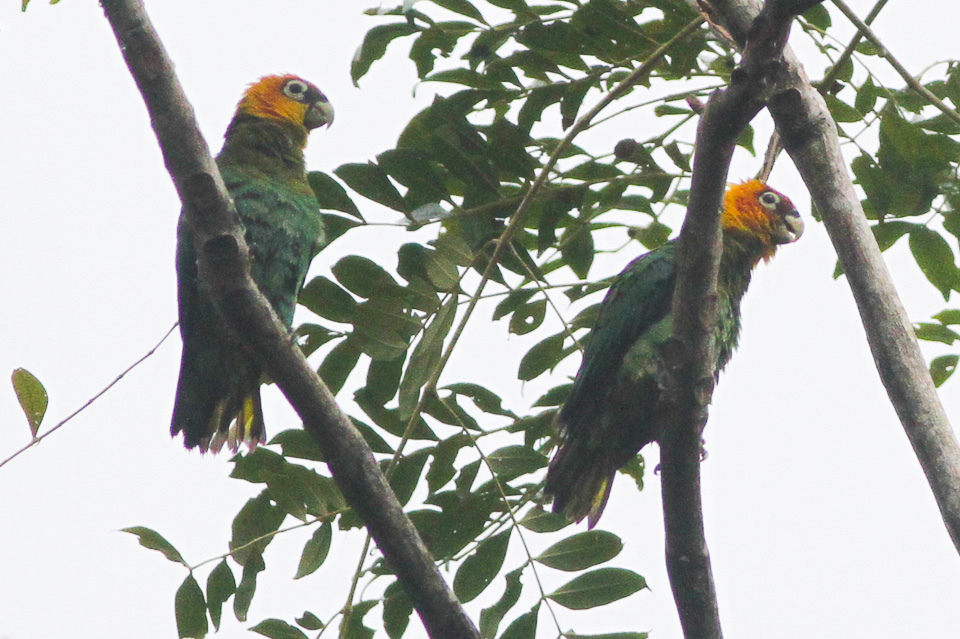 Saffron-headed ParrotPyrilia pyrilia
-
 Rose-faced ParrotPyrilia pulchra
-
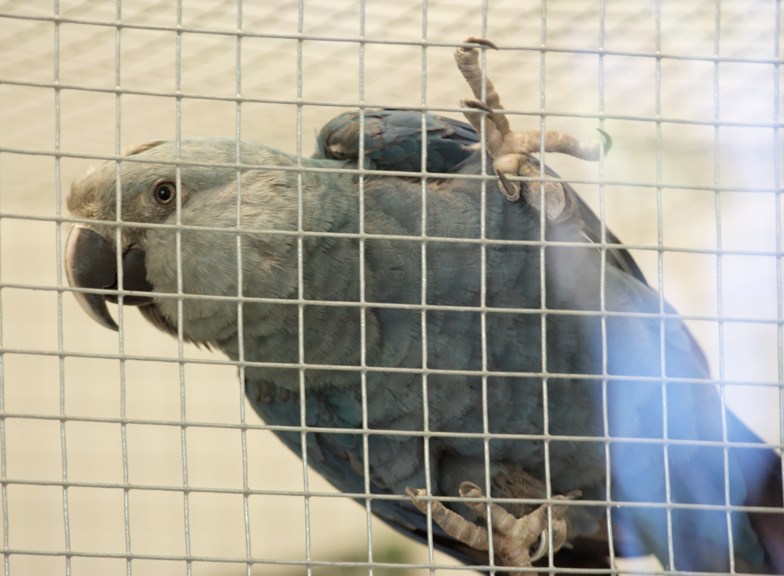 Spix's MacawCyanopsitta spixii
-
 Grey ParrotPsittacus erithacus
Compare
Questions and answers
What is the scientific name of the Orange-cheeked Parrot?
The scientific name of the Orange-cheeked Parrot is Pyrilia barrabandi. Written with its author, the full name is Pyrilia barrabandi (Kuhl, 1820).
Which family does the Orange-cheeked Parrot belong to?
Pyrilia barrabandi belongs to the family Psittacidae, in the order Psittaciformes and the class Aves.
Where is the Orange-cheeked Parrot found?
Checklists and occurrence records place Pyrilia barrabandi in 6 countries: Peru, Ecuador, Brazil, Colombia, Venezuela and Bolivia.
What is the conservation status of the Orange-cheeked Parrot?
The IUCN Red List category recorded for Pyrilia barrabandi is Least Concern (LC).
What kind of bird has orange cheeks?
The Orange-cheeked Parrot has cheeks colored orange to yellow. Its aurantiigena subspecies has deep orange cheeks.[3][9]
Sources
Passages the profile rests on
- The Orange-cheeked Parrot measures approximately 25 cm in length. Source passage: “The parrots are 25 cm (9.8 in) in size” — English Wikipedia
- The Orange-cheeked Parrot weighs between 165 and 190 g. Source passage: “weigh 165–190 g (5.8–6.7 oz).” — English Wikipedia
- Adults have a black head and cheeks colored orange to yellow. Source passage: “They have a black head and orange to yellow cheeks” — English Wikipedia
- Adults have a distinctive white eye-ring surrounding a brown eye. Source passage: “with a distinctive white eye-ring around a brown eye.” — English Wikipedia
- The adult bill is gray to black. Source passage: “The beak is gray to black.” — English Wikipedia
- Adults have an olive-colored throat and breast. Source passage: “Adults have an olive throat and breast.” — English Wikipedia
- Adults have yellow thighs. Source passage: “The thighs are yellow” — English Wikipedia
- The wing tips and tail tips are blue. Source passage: “The tips of the tail and the wing feathers are blue.” — English Wikipedia
- The aurantiigena subspecies has deep orange cheeks, thighs, and wing-coverts. Source passage: “P.b. aurantiigena has deep orange cheeks, bend of wing, underwing and lesser wing coverts, and thighs” — English Wikipedia
- Juveniles have a brown crown and an olive forehead, nape, cheeks, and chin. Source passage: “Juveniles have a brown crown and olive forehead, nape, cheeks and chin” — English Wikipedia
- The species inhabits humid lowland forests in the Amazon Basin. Source passage: “in humid lowland forests in the northwestern, southwestern, and south-central Amazon Basin in South America.” — English Wikipedia
- The species occurs in lowland terra firme forest at elevations up to 400 m. Source passage: “at elevations of up to 400 m (1,300 ft) in lowland terra firme forest” — English Wikipedia
- The species also inhabits forest edges and partly disturbed forests. Source passage: “They also inhabit forest edges and partly disturbed forests.” — English Wikipedia
- The species occurs uncommonly in várzea forest stands. Source passage: “and uncommonly in varzea stands.” — English Wikipedia
- The species feeds on seeds, fruit, and wasp larvae found in galls. Source passage: “They feed on seeds, fruit, and on wasp larvae in galls.” — English Wikipedia
- The species forages high in the forest canopy or immediately below it. Source passage: “Foraging occurs high in canopy or just below the canopy.” — English Wikipedia
- The species consumes clay-bank soil to neutralize acids in its food. Source passage: “They also visit clay banks to consume antacid-like soil which neutralizes the acids found in their food.” — English Wikipedia
- The species is active during the early morning. Source passage: “They are active in the early morning.” — English Wikipedia
- The species is commonly observed alone, in pairs, or in groups of up to ten individuals at clay banks. Source passage: “They are often seen singly, in pairs or in small groups of up to 10 individuals at clay banks.” — English Wikipedia
- The species produces distinctive reedy, slurred calls while flying. Source passage: “Distinctive calls that are reedy and slurred in flight.” — English Wikipedia
- The species produces guttural alarm calls. Source passage: “They have guttural alarm calls.” — English Wikipedia
- The breeding season is possibly September to October. Source passage: “Their breeding season is possibly from September–October.” — English Wikipedia
- The species is classified as Least Concern on the IUCN Red List. Source passage: “The species is listed as least concern on the IUCN Red List.” — English Wikipedia
- The species was most recently assessed for the IUCN Red List in 2021. Source passage: “has most recently been assessed for The IUCN Red List of Threatened Species in 2021.” — iucnredlist.org
- Increasing deforestation in the Amazon threatens the species through habitat loss. Source passage: “They are threatened with loss of habitat due to the increasing deforestation of the Amazon.” — English Wikipedia
- The species is naturally rare throughout its range. Source passage: “The species is naturally rare in its range.” — English Wikipedia
- The species' population is likely to decline by 25–30% as habitat is lost. Source passage: “with its population likely to decrease by 25-30% as it loses habitat.” — English Wikipedia
- The Orange-cheeked Parrot is occasionally kept as a pet in Brazil. Source passage: “They are uncommonly kept as pets, and are kept as pets in Brazil.” — English Wikipedia
Data
- Catalogue of Life, 2026-10-16 XR cc by
- Global Biodiversity Information Facility CC BY 4.0
- Wikidata CC0
- GeoNames CC BY 4.0
- Wikimedia Commons per image; credit shown with each image
- Within the Catalogue of Life, this name comes from The Integrated Taxonomic Information System cc0
References
- Dickinson, E. C., and L. Christidis, eds. (2014). The Howard and Moore Complete Checklist of the Birds of the World, 4th Edition, Vol. 2 Passerines.
This species in other databases
Page built on 29 November 2026. See how the catalog is made and all sources and licences.
Cite this page
ScientificNames.org. (2026). Pyrilia barrabandi (Orange-cheeked Parrot). Retrieved November 29, 2026, from https://scientificnames.org/species/pyrilia-barrabandi
“Pyrilia barrabandi (Orange-cheeked Parrot).” ScientificNames.org, 2026, scientificnames.org/species/pyrilia-barrabandi. Accessed 29 Nov. 2026.
ScientificNames.org. “Pyrilia barrabandi (Orange-cheeked Parrot).” Accessed November 29, 2026. https://scientificnames.org/species/pyrilia-barrabandi.
@misc{scientificnames_pyrilia_barrabandi_orange_cheeked_parrot,
  author = {{ScientificNames.org}},
  title = {Pyrilia barrabandi (Orange-cheeked Parrot)},
  year = {2026},
  url = {https://scientificnames.org/species/pyrilia-barrabandi},
  note = {Accessed 2026-11-29}
}