Species · Birds
Blaze-winged Parakeet Pyrrhura devillei
The scientific name of the Blaze-winged Parakeet is Pyrrhura devillei. It is a species of bird in the family Psittacidae (macaws), order Psittaciformes. The name dates from 1854.
- Scientific name
- Pyrrhura devillei (Massena & Souancé, 1854)
- Common name
- Blaze-winged Parakeet
- Genus
- Pyrrhura
- Family
- Psittacidae (Macaws)
- Order
- Psittaciformes
- Class
- Aves
- Red List category
- LC Least Concern
- Recorded in
- 2 countries
- Name status
- accepted in the Catalogue of Life

Overview
Pyrrhura devillei occurs in the Pantanal and Chaco regions of southern Brazil and northern Paraguay. It is distinguished by its green plumage, red and yellow wing markings, and maroon belly patch.
Written 26 November 2026 from the sources listed below. Each statement was checked against the passage it cites; statements that could not be supported were removed.
Appearance
Adults have a brownish crown and reddish-brown ear coverts, while the remainder of the face is yellowish green. The upperparts are green.[1][2]
The chin, sides of the neck, and breast are yellowish green, with brown feather edges creating a scaly appearance. The center of the belly is maroon, while the remaining underparts are green.[3][4]
The wings are predominantly green, with blue primary feathers, a red carpal area, and red and yellow underwing coverts. The upper surface of the tail is olive green with maroon coloring on its outer third, while the lower surface is dull rufous brown.[5][6]
The species has a long, pointed greenish-yellow tail. The maroon belly patch varies in size among individuals.[7][8]
Habitat
The species inhabits parts of the Pantanal and Chaco regions. It occurs mainly in deciduous and gallery forests.[9][10]
It also inhabits ecotones between forests and adjoining scrublands and savannah, as well as other wooded habitats.[11][12]
Diet
The species feeds on fruits, seeds, and nuts.[13]
Behaviour
The species' movements, if any, have not been determined.[14]
Its most common call consists of a series of high-pitched, shrill notes. It gives its characteristic calls both while perched and during flight.[15][16]
Perched individuals are often silent. Flying flocks frequently call simultaneously, producing noisy, harsh, piercing chatter.[17][18]
Reproduction and life cycle
The breeding biology of the species in the wild is unknown.[19]
Captive-raised young fledge seven to eight weeks after hatching.[20]
Similar species
The Blaze-winged Parakeet is closely related to the maroon-bellied parakeet (Pyrrhura frontalis), and the two species may be conspecific. It is monotypic.[21][22]
The species hybridizes with Pyrrhura frontalis chiripepe where their ranges overlap in Paraguay.[23]
Conservation
The species was assessed as Least Concern initially, Near Threatened in 2009, and Least Concern again in 2021.[24]
It has a somewhat limited range that is remote and largely undisturbed. Logging, habitat conversion for small-scale farming and ranching, and the pet trade are identified as potential threats, but these do not appear to be major problems for the species.[25][26][27]
The species is considered rare to uncommon in Paraguay and locally common in Brazil.[28][29]
Classification of the Blaze-winged Parakeet
| Kingdom | Animalia |
|---|---|
| Phylum | Chordata |
| Subphylum | Vertebrata |
| Infraphylum | Gnathostomata |
| Parvphylum | Osteichthyes |
| Megaclass | Tetrapoda |
| Class | Aves (Bird) |
| Order | Psittaciformes (Parrot) |
| Family | Psittacidae (Macaws) |
| Genus | Pyrrhura (Pyrrhuras) |
| Species | Pyrrhura devillei (Massena & Souancé, 1854) |
Where the Blaze-winged Parakeet is found
Checklists and occurrence records place Pyrrhura devillei in 2 countries across South America. GBIF holds 1,755 georeferenced records of it.
Countries
Regions and cities with the most records
- Mato Grosso do Sul, Brazil 1,682
- Bonito, Brazil 575
- Miranda, Brazil 46
- Concepción, Paraguay 43
- Aquidauana, Brazil 41
- Anastácio, Brazil 40
- Alto Paraguay, Paraguay 6
- Jardim, Brazil 3
Range as the checklists state it
South America
A number beside a place is its count of GBIF occurrence records. A place without a number comes from a checklist alone. Records show where a species has been observed or collected, which can include escapes and vagrants.
Common names
English
- Blaze-winged Parakeet
Names in 25 other languages
- Chinese
- 辉翅鹦哥, 閃翅鸚哥
- Croatian
- žutorepa papiga
- Czech
- papoušek zlatoocasý, pyrura zlatoocasý, pyrura červenokřídlý
- Danish
- Brunskuldret Conure
- Dutch
- Devilles Parkiet
- Esperanto
- flamflugila papago
- Estonian
- chaco võrkpapagoi
- Finnish
- bolivianaratti, hehkusiipiaratti
- French
- Conure de Deville
- German
- Bolivienrotschwanzsittich, Devillesittich, Rotschwanzsittich
- Hungarian
- Deville-papagáj, bolíviai pirosfarkú papagáj
- Italian
- Parrocchetto aliflammee
- Japanese
- ボリビアウロコインコ
- Lithuanian
- bolivinė raudonuodegė papūga
- Norwegian
- ildvingeparakitt
- Polish
- rudosterka brązowoucha
- Portuguese
- periquitão-asa-de-fogo, tiriba-fogo
- Russian
- Боливийская которра, Боливийский краснохвостый попугай
- Serbian
- Bolivijski smeđouhi pirura papagaj
- Slovak
- klinochvost pestrý
- Spanish
- Cotorra de Deville, chiripepé de ala anaranjada
- Swedish
- eldvingad parakit, eldvingeparakit
- Turkish
- Deville Papağanı
- Ukrainian
- котора болівійський
- Welsh
- conwra adeingoch
Synonyms
One other scientific name has been used for this species and is now treated as a synonym of Pyrrhura devillei.
- Conurus devillei Massena & Souancé, 1854
Related species
-
 Green-cheeked ParakeetPyrrhura molinae
-
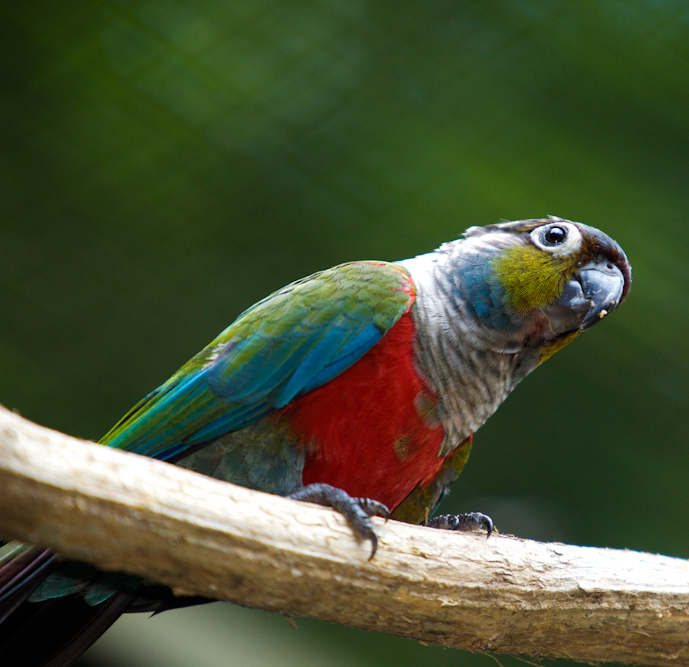 Crimson-bellied ParakeetPyrrhura perlata
-
 Black-capped ParakeetPyrrhura rupicola
-
 Maroon-bellied ParakeetPyrrhura frontalis
-
 Pearly ParakeetPyrrhura lepida
-
 Painted ParakeetPyrrhura picta
-
 Ochre-marked ParakeetPyrrhura cruentata
-
 Sulphur-winged ParakeetPyrrhura hoffmanni
Compare
Questions and answers
What is the scientific name of the Blaze-winged Parakeet?
The scientific name of the Blaze-winged Parakeet is Pyrrhura devillei. Written with its author, the full name is Pyrrhura devillei (Massena & Souancé, 1854).
Which family does the Blaze-winged Parakeet belong to?
Pyrrhura devillei belongs to the family Psittacidae, in the order Psittaciformes and the class Aves.
Where is the Blaze-winged Parakeet found?
Checklists and occurrence records place Pyrrhura devillei in 2 countries: Brazil and Paraguay.
What is the conservation status of the Blaze-winged Parakeet?
The IUCN Red List category recorded for Pyrrhura devillei is Least Concern (LC).
What do parakeets eat in the wild?
The Blaze-winged Parakeet feeds on fruits, seeds, and nuts.[13]
Sources
Passages the profile rests on
- Adults have a brownish crown and reddish-brown ear coverts, while the remainder of the face is yellowish green. Source passage: “Adults have a brownish crown and reddish brown ear coverts; the rest of their face is yellowish green.” — English Wikipedia
- The upperparts are green. Source passage: “Their upperparts are green.” — English Wikipedia
- The chin, sides of the neck, and breast are yellowish green, with brown feather edges creating a scaly appearance. Source passage: “Their chin, the sides of their neck, and their breast are yellowish green; brown feather edges give a scaly appearance.” — English Wikipedia
- The center of the belly is maroon, while the remaining underparts are green. Source passage: “The center of their belly is maroon and the rest of their underparts are the same green as their upperparts.” — English Wikipedia
- The wings are predominantly green, with blue primary feathers, a red carpal area, and red and yellow underwing coverts. Source passage: “Their wing is mostly green, with blue primaries, a red carpal area, and red and yellow underwing coverts.” — English Wikipedia
- The upper surface of the tail is olive green with maroon coloring on its outer third, while the lower surface is dull rufous brown. Source passage: “Their tail's top surface is olive green with maroon on the outer third, and the lower surface is dull rufous brown.” — English Wikipedia
- The species has a long, pointed greenish-yellow tail. Source passage: “Small parakeet with a long, pointed greenish-yellow tail.” — ebird.org
- The maroon belly patch varies in size among individuals. Source passage: “Has a brown crown, a scaled breast, and a variable-sized maroon belly patch.” — ebird.org
- The species inhabits parts of the Pantanal and Chaco regions. Source passage: “The blaze-winged parakeet inhabits parts of the Pantanal and Chaco” — English Wikipedia
- The species occurs mainly in deciduous and gallery forests. Source passage: “where it occurs mostly in deciduous and gallery forest.” — English Wikipedia
- The species also inhabits ecotones between forests and adjoining scrublands and savannah. Source passage: “It is also found in the ecotones between those habitats and adjoining scrublands and savannah.” — English Wikipedia
- The species occurs in wooded habitats. Source passage: “is a species of parrot found in wooded habitats ...” — inaturalist.org
- The species feeds on fruits, seeds, and nuts. Source passage: “The blaze-winged parakeet feeds on fruits, seeds, and nuts.” — English Wikipedia
- The species' movements, if any, have not been determined. Source passage: “The blaze-winged parakeet's movements, if any, have not been determined.” — English Wikipedia
- Its most common call consists of a series of high-pitched, shrill notes. Source passage: “The blaze-winged parakeet's most common call is "a series of rather high-pitched shrill notes” — English Wikipedia
- The species gives its characteristic calls both while perched and during flight. Source passage: “which it makes both from a perch and in flight.” — English Wikipedia
- Perched individuals are often silent. Source passage: “However, perched birds are often silent.” — English Wikipedia
- Flying flocks frequently call simultaneously, producing noisy, harsh, piercing chatter. Source passage: “Flocks in flight "call frequently and simultaneously, producing a noisy, harsh and piercing chattering."” — English Wikipedia
- The breeding biology of the species in the wild is unknown. Source passage: “Nothing is known about the blaze-winged parakeet's breeding biology in the wild.” — English Wikipedia
- Captive-raised young fledge seven to eight weeks after hatching. Source passage: “and fledging seven to eight weeks after hatch.” — English Wikipedia
- The blaze-winged parakeet is closely related to the maroon-bellied parakeet (Pyrrhura frontalis), and the two species may be conspecific. Source passage: “The blaze-winged parakeet is closely related to the maroon-bellied parakeet (P. frontalis) and they may be conspecific.” — English Wikipedia
- The blaze-winged parakeet is monotypic. Source passage: “The blaze-winged parakeet is monotypic.” — English Wikipedia
- The species hybridizes with Pyrrhura frontalis chiripepe where their ranges overlap in Paraguay. Source passage: “The blaze-winged parakeet hybridizes with P. f. chiripepe where their ranges overlap in Paraguay.” — English Wikipedia
- The species was assessed as Least Concern initially, Near Threatened in 2009, and Least Concern again in 2021. Source passage: “The IUCN originally assessed the blaze-winged parakeet as being of Least Concern, then in 2009 as Near Threatened, and then in 2021 again as of Least Concern.” — English Wikipedia
- The species has a somewhat limited range that is remote and largely undisturbed. Source passage: “It has a somewhat limited range that is "remote and largely undisturbed".” — English Wikipedia
- Logging, habitat conversion for small-scale farming and ranching, and the pet trade are identified as potential threats. Source passage: “Logging, conversion of habitat to small-scale farming and ranching, and the pet trade are potential threats” — English Wikipedia
- The identified potential threats do not appear to be major problems for the species. Source passage: “but none of them appear to be major problems.” — English Wikipedia
- The species is considered rare to uncommon in Paraguay. Source passage: “The species is considered rare to uncommon in Paraguay” — English Wikipedia
- The species is locally common in Brazil. Source passage: “and locally common in Brazil.” — English Wikipedia
Data
- Catalogue of Life, 2026-10-16 XR cc by
- Global Biodiversity Information Facility CC BY 4.0
- Wikidata CC0
- GeoNames CC BY 4.0
- Wikimedia Commons per image; credit shown with each image
- Within the Catalogue of Life, this name comes from The Integrated Taxonomic Information System cc0
References
- Gill, Frank, & and Minturn Wright. (2006). Birds of the World: Recommended English Names.
- Dickinson, E. C., and L. Christidis, eds. (2014). The Howard and Moore Complete Checklist of the Birds of the World, 4th Edition, Vol. 2 Passerines.
This species in other databases
Page built on 27 November 2026. See how the catalog is made and all sources and licences.
Cite this page
ScientificNames.org. (2026). Pyrrhura devillei (Blaze-winged Parakeet). Retrieved November 27, 2026, from https://scientificnames.org/species/pyrrhura-devillei
“Pyrrhura devillei (Blaze-winged Parakeet).” ScientificNames.org, 2026, scientificnames.org/species/pyrrhura-devillei. Accessed 27 Nov. 2026.
ScientificNames.org. “Pyrrhura devillei (Blaze-winged Parakeet).” Accessed November 27, 2026. https://scientificnames.org/species/pyrrhura-devillei.
@misc{scientificnames_pyrrhura_devillei_blaze_winged_parakeet,
  author = {{ScientificNames.org}},
  title = {Pyrrhura devillei (Blaze-winged Parakeet)},
  year = {2026},
  url = {https://scientificnames.org/species/pyrrhura-devillei},
  note = {Accessed 2026-11-27}
}