Species · Flowering plants
Quintinia Quintinia serrata
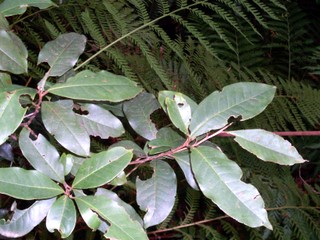
The scientific name of the Quintinia is Quintinia serrata. It is a species of flowering plant in the family Paracryphiaceae (paracryphia family), order Paracryphiales.
- Scientific name
- Quintinia serrata A.Cunn.
- Common name
- Quintinia
- Genus
- Quintinia
- Family
- Paracryphiaceae (Paracryphia Family)
- Order
- Paracryphiales
- Class
- Magnoliopsida
- Recorded in
- 1 country
- Name status
- accepted in the Catalogue of Life

Overview
Quintinia is an evergreen tree in the family Paracryphiaceae, order Paracryphiales and class Magnoliopsida. Quintinia is endemic to New Zealand. Its leaves contain anthocyanins that help protect shade-adapted chloroplasts from direct sunlight.
Written 27 November 2026 from the sources listed below. Each statement was checked against the passage it cites; statements that could not be supported were removed.
Appearance
Quintinia is an evergreen tree. Its leaves contain anthocyanins, including cyanidin 3-O-glucoside and cyanidin 3-O-galactoside.[1][2]
The leaf anthocyanins help protect shade-adapted chloroplasts from direct sunlight.[3]
Habitat
Quintinia grows primarily in the subtropical biome.[4]
Classification of the Quintinia
| Kingdom | Plantae |
|---|---|
| Subkingdom | Pteridobiotina |
| Phylum | Tracheophyta |
| Class | Magnoliopsida |
| Order | Paracryphiales |
| Family | Paracryphiaceae (Paracryphia Family) |
| Genus | Quintinia |
| Species | Quintinia serrata A.Cunn. |
Where the Quintinia is found
Checklists and occurrence records place Quintinia serrata in 1 country across Oceania. GBIF holds 6,152 georeferenced records of it.
Countries
Regions and cities with the most records
- West Coast, New Zealand 2,056
- Waikato Region, New Zealand 1,952
- Bay of Plenty, New Zealand 550
- Tasman District, New Zealand 370
- Manawatu-Wanganui, New Zealand 239
- Auckland, New Zealand 191
- Hawke's Bay Region, New Zealand 183
- Northland, New Zealand 178
- Taranaki Region, New Zealand 149
- Gisborne, New Zealand 134
- New Lynn, New Zealand 100
- Avondale, New Zealand 94
- Rotorua, New Zealand 31
- Mount Eden, New Zealand 17
- Papakura, New Zealand 16
- Takanini, New Zealand 15
- Whangarei, New Zealand 13
- Auckland, New Zealand 12
- Cambridge, New Zealand 12
- Mangere, New Zealand 12
- Manurewa, New Zealand 9
- Otahuhu, New Zealand 9
- Otara, New Zealand 9
- Papatoetoe, New Zealand 9
- Pukekohe East, New Zealand 9
- Manukau City, New Zealand 8
- Remuera, New Zealand 8
- Richmond, New Zealand 5
- Stoke, New Zealand 5
- Nelson, New Zealand 4
- Nelson Region, New Zealand 4
- Canterbury, New Zealand 3
- Marlborough, New Zealand 3
Range as the checklists state it
New Zealand (Mangonui south to Taumarunui)
A number beside a place is its count of GBIF occurrence records. A place without a number comes from a checklist alone. Records show where a species has been observed or collected, which can include escapes and vagrants.
Common names
English
- Quintinia
- Tawheowheo
Names in 1 other language
- Māori
- Kūmarahou, Tāwheowheo
Related species
-
 PossumwoodQuintinia sieberi
-
 Grey PossumwoodQuintinia verdonii
- Quintinia acutifolia
- Quintinia quatrefagesii
- Quintinia fawkneri
- Quintinia major
- Quintinia media
- Quintinia altigena
Compare
Questions and answers
What is the scientific name of the Quintinia?
The scientific name of the Quintinia is Quintinia serrata. Written with its author, the full name is Quintinia serrata A.Cunn..
Which family does the Quintinia belong to?
Quintinia serrata belongs to the family Paracryphiaceae, in the order Paracryphiales and the class Magnoliopsida.
Where is the Quintinia found?
Checklists and occurrence records place Quintinia serrata in 1 country: New Zealand.
What other names does the Quintinia have?
Quintinia serrata is also known in English as Tawheowheo.
What anthocyanins are found in its leaves?
Its leaves contain cyanidin 3-O-glucoside and cyanidin 3-O-galactoside.[2]
What is the function of its leaf anthocyanins?
They help protect shade-adapted chloroplasts from direct sunlight.[3]
Sources
Passages the profile rests on
- Quintinia serrata is an evergreen tree. Source passage: “is a species of evergreen tree in the genus Quintinia.” — English Wikipedia
- The leaves contain anthocyanins including cyanidin 3-O-glucoside and cyanidin 3-O-galactoside. Source passage: “different patterns of anthocyanins (cyanidin 3-O-glucoside and cyanidin 3-O-galactoside) in its leaves” — English Wikipedia
- The leaf anthocyanins help protect shade-adapted chloroplasts from direct sunlight. Source passage: “to protect the shade-adapted chloroplasts from direct sun light.” — English Wikipedia
- Quintinia serrata grows primarily in the subtropical biome. Source passage: “grows primarily in the subtropical biome.” — powo.science.kew.org
- Quintinia serrata is endemic to New Zealand. Source passage: “It is endemic to New Zealand.” — English Wikipedia
- The native range of Quintinia serrata is New Zealand. Source passage: “The native range of this species is New Zealand.” — powo.science.kew.org
Data
- Catalogue of Life, 2026-10-16 XR cc by
- Global Biodiversity Information Facility CC BY 4.0
- Wikidata CC0
- GeoNames CC BY 4.0
- Wikimedia Commons per image; credit shown with each image
- Within the Catalogue of Life, this name comes from Synonymic Checklists of the Vascular Plants of the World cc by
References
- A.Cunn. Ann. Nat. Hist., Sér. 1: 2: 356 (1839). where the name was published
This species in other databases
- Catalogue of Life 4R7HM
- Wikidata Q21311020
- iNaturalist 366626
- World Flora Online wfo-0000733598
- GRIN 451016
Page built on 29 November 2026. See how the catalog is made and all sources and licences.
Cite this page
ScientificNames.org. (2026). Quintinia serrata (Quintinia). Retrieved November 29, 2026, from https://scientificnames.org/species/quintinia-serrata
“Quintinia serrata (Quintinia).” ScientificNames.org, 2026, scientificnames.org/species/quintinia-serrata. Accessed 29 Nov. 2026.
ScientificNames.org. “Quintinia serrata (Quintinia).” Accessed November 29, 2026. https://scientificnames.org/species/quintinia-serrata.
@misc{scientificnames_quintinia_serrata_quintinia,
  author = {{ScientificNames.org}},
  title = {Quintinia serrata (Quintinia)},
  year = {2026},
  url = {https://scientificnames.org/species/quintinia-serrata},
  note = {Accessed 2026-11-29}
}