Species · Spiders and other arachnids
Rabid Wolf Spider Rabidosa rabida
The scientific name of the Rabid Wolf Spider is Rabidosa rabida. It is a species of arachnid in the family Lycosidae (wolf spider), order Araneae. The name dates from 1837.
- Scientific name
- Rabidosa rabida (Walckenaer, 1837)
- Common name
- Rabid Wolf Spider
- Genus
- Rabidosa
- Family
- Lycosidae (Wolf Spider)
- Order
- Araneae
- Class
- Arachnida
- Recorded in
- 4 countries
- Name status
- accepted in the Catalogue of Life

Overview
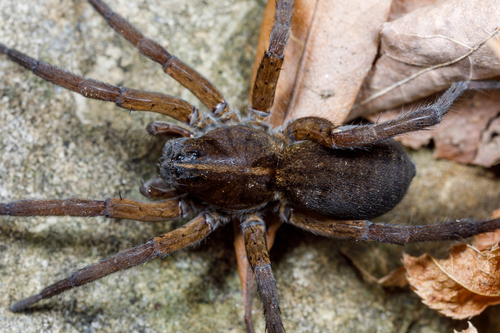
Rabidosa rabida inhabits wooded areas, cotton fields, prairies, woodlands, pastures, and other open areas with tall grasses. It has eight eyes arranged in two rows of four, longitudinal stripes on its cephalothorax, and a distinctive pattern of light markings on its abdomen.
Written 24 November 2026 from the sources listed below. Each statement was checked against the passage it cites; statements that could not be supported were removed.
Appearance
The body is generally light brown, with alternating longitudinal light and dark stripes on the cephalothorax. The cephalothorax has two dark longitudinal stripes, and the abdomen has a contrasting stripe.[1][2]
The abdomen has a dark median band or central stripe with paired light spots toward the rear. Slanted pale tan or orangish spots occur within the brown abdominal center stripe.[3][4][5]
The species has eight eyes arranged in two rows of four, with small white eyebrow-like markings behind the eyes.[6][7]
Females have a dark gray cephalothorax with two light longitudinal stripes and a narrow light line along each lateral thoracic margin. Their average body length is 16 to 21 mm.[8][9]
Males have black or dark front legs, while their remaining legs are brown. Their average body length is approximately 13 mm.[10][11][12][13]
Habitat
The Rabid Wolf Spider occurs in wooded areas and cotton fields. It also inhabits prairies, woodlands, pastures, and other open areas with tall grasses.[14][15]
Individuals commonly inhabit leaf litter, rubbish, holes, areas beneath rocks, and low vegetation. Some occur around ponds or in deep burrows with debris turrets.[16][17][18]
The species commonly hides in leaf litter and sometimes enters houses.[18]
Diet
The Rabid Wolf Spider feeds mainly on insects, smaller wolf spiders, and other invertebrates. Recorded prey includes crickets, locusts, ants, grasshoppers, and other spiders.[19][20][21]
It obtains liquids and nutrients by sucking them from captured prey.[22]
Behaviour
The species hunts by ambushing or pursuing prey and is commonly recorded as a wandering spider. Adults hunt during both the day and night.[23][24][25]
It does not construct webs for capturing prey but produces silk blankets for prey capture or protection of its young. Individuals sometimes camouflage themselves as bark or leaves when hunting.[26][27]
Males perform courtship dances and produce sounds through stridulation. The species uses pheromones and silk draglines in communication and mate location.[28][29]
Reproduction and life cycle
Females attach their silken egg cocoons to their spinnerets and carry them while moving. Egg sacs measure 7 to 10 mm in diameter and contain between 168 and 365 eggs.[30][31][32]
The egg cocoon changes from shiny white to dirty brown before hatching. Females with egg sacs are present from July through October.[33][34]
Spiderlings remain on their mother's back until they are ready to disperse. Females may move into or out of sunlight to regulate the temperature of their developing eggs.[35][36]
Conservation
The species is not currently endangered and is not considered at significant risk of becoming threatened.[37]
Uses
The Rabid Wolf Spider provides pest-control benefits through its predation on insects in semi-urban and rural areas.[38]
Similar species
Rabidosa punctulata differs from Rabidosa rabida in having males whose legs are all the same color rather than predominantly black front legs.[39]
Classification of the Rabid Wolf Spider
| Kingdom | Animalia |
|---|---|
| Phylum | Arthropoda |
| Subphylum | Chelicerata |
| Class | Arachnida (Arachnid) |
| Order | Araneae (Spider) |
| Family | Lycosidae (Wolf Spider) |
| Genus | Rabidosa |
| Species | Rabidosa rabida (Walckenaer, 1837) |
Origin of the name. Etymology. Latin, unfavorable behavior, furious
Where the Rabid Wolf Spider is found
Checklists and occurrence records place Rabidosa rabida in 4 countries across North America. GBIF holds 18,537 georeferenced records of it.
Countries
Regions and cities with the most records
- Texas, United States 8,043
- North Carolina, United States 1,054
- Oklahoma, United States 904
- Virginia, United States 892
- Maryland, United States 507
- Kansas, United States 498
- Ohio, United States 496
- Tennessee, United States 481
- Austin, United States 478
- Georgia, United States 473
- Missouri, United States 428
- Arkansas, United States 419
- Alabama, United States 414
- Plano, United States 356
- Fort Worth, United States 335
- Frisco, United States 334
- Pennsylvania, United States 332
- South Carolina, United States 329
- Pflugerville, United States 309
- Round Rock, United States 300
- Massachusetts, United States 293
- Allen, United States 291
- Grapevine, United States 283
- Lewisville, United States 282
- North Richland Hills, United States 269
- Florida, United States 268
- Richardson, United States 267
- Carrollton, United States 266
- Cedar Park, United States 255
- Mesquite, United States 254
- Dallas, United States 250
- Bedford, United States 248
- Flower Mound, United States 247
- Kentucky, United States 247
- Illinois, United States 245
- Wylie, United States 239
Range as the checklists state it
Canada, USA, Mexico
USA
A number beside a place is its count of GBIF occurrence records. A place without a number comes from a checklist alone. Records show where a species has been observed or collected, which can include escapes and vagrants.
Common names
English
- Rabid Wolf Spider
Names in 1 other language
- Spanish
- Arañas lobo de tres bandas
Synonyms
4 other scientific names have been used for this species and are now treated as synonyms of Rabidosa rabida.
- Lycosa rabida
- Lycosa scutulata
- Rabidosa lineata (Walckenaer, 1837)
- Rabidosa scutulata (Emerton, 1885)
Related species
- Dotted Wolf SpiderRabidosa punctulata
- Rabidosa hentzi
- Rabidosa carrana
- Rabidosa santrita
-
 Carolina Wolf SpiderHogna carolinensis
- Hogna radiata
-
 Tarantula Wolf SpiderLycosa tarantula
-
 Wetland Giant Wolf SpiderTigrosa helluo
Compare
Questions and answers
What is the scientific name of the Rabid Wolf Spider?
The scientific name of the Rabid Wolf Spider is Rabidosa rabida. Written with its author, the full name is Rabidosa rabida (Walckenaer, 1837).
Which family does the Rabid Wolf Spider belong to?
Rabidosa rabida belongs to the family Lycosidae, in the order Araneae and the class Arachnida.
Where is the Rabid Wolf Spider found?
Checklists and occurrence records place Rabidosa rabida in 4 countries: United States, Mexico, Canada and El Salvador.
Why shouldn't you squish a wolf spider?
The Rabid Wolf Spider provides pest-control benefits through its predation on insects in semi-urban and rural areas.[38]
What do rabid wolf spiders eat?
Rabid Wolf Spiders mainly consume insects, smaller wolf spiders, and other invertebrates. Recorded prey includes crickets, locusts, ants, grasshoppers, and other spiders.[19][20][21]
What kind of habitat do wolf spiders live in?
The Rabid Wolf Spider inhabits wooded areas, cotton fields, prairies, woodlands, pastures, and open areas with tall grasses. It commonly hides in leaf litter, rubbish, holes, beneath rocks, and in low vegetation.[14][16][18][15]
Sources
Passages the profile rests on
- The cephalothorax has two dark longitudinal stripes and the abdomen has a contrasting stripe. Source passage: “The cephalothorax has two dark stripes. The abdomen has one stripe of the same color.” — English Wikipedia
- The body is generally light brown, with alternating longitudinal light and dark stripes on the cephalothorax. Source passage: “The body color is generally light brown. The cephalothorax has a pattern of alternating longitudinal light and dark stripes.” — dnr.illinois.gov
- The abdomen has a dark median band with paired light spots toward its rear. Source passage: “The abdomen has a dark median band, notched on each side in front of the middle of the abdomen, with several pairs of light spots on the rear part of the abdomen.” — animaldiversity.org
- The species has slanted pale tan or orangish spots within the brown abdominal center stripe. Source passage: “Rabid wolf spider (Rabidosa rabida): similar to dotted wolf spider, but has a series of slanted pale tan or orangish spots inside the brown center stripe on the abdomen” — mdc.mo.gov
- The dorsal abdomen has a central light stripe and paired light spots toward the rear. Source passage: “The dorsal side of the abdomen has a light stripe in the middle and paired, light spots toward the back.” — dnr.illinois.gov
- The species has eight eyes arranged in two rows of four. Source passage: “The species has eight eyes: four above, and four below” — English Wikipedia
- Small white eyebrow-like markings occur behind the eyes. Source passage: “also has small white eyebrow-like marks behind the eyes” — mdc.mo.gov
- Females have a dark gray cephalothorax with two light longitudinal stripes and a narrow light line along each lateral thoracic margin. Source passage: “A typical rabid wolf spider has a dark gray cephalothorax with two light longitudinal stripes extending across the top and a narrow light line on each lateral margin of the thorax.” — animaldiversity.org
- Females have an average body length of 16 to 21 mm. Source passage: “Females average 16 to 21 mm long” — animaldiversity.org
- The first pair of legs is often black or dark brown, while the remaining legs are brown. Source passage: “The first pair of legs is often black or dark brown, and the other legs are brown.” — animaldiversity.org
- The front legs of males are usually darker than their other legs. Source passage: “forelegs of males usually blackish or darker brown than other legs.” — mdc.mo.gov
- The male's front legs are black. Source passage: “The male’s front legs are black.” — dnr.illinois.gov
- Males have an average body length of approximately 13 mm. Source passage: “Males are typically much smaller than females, measuring an average of 13 mm in length.” — animaldiversity.org
- The species occurs in wooded areas and cotton fields. Source passage: “The species likes cotton fields and wooded areas.” — English Wikipedia
- The species inhabits prairies, woodlands, pastures, and other open areas with tall grasses. Source passage: “This species is found in prairies, woodlands, pastures and other open areas where it is common in tall grasses.” — dnr.illinois.gov
- Individuals commonly inhabit litter, rubbish, holes, areas beneath rocks, and low vegetation. Source passage: “These spiders usually reside among litter, rubbish, in holes, under rocks, and on low foliage in these areas.” — animaldiversity.org
- Some individuals occur around ponds or in deep burrows with debris turrets. Source passage: “Some individuals have been found around ponds or in deep burrows with a turret of debris.” — animaldiversity.org
- The species is commonly found hiding in leaf litter and sometimes enters houses. Source passage: “The rabid wolf spider (Rabidosa rabida) (which is absolutely not rabid!) commonly hides in leaf litter and sometimes gets into houses.” — mdc.mo.gov
- The species commonly consumes small insects and other invertebrates. Source passage: “Rabid wolf spiders usually prefer to eat small insects and other invertebrates.” — animaldiversity.org
- Recorded prey includes crickets, locusts, ants, grasshoppers, and other spiders. Source passage: “They have been known to eat crickets, locusts, ants, grasshoppers and even other spiders.” — animaldiversity.org
- Its diet consists mainly of insects and smaller wolf spiders. Source passage: “The diet consists mainly of insects and other, smaller wolf spiders.” — dnr.illinois.gov
- The species obtains liquids and nutrients by sucking them from captured prey. Source passage: “These spiders do not eat solid material, so once they overtake the insect, they usually suck out liquids and nutrients of their prey.” — animaldiversity.org
- The species hunts at night by ambushing or pursuing prey. Source passage: “They hunt at night, by ambushing or chasing down prey.” — English Wikipedia
- The species is commonly recorded as a wandering spider. Source passage: “It is often recorded as a wandering spider.” — animaldiversity.org
- Adults hunt both during the day and at night. Source passage: “It hunts at night and in the day.” — dnr.illinois.gov
- The species does not construct webs for capturing prey but produces silk blankets for prey capture or protection of its young. Source passage: “This species doesn't build webs to catch prey, instead they weave silk blankets to catch prey or to protect young.” — English Wikipedia
- Individuals sometimes camouflage themselves as bark or leaves when hunting. Source passage: “Sometimes, in order to catch their prey, they camouflage themselves as bark or leaves.” — English Wikipedia
- Males perform courtship dances and produce sounds through stridulation. Source passage: “During breeding, the male performs a "dance" in front of the female and makes noise via stridulation.” — English Wikipedia
- The species uses pheromones and silk draglines in communication and mate location. Source passage: “Both males and females lay out a dragline and deposit a chemical attractor on the line.” — animaldiversity.org
- Females attach their silken egg cocoons to their spinnerets and carry them while moving. Source passage: “Female R. rabida drag their egg mass around, having spun a silken cocoon around the egg mass and attached it to spinnerets.” — animaldiversity.org
- Egg sacs measure 7 to 10 mm in diameter. Source passage: “Egg sacs are from 7 to 10 mm in diameter” — animaldiversity.org
- Each egg sac contains between 168 and 365 eggs. Source passage: “contain from 168 to 365 eggs.” — animaldiversity.org
- The egg cocoon changes from shiny white to dirty brown before hatching. Source passage: “The cocoon darkens from shiny white to dirty brown before the eggs hatch.” — animaldiversity.org
- Females with egg sacs are present from July through October. Source passage: “Females with egg sacs are present from July through October.” — dnr.illinois.gov
- Spiderlings remain on their mother's back until they are ready to disperse. Source passage: “Spiderlings ride on their mother's back until they are ready for dispersal.” — animaldiversity.org
- Females may move into or out of sunlight to regulate the temperature of their developing eggs. Source passage: “She carries it with her as she hunts and may move into or out of sunlight to help control the temperature of the developing eggs.” — dnr.illinois.gov
- The species is not currently endangered and is not considered at significant risk of becoming threatened. Source passage: “Rabid wolf spiders are not currently endangered or at any prevelant risk of becoming threatened.” — animaldiversity.org
- The species provides pest-control benefits through its predation on insects in semi-urban and rural areas. Source passage: “R. rabida is very common among semi-urban and rural areas and is very active in its predation of insects. This can be a big benefit where pests are a problem.” — animaldiversity.org
- Rabidosa punctulata differs from R. rabida in having males whose legs are all the same color rather than predominantly black front legs. Source passage: “B. J. Kaston distinguishes R. rabida from R. punctulata by observing that the males of the former have front legs that are mostly black, whereas the latter have all legs of the same color.” — English Wikipedia
Data
- Catalogue of Life, 2026-10-16 XR cc by
- Global Biodiversity Information Facility CC BY 4.0
- Wikidata CC0
- GeoNames CC BY 4.0
- Wikimedia Commons per image; credit shown with each image
- iNaturalist per image; credit shown with each image
- Within the Catalogue of Life, this name comes from The World Spider Catalog cc by
References
- Walckenaer, C. A. (1837). Histoire naturelle des insectes. Aptères. Tome premier. Roret, Paris, 682 pp., pl. 1-15. doi: <a href="https://doi.org/10.5962/bhl.title.61095" target="_blank">10.5962/bhl.title.61095 Link where the name was published
This species in other databases
Page built on 24 November 2026. See how the catalog is made and all sources and licences.
Cite this page
ScientificNames.org. (2026). Rabidosa rabida (Rabid Wolf Spider). Retrieved November 24, 2026, from https://scientificnames.org/species/rabidosa-rabida
“Rabidosa rabida (Rabid Wolf Spider).” ScientificNames.org, 2026, scientificnames.org/species/rabidosa-rabida. Accessed 24 Nov. 2026.
ScientificNames.org. “Rabidosa rabida (Rabid Wolf Spider).” Accessed November 24, 2026. https://scientificnames.org/species/rabidosa-rabida.
@misc{scientificnames_rabidosa_rabida_rabid_wolf_spider,
  author = {{ScientificNames.org}},
  title = {Rabidosa rabida (Rabid Wolf Spider)},
  year = {2026},
  url = {https://scientificnames.org/species/rabidosa-rabida},
  note = {Accessed 2026-11-24}
}