Species · Flowering plants
Fall Buttercup Ranunculus aestivalis
The scientific name of the Fall Buttercup is Ranunculus aestivalis. It is a species of flowering plant in the family Ranunculaceae (crowfoot family), order Ranunculales.
- Scientific name
- Ranunculus aestivalis (L.D.Benson) Van Buren & K.T.Harper
- Common name
- Fall Buttercup
- Genus
- Ranunculus
- Family
- Ranunculaceae (Crowfoot Family)
- Order
- Ranunculales
- Class
- Magnoliopsida
- Recorded in
- 1 country
- Name status
- accepted in the Catalogue of Life

Overview
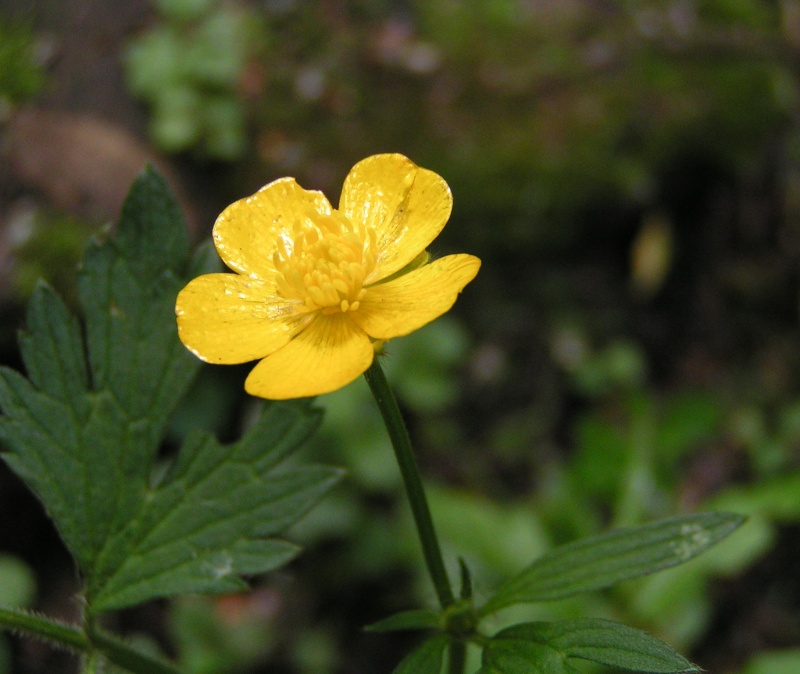
The fall buttercup (Ranunculus aestivalis) is a herbaceous perennial flowering plant in the family Ranunculaceae, order Ranunculales, and class Magnoliopsida. It grows in wet riparian meadows along the Sevier River in Garfield County, Utah, United States. It has an erect hairy stem, leaves divided into three sections or occasionally three leaflets, and yellow flowers with five petals, occasionally increasing to ten.
Written 27 November 2026 from the sources listed below. Each statement was checked against the passage it cites; statements that could not be supported were removed.
Appearance
The fall buttercup has an erect stem covered in hairs. Its stem reaches 30 to 60 centimeters in height.[1][2]
Its leaves are divided into three dissected sections or, occasionally, three leaflets. Each plant produces approximately 6 to 10 flowers.[3][4]
Each flower has five yellow petals, occasionally increasing to ten. Each petal is approximately one centimeter long.[5][6]
Habitat
The fall buttercup grows in wet riparian meadows on the western slope of Utah's Sevier River Valley. Spring-fed water keeps these meadows marshy.[7][8]
Plants grow on slightly elevated mounds within boggy meadows and in neighboring drier habitats. The species is restricted to moist microhabitats within an otherwise dry, open ecosystem.[9][10]
The species depends on perennially moist soils in wet meadows along the Sevier River in Garfield County.[11]
Reproduction and life cycle
The fall buttercup is a herbaceous perennial. It flowers from July through October.[12][13]
Conservation
The fall buttercup is federally listed as endangered in the United States. The Utah Wildlife Action Plan lists the autumn buttercup as endangered.[14][15]
Changes in local hydrology threaten the species because it requires a particular moisture level in its habitat. Irrigation may contribute to these hydrological changes.[16][17]
Grazing can affect the species and its habitat. Livestock grazing may sometimes benefit the species by reducing competing vegetation such as sedges.[18][19]
The small number of remaining plants may lead to a genetic bottleneck. The species was feared extinct during the 1970s but was rediscovered in 1982.[20][21]
The Nature Conservancy purchased land containing the species and established a nature preserve. The species has been propagated using tissue culture, and plants have been introduced into the preserve near Panguitch, Utah, to increase the small population.[22][23][24]
Similar species
The fall buttercup has sometimes been classified as a variety of Ranunculus acriformis or treated as a variety of Ranunculus acris. A genetic analysis found the plant sufficiently distinct to be elevated to species status in 1994.[25][26][27]
Classification of the Fall Buttercup
| Kingdom | Plantae |
|---|---|
| Subkingdom | Pteridobiotina |
| Phylum | Tracheophyta |
| Class | Magnoliopsida |
| Order | Ranunculales |
| Family | Ranunculaceae (Crowfoot Family) |
| Subfamily | Ranunculoideae |
| Tribe | Ranunculeae |
| Genus | Ranunculus (Crowfoot) |
| Species | Ranunculus aestivalis (L.D.Benson) Van Buren & K.T.Harper |
Where the Fall Buttercup is found
Checklists and occurrence records place Ranunculus aestivalis in 1 country across North America. GBIF holds 28 georeferenced records of it.
Countries
Regions and cities with the most records
Range as the checklists state it
USA (Utah: Garfield Co.)
A number beside a place is its count of GBIF occurrence records. A place without a number comes from a checklist alone. Records show where a species has been observed or collected, which can include escapes and vagrants.
Common names
English
- Fall Buttercup
Synonyms
3 other scientific names have been used for this species and are now treated as synonyms of Ranunculus aestivalis.
- Ranunculus acriformis subsp. aestivalis (L.D.Benson) S.L.Welsh
- Ranunculus acriformis var. aestivalis L.D.Benson
- Ranunculus acris var. aestivalis (L.D.Benson) S.L.Welsh
Related species
-
 Creeping ButtercupRanunculus repens
-
 Persian ButtercupRanunculus asiaticus
-
 Meadow ButtercupRanunculus acris
-
 Bulbous ButtercupRanunculus bulbosus
-
 Common Water-CrowfootRanunculus aquatilis
-
 Celery-Leaved ButtercupRanunculus sceleratus
-
 Goldilocks ButtercupRanunculus auricomus
-
 Mount Cook ButtercupRanunculus lyallii
Compare
Questions and answers
What is the scientific name of the Fall Buttercup?
The scientific name of the Fall Buttercup is Ranunculus aestivalis. Written with its author, the full name is Ranunculus aestivalis (L.D.Benson) Van Buren & K.T.Harper.
Which family does the Fall Buttercup belong to?
Ranunculus aestivalis belongs to the family Ranunculaceae, in the order Ranunculales and the class Magnoliopsida.
Where is the Fall Buttercup found?
Checklists and occurrence records place Ranunculus aestivalis in 1 country: United States.
Sources
Passages the profile rests on
- The plant has an erect stem covered in hairs. Source passage: “This plant produces a hairy, erect stem 30 to 60 centimeters tall.” — English Wikipedia
- The plant's stem reaches 30 to 60 centimeters in height. Source passage: “This plant produces a hairy, erect stem 30 to 60 centimeters tall.” — English Wikipedia
- Its leaves are divided into three dissected sections or, occasionally, three leaflets. Source passage: “The leaves are divided into three dissected parts, or sometimes three leaflets.” — English Wikipedia
- Each plant produces approximately 6 to 10 flowers. Source passage: “Each plant produces about 6 to 10 flowers.” — English Wikipedia
- Its flowers have five yellow petals, occasionally increasing to ten. Source passage: “The flower has five, or occasionally ten yellow petals” — English Wikipedia
- Each flower petal is approximately one centimeter long. Source passage: “each around a centimeter long.” — English Wikipedia
- The species grows in wet riparian meadows on the western slope of Utah's Sevier River Valley. Source passage: “This wildflower grows in wet riparian meadows on the western slope of the Sevier River Valley of Utah.” — English Wikipedia
- Its meadow habitat is kept marshy by spring-fed water. Source passage: “The meadows are fed by springs, keeping them marshy.” — English Wikipedia
- The plants grow on slightly elevated mounds within boggy meadows and in neighboring drier habitats. Source passage: “The plants grow on slightly raised mounds in the boggy meadows and adjacent drier habitat.” — English Wikipedia
- The species is restricted to moist microhabitats within an otherwise dry, open ecosystem. Source passage: “It is restricted to a moist microhabitat in an otherwise dry, open ecosystem” — English Wikipedia
- The species depends on perennially moist soils in wet meadows along the Sevier River in Garfield County. Source passage: “The autumn buttercup (Ranunculus aestivalis) is restricted to perennially moist soils in wet meadows along the. Sevier River, Garfield County,” — digitalcommons.usu.edu
- The species flowers from July through October. Source passage: “Blooming occurs in July through October” — English Wikipedia
- The species is a herbaceous perennial. Source passage: “The Autumn buttercup (Ranunculus acriformis var. aestivalis) is a herbaceous perennial.” — ecos.fws.gov
- The species is federally listed as endangered in the United States. Source passage: “This is a federally listed endangered species of the United States.” — English Wikipedia
- The Utah Wildlife Action Plan lists the autumn buttercup as endangered. Source passage: “Autumn buttercup, Ranunculus aestivalis, S1 (2024), N1, Endangered.” — wildlife.utah.gov
- Changes in local hydrology threaten the species because it requires a particular moisture level in its habitat. Source passage: “Threats to the plant include changes in the local hydrology, because the plant relies on a certain level of moisture in its microhabitat.” — English Wikipedia
- Irrigation may contribute to hydrological changes threatening the species. Source passage: “Irrigation may be a cause of these changes.” — English Wikipedia
- Grazing can affect the species and its habitat. Source passage: “Grazing may also affect the plant.” — English Wikipedia
- Livestock grazing may sometimes benefit the species by reducing competing vegetation such as sedges. Source passage: “Grazing may have positive effects at times, as livestock trims down competing vegetation, such as sedges.” — English Wikipedia
- The small number of remaining plants may lead to a genetic bottleneck. Source passage: “A genetic bottleneck may result from the small numbers of remaining plants.” — English Wikipedia
- The species was feared extinct during the 1970s but was rediscovered in 1982. Source passage: “This plant was feared extinct in the 1970s and was rediscovered in 1982.” — English Wikipedia
- The Nature Conservancy purchased land containing the species and established a nature preserve. Source passage: “The Nature Conservancy purchased the land holding the buttercups and made it a nature preserve.” — English Wikipedia
- The species has been propagated using tissue culture. Source passage: “The plant was propagated in tissue culture.” — English Wikipedia
- Plants have been introduced into the Nature Conservancy's preserve near Panguitch, Utah, to increase the small population. Source passage: “The Conservancy and other agencies have planted some autumn buttercup plants in the Conservancy's preserve near Panguitch, Utah to augment the small population.” — English Wikipedia
- The species has sometimes been classified as a variety of Ranunculus acriformis. Source passage: “This plant is often treated as a variety of Ranunculus acriformis or Ranunculus acris.” — English Wikipedia
- The species has sometimes been treated as a variety of Ranunculus acris. Source passage: “This plant is often treated as a variety of Ranunculus acriformis or Ranunculus acris.” — English Wikipedia
- A genetic analysis found the plant sufficiently distinct to be elevated to species status in 1994. Source passage: “A genetic analysis study showed it to be sufficiently separate and it was elevated to species status by one group of authors in 1994.” — English Wikipedia
- The species is endemic to Utah in the United States. Source passage: “It is endemic to the state of Utah in the United States” — English Wikipedia
- Its documented range is restricted to Garfield County beside the Sevier River. Source passage: “where it exists only in Garfield County next to the Sevier River.” — English Wikipedia
Data
- Catalogue of Life, 2026-10-16 XR cc by
- Global Biodiversity Information Facility CC BY 4.0
- Wikidata CC0
- GeoNames CC BY 4.0
- Wikimedia Commons per image; credit shown with each image
- Within the Catalogue of Life, this name comes from Synonymic Checklists of the Vascular Plants of the World cc by
References
- Van Buren, & Harper, K. T. (1994). Amer. J. Bot. 81(4): 518 (1994). where the name was published
This species in other databases
Page built on 27 November 2026. See how the catalog is made and all sources and licences.
Cite this page
ScientificNames.org. (2026). Ranunculus aestivalis (Fall Buttercup). Retrieved November 27, 2026, from https://scientificnames.org/species/ranunculus-aestivalis
“Ranunculus aestivalis (Fall Buttercup).” ScientificNames.org, 2026, scientificnames.org/species/ranunculus-aestivalis. Accessed 27 Nov. 2026.
ScientificNames.org. “Ranunculus aestivalis (Fall Buttercup).” Accessed November 27, 2026. https://scientificnames.org/species/ranunculus-aestivalis.
@misc{scientificnames_ranunculus_aestivalis_fall_buttercup,
  author = {{ScientificNames.org}},
  title = {Ranunculus aestivalis (Fall Buttercup)},
  year = {2026},
  url = {https://scientificnames.org/species/ranunculus-aestivalis},
  note = {Accessed 2026-11-27}
}