Species · Flowering plants
Allegheny Mountain Buttercup Ranunculus allegheniensis
The scientific name of the Allegheny Mountain Buttercup is Ranunculus allegheniensis. It is a species of flowering plant in the family Ranunculaceae (crowfoot family), order Ranunculales.
- Scientific name
- Ranunculus allegheniensis Britton
- Common name
- Allegheny Mountain Buttercup
- Genus
- Ranunculus
- Family
- Ranunculaceae (Crowfoot Family)
- Order
- Ranunculales
- Class
- Magnoliopsida
- Recorded in
- 1 country
- Name status
- accepted in the Catalogue of Life

Overview
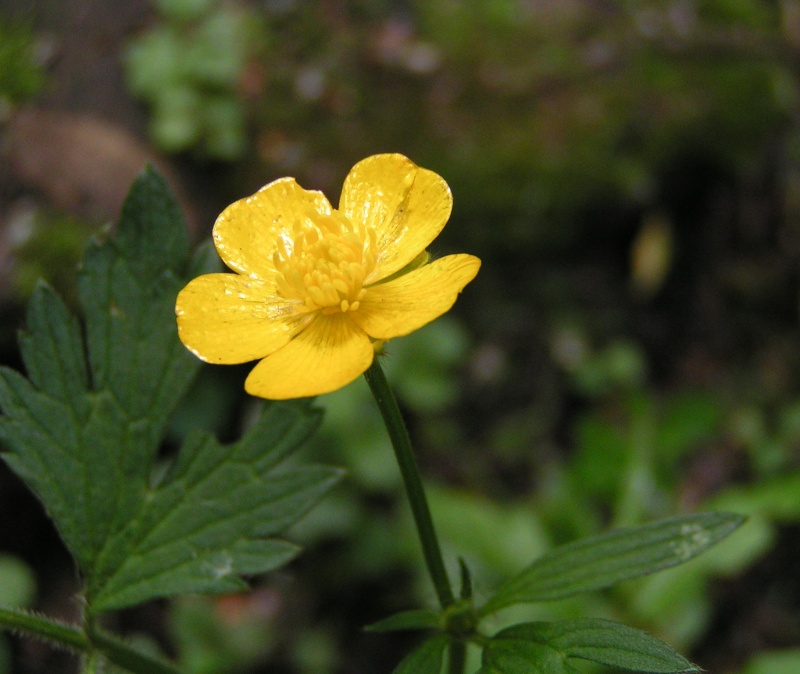
Allegheny Mountain Buttercup is a flowering plant in the family Ranunculaceae. The species occurs in the northeastern United States, especially in and around the northern Appalachian Mountains. It has hairless stems and leaves, five-petaled flowers, and smooth green carpels with slender, curved beak-like appendages.
Written 27 November 2026 from the sources listed below. Each statement was checked against the passage it cites; statements that could not be supported were removed.
Appearance
The plant has hairless stems and leaves. Its outer basal leaves are kidney-shaped with scalloped margins, while its inner basal leaves are either three-lobed or trifoliate.[1][2][3]
Its stem leaves are alternate and deeply lobed or divided. Lower stem leaves have long petioles, while upper leaves have shorter or absent petioles.[4][5]
The flowers have five petals that are shorter than their sepals. The petals measure up to 1–2 mm long, and the sepals measure up to 2–3 mm long.[6][7][8]
The flower center contains numerous smooth, green carpels clustered on an ovoid receptacle. Each carpel has a slender, curved beak-like appendage measuring 0.6–1.0 mm, and the carpels are surrounded by a ring of yellowish stamens.[9][10][11]
The stems measure 10–50 cm tall. Each stem can bear as many as 40 flowers.[12][13]
Habitat
The species occurs particularly in areas with high-pH bedrock.[14]
Similar species
Ranunculus abortivus is a similar species distinguished by having much shorter carpel beaks.[15]
Conservation
The species is listed in the New Jersey State Wildlife Action Plan's plants and fungi section.[16]
Classification of the Allegheny Mountain Buttercup
| Kingdom | Plantae |
|---|---|
| Subkingdom | Pteridobiotina |
| Phylum | Tracheophyta |
| Class | Magnoliopsida |
| Order | Ranunculales |
| Family | Ranunculaceae (Crowfoot Family) |
| Subfamily | Ranunculoideae |
| Tribe | Ranunculeae |
| Genus | Ranunculus (Crowfoot) |
| Species | Ranunculus allegheniensis Britton |
Where the Allegheny Mountain Buttercup is found
Checklists and occurrence records place Ranunculus allegheniensis in 1 country across North America. GBIF holds 866 georeferenced records of it.
Countries
Regions and cities with the most records
- Pennsylvania, United States 169
- Connecticut, United States 45
- Massachusetts, United States 36
- Virginia, United States 36
- Plum, United States 24
- Arlington, United States 23
- Belmont, United States 23
- Lexington, United States 23
- Cambridge, United States 22
- Medford, United States 22
- Somerville, United States 22
- Allston, United States 21
- Burlington, United States 21
- Charlestown, United States 21
- Watertown, United States 21
- Brighton, United States 20
- Chestnut Hill, United States 20
- East Boston, United States 20
- Murrysville, United States 20
- Newton, United States 20
- Wilkinsburg, United States 20
- Wilmington, United States 20
- Winchester, United States 20
- Woburn, United States 20
- Back Bay, United States 19
- Boston, United States 19
- Brookline, United States 19
- Mission Hill, United States 19
- Monroeville, United States 19
- Stoneham, United States 19
- Waltham, United States 19
- Chelsea, United States 18
- Everett, United States 18
- Melrose, United States 18
- Orient Heights, United States 18
- Reading, United States 18
Range as the checklists state it
USA (Connecticut, Kentucky, Massachusetts, Maryland, North Carolina, New Jersey, New York, Ohio, Pennsylvania, Rhode Island, South Carolina, Tennessee, Virginia, Vermont, West Virginia)
A number beside a place is its count of GBIF occurrence records. A place without a number comes from a checklist alone. Records show where a species has been observed or collected, which can include escapes and vagrants.
Common names
English
- Allegheny Mountain Buttercup
Related species
-
 Creeping ButtercupRanunculus repens
-
 Persian ButtercupRanunculus asiaticus
-
 Meadow ButtercupRanunculus acris
-
 Bulbous ButtercupRanunculus bulbosus
-
 Common Water-CrowfootRanunculus aquatilis
-
 Celery-Leaved ButtercupRanunculus sceleratus
-
 Goldilocks ButtercupRanunculus auricomus
-
 Mount Cook ButtercupRanunculus lyallii
Compare
Questions and answers
What is the scientific name of the Allegheny Mountain Buttercup?
The scientific name of the Allegheny Mountain Buttercup is Ranunculus allegheniensis. Written with its author, the full name is Ranunculus allegheniensis Britton.
Which family does the Allegheny Mountain Buttercup belong to?
Ranunculus allegheniensis belongs to the family Ranunculaceae, in the order Ranunculales and the class Magnoliopsida.
Where is the Allegheny Mountain Buttercup found?
Checklists and occurrence records place Ranunculus allegheniensis in 1 country: United States.
Sources
Passages the profile rests on
- The plant has hairless stems and leaves. Source passage: “both stems and leaves are hairless.” — English Wikipedia
- Its outer basal leaves are kidney-shaped with scalloped margins. Source passage: “The outer basal leaves are kidney-shaped with variously scalloped margins” — English Wikipedia
- Its inner basal leaves are either three-lobed or trifoliate. Source passage: “the inner basal leaves are either three-lobed or trifoliate.” — English Wikipedia
- Its stem leaves are alternate and deeply lobed or divided. Source passage: “The stem leaves are alternate and deeply lobed or divided.” — English Wikipedia
- The lower stem leaves have long petioles, while upper leaves have shorter or absent petioles. Source passage: “Those at the bottom have long petioles (stems), those at the top are shorter-stemmed to stemless” — English Wikipedia
- The plant produces flowers with five petals that are shorter than its sepals. Source passage: “The flower has five petals up to 1 to 2 mm (1⁄32 to 3⁄32 in) long, the petals shorter than the sepals” — English Wikipedia
- Its petals measure up to 1–2 mm long. Source passage: “five petals up to 1 to 2 mm (1⁄32 to 3⁄32 in) long” — English Wikipedia
- Its sepals measure up to 2–3 mm long. Source passage: “the sepals, which are up to 2 to 3 mm (3⁄32 to 1⁄8 in) long.” — English Wikipedia
- The flower center contains numerous smooth, green carpels clustered on an ovoid receptacle. Source passage: “The center of the flower has many smooth, green carpels clustered on an ovoid receptacle.” — English Wikipedia
- Each carpel has a slender, curved beak-like appendage measuring 0.6–1.0 mm. Source passage: “Each carpel has a slender, curved "beak" appendage at the top; the length of these appendages, (0.6 to 1.0 mm” — English Wikipedia
- The carpels are surrounded by a ring of yellowish stamens. Source passage: “The cluster of carpels is surrounded by a ring of yellowish stamens.” — English Wikipedia
- The plant produces stems measuring 10–50 cm tall. Source passage: “produces stems 10 to 50 cm (3.9 to 19.7 in) tall” — English Wikipedia
- Each stem can bear as many as 40 flowers. Source passage: “Each stem can bear up to 40 flowers.” — English Wikipedia
- The species occurs particularly in areas with high-pH bedrock. Source passage: “particularly in areas of high pH bedrock.” — English Wikipedia
- Ranunculus abortivus is identified as a similar species distinguished by having much shorter carpel beaks. Source passage: “Ranunculus abortivus, which has carpels with much shorter beaks.” — English Wikipedia
- The species is listed in the New Jersey State Wildlife Action Plan's plants and fungi section. Source passage: “Ranunculus allegheniensis, Allegheny Mountain Buttercup, Plants and ...” — dep.nj.gov
Data
- Catalogue of Life, 2026-10-16 XR cc by
- Global Biodiversity Information Facility CC BY 4.0
- Wikidata CC0
- GeoNames CC BY 4.0
- Wikimedia Commons per image; credit shown with each image
- Within the Catalogue of Life, this name comes from Synonymic Checklists of the Vascular Plants of the World cc by
References
- Britton. (1895). Bull. Torrey Bot. Club 22: 224 (1895). where the name was published
This species in other databases
Page built on 29 November 2026. See how the catalog is made and all sources and licences.
Cite this page
ScientificNames.org. (2026). Ranunculus allegheniensis (Allegheny Mountain Buttercup). Retrieved November 29, 2026, from https://scientificnames.org/species/ranunculus-allegheniensis
“Ranunculus allegheniensis (Allegheny Mountain Buttercup).” ScientificNames.org, 2026, scientificnames.org/species/ranunculus-allegheniensis. Accessed 29 Nov. 2026.
ScientificNames.org. “Ranunculus allegheniensis (Allegheny Mountain Buttercup).” Accessed November 29, 2026. https://scientificnames.org/species/ranunculus-allegheniensis.
@misc{scientificnames_ranunculus_allegheniensis_allegheny_mountain_buttercup,
  author = {{ScientificNames.org}},
  title = {Ranunculus allegheniensis (Allegheny Mountain Buttercup)},
  year = {2026},
  url = {https://scientificnames.org/species/ranunculus-allegheniensis},
  note = {Accessed 2026-11-29}
}