Species · Flowering plants
Sagebrush Buttercup Ranunculus glaberrimus
The scientific name of the Sagebrush Buttercup is Ranunculus glaberrimus. It is a species of flowering plant in the family Ranunculaceae (crowfoot family), order Ranunculales.
- Scientific name
- Ranunculus glaberrimus Hook.
- Common name
- Sagebrush Buttercup
- Genus
- Ranunculus
- Family
- Ranunculaceae (Crowfoot Family)
- Order
- Ranunculales
- Class
- Magnoliopsida
- Recorded in
- 2 countries
- Name status
- accepted in the Catalogue of Life

Overview
Ranunculus glaberrimus is native to western Canada and the western United States, with a documented range extending from central British Columbia to southern Saskatchewan and south to Kansas. It produces yellow flowers with usually five petals and typically flowers in March and April.
Written 27 November 2026 from the sources listed below. Each statement was checked against the passage it cites; statements that could not be supported were removed.
Appearance
The sagebrush buttercup is a herbaceous perennial with clustered, fleshy roots. It typically grows between 4 and 15 centimetres tall.[1][2]
Its basal leaves are somewhat thick and oval, with long petioles and margins ranging from entire to deeply three-lobed. Its cauline leaves have short petioles and otherwise resemble the basal leaves.[3][4]
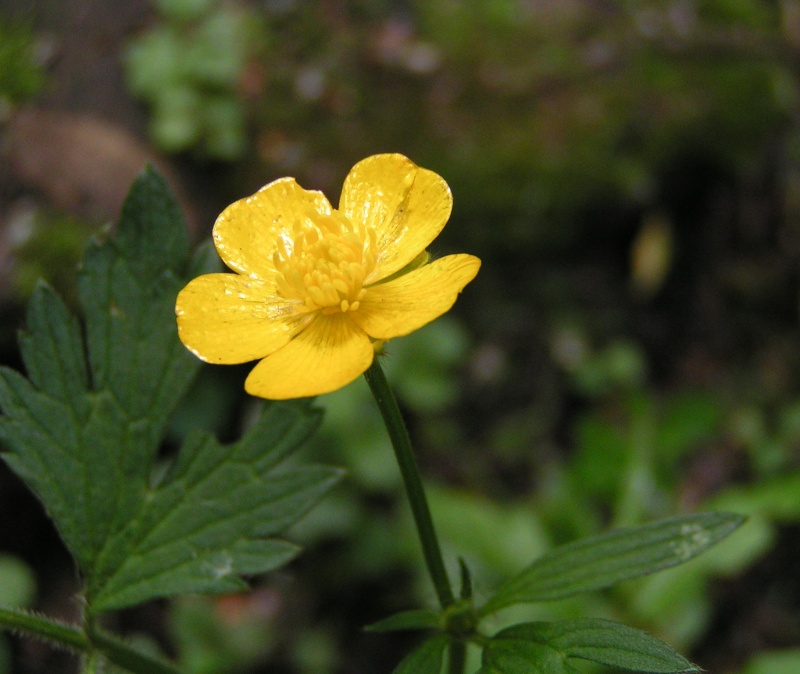
Its flowers have four to ten yellow petals, usually five, measuring approximately one centimetre long. The sepals are yellow-purple, and the flowers contain numerous stamens and pistils.[5][6]
The plant has fleshy, fibrous clustered roots measuring approximately 2 to 3 millimetres thick. Its stems measure approximately 5 to 20 centimetres long.[7][8]
Its flowers occur singly, measure 10 to 20 millimetres in diameter and have five yellow petals. Its five sepals commonly have a purplish tinge.[9][10]
Habitat
The sagebrush buttercup occurs in habitats containing junipers, sagebrush and bitterbrush, including damp ground. It grows in sandy or loamy soils.[11][12]
Its habitats include open woodlands, shrublands, grasslands, subalpine meadows and alpine meadows. It is frequently associated with ponderosa pine and sagebrush communities.[13][14]
The species occurs on well-drained soils in southern Alberta and has been recorded on wet ground in New Mexico. It can be abundant in moist locations during early spring in southeastern Washington and adjacent Idaho.[15][16][17]
The typical variety generally occupies drier sites at lower elevations. In west-central Montana, it is most common in dry, open valleys and foothills.[18][19]
The elliptical variety occurs in more mountainous areas than the typical variety.[20]
Behaviour
The sagebrush buttercup is a cool-season plant that flowers in early spring. It generally completes its growth by midsummer.[21][22]
Reproduction and life cycle
The sagebrush buttercup typically flowers in March and April, although flowering can occasionally begin in February.[23]
Each flower produces between 30 and 180 achenes arranged in a semiglobose cluster at the top of the flower stalk. Each achene contains a single seed.[24][25]
Conservation
The sagebrush buttercup is reported to be toxic to livestock and possibly to humans.[26]
Uses
The Fraser River Stl'atl'imx use the plant's annual flowering as an indicator of the beginning of the chinook salmon run above Lillooet. They call the period associated with the flowering and the beginning of the salmon run spring salmon eye.[27][28]
Similar species
The recognized varieties include Ranunculus glaberrimus var. ellipticus and Ranunculus glaberrimus var. glaberrimus. The elliptical variety has entire, elliptic to oblanceolate basal leaves, unlike the ovate to obovate and shallowly lobed basal leaves of the typical variety.[29][30]
Classification of the Sagebrush Buttercup
| Kingdom | Plantae |
|---|---|
| Subkingdom | Pteridobiotina |
| Phylum | Tracheophyta |
| Class | Magnoliopsida |
| Order | Ranunculales |
| Family | Ranunculaceae (Crowfoot Family) |
| Subfamily | Ranunculoideae |
| Tribe | Ranunculeae |
| Genus | Ranunculus (Crowfoot) |
| Species | Ranunculus glaberrimus Hook. |
Where the Sagebrush Buttercup is found
Checklists and occurrence records place Ranunculus glaberrimus in 2 countries across North America. GBIF holds 8,999 georeferenced records of it.
Countries
Regions and cities with the most records
- British Columbia, Canada 2,270
- Washington, United States 1,435
- Idaho, United States 989
- Montana, United States 698
- Oregon, United States 677
- Kelowna, Canada 502
- West Kelowna, Canada 466
- Lake Country, Canada 437
- Spokane, United States 363
- Spokane Valley, United States 330
- Kamloops, Canada 318
- Colorado, United States 310
- Wyoming, United States 286
- Missoula, United States 242
- Nevada, United States 232
- California, United States 213
- Penticton, Canada 192
- Moscow, United States 180
- Pocatello, United States 179
- Vernon, Canada 177
- Pullman, United States 171
- Boise, United States 163
- Alberta, Canada 92
- Reno, United States 90
- Utah, United States 88
- Post Falls, United States 76
- Saskatchewan, Canada 74
- Sparks, United States 74
- Eagle, United States 71
- Arizona, United States 70
- Ellensburg, United States 70
- Coeur d'Alene, United States 55
- Meridian, United States 54
- Truckee, United States 54
- Wenatchee, United States 52
- Yakima, United States 52
Range as the checklists state it
Canada (British Columbia); USA (California, Idaho, Montana, Nevada, Oregon, South Dakota, Utah, Washington State)
A number beside a place is its count of GBIF occurrence records. A place without a number comes from a checklist alone. Records show where a species has been observed or collected, which can include escapes and vagrants.
Common names
English
- Sagebrush Buttercup
- Early Buttercup
- Elliptical Buttercup
- Shiny-leaved Buttercup
Names in 3 other languages
- Chinese
- 松葉毛茛
- French
- renoncule très glabre
- Russian
- лютик полынный
Synonyms
4 other scientific names have been used for this species and are now treated as synonyms of Ranunculus glaberrimus.
- Beckwithia austinae (Greene) Jeps.
- Ranunculus austinae Greene
- Ranunculus cusickii M.E.Jones
- Ranunculus glaberrimus var. glaberrimus
Subspecies and varieties
- Ranunculus glaberrimus var. ellipticus (Timberline Buttercup) variety
Related species
-
 Creeping ButtercupRanunculus repens
-
 Persian ButtercupRanunculus asiaticus
-
 Meadow ButtercupRanunculus acris
-
 Bulbous ButtercupRanunculus bulbosus
-
 Common Water-CrowfootRanunculus aquatilis
-
 Celery-Leaved ButtercupRanunculus sceleratus
-
 Goldilocks ButtercupRanunculus auricomus
-
 Mount Cook ButtercupRanunculus lyallii
Compare
Questions and answers
What is the scientific name of the Sagebrush Buttercup?
The scientific name of the Sagebrush Buttercup is Ranunculus glaberrimus. Written with its author, the full name is Ranunculus glaberrimus Hook..
Which family does the Sagebrush Buttercup belong to?
Ranunculus glaberrimus belongs to the family Ranunculaceae, in the order Ranunculales and the class Magnoliopsida.
Where is the Sagebrush Buttercup found?
Checklists and occurrence records place Ranunculus glaberrimus in 2 countries: United States and Canada.
What other names does the Sagebrush Buttercup have?
Ranunculus glaberrimus is also known in English as Early Buttercup, Elliptical Buttercup and Shiny-leaved Buttercup.
What is the scientific name for a buttercup flower?
The scientific name of the sagebrush buttercup is Ranunculus glaberrimus Hook.[1]
What are the different types of buttercups?
The recognized varieties of the sagebrush buttercup are Ranunculus glaberrimus var. ellipticus and Ranunculus glaberrimus var. glaberrimus.[29]
Is a buttercup the same as a Ranunculus?
The sagebrush buttercup is a Ranunculus species. Its scientific name is Ranunculus glaberrimus Hook.[1]
Where is Ranunculus native to?
Ranunculus glaberrimus is native to the United States and Canada. Its documented range extends from central British Columbia to southern Saskatchewan, south through the Dakotas to Kansas, and west through the Rocky Mountains to northern New Mexico, the Great Basin and northeastern California.[31][32][33]
Is Ranunculus poisonous to humans?
The sagebrush buttercup is reported to be possibly toxic to humans.[26]
Is a Ranunculus a buttercup?
The sagebrush buttercup is a flowering plant with the scientific name Ranunculus glaberrimus Hook.[1]
Sources
Passages the profile rests on
- Ranunculus glaberrimus is a herbaceous perennial plant with clustered, fleshy roots. Source passage: “The roots are clustered and fleshy.” — English Wikipedia
- The plant typically grows between 4 and 15 centimetres tall. Source passage: “growing to 4–15 centimetres (1+1⁄2–6 in) tall.” — English Wikipedia
- Its basal leaves are somewhat thick and oval, with long petioles and margins ranging from entire to deeply three-lobed. Source passage: “The somewhat thick basal leaves are oval, with long petioles, ranging from entire to having three deep lobes.” — English Wikipedia
- Its cauline leaves have short petioles and otherwise resemble its basal leaves. Source passage: “Cauline leaves have short petioles but are otherwise similar.” — English Wikipedia
- Its flowers have four to ten yellow petals, usually five, measuring approximately one centimetre long. Source passage: “The flowers have four to ten yellow petals (usually five) about 1 cm long.” — English Wikipedia
- The sepals are yellow-purple, and the flowers contain numerous stamens and pistils. Source passage: “The sepals are yellow-purple, and the stamens and pistils are numerous.” — English Wikipedia
- Its stems measure approximately 5 to 20 centimetres long. Source passage: “The stems are erect to prostrate, 2 to 8 inches (5-20 cm) long” — fs.usda.gov
- Its clustered roots are fleshy and fibrous, measuring approximately 2 to 3 millimetres thick. Source passage: “Sagebrush buttercup has a cluster of fleshy [4,14,18,19,26], fibrous [4] roots 2 to 3 mm thick” — fs.usda.gov
- Its five sepals commonly have a purplish tinge. Source passage: “The 5 sepals are commonly purplish-tinged” — fs.usda.gov
- Its flowers occur singly, measure 10 to 20 millimetres in diameter and have five yellow petals. Source passage: “The flowers occur singly, are 10 to 20 mm in diameter, and have 5 yellow petals” — fs.usda.gov
- The species occurs in habitats containing junipers, sagebrush and bitterbrush, including damp ground. Source passage: “It occurs in habitat types with junipers (Juniperus occidentalis), sagebrush (Artemisia tridentata) and bitterbrush (Purshia tridentata), in damp ground.” — English Wikipedia
- The species grows in sandy or loamy soils. Source passage: “Sagebrush buttercup grows on sandy [4,24,36] or loamy soils [8].” — fs.usda.gov
- The species occurs in open woodlands, shrublands, grasslands, subalpine meadows and alpine meadows. Source passage: “Plant communities: Sagebrush buttercup is common throughout many plant communities including open woodlands [41], shrublands [5,34], grasslands [4,5,6,34], and subalpine [41] and alpine [42] meadows.” — fs.usda.gov
- The species is frequently associated with ponderosa pine and sagebrush communities. Source passage: “It is most often associated with ponderosa pine (Pinus ponderosa)[7,11,14,19,50] and sagebrush communities” — fs.usda.gov
- In southern Alberta, the species occurs on well-drained soils. Source passage: “In southern Alberta, sites with sagebrush buttercup had well-drained soils [4].” — fs.usda.gov
- The species has been recorded on wet ground in New Mexico. Source passage: “In New Mexico sagebrush buttercup was described as occurring on wet ground [33]” — fs.usda.gov
- The species can be abundant in moist locations during early spring in southeastern Washington and adjacent Idaho. Source passage: “in southeastern Washington and adjacent Idaho it might be abundant in moist places in the early spring [47].” — fs.usda.gov
- The typical variety generally occupies drier sites at lower elevations. Source passage: “The typical variety grows on drier sites and at lower elevations [8].” — fs.usda.gov
- In west-central Montana, the typical variety is most common in dry, open valleys and foothills. Source passage: “In west-central Montana, the typical variety is most common in dry, open valleys and foothills [26].” — fs.usda.gov
- The elliptical variety occurs in more mountainous areas than the typical variety. Source passage: “Elliptical buttercup occurs in more montane areas [19,26].” — fs.usda.gov
- The species is a cool-season plant that flowers in early spring. Source passage: “Sagebrush buttercup is a cool-season species that flowers in early spring” — fs.usda.gov
- The plant generally completes its growth by midsummer. Source passage: “Growth is generally completed by midsummer [44].” — fs.usda.gov
- The species typically flowers in March and April, although flowering can occasionally begin in February. Source passage: “typically in March and April, though occasionally blooming in February.” — English Wikipedia
- Each flower produces between 30 and 180 achenes arranged in a semiglobose cluster at the top of the flower stalk. Source passage: “From 30 to 180 achenes [4,14,19,50] occur in a semiglobose cluster at the top of the flower stalk.” — fs.usda.gov
- Each achene contains a single seed. Source passage: “Each sagebrush buttercup achene contains one seed [4].” — fs.usda.gov
- The species is reported to be toxic to livestock and possibly to humans. Source passage: “The species is reportedly toxic to livestock and possibly to humans as well.” — English Wikipedia
- The Fraser River Stl'atl'imx use the plant's annual flowering as an indicator of the beginning of the chinook salmon run above Lillooet. Source passage: “use the annual bloom of sagebrush buttercup as an indicator of the beginning of the chinook salmon run up the Fraser River above Lillooet.” — English Wikipedia
- The Fraser River Stl'atl'imx call the period associated with the plant's flowering and the beginning of the salmon run spring salmon eye. Source passage: “This period of time is called "spring salmon eye"” — English Wikipedia
- The recognized varieties include Ranunculus glaberrimus var. ellipticus and Ranunculus glaberrimus var. glaberrimus. Source passage: “Ranunculus glaberrimus var. ellipticus (Greene) Green, elliptical buttercup Ranunculus glaberrimus var. glaberrimus, typical variety” — fs.usda.gov
- The elliptical variety has entire, elliptic to oblanceolate basal leaves, unlike the ovate to obovate and shallowly lobed basal leaves of the typical variety. Source passage: “Elliptical buttercup has entire, elliptic to oblanceolate basal leaves, while the typical variety has ovate to obovate, shallowly lobed basal leaves” — fs.usda.gov
- Its documented range extends from central British Columbia to southern Saskatchewan and south through the Dakotas to Kansas. Source passage: “found from central British Columbia east to southern Saskatchewan, south through the Dakotas to Kansas” — English Wikipedia
- Its distribution extends through the Rocky Mountains to northern New Mexico and west to the Great Basin and northeastern California. Source passage: “through the Rocky Mountains southeast to northern New Mexico, west to the Great Basin region, and southwest to northeastern California.” — English Wikipedia
- The species is native to the United States and Canada. Source passage: “Sagebrush buttercup is native to the United States and Canada.” — fs.usda.gov
Data
- Catalogue of Life, 2026-10-16 XR cc by
- Global Biodiversity Information Facility CC BY 4.0
- Wikidata CC0
- GeoNames CC BY 4.0
- Wikimedia Commons per image; credit shown with each image
- Within the Catalogue of Life, this name comes from Synonymic Checklists of the Vascular Plants of the World cc by
References
- Hook. (1829). Fl. Bor.-Amer. [Hooker] 1: 12 (1829). where the name was published
This species in other databases
- Catalogue of Life 78SSC
- Wikidata Q4117731
- iNaturalist 78824
- World Flora Online wfo-0001129408
- GRIN 453080
Page built on 27 November 2026. See how the catalog is made and all sources and licences.
Cite this page
ScientificNames.org. (2026). Ranunculus glaberrimus (Sagebrush Buttercup). Retrieved November 27, 2026, from https://scientificnames.org/species/ranunculus-glaberrimus
“Ranunculus glaberrimus (Sagebrush Buttercup).” ScientificNames.org, 2026, scientificnames.org/species/ranunculus-glaberrimus. Accessed 27 Nov. 2026.
ScientificNames.org. “Ranunculus glaberrimus (Sagebrush Buttercup).” Accessed November 27, 2026. https://scientificnames.org/species/ranunculus-glaberrimus.
@misc{scientificnames_ranunculus_glaberrimus_sagebrush_buttercup,
  author = {{ScientificNames.org}},
  title = {Ranunculus glaberrimus (Sagebrush Buttercup)},
  year = {2026},
  url = {https://scientificnames.org/species/ranunculus-glaberrimus},
  note = {Accessed 2026-11-27}
}