Species · Amphibians
Cane Toad Rhinella marina
The scientific name of the Cane Toad is Rhinella marina. It is a species of amphibian in the family Bufonidae (true toad), order Anura. The name dates from 1758.
- Scientific name
- Rhinella marina (Linnaeus, 1758)
- Common name
- Cane Toad
- Genus
- Rhinella
- Family
- Bufonidae (True Toad)
- Order
- Anura
- Class
- Amphibia
- Red List category
- LC Least Concern
- Environment
- freshwater, terrestrial
- Recorded in
- 43 countries
- Name status
- accepted in the Catalogue of Life
Overview
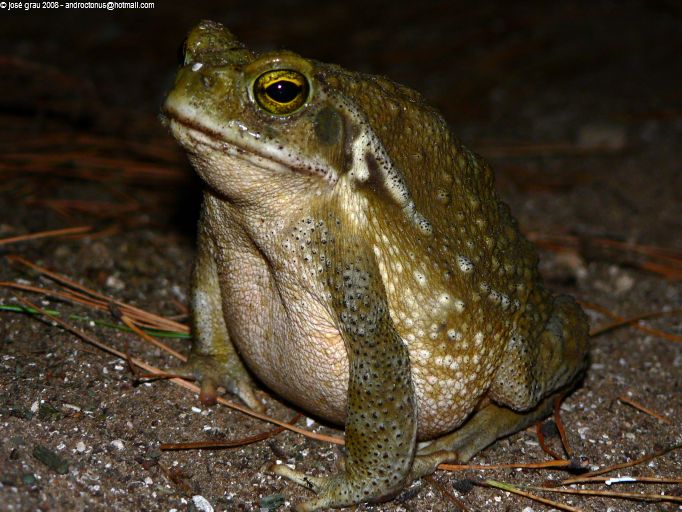
The Cane Toad is native to South America and mainland Central America. The Cane Toad has dry, warty skin, prominent ridges above its eyes, and large parotoid glands behind its eyes.
Written 24 November 2026 from the sources listed below. Each statement was checked against the passage it cites; statements that could not be supported were removed.
Appearance
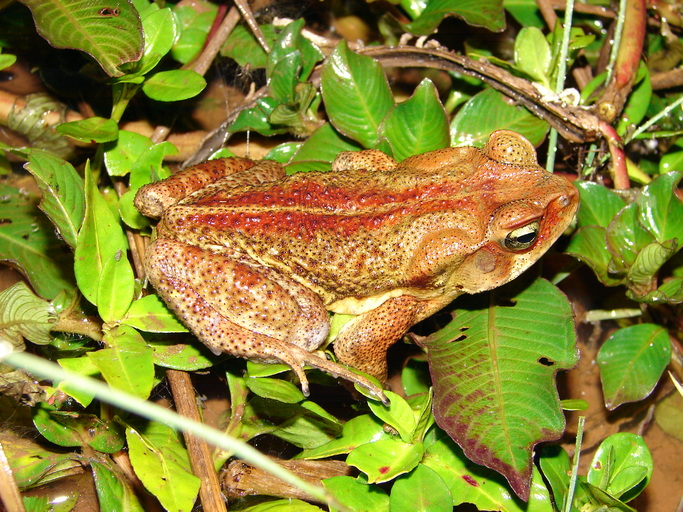
The Cane Toad has dry, warty skin that can be grey, yellowish, red-brown, or olive-brown, with variable patterns. It has prominent ridges above its eyes that extend down its snout and a large parotoid gland behind each eye.[1][2][3][4]
The Cane Toad has horizontal pupils and golden irises. Its ventral surface is cream-coloured and may contain black or brown blotches.[5][6]
Adult Cane Toads typically have light brown or yellow-brown backs with darker patches and spots. Their bellies are white or yellow and sometimes have grey mottling.[7][8]
Young Cane Toads often have grey backs with distinct yellow or red spots or patches. Their fingers are unwebbed, while their toes have fleshy webbing at the bases.[9][10]
Adult Cane Toads typically measure 10–15 cm in length. The largest recorded individual measured 24 cm in snout–vent length, and Cane Toads can weigh up to 1.5 kg.[11][12][13]
Habitat
Cane Toads inhabit open grasslands and woodlands and occur in subtropical forests within their native habitats. Recorded habitats include closed scrub, grassland, low open forest, low shrubland, open forest, open woodland, and woodland.[14][15][16]
Cane Toads show a preference for human-modified environments, including gardens and drainage ditches.[17]
Introduced Cane Toad populations have become established in Australia, Pacific islands, Caribbean islands, and southern Florida. In Australia, they have spread from Queensland through the northern Northern Territory to the Kimberley region of Western Australia and south to the mid-north coast of New South Wales.[18][19]
Diet
Cane Toads consume invertebrates including ants, beetles, earwigs, dragonflies, grasshoppers, crustaceans, and gastropods. They also consume plants, pet food, feces, and household refuse.[20][21]
Yellow-banded millipedes, big-headed ants, and hunting billbugs were among the most frequently consumed prey of adult Cane Toads studied in southwest Florida. Big-headed ants were the most important prey during the wet season in both studied southwest Florida communities.[22][23]
Behaviour
When threatened, Cane Toads can inflate their lungs and raise their bodies to appear larger.[24]
Cane Toad tadpoles are bottom-dwelling and tend to form schools. Tadpoles measure between 10 and 25 mm in length.[25][26]
Reproduction and life cycle
Female Cane Toads can lay between 8,000 and 25,000 eggs in a single spawning event. The eggs are deposited in long jelly strings in freshwater bodies, and these strings can reach 20 m in length.[27][28][29]
Cane Toad eggs typically hatch within 48 hours, although hatching can take from 14 hours to almost a week. Tadpoles generally require approximately four weeks to develop into juveniles, which typically measure approximately 10–11 mm in length when newly emerged.[30][31][32]
Cane Toads breed throughout the year in tropical regions. In Australia, they breed at any time of the year.[33][34]
Conservation
The Cane Toad is considered an invasive species in many regions where it has been introduced.[35]
Uses
The common name Cane Toad derives from its historical use against beetles that damage sugar cane.[36]
Similar species
Young Cane Toads can resemble species of Uperoleia and Crinia but lack colourful markings on the groin and backs of the thighs.[37]
The giant burrowing frog can be distinguished from the Cane Toad by its vertical pupils and silver-grey irises.[38]
Classification of the Cane Toad
| Kingdom | Animalia |
|---|---|
| Phylum | Chordata |
| Subphylum | Vertebrata |
| Infraphylum | Gnathostomata |
| Parvphylum | Osteichthyes |
| Megaclass | Tetrapoda |
| Class | Amphibia (Amphibians) |
| Order | Anura (Frogs) |
| Family | Bufonidae (True Toad) |
| Genus | Rhinella (South American Toads) |
| Species | Rhinella marina (Linnaeus, 1758) |
Where the Cane Toad is found
Checklists and occurrence records place Rhinella marina in 43 countries across North America. GBIF holds 117,131 georeferenced records of it.
Countries
- Antigua and Barbuda 17
- Aruba 73
- Australia 72,116
- Barbados 114
- Belize 159
- Bermuda 171
- Bolivia 373
- Brazil 6,106
- Canada 3
- Colombia 4,946
- Costa Rica 991
- Cuba 11
- Dominica 4
- Dominican Republic 350
- Ecuador 2,180
- El Salvador 304
- Fiji 660
- French Guiana 1,108
- Grenada 59
- Guadeloupe 207
- Guatemala 1,191
- Guyana 567
- Haiti 117
- Honduras 370
- Jamaica 289
- Martinique 270
- Mexico 4,489
- Montserrat 75
- Nicaragua 575
- Palau 361
- Panama 1,045
- Papua New Guinea 648
- Peru 2,770
- Philippines 2,341
- Puerto Rico 1,479
- Saint Kitts and Nevis 18
- Saint Lucia 94
- Saint Vincent and the Grenadines 24
- Suriname 1,075
- Trinidad and Tobago 825
- U.S. Virgin Islands 39
- United States 7,694
- Venezuela 823
Regions and cities with the most records
- Queensland, Australia 27,177
- Northern Territory, Australia 22,569
- Western Australia, Australia 15,859
- New South Wales, Australia 6,034
- Florida, United States 4,603
- Brisbane, Australia 2,651
- Darwin, Australia 2,198
- Hawaii, United States 2,065
- Logan City, Australia 1,951
- Pará, Brazil 1,281
- Amazonas, Brazil 1,158
- The Hammocks, United States 932
- Kendall, United States 922
- Cutler Bay, United States 917
- Antioquia, Colombia 910
- Kendale Lakes, United States 891
- Madre de Dios, Peru 845
- Sunshine Coast, Australia 837
- Townsville, Australia 833
- Flagami, United States 829
- Fountainebleau, United States 793
- Coral Gables, United States 791
- Tamiami, United States 774
- Hialeah, United States 766
- Doral, United States 762
- Cairns, Australia 741
- Davie, United States 741
- Little Havana, United States 735
- Plantation, United States 717
- Tabasco, Mexico 699
- Caguas, Puerto Rico 677
- Pembroke Pines, United States 661
- Lauderhill, United States 660
- Meta Department, Colombia 651
- Miami Gardens, United States 638
- Miramar, United States 638
23 more countries have a few records outside this range
These countries hold a few records of Rhinella marina but lie outside the range the checklists give for it. Such records are often zoo or garden specimens, museum material or vagrants, so the species is not counted as occurring there.
- American Samoa 196
- Argentina 62
- British Indian Ocean Territory 32
- Chile 3
- Estonia 4
- France 31
- French Polynesia 3
- Germany 3
- Guam 288
- Indonesia 16
- Japan 168
- Kiribati 4
- Micronesia 108
- New Caledonia 3
- Northern Mariana Islands 91
- Paraguay 50
- Solomon Islands 208
- Taiwan 30
- Thailand 3
- Tuvalu 5
- United Kingdom 4
- United States Minor Outlying Islands 6
- Uruguay 7
Range as the checklists state it
North America
A number beside a place is its count of GBIF occurrence records. A place without a number comes from a checklist alone. Records show where a species has been observed or collected, which can include escapes and vagrants.
Common names
English
- Cane Toad
- Agua Toad
- Crapoud
- Dominican Toad
- Eastern Cane Toad
- Giant Marine Toad
- Giant Neotropical Toad
- Marine Toad
- Shoulder-knot Frog
- South American Cane Toad
- Giant Toad
Names in 31 other languages
- Afrikaans
- Rietpadda
- Arabic
- ضفدع القصب
- Armenian
- Եղեգի դոդոշ
- Asturian
- sapu xigante
- Azerbaijani
- Aqa
- Catalan
- Gripau gegant
- Chinese
- 海蟾蜍, 甘蔗蟾蜍, 蔗蟾
- Czech
- ropucha obrovská
- Dutch
- Aga-pad, Agapad, reuzenpad, suikerrietpad, zeepad
- Estonian
- Aaga
- Finnish
- Agakonna
- French
- Crapaud, Crapaud Buffle, Crapaud agua, Crapaud bœuf, Crapaud géant
- Georgian
- აგა
- German
- Aga, Aga-Kröte, Riesenkröte
- Hebrew
- קרפדת ענק, קרפדת קנים
- Hungarian
- óriásvarangy
- Irish
- Buaf chána
- Italian
- Rospo delle canne, Rospo gigante neotropicale, Rospo marino
- Japanese
- オオヒキガエル
- Korean
- 사탕수수두꺼비
- Latvian
- Jūras krupis
- Papiamento
- Sapo
- Polish
- ropucha aga
- Portuguese
- Cururu, Sapo-boi, Sapo-cururu
- Russian
- Жаба-ага
- Spanish
- Maco Pen Pen, Sapo Común, Sapo Grande, Sapo Lechero, Sapo de Caña, Sapo de la caña, Sapo gigante
- Swedish
- agapadda
- Thai
- คางคกอ้อย
- Ukrainian
- Ага
- Vietnamese
- Cóc mía
- pau
- Dechedch
Synonyms
22 other scientific names have been used for this species and are now treated as synonyms of Rhinella marina.
- Bombinator horridus (Daudin, 1802)
- Bombinator maculatus Merrem, 1820
- Bufo agua Hens.
- Bufo albicans Spix, 1824
- Bufo brasiliensis Laurenti, 1768
- Bufo horridus Daudin, 1802
- Bufo humeralis Daudin, 1803
- Bufo lazarus Spix, 1824
- Bufo maculiventris Spix, 1824
- Bufo marinis (Linnaeus, 1758)
- Bufo marinus Schneider, 1799
- Bufo marinus (Linnaeus, 1758)
- Bufo marinus fluminensis Jiménez de la Espada, 1875
- Bufo marinus marinus (Linnaeus, 1758)
- Bufo marinus napensis Jiménez de la Espada, 1875
- Bufo pithecodactylus Werner, 1899
- Chaunus marinus (Linnaeus, 1758)
- Docidophryne lazarus (Spix, 1824)
- Rana gigas Walbaum, 1784
- Rana humerisarmata Bonnaterre, 1789
- Rana marina Linnaeus, 1758
- Rhinella marinus (Linnaeus, 1758)
Related species
- Mesoamerican Cane ToadRhinella horribilis
-
 Cope's ToadRhinella diptycha
-
 Common ToadRhinella arenarum
-
 Ornate Forest ToadRhinella ornata
-
 Yellow Cururu ToadRhinella icterica
-
 South American Common ToadRhinella margaritifera
-
 Snouted ToadRhinella proboscidea
-
 Atacama ToadRhinella atacamensis
Compare
Questions and answers
What is the scientific name of the Cane Toad?
The scientific name of the Cane Toad is Rhinella marina. Written with its author, the full name is Rhinella marina (Linnaeus, 1758).
Which family does the Cane Toad belong to?
Rhinella marina belongs to the family Bufonidae, in the order Anura and the class Amphibia.
Where is the Cane Toad found?
Checklists and occurrence records place Rhinella marina in 43 countries, including Australia, United States, Brazil, Colombia, Mexico and Peru.
What is the conservation status of the Cane Toad?
The IUCN Red List category recorded for Rhinella marina is Least Concern (LC).
What other names does the Cane Toad have?
Rhinella marina is also known in English as Agua Toad, Crapoud, Dominican Toad, Eastern Cane Toad, Giant Marine Toad and Giant Neotropical Toad.
What US states have cane toads?
Cane Toad populations have become established in southern Florida.[18]
What is the diet of a cane toad?
Cane Toads eat invertebrates including ants, beetles, earwigs, dragonflies, grasshoppers, crustaceans, and gastropods. They also consume plants, pet food, feces, and household refuse.[20][21]
Sources
Passages the profile rests on
- The cane toad has dry, warty skin. Source passage: “The skin of the cane toad is dry and warty.” — English Wikipedia
- The cane toad can be grey, yellowish, red-brown, or olive-brown, with variable skin patterns. Source passage: “Individual cane toads can be grey, yellowish, red-brown, or olive-brown, with varying patterns.” — English Wikipedia
- The cane toad has prominent ridges above its eyes that extend down its snout. Source passage: “Distinct ridges above the eyes run down the snout.” — English Wikipedia
- The cane toad has a large parotoid gland behind each eye. Source passage: “A large parotoid gland lies behind each eye.” — English Wikipedia
- The cane toad has horizontal pupils and golden irises. Source passage: “The pupils are horizontal and the irises golden.” — English Wikipedia
- The cane toad's ventral surface is cream-coloured and may contain black or brown blotches. Source passage: “The ventral surface is cream-coloured and may have blotches in shades of black or brown.” — English Wikipedia
- Adult cane toads have a light brown or yellow-brown back with darker patches and spots. Source passage: “Adult toads have a light brown or yellow-brown back, with darker patches and spots.” — australian.museum
- The belly of the cane toad is white or yellow and sometimes has grey mottling. Source passage: “The belly is white or yellow, sometimes with grey mottling.” — australian.museum
- The cane toad has unwebbed fingers and fleshy webbing at the bases of its toes. Source passage: “The toes have a fleshy webbing at their base, and the fingers are free of webbing.” — English Wikipedia
- Young cane toads often have grey backs with distinct yellow or red spots or patches. Source passage: “Young toads often have a grey back, with distinct yellow or red spots or patches.” — australian.museum
- Adult cane toads typically measure 10–15 cm in length. Source passage: “Adults average 10–15 cm (4–6 in) in length;” — English Wikipedia
- The largest recorded cane toad measured 24 cm in snout–vent length. Source passage: “the largest recorded specimen had a snout–vent length of 24 cm (9.4 in).” — English Wikipedia
- Cane toads can weigh up to 1.5 kg. Source passage: “can weigh up to 1.5 kg (3.3 lbs)” — nas.er.usgs.gov
- Cane toads inhabit open grasslands and woodlands. Source passage: “The cane toad inhabits open grassland and woodland,” — English Wikipedia
- Cane toads occur in subtropical forests within their native habitats. Source passage: “In their native habitats, the toads can be found in subtropical forests,” — English Wikipedia
- Recorded cane toad habitats include closed scrub, grassland, low open forest, low shrubland, open forest, open woodland, and woodland. Source passage: “Habitats closed scrub, grassland, low open forest, low shrubland, open forest, open woodland, woodland” — australian.museum
- Cane toads show a preference for human-modified environments, including gardens and drainage ditches. Source passage: “a "distinct preference" for areas modified by humans, such as gardens and drainage ditches.” — English Wikipedia
- Introduced cane toad populations have become established in Australia, Pacific islands, Caribbean islands, and southern Florida. Source passage: “This Neotropical species was introduced as biocontrol for agricultural insect pests and has since become established in Australia, Pacific and Caribbean islands, and southern Florida [13].” — pmc.ncbi.nlm.nih.gov
- In Australia, cane toads have spread from Queensland through the northern Northern Territory to the Kimberley region of Western Australia and south to the mid-north coast of New South Wales. Source passage: “since then has spread very rapidly throughout most of QLD, west through the northern NT to the Kimberley region in WA, as well as south to the mid north coast of NSW.” — australian.museum
- Cane toads consume invertebrates including ants, beetles, earwigs, dragonflies, grasshoppers, crustaceans, and gastropods. Source passage: “a range of invertebrates (such as ants, beetles, earwigs, dragonflies, grasshoppers, true bugs, crustaceans, and gastropods)” — English Wikipedia
- Cane toads also consume plants, pet food, feces, and household refuse. Source passage: “they also eat plants, dog food, cat food, feces, and household refuse.” — English Wikipedia
- Yellow-banded millipedes, big-headed ants, and hunting billbugs were among the most frequently consumed prey of adult cane toads studied in southwest Florida. Source passage: “Yellow-banded millipedes (Anadenobolus monilicornis), big-headed ants (Pheidole spp.), and hunting billbugs (Sphenophorus venatus vestitus) were the most frequently consumed prey items” — pmc.ncbi.nlm.nih.gov
- Big-headed ants were the most important prey during the wet season in both studied southwest Florida communities. Source passage: “big-headed ants were the most important prey in both communities during the wet season,” — pmc.ncbi.nlm.nih.gov
- Cane toads can inflate their lungs and raise their bodies to appear larger when threatened. Source passage: “the cane toad is capable of inflating its lungs, puffing up, and lifting its body off the ground to appear taller and larger to a potential predator.” — English Wikipedia
- Cane toad tadpoles measure between 10 and 25 mm in length. Source passage: “Tadpoles range from 10 to 25 mm (0.4 to 1.0 in) in length.” — English Wikipedia
- Cane toad tadpoles are bottom-dwelling and tend to form schools. Source passage: “The tadpoles are small and uniformly black, and are bottom-dwellers, tending to form schools.” — English Wikipedia
- Female cane toads can lay between 8,000 and 25,000 eggs in a single spawning event. Source passage: “A female lays 8,000–25,000 eggs at once” — English Wikipedia
- Cane toad eggs are deposited in long jelly strings that can reach 20 m in length. Source passage: “the strings can stretch up to 20 m (66 ft) in length.” — English Wikipedia
- Cane toad eggs are laid in long strings in freshwater bodies. Source passage: “Eggs are laid as very long strings in nearly all fresh water bodies.” — australian.museum
- Newly emerged cane toad juveniles typically measure approximately 10–11 mm in length. Source passage: “When they emerge, toadlets typically are about 10–11 mm (0.39–0.43 in) in length,” — English Wikipedia
- Cane toad eggs typically hatch within 48 hours, although hatching can take from 14 hours to almost a week. Source passage: “Tadpoles typically hatch within 48 hours, but the period can vary from 14 hours to almost a week.” — English Wikipedia
- Cane toad tadpoles generally require approximately four weeks to develop into juveniles. Source passage: “Between 12 and 60 days are needed for the tadpoles to develop into juveniles, with four weeks being typical.” — English Wikipedia
- Cane toads breed throughout the year in tropical regions. Source passage: “In tropical regions, such as their native habitats, breeding occurs throughout the year,” — English Wikipedia
- Cane toads in Australia breed at any time of the year. Source passage: “Breeds during any time of the year.” — australian.museum
- The cane toad is considered an invasive species in many regions where it has been introduced. Source passage: “The cane toad is now considered a pest and an invasive species in many of its introduced regions.” — English Wikipedia
- The cane toad's common name derives from its historical use against beetles that damage sugar cane. Source passage: “The common name of the species is derived from its use against the cane beetle (Dermolepida albohirtum), which damages sugar cane.” — English Wikipedia
- Young cane toads can resemble species of Uperoleia and Crinia, but lack colourful markings on the groin and backs of the thighs. Source passage: “Young toads, however, look similar to many Uperoleia and Crinia species, but lack colourful markings on the groin and backs of the thighs.” — australian.museum
- The giant burrowing frog can be distinguished from the cane toad by its vertical pupils and silver-grey irises. Source passage: “the latter can be readily distinguished from the former by its vertical pupils and its silver-grey (as opposed to gold) irises.” — English Wikipedia
- The cane toad is native to South America and mainland Central America. Source passage: “native to South and mainland Central America,” — English Wikipedia
Data
- Catalogue of Life, 2026-10-16 XR cc by
- Global Biodiversity Information Facility CC BY 4.0
- Wikidata CC0
- GeoNames CC BY 4.0
- Within the Catalogue of Life, this name comes from The Integrated Taxonomic Information System cc0
References
- Crother, Brian I., Jeff Boundy, Frank T. Burbrink, et al. / Moriarty, John J., ed. (2008). Scientific and Standard English Names of Amphibians and Reptiles of North America North of Mexico, With Comments Regarding Confidence in Our Understanding, Sixth Ed. Herpetological Circular No. 37.
This species in other databases
- Catalogue of Life 4S7NY
- Wikidata Q321087
- iNaturalist 553515
- WoRMS urn:lsid:marinespecies.org:taxname:1432725
Page built on 24 November 2026. See how the catalog is made and all sources and licences.
Cite this page
ScientificNames.org. (2026). Rhinella marina (Cane Toad). Retrieved November 24, 2026, from https://scientificnames.org/species/rhinella-marina
“Rhinella marina (Cane Toad).” ScientificNames.org, 2026, scientificnames.org/species/rhinella-marina. Accessed 24 Nov. 2026.
ScientificNames.org. “Rhinella marina (Cane Toad).” Accessed November 24, 2026. https://scientificnames.org/species/rhinella-marina.
@misc{scientificnames_rhinella_marina_cane_toad,
  author = {{ScientificNames.org}},
  title = {Rhinella marina (Cane Toad)},
  year = {2026},
  url = {https://scientificnames.org/species/rhinella-marina},
  note = {Accessed 2026-11-24}
}