Species · Fishes
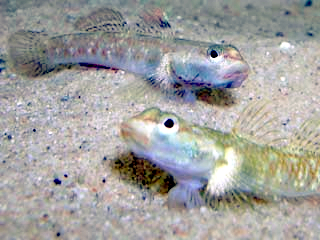
Whitecheek Goby Rhinogobius duospilus
The scientific name of the Whitecheek Goby is Rhinogobius duospilus. It is a species of fish in the family Gobiidae (true gobies), order Gobiiformes. The name dates from 1935.
- Scientific name
- Rhinogobius duospilus (Herre, 1935)
- Common name
- Whitecheek Goby
- Genus
- Rhinogobius
- Family
- Gobiidae (True Gobies)
- Order
- Gobiiformes
- Class
- Teleostei
- Environment
- brackish, freshwater
- Recorded in
- 3 countries
- Name status
- accepted in the Catalogue of Life
Overview
The species is native to China and Vietnam, where it inhabits subtropical creeks and freshwater and brackish waters. It has a modified pelvic fin resembling a sucker that enables it to cling to underwater substrates.
Written 27 November 2026 from the sources listed below. Each statement was checked against the passage it cites; statements that could not be supported were removed.
Appearance
Mature males exhibit vibrant breeding colours.[1]
Habitat
The Whitecheek Goby is native to China and Vietnam. It inhabits subtropical creeks and freshwater and brackish waters within its native range.[2][3][4]
Its populations occur in fragmented habitats across different environments and exhibit genetic differentiation across distinct environments.[5][6]
Diet
The Whitecheek Goby feeds on small invertebrates, including larvae and similar small organisms.[7][8]
Brine shrimp and bloodworms are suitable foods for the species in captivity.[9]
Behaviour
The Whitecheek Goby uses its specialized pelvic fin to cling to substrates in flowing water.[10][11]
The species serves as prey for larger carnivorous animals in freshwater ecosystems.[12]
Classification of the Whitecheek Goby
| Kingdom | Animalia |
|---|---|
| Phylum | Chordata |
| Subphylum | Vertebrata |
| Infraphylum | Gnathostomata |
| Parvphylum | Osteichthyes |
| Gigaclass | Actinopterygii |
| Superclass | Actinopteri |
| Class | Teleostei (Teleost) |
| Order | Gobiiformes |
| Family | Gobiidae (True Gobies) |
| Subfamily | Gobionellinae |
| Genus | Rhinogobius (Rhinogobies) |
| Species | Rhinogobius duospilus (Herre, 1935) |
Where the Whitecheek Goby is found
Checklists and occurrence records place Rhinogobius duospilus in 3 countries. GBIF holds 482 georeferenced records of it.
Countries
Regions and cities with the most records
- Sham Tseng, Hong Kong 313
- Ting Kau, Hong Kong 311
- Tsing Yi Town, Hong Kong 304
- Kam Ying, Hong Kong 301
- Lee On, Hong Kong 301
- Wu Kai Sha, Hong Kong 301
- Tsuen Wan, Hong Kong 299
- Discovery Park, Hong Kong 297
- Tai Po, Hong Kong 296
- Kwai Chung, Hong Kong 295
- Tai Wo Hau, Hong Kong 295
- Pat Heung, Hong Kong 293
- Shek Lei, Hong Kong 293
- San Tin, Hong Kong 292
- Tai Wai, Hong Kong 292
- Hong Lok Yuen, Hong Kong 291
- Mount Davis, Hong Kong 291
- Tai Shui Hang, Hong Kong 291
- City One, Hong Kong 290
- Fo Tan, Hong Kong 290
- Keng Hau, Hong Kong 290
- Sha Tin, Hong Kong 290
- Shuen Wan, Hong Kong 290
- Sun Tin Wai, Hong Kong 290
- Ma On Shan, Hong Kong 289
- Siu Lek Yuen, Hong Kong 289
- Wo Che, Hong Kong 289
- Fanling, Hong Kong 288
- Tai Mei Tuk, Hong Kong 288
- Sai Kung, Hong Kong 286
- Sha Tin Wai, Hong Kong 286
- Shap Pat Heung, Hong Kong 286
- Mei Foo, Hong Kong 285
- Mei Foo Sun Chuen, Hong Kong 285
- Pok Hong, Hong Kong 285
- Tsz Wan Shan, Hong Kong 285
1 more country has a few records outside this range
These countries hold a few records of Rhinogobius duospilus but lie outside the range the checklists give for it. Such records are often zoo or garden specimens, museum material or vagrants, so the species is not counted as occurring there.
A number beside a place is its count of GBIF occurrence records. A place without a number comes from a checklist alone. Records show where a species has been observed or collected, which can include escapes and vagrants.
Common names
English
- Whitecheek Goby
Names in 3 other languages
- Chinese
- 溪吻鰕虎, 溪吻鰕虎魚
- Japanese
- ホンコンヨシノボリ
- Spanish
- Gobio de mejillas blancas
Synonyms
6 other scientific names have been used for this species and are now treated as synonyms of Rhinogobius duospilus.
- Ctenogobius duospilus Herre, 1935
- Ctenogobius whitleyi Herre, 1936
- Ctenogobius wui Liu, 1940
- Gobius duospilus (Herre, 1935)
- Gobius whitleyi (Herre, 1936)
- Rhinogobius wui (Liu, 1940)
Related species
-
 Lizard GobyRhinogobius flumineus
-
 Amur GobyRhinogobius brunneus
-
 Barcheek GobyRhinogobius giurinus
-
 Zhou's Scarlet GobyRhinogobius zhoui
-
 Amur GobyRhinogobius similis
- Candi River GobyRhinogobius candidianus
-
 Rhinogobius mizunoi
-
 Rhinogobius carpenteri
Compare
Questions and answers
What is the scientific name of the Whitecheek Goby?
The scientific name of the Whitecheek Goby is Rhinogobius duospilus. Written with its author, the full name is Rhinogobius duospilus (Herre, 1935).
Which family does the Whitecheek Goby belong to?
Rhinogobius duospilus belongs to the family Gobiidae, in the order Gobiiformes and the class Teleostei.
Where is the Whitecheek Goby found?
Checklists and occurrence records place Rhinogobius duospilus in 3 countries: Hong Kong, China and Macao.
What do gobies like to eat?
The Whitecheek Goby feeds naturally on small invertebrates, including larvae and similar small organisms. Brine shrimp and bloodworms are suitable foods in captivity.[7][9][8]
Will goby eat shrimp?
Brine shrimp are a suitable food for the Whitecheek Goby in captivity.[9]
Sources
Passages the profile rests on
- Mature males exhibit vibrant breeding colours. Source passage: “the vibrant breeding colors exhibited by mature males.” — pmc.ncbi.nlm.nih.gov
- The species inhabits freshwater and brackish waters in its native range. Source passage: “where they can be found in fresh or brackish waters.” — English Wikipedia
- The species is native to China and Vietnam. Source passage: “native to China and Vietnam” — English Wikipedia
- The species inhabits subtropical creeks in China and Vietnam. Source passage: “endemic to subtropical creeks in China and Vietnam (Pan et al. 1991).” — pmc.ncbi.nlm.nih.gov
- Populations of the species occur in fragmented habitats across different environments. Source passage: “Such ecological habit results in highly fragmented habitats of this species” — pmc.ncbi.nlm.nih.gov
- Populations of the species exhibit genetic differentiation across distinct environments. Source passage: “leading to genetic differentiation among populations across distinct environments (Wu et al. 2016).” — pmc.ncbi.nlm.nih.gov
- The species naturally consumes larvae and similar small organisms. Source passage: “these fish consume larvae or other similar creatures” — English Wikipedia
- The species feeds on small invertebrates. Source passage: “feeding on small invertebrates while serving as prey for larger carnivorous species” — pmc.ncbi.nlm.nih.gov
- Brine shrimp and bloodworms are suitable foods for this species in captivity. Source passage: “they can be fed brine shrimp or blood worms.” — English Wikipedia
- The species uses its modified pelvic fin to cling to substrates in flowing water. Source passage: “which allows it to cling to substrate in flowing water” — pmc.ncbi.nlm.nih.gov
- The species can cling to substrates in flowing water using its specialized pelvic fin. Source passage: “its specialized sucker-like pelvic fin, which allows it to cling to substrate in flowing water” — pmc.ncbi.nlm.nih.gov
- The species serves as prey for larger carnivorous animals in freshwater ecosystems. Source passage: “serving as prey for larger carnivorous species” — pmc.ncbi.nlm.nih.gov
Data
- Catalogue of Life, 2026-10-16 XR cc by
- Global Biodiversity Information Facility CC BY 4.0
- Wikidata CC0
- GeoNames CC BY 4.0
- Wikimedia Commons per image; credit shown with each image
- Within the Catalogue of Life, this name comes from World Register of Marine Species cc by
This species in other databases
- Catalogue of Life 4S8YZ
- Wikidata Q2422422
- iNaturalist 342836
- WoRMS urn:lsid:marinespecies.org:taxname:282582
- ITIS 637960
Page built on 27 November 2026. See how the catalog is made and all sources and licences.
Cite this page
ScientificNames.org. (2026). Rhinogobius duospilus (Whitecheek Goby). Retrieved November 27, 2026, from https://scientificnames.org/species/rhinogobius-duospilus
“Rhinogobius duospilus (Whitecheek Goby).” ScientificNames.org, 2026, scientificnames.org/species/rhinogobius-duospilus. Accessed 27 Nov. 2026.
ScientificNames.org. “Rhinogobius duospilus (Whitecheek Goby).” Accessed November 27, 2026. https://scientificnames.org/species/rhinogobius-duospilus.
@misc{scientificnames_rhinogobius_duospilus_whitecheek_goby,
  author = {{ScientificNames.org}},
  title = {Rhinogobius duospilus (Whitecheek Goby)},
  year = {2026},
  url = {https://scientificnames.org/species/rhinogobius-duospilus},
  note = {Accessed 2026-11-27}
}