Species · Birds
Rufous Mourner Rhytipterna holerythra
The scientific name of the Rufous Mourner is Rhytipterna holerythra. It is a species of bird in the family Tyrannidae (tyrant flycatcher), order Passeriformes. The name dates from 1860.
- Scientific name
- Rhytipterna holerythra (P. L. Sclater & Salvin, 1860)
- Common name
- Rufous Mourner
- Genus
- Rhytipterna
- Family
- Tyrannidae (Tyrant Flycatcher)
- Order
- Passeriformes
- Class
- Aves
- Red List category
- LC Least Concern
- Environment
- terrestrial
- Recorded in
- 9 countries
- Name status
- accepted in the Catalogue of Life
Overview
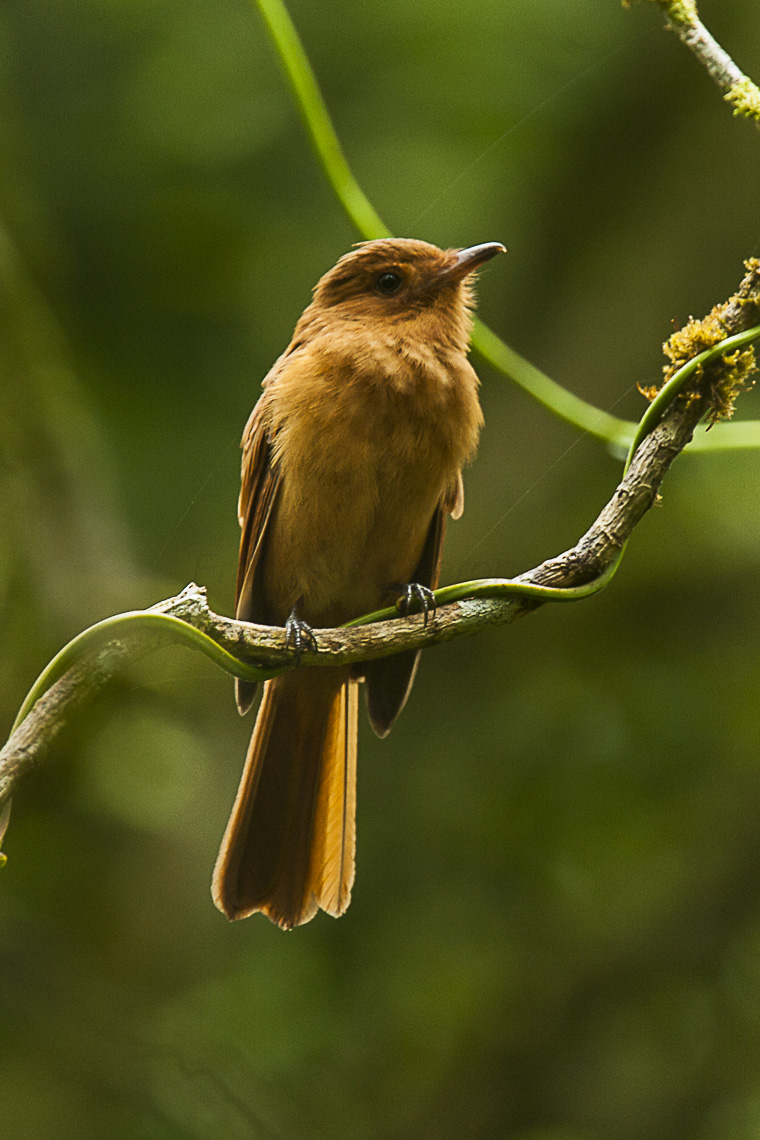
The Rufous Mourner is a medium-sized flycatcher. It occurs in Mexico, every Central American country except El Salvador, Colombia, and Ecuador. It is overall rusty-colored, with cinnamon-brown to russet upperparts and bright cinnamon to tawny ochraceous underparts.
Written 26 November 2026 from the sources listed below. Each statement was checked against the passage it cites; statements that could not be supported were removed.
Appearance
The Rufous Mourner measures between 19.5 and 21 cm in length and weighs approximately 32–39 g. Male and female Rufous Mourners have the same plumage.[1][2][3]
Adult males of the nominate subspecies have cinnamon-brown to russet heads and upperparts, with darker rufous crowns. The wings are darker brown than the back, with cinnamon-rufous edges on the flight feathers, and the tail is predominantly cinnamon-rufous with darker central feathers.[4][5][6]
The underparts are bright cinnamon to tawny ochraceous, with lighter coloration on the throat and belly and darker coloration on the breast. Juveniles have more intensely rufous upperparts and paler cinnamon-buff underparts than adults.[7][8]
Rhytipterna holerythra rosenbergi has more deeply colored upperparts and underparts than the nominate subspecies. Both subspecies have light-brown to reddish-brown irises.[9][10]
The species has a slightly hooked black bill, with a dusky-brown base to the upper mandible and a variably pale base to the lower mandible. Its legs and feet range from gray to black.[11][12]
Habitat
The Rufous Mourner inhabits humid evergreen forests and mature secondary forests in tropical and lower subtropical lowlands. It favors middle to upper levels within humid tropical lowland forests.[13][14]
The species occupies elevations from sea level to 1,200 m in northern Central America and Costa Rica. In Colombia, it occurs at elevations up to 1,400 m, and in Ecuador it occurs up to 700 m.[15][16][17]
Similar species
The Rufous Mourner shares its genus with the Pale-bellied Mourner (Rhytipterna immunda) and Grayish Mourner (Rhytipterna simplex). The Rufous Mourner and Grayish Mourner apparently form a superspecies.[18][19]
Diet
The Rufous Mourner primarily consumes large insects and spiders, supplementing its diet with some fruit. Recorded insect prey includes members of the families Tettigoniidae, Cicadidae, Membracidae, Formicidae, and Phasmatidae.[20][21]
The species also eats beetles and lepidopterans. Recorded fruit foods include species from the genera Alchornea, Casearia, Bursera, Cymbopetalum, and Guarea.[22][23]
Behaviour
The Rufous Mourner is a year-round resident. It forages alone or in pairs and frequently joins mixed-species feeding flocks.[24][25]
While foraging, the species perches on branches, sometimes nearly horizontally, usually in the forest mid-story. It captures prey by sallying from a perch to glean it from the underside of vegetation while briefly hovering.[26][27]
The Rufous Mourner is not highly vocal.[28]
Reproduction and life cycle
The breeding season includes March through May in Belize and March through June in Costa Rica. In Colombia, it includes February through May.[29][30][31]
The Rufous Mourner apparently nests mainly in tree cavities, including abandoned woodpecker holes. Nesting in holes in earthen banks has also been proposed, although this report is disputed.[32][33]
Conservation
The IUCN has assessed the Rufous Mourner as Least Concern. Its estimated population is at least 50,000 mature individuals, and its population is believed to be decreasing.[34][35][36]
No immediate threats to the Rufous Mourner have been identified. The species depends on threatened tropical lowland evergreen forest habitats, with logging of mature forests and conversion of forest land to agriculture identified as primary threats.[37][38][39]
The species is uncommon to fairly common in northern Central America and fairly common in Costa Rica. In Colombia, it is described as uncommon and inconspicuous.[40][41][42]
The IUCN Red List assessment for the Rufous Mourner was dated 18 August 2022.[43]
Classification of the Rufous Mourner
| Kingdom | Animalia |
|---|---|
| Phylum | Chordata |
| Subphylum | Vertebrata |
| Infraphylum | Gnathostomata |
| Parvphylum | Osteichthyes |
| Megaclass | Tetrapoda |
| Class | Aves (Bird) |
| Order | Passeriformes (Passerine) |
| Family | Tyrannidae (Tyrant Flycatcher) |
| Genus | Rhytipterna (Mourners) |
| Species | Rhytipterna holerythra (P. L. Sclater & Salvin, 1860) |
Where the Rufous Mourner is found
Checklists and occurrence records place Rhytipterna holerythra in 9 countries across North America and South America. GBIF holds 26,334 georeferenced records of it.
Countries
- Belize 1,881
- Colombia 1,093
- Costa Rica 16,737
- Ecuador 380
- Guatemala 1,207
- Honduras 690
- Mexico 800
- Nicaragua 117
- Panama 3,429
Regions and cities with the most records
- Heredia Province, Costa Rica 4,678
- Alajuela Province, Costa Rica 3,890
- Puntarenas Province, Costa Rica 3,114
- Turrialba, Costa Rica 2,255
- Cartago Province, Costa Rica 2,249
- Limón Province, Costa Rica 1,825
- Chilibre, Panama 1,302
- Alcalde Díaz, Panama 1,294
- Colón, Panama 1,289
- Paraíso, Costa Rica 1,073
- Guápiles, Costa Rica 939
- Cayo District, Belize 886
- Petén, Guatemala 770
- Cartago, Costa Rica 729
- Chiapas, Mexico 682
- Atlántida Department, Honduras 547
- Guanacaste Province, Costa Rica 494
- Darién, Panama 467
- Belmopan, Belize 448
- Orange Walk District, Belize 442
- Panamá Oeste Province, Panama 416
- Coclé, Panama 402
- Valle del Cauca Department, Colombia 399
- Quesada, Costa Rica 378
- Stann Creek, Belize 362
- San José, Costa Rica 340
- Izabal Department, Guatemala 322
- La Ceiba, Honduras 315
- La Ceiba, Honduras 313
- Siquirres, Costa Rica 311
- Panamá, Panama 299
- Esmeraldas, Ecuador 274
- San Ignacio, Belize 271
- Buenaventura, Colombia 240
- Antioquia, Colombia 229
- Limón, Costa Rica 208
Range as the checklists state it
Middle America
South America
A number beside a place is its count of GBIF occurrence records. A place without a number comes from a checklist alone. Records show where a species has been observed or collected, which can include escapes and vagrants.
Common names
English
- Rufous Mourner
Names in 25 other languages
- Catalan
- tirà ploraner rogenc
- Chinese
- 棕悲雀, 棕悲霸鹟
- Croatian
- riđi silnik
- Czech
- kotingovec rezavý
- Danish
- Rødbrun Klagetyran
- Dutch
- Rosse Treurtiran
- Esperanto
- cinama tirano
- Finnish
- kanelityranni
- French
- Tyran plaintif
- German
- Rost-Aulia, Zimtschmucktyrann
- Hungarian
- rozsdás siratómadár
- Italian
- Piagnone rossiccio
- Japanese
- ナゲキタイランチョウ
- Lithuanian
- ugninis niūrusis tironas
- Norwegian
- brunsørgetyrann
- Polish
- pokutnik rdzawy
- Portuguese
- carpideira-ruiva, vissiá-ruivo
- Russian
- Рыжий траурный тиранн, Рыжия тиранн-плакса
- Serbian
- Riđa žalobna muharka
- Slovak
- postriežkar hrdzavý
- Spanish
- Mosquero Canelo, Plañidera alazán, Plañidera rojiza
- Swedish
- rödbrun sorgtyrann
- Turkish
- Kızıl Ağıtçı Tiran
- Ukrainian
- планідера руда
- Welsh
- galarwr gwinau
Synonyms
One other scientific name has been used for this species and is now treated as a synonym of Rhytipterna holerythra.
- Lipaugus holerythrus P. L. Sclater & Salvin, 1860
Subspecies and varieties
- Rhytipterna holerythra holerythra subspecies
- Rhytipterna holerythra rosenbergi subspecies
Related species
-
 Greyish MournerRhytipterna simplex
-
 Pale-bellied MournerRhytipterna immunda
-
 Great KiskadeePitangus sulphuratus
-
 Eastern PhoebeSayornis phoebe
-
 Cinnamon FlycatcherPyrrhomyias cinnamomeus
-
 Dusky-capped FlycatcherMyiarchus tuberculifer
-
 Vermilion FlycatcherPyrocephalus obscurus
-
 Black PhoebeSayornis nigricans
Compare
Questions and answers
What is the scientific name of the Rufous Mourner?
The scientific name of the Rufous Mourner is Rhytipterna holerythra. Written with its author, the full name is Rhytipterna holerythra (P. L. Sclater & Salvin, 1860).
Which family does the Rufous Mourner belong to?
Rhytipterna holerythra belongs to the family Tyrannidae, in the order Passeriformes and the class Aves.
Where is the Rufous Mourner found?
Checklists and occurrence records place Rhytipterna holerythra in 9 countries, including Costa Rica, Panama, Belize, Guatemala, Colombia and Mexico.
What is the conservation status of the Rufous Mourner?
The IUCN Red List category recorded for Rhytipterna holerythra is Least Concern (LC).
Sources
Passages the profile rests on
- The Rufous Mourner measures between 19.5 and 21 cm in length. Source passage: “The rufous mourner is 19.5 to 21 cm (7.7 to 8.3 in) long” — English Wikipedia
- The Rufous Mourner weighs approximately 32–39 g. Source passage: “weighs about 32 to 39 g (1.1 to 1.4 oz).” — English Wikipedia
- Male and female Rufous Mourners have the same plumage. Source passage: “The sexes have the same plumage.” — English Wikipedia
- Adult males of the nominate subspecies have cinnamon-brown to russet heads and upperparts with darker rufous crowns. Source passage: “Males of the nominate subspecies have a mostly cinnamon brown to russet head and upperparts with a darker rufous crown.” — English Wikipedia
- The wings are darker brown than the back and have cinnamon-rufous edges on the flight feathers. Source passage: “Their wings are a darker brown than the back with cinnamon rufous edges on the flight feathers.” — English Wikipedia
- The tail is predominantly cinnamon-rufous with darker central feathers. Source passage: “Their tail is mostly cinnamon rufous with darker central feathers.” — English Wikipedia
- The underparts are bright cinnamon to tawny ochraceous, with lighter coloration on the throat and belly and darker coloration on the breast. Source passage: “Their underparts are bright cinnamon to tawny ochraceous that is lighter on the throat and belly and darker on the breast.” — English Wikipedia
- Juveniles have more intensely rufous upperparts and paler cinnamon-buff underparts than adults. Source passage: “Juveniles have brighter, more rufous upperparts and paler cinnamon buff underparts than adults.” — English Wikipedia
- The subspecies Rhytipterna holerythra rosenbergi has more deeply colored upperparts and underparts than the nominate subspecies. Source passage: “Subspecies R. h. rosenbergi is similar to the nominate but more deeply colored on both the upper- and underparts.” — English Wikipedia
- Both subspecies have light-brown to reddish-brown irises. Source passage: “Both subspecies have a light brown to reddish brown iris” — English Wikipedia
- The species has a slightly hooked black bill with a dusky-brown base to the upper mandible and a variably pale base to the lower mandible. Source passage: “a slightly hooked black bill with a dusky brown base to the maxilla and a variable pale base to the mandible” — English Wikipedia
- The legs and feet range from gray to black. Source passage: “and gray to black legs and feet.” — English Wikipedia
- The Rufous Mourner inhabits humid evergreen forests and mature secondary forests in tropical and lower subtropical lowlands. Source passage: “The rufous mourner inhabits humid evergreen forest and mature secondary forest in the lowlands of the tropical and lower subtropical zones.” — English Wikipedia
- The Rufous Mourner favors middle to upper levels within humid tropical lowland forests. Source passage: “Favors middle to upper levels inside forest” — ebird.org
- The species occupies elevations from sea level to 1,200 m in northern Central America and Costa Rica. Source passage: “In elevation it ranges from sea level to 1,200 m (3,900 ft) in northern Central America and Costa Rica.” — English Wikipedia
- In Colombia, the Rufous Mourner occurs at elevations up to 1,400 m. Source passage: “It is found up to 1,400 m (4,600 ft) in Colombia” — English Wikipedia
- In Ecuador, the species occurs at elevations up to 700 m. Source passage: “but only as high as 700 m (2,300 ft) in Ecuador.” — English Wikipedia
- The Rufous Mourner shares its genus with the Pale-bellied Mourner (Rhytipterna immunda) and Grayish Mourner (Rhytipterna simplex). Source passage: “The rufous mourner shares the genus with the pale-bellied mourner (R. immunda) and grayish mourner (R. simplex).” — English Wikipedia
- The Rufous Mourner and Grayish Mourner apparently form a superspecies. Source passage: “The rufous and greyish mourners apparently form a superspecies.” — English Wikipedia
- The species primarily consumes large insects and spiders, supplementing its diet with some fruit. Source passage: “The rufous mourner primarily feeds on large insects and spiders and also includes some fruit in its diet.” — English Wikipedia
- Recorded insect prey includes members of the families Tettigoniidae, Cicadidae, Membracidae, Formicidae, and Phasmatidae. Source passage: “It is known to take insects of the families Tettigoniidae, Cicadidae, Membracidae, Formicidae, and Phasmatidae” — English Wikipedia
- The Rufous Mourner also eats beetles and lepidopterans. Source passage: “and members of the orders Coleoptera and Lepidoptera.” — English Wikipedia
- Recorded fruit foods include species from the genera Alchornea, Casearia, Bursera, Cymbopetalum, and Guarea. Source passage: “Fruits taken include those of genera Alchornea, Casearia, Bursera, Cymbopetalum, and Guarea.” — English Wikipedia
- The Rufous Mourner is a year-round resident. Source passage: “The rufous mourner is a year-round resident.” — English Wikipedia
- The Rufous Mourner forages alone or in pairs and frequently joins mixed-species feeding flocks. Source passage: “The rufous mourner forages singly or in pairs and often joins mixed-species feeding flocks.” — English Wikipedia
- While foraging, the species perches on branches, sometimes nearly horizontally, usually in the forest mid-story. Source passage: “It perches on a branch, sometimes almost horizontally, usually in the forest's mid-story” — English Wikipedia
- The Rufous Mourner captures prey by sallying from a perch to glean it from the underside of vegetation while briefly hovering. Source passage: “and sallies from there to glean prey from the underside of vegetation while briefly hovering.” — English Wikipedia
- The Rufous Mourner is not highly vocal. Source passage: “The rufous mourner is not highly vocal.” — English Wikipedia
- The breeding season includes March through May in Belize. Source passage: “includes March to May in Belize” — English Wikipedia
- The breeding season includes March through June in Costa Rica. Source passage: “March to June in Costa Rica” — English Wikipedia
- The breeding season includes February through May in Colombia. Source passage: “and February to May in Colombia.” — English Wikipedia
- The Rufous Mourner apparently nests mainly in tree cavities, including abandoned woodpecker holes. Source passage: “They apparently mostly nest in tree cavities such as old woodpecker holes.” — English Wikipedia
- Nesting in holes in earthen banks has also been proposed, although this report is disputed. Source passage: “They perhaps also nest in holes in earthen banks but that account has been disputed.” — English Wikipedia
- The IUCN has assessed the Rufous Mourner as Least Concern. Source passage: “The IUCN has assessed the rufous mourner as being of Least Concern.” — English Wikipedia
- The species has an estimated population of at least 50,000 mature individuals. Source passage: “its estimated population of at least 50,000 mature individuals” — English Wikipedia
- The Rufous Mourner's population is believed to be decreasing. Source passage: “is believed to be decreasing.” — English Wikipedia
- No immediate threats to the Rufous Mourner have been identified. Source passage: “No immediate threats have been identified.” — English Wikipedia
- The Rufous Mourner depends on threatened tropical lowland evergreen forest habitats. Source passage: “Rufous Mourner is dependent on threatened tropical lowland evergreen forest habitats.” — English Wikipedia
- Logging of mature forests and conversion of forest land to agriculture are identified as primary threats to the species. Source passage: “The primary threats to this species are logging of mature forests, and conversion of forest land to agriculture.” — English Wikipedia
- The species is described as uncommon to fairly common in northern Central America. Source passage: “It is considered "uncommon to fairly common" in northern Central America” — English Wikipedia
- The Rufous Mourner is described as fairly common in Costa Rica. Source passage: “"fairly common" in Costa Rica” — English Wikipedia
- The species is described as uncommon and inconspicuous in Colombia. Source passage: “"uncommon and inconspicuous" in Colombia.” — English Wikipedia
- The IUCN Red List assessment for the Rufous Mourner was dated 18 August 2022. Source passage: “Date assessed. 18 August 2022” — iucnredlist.org
Data
- Catalogue of Life, 2026-10-16 XR cc by
- Global Biodiversity Information Facility CC BY 4.0
- Wikidata CC0
- GeoNames CC BY 4.0
- Wikimedia Commons per image; credit shown with each image
- Within the Catalogue of Life, this name comes from The Integrated Taxonomic Information System cc0
References
- Proc. Zool. Soc. London (1860): 300. 1861 where the name was published
- Gill, Frank, & and Minturn Wright. (2006). Birds of the World: Recommended English Names.
This species in other databases
Page built on 28 November 2026. See how the catalog is made and all sources and licences.
Cite this page
ScientificNames.org. (2026). Rhytipterna holerythra (Rufous Mourner). Retrieved November 28, 2026, from https://scientificnames.org/species/rhytipterna-holerythra
“Rhytipterna holerythra (Rufous Mourner).” ScientificNames.org, 2026, scientificnames.org/species/rhytipterna-holerythra. Accessed 28 Nov. 2026.
ScientificNames.org. “Rhytipterna holerythra (Rufous Mourner).” Accessed November 28, 2026. https://scientificnames.org/species/rhytipterna-holerythra.
@misc{scientificnames_rhytipterna_holerythra_rufous_mourner,
  author = {{ScientificNames.org}},
  title = {Rhytipterna holerythra (Rufous Mourner)},
  year = {2026},
  url = {https://scientificnames.org/species/rhytipterna-holerythra},
  note = {Accessed 2026-11-28}
}