Species · Flowering plants
Giant Coneflower Rudbeckia maxima
The scientific name of the Giant Coneflower is Rudbeckia maxima. It is a species of flowering plant in the family Asteraceae (composite), order Asterales.
- Scientific name
- Rudbeckia maxima Nutt.
- Common name
- Giant Coneflower
- Genus
- Rudbeckia
- Family
- Asteraceae (Composite)
- Order
- Asterales
- Class
- Magnoliopsida
- Recorded in
- 1 country
- Name status
- accepted in the Catalogue of Life

Overview
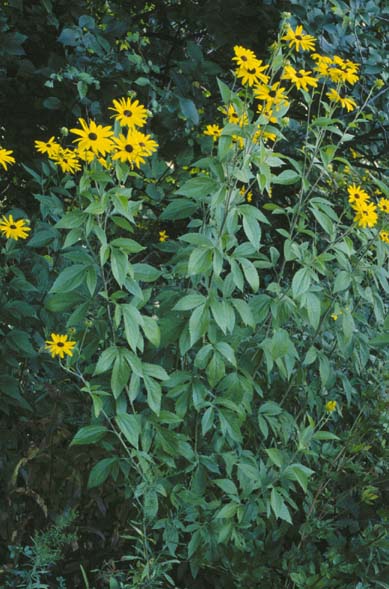
Rudbeckia maxima Nutt. is an herbaceous perennial flowering plant in the family Asteraceae. The species is native to the south-central United States and the Central and Southern United States, with records also existing from South Carolina. The giant coneflower has large, bluish-green paddle-shaped leaves and yellow flowers surrounding a dark brown central cone.
Written 26 November 2026 from the sources listed below. Each statement was checked against the passage it cites; statements that could not be supported were removed.
Appearance
The giant coneflower has large, waxy, paddle-shaped leaves with a bluish-green coloration. Its basal leaves measure 8–24 inches long and approximately 10 inches wide, and can reach two feet in length.[1][2][3]
Its flowers have intense yellow drooping ray petals surrounding a dark brown central cone. The flowers are approximately three inches across, and the central cone measures approximately 2–6 inches in length.[4][5][6]
Its sturdy flower stalks bear single flowers and can reach heights of six to eight feet.[7][8]
Habitat
The species can grow in moist, well-drained, organically rich soil and can tolerate light shade.[9][10]
It is suitable for planting in wildflower meadows.[11]
Reproduction and life cycle
The giant coneflower can be propagated from seed. It can also spread through rhizomes to form large masses.[12][13]
Conservation
The species is hardy in USDA planting zones 4 through 9.[14]
Uses
The giant coneflower is cultivated as an ornamental plant. It is suitable for pollinator gardens, garden borders, and perennial gardens.[15][16][17][18]
Diet
Goldfinches feed on the mature seeds of the giant coneflower. Goldfinches and other small songbirds consume its seeds during winter.[19][20]
Slugs and snails may feed on young plants.[21]
Behaviour
The giant coneflower typically flowers early among Rudbeckia species. Its flowering period includes June and July, and its flowers are long-lasting.[22][23][24]
The species is resistant to deer, rabbits, and voles. It can form large masses when growing in suitable conditions.[25][26]
Classification of the Giant Coneflower
| Kingdom | Plantae |
|---|---|
| Subkingdom | Pteridobiotina |
| Phylum | Tracheophyta |
| Class | Magnoliopsida |
| Order | Asterales |
| Family | Asteraceae (Composite) |
| Subfamily | Asteroideae |
| Tribe | Heliantheae |
| Subtribe | Rudbeckiinae |
| Genus | Rudbeckia (Coneflower) |
| Species | Rudbeckia maxima Nutt. |
Where the Giant Coneflower is found
Checklists and occurrence records place Rudbeckia maxima in 1 country across North America. GBIF holds 946 georeferenced records of it.
Countries
Regions and cities with the most records
- Texas, United States 476
- Paris, United States 75
- Arkansas, United States 55
- Louisiana, United States 38
- Lewisville, United States 37
- Coppell, United States 35
- Highland Village, United States 35
- Farmers Branch, United States 34
- Addison, United States 31
- Carrollton, United States 31
- The Colony, United States 31
- Corinth, United States 30
- Flower Mound, United States 29
- Frisco, United States 29
- Grapevine, United States 29
- The Trails of Frisco, United States 28
- Little Elm, United States 26
- Fort Worth, United States 25
- Oklahoma, United States 25
- Pennsylvania, United States 25
- Benbrook, United States 23
- Maryland, United States 23
- Saginaw, United States 23
- White Settlement, United States 23
- North Richland Hills, United States 21
- Southlake, United States 21
- Plano, United States 19
- Haltom City, United States 18
- Watauga, United States 18
- New York, United States 17
- Richardson, United States 17
- Allen, United States 14
- Dallas, United States 14
- Murphy, United States 14
- Sachse, United States 14
- Colleyville, United States 13
Range as the checklists state it
USA (Arkansas, Louisiana, Oklahoma, South Carolina, Texas)
A number beside a place is its count of GBIF occurrence records. A place without a number comes from a checklist alone. Records show where a species has been observed or collected, which can include escapes and vagrants.
Common names
English
- Giant Coneflower
- Cabbage Coneflower
- Great Coneflower
Names in 4 other languages
- Finnish
- isopäivänhattu
- German
- Riesen-Sonnenhut
- Russian
- Рудбекия большая
- Swedish
- jätterudbeckia
Related species
-
 Black-Eyed-SusanRudbeckia hirta
-
 Cut-leaf ConeflowerRudbeckia laciniata
-
 Perennial ConeflowerRudbeckia fulgida
-
 Brown-eyed SusanRudbeckia triloba
-
 Western Cone-flowerRudbeckia occidentalis
-
 Sweet ConeflowerRudbeckia subtomentosa
-
 Clasping-leaved ConeflowerRudbeckia amplexicaulis
-
 Rough ConeflowerRudbeckia grandiflora
Compare
Questions and answers
What is the scientific name of the Giant Coneflower?
The scientific name of the Giant Coneflower is Rudbeckia maxima. Written with its author, the full name is Rudbeckia maxima Nutt..
Which family does the Giant Coneflower belong to?
Rudbeckia maxima belongs to the family Asteraceae, in the order Asterales and the class Magnoliopsida.
Where is the Giant Coneflower found?
Checklists and occurrence records place Rudbeckia maxima in 1 country: United States.
What other names does the Giant Coneflower have?
Rudbeckia maxima is also known in English as Cabbage Coneflower and Great Coneflower.
Is Rudbeckia maxima aggressive?
The species can spread through rhizomes and form large masses when growing in suitable conditions.[13][26]
What is the giant Rudbeckia plant?
The giant coneflower (Rudbeckia maxima Nutt.) is an herbaceous perennial flowering plant in the family Asteraceae. It typically grows at least five feet tall and can reach a maximum height of eight feet.[27][28][29][30]
Sources
Passages the profile rests on
- The plant has large, waxy, paddle-shaped leaves with a bluish-green coloration. Source passage: “a basal clump of large, waxy, paddle-shaped, bluish-green leaves” — extension.psu.edu
- Its basal leaves can reach two feet in length. Source passage: “The 2-foot-long basal leaves are a striking bluish-green” — hgic.clemson.edu
- Its basal leaves can measure 8–24 inches long and approximately 10 inches wide. Source passage: “8-24 inches long, 10 inches wide” — extension.psu.edu
- Its flowers have intense yellow drooping ray petals surrounding a dark brown central cone. Source passage: “Intense yellow drooping ray petals; tall, 2-6 inches, dark brown beefy central cone” — extension.psu.edu
- Its flowers are yellow and approximately three inches across. Source passage: “the long-lasting yellow 3-inch flowers” — hgic.clemson.edu
- Its central flower cone measures approximately 2–6 inches in length. Source passage: “tall, 2-6 inches, dark brown beefy central cone” — extension.psu.edu
- Its flower stalks are sturdy and bear single flowers. Source passage: “sturdy stalks topped by single flowers” — extension.psu.edu
- Its bloom stalks can reach heights of six to eight feet. Source passage: “The bloom stalks can reach a height of 6 to 8 feet.” — hgic.clemson.edu
- The species can grow in moist, well-drained, organically rich soil. Source passage: “Plant it in moist, well-drained, organically rich soil.” — hgic.clemson.edu
- The species can tolerate light shade. Source passage: “It is best planted in full sun but will tolerate light shade.” — hgic.clemson.edu
- The species is suitable for planting in wildflower meadows. Source passage: “Giant coneflower is an excellent addition to a pollinator garden, wildflower meadow, or borders.” — hgic.clemson.edu
- The species can be propagated from seed. Source passage: “It can be grown from seed” — hgic.clemson.edu
- The species can spread through rhizomes to form large masses. Source passage: “spread by rhizomes to form a large mass.” — hgic.clemson.edu
- The species is hardy in USDA planting zones 4 through 9. Source passage: “This beautiful perennial is hardy in USDA planting zones 4 to 9.” — hgic.clemson.edu
- The species is cultivated as an ornamental plant. Source passage: “which is used as an ornamental plant.” — English Wikipedia
- The species is suitable for pollinator gardens. Source passage: “Giant coneflower is an excellent addition to a pollinator garden” — hgic.clemson.edu
- The species can be planted in garden borders. Source passage: “wildflower meadow, or borders.” — hgic.clemson.edu
- The species can be used in perennial gardens. Source passage: “add to your perennial collection.” — hgic.clemson.edu
- Goldfinches feed on the mature seeds of this species. Source passage: “goldfinches swoop in to eat their mature seeds.” — extension.psu.edu
- Goldfinches and other small songbirds consume its seeds during winter. Source passage: “Goldfinches and other small songbirds feed on the seeds during the winter months.” — hgic.clemson.edu
- Slugs and snails may feed on young plants. Source passage: “slugs and snails might feed on young plants.” — hgic.clemson.edu
- The species typically flowers early among Rudbeckia species. Source passage: “Often, the earliest Rudbeckia to flower.” — extension.psu.edu
- Its flowering period includes June and July. Source passage: “Blooming in June and July” — hgic.clemson.edu
- Its flowers are long-lasting. Source passage: “the long-lasting yellow 3-inch flowers” — hgic.clemson.edu
- The species is resistant to deer, rabbits, and voles. Source passage: “It’s deer, rabbit, and vole resistant.” — hgic.clemson.edu
- The species can form large masses when growing in suitable conditions. Source passage: “they will self-sow or spread by rhizomes to form a large mass.” — hgic.clemson.edu
- The species is an herbaceous perennial. Source passage: “Large coneflower is an herbaceous perennial” — plants.ces.ncsu.edu
- The species belongs to the daisy family, Asteraceae. Source passage: “in the daisy family (Asteraceae)” — plants.ces.ncsu.edu
- The plant can reach a maximum height of eight feet. Source passage: “They can reach a maximum height of eight feet.” — English Wikipedia
- The plant typically grows at least five feet tall. Source passage: “Height: 5 or more feet” — extension.psu.edu
Data
- Catalogue of Life, 2026-10-16 XR cc by
- Global Biodiversity Information Facility CC BY 4.0
- Wikidata CC0
- GeoNames CC BY 4.0
- Wikimedia Commons per image; credit shown with each image
- Within the Catalogue of Life, this name comes from Synonymic Checklists of the Vascular Plants of the World cc by
References
- Nutt. (1840). Trans. Amer. Philos. Soc., n. s. 7: 354 (1840). where the name was published
This species in other databases
- Catalogue of Life 6WXQP
- Wikidata Q7376817
- iNaturalist 128694
- World Flora Online wfo-0000032032
- GRIN 423991
Page built on 27 November 2026. See how the catalog is made and all sources and licences.
Cite this page
ScientificNames.org. (2026). Rudbeckia maxima (Giant Coneflower). Retrieved November 27, 2026, from https://scientificnames.org/species/rudbeckia-maxima
“Rudbeckia maxima (Giant Coneflower).” ScientificNames.org, 2026, scientificnames.org/species/rudbeckia-maxima. Accessed 27 Nov. 2026.
ScientificNames.org. “Rudbeckia maxima (Giant Coneflower).” Accessed November 27, 2026. https://scientificnames.org/species/rudbeckia-maxima.
@misc{scientificnames_rudbeckia_maxima_giant_coneflower,
  author = {{ScientificNames.org}},
  title = {Rudbeckia maxima (Giant Coneflower)},
  year = {2026},
  url = {https://scientificnames.org/species/rudbeckia-maxima},
  note = {Accessed 2026-11-27}
}