Species · Flowering plants
Wapato Sagittaria cuneata
The scientific name of the Wapato is Sagittaria cuneata. It is a species of flowering plant in the family Alismataceae (arrowhead family), order Alismatales.
- Scientific name
- Sagittaria cuneata E.Sheld.
- Common name
- Wapato
- Genus
- Sagittaria
- Family
- Alismataceae (Arrowhead Family)
- Order
- Alismatales
- Class
- Liliopsida
- Red List category
- LC Least Concern
- Recorded in
- 2 countries
- Name status
- accepted in the Catalogue of Life

Overview
Wapato (Sagittaria cuneata E.Sheld.) is an aquatic herbaceous perennial in the family Alismataceae, order Alismatales, and class Liliopsida. It is native to much of North America, including every Canadian province and territory except Nunavut, and parts of the United States. It grows from a white or blue-tinged tuber and has arrow-shaped leaves and white flowers.
Written 26 November 2026 from the sources listed below. Each statement was checked against the passage it cites; statements that could not be supported were removed.
Appearance
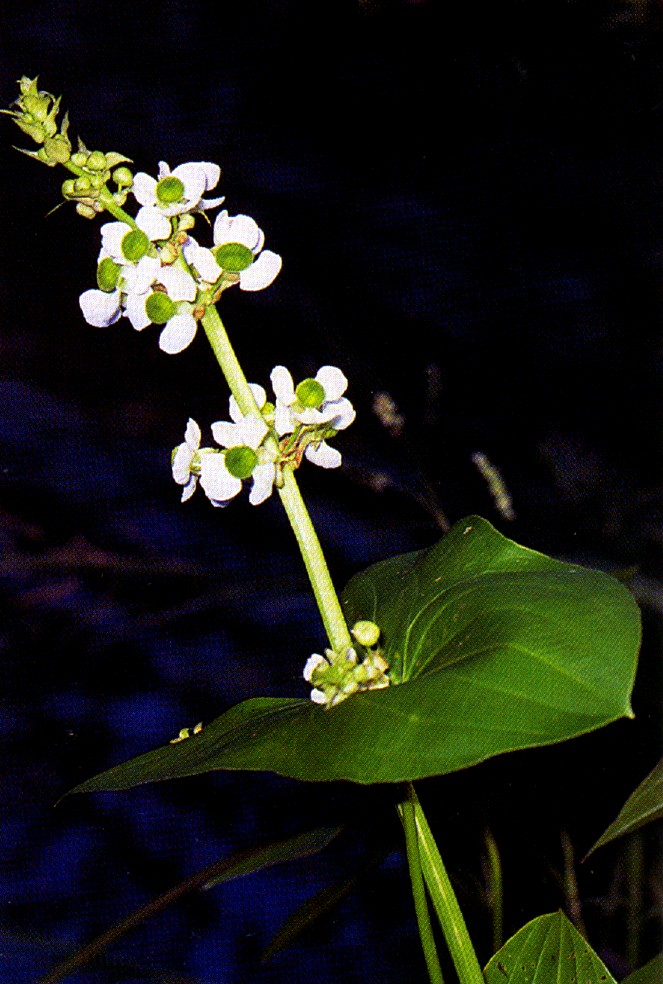
Wapato is an aquatic plant with variable appearance depending on whether its parts grow submerged, above water, or on land. It is a perennial herb that grows from a white or blue-tinged tuber.[1][2]
Many leaves are arrow-shaped, with two smaller pointed lobes opposite their tips. The leaf blades grow on very long petioles.[3][4]
The inflorescence rises above the water surface and consists of several whorls of flowers arranged in a raceme. The flowers have white petals and can reach 2.5 centimetres in width.[5][6][7]
Male flowers have rings of yellow stamens at their centres. Each female flower develops a spherical cluster of pistils into a group of tiny fruits.[8][9]
Habitat
Wapato grows in slow-moving and stagnant water bodies, including ponds and small streams.[10]
Reproduction and life cycle
Individual wapato plants bear both male and female flowers. Female flowers occur at the lowest inflorescence node, while male flowers occupy the upper nodes.[11][12]
The female flowers produce clusters of tiny fruits from their spherical groups of pistils.[13]
Behaviour
Muskrats and beavers store wapato tubers in large caches.[14]
Conservation
Wapato is listed as endangered in Connecticut and New Jersey. It is listed as threatened in Massachusetts, New Hampshire, and Ohio.[15][16]
Uses
The Cheyenne use dried wapato leaves as a remedy for urinary troubles and sore mouths in horses. The Klamath use its rootstocks as food.[17][18]
The Menominee preserve wapato tubers for winter by stringing them after drying, boiling, and slicing. The Ojibwe eat its corms to address indigestion and as food.[19][20]
The Ojibwe consume wapato corms boiled fresh, dried, or candied with maple sugar. They sometimes collect caches made by muskrats or beavers for their own use.[21][22]
The Northern Paiute use wapato roots as food. Indigenous people of Montana eat its tubers both raw and boiled.[23][24]
Classification of the Wapato
| Kingdom | Plantae |
|---|---|
| Subkingdom | Pteridobiotina |
| Phylum | Tracheophyta |
| Class | Liliopsida |
| Order | Alismatales |
| Family | Alismataceae (Arrowhead Family) |
| Genus | Sagittaria (Wapato) |
| Species | Sagittaria cuneata E.Sheld. |
Where the Wapato is found
Checklists and occurrence records place Sagittaria cuneata in 2 countries across North America. GBIF holds 6,713 georeferenced records of it.
Countries where it is native or its origin is not stated
Countries where it has been introduced
Regions and cities with the most records
- Quebec, Canada 444
- Alberta, Canada 442
- Ontario, Canada 440
- Minnesota, United States 291
- British Columbia, Canada 223
- California, United States 221
- Montana, United States 201
- Idaho, United States 186
- Colorado, United States 178
- Wisconsin, United States 167
- Saskatchewan, Canada 162
- Manitoba, Canada 151
- Oregon, United States 141
- Utah, United States 126
- Nebraska, United States 112
- Michigan, United States 98
- Nevada, United States 98
- Washington, United States 90
- New Mexico, United States 69
- Maine, United States 61
- Wyoming, United States 61
- New Brunswick, Canada 57
- Nova Scotia, Canada 48
- Illinois, United States 45
- Winnipeg, Canada 45
- Spruce Grove, Canada 44
- St. Albert, Canada 42
- Vermont, United States 42
- North Dakota, United States 41
- South Dakota, United States 40
- Northwest Territories, Canada 36
- Edmonton, Canada 33
- Villeray–Saint-Michel–Parc-Extension, Canada 32
- Saint-Michel, Canada 31
- Le Plateau-Mont-Royal, Canada 30
- Mont-Royal, Canada 30
A number beside a place is its count of GBIF occurrence records. A place without a number comes from a checklist alone. Records show where a species has been observed or collected, which can include escapes and vagrants.
Common names
English
- Wapato
- Arumleaf Arrowhead
- Arum-leaved Arrowhead
- Duck-potato Arrowhead
- Northern Arrowhead
- Tule Potato
- Wapatum Arrowhead
Names in 3 other languages
- Dutch
- Wigbladig Pijlkruid
- French
- sagittaire arifoliée, sagittaire cunéaire, sagittaire à feuilles en coin, sagittaria cunéaire
- oji
- Waabaziipin (Wabasi'pîn)
Synonyms
15 other scientific names have been used for this species and are now treated as synonyms of Sagittaria cuneata.
- Sagittaria arifolia Nutt. ex J.G.Sm.
- Sagittaria arifolia var. aquatilis J.G.Sm. ex Norton
- Sagittaria arifolia var. cuneata Lunell
- Sagittaria arifolia var. dimorpha Lunell
- Sagittaria arifolia var. monomorpha Lunell
- Sagittaria arifolia var. polymorpha Lunell
- Sagittaria arifolia var. stricta J.G.Sm.
- Sagittaria arifolia var. tenuor Blank.
- Sagittaria cuneata f. cuneata
- Sagittaria cuneata f. equiloba Fernald
- Sagittaria cuneata f. hemicycla Fernald
- Sagittaria hebetiloba A.Nelson
- Sagittaria suksdorfii Gand.
- Sagittaria paniculata Blank. ambiguous synonym
- Sagittaria sagittifolia var. minor Pursh ambiguous synonym
Related species
-
 Broadleaf ArrowheadSagittaria latifolia
-
 ArrowheadSagittaria sagittifolia
-
 Narrow-leaved ArrowheadSagittaria subulata
-
 Chinese ArrowheadSagittaria trifolia
-
 Bulltongue ArrowheadSagittaria lancifolia
-
 Giant ArrowheadSagittaria montevidensis
-
 Delta ArrowheadSagittaria platyphylla
-
 Grassleaf ArrowheadSagittaria graminea
Compare
Questions and answers
What is the scientific name of the Wapato?
The scientific name of the Wapato is Sagittaria cuneata. Written with its author, the full name is Sagittaria cuneata E.Sheld..
Which family does the Wapato belong to?
Sagittaria cuneata belongs to the family Alismataceae, in the order Alismatales and the class Liliopsida.
Where is the Wapato found?
Checklists and occurrence records place Sagittaria cuneata in 2 countries, including United States.
What is the conservation status of the Wapato?
The IUCN Red List category recorded for Sagittaria cuneata is Least Concern (LC).
What other names does the Wapato have?
Sagittaria cuneata is also known in English as Arumleaf Arrowhead, Arum-leaved Arrowhead, Duck-potato Arrowhead, Northern Arrowhead, Tule Potato and Wapatum Arrowhead.
What is wapato known for?
Wapato is an aquatic perennial that grows from a tuber and has arrow-shaped leaves and white flowers. Its tubers and other underground parts are used as food by several Indigenous peoples.[2][3][6][18][20][23][24]
Sources
Passages the profile rests on
- Sagittaria cuneata is an aquatic plant with variable appearance depending on whether its parts grow submerged, above water, or on land. Source passage: “It is quite variable in appearance, and submerged parts of the plant look different from those growing above the surface or on land.” — English Wikipedia
- The plant is a perennial herb that grows from a white or blue-tinged tuber. Source passage: “It is a perennial herb growing from a white or blue-tinged tuber.” — English Wikipedia
- Many leaves are arrow-shaped and have two smaller pointed lobes opposite their tips. Source passage: “The leaves are variable in shape, many of them sagittate (arrow-shaped) with two smaller, pointed lobes opposite the tip.” — English Wikipedia
- The leaf blades grow on very long petioles. Source passage: “The leaf blades are borne on very long petioles.” — English Wikipedia
- The inflorescence rises above the water surface and consists of several whorls of flowers arranged in a raceme. Source passage: “The inflorescence, which rises above the surface of the water, is a raceme made up of several whorls of flowers” — English Wikipedia
- The flowers have white petals. Source passage: “The flower is up to 2.5 centimetres (1 inch) wide with white petals.” — English Wikipedia
- The flowers can reach 2.5 centimetres in width. Source passage: “The flower is up to 2.5 centimetres (1 inch) wide with white petals.” — English Wikipedia
- Male flowers have rings of yellow stamens at their centres. Source passage: “The male flowers have rings of yellow stamens at the centers.” — English Wikipedia
- Each female flower develops a spherical cluster of pistils into a group of tiny fruits. Source passage: “Each female flower has a spherical cluster of pistils which develops into a group of tiny fruits.” — English Wikipedia
- Sagittaria cuneata grows in slow-moving and stagnant water bodies, including ponds and small streams. Source passage: “Sagittaria cuneata is an aquatic plant, growing in slow-moving and stagnant water bodies such as ponds and small streams.” — English Wikipedia
- Individual Sagittaria cuneata plants bear both male and female flowers. Source passage: “The plant is monoecious (individuals bearing both male and female flowers).” — English Wikipedia
- Female flowers occur at the lowest inflorescence node, while male flowers occupy the upper nodes. Source passage: “the lowest node bearing female flowers and upper ones bearing males.” — English Wikipedia
- The female flowers produce clusters of tiny fruits from their spherical groups of pistils. Source passage: “Each female flower has a spherical cluster of pistils which develops into a group of tiny fruits.” — English Wikipedia
- Muskrats and beavers store the plant's tubers in large caches. Source passage: “Muskrat and beavers store them in large caches.” — English Wikipedia
- Sagittaria cuneata is listed as endangered in Connecticut and New Jersey. Source passage: “It is listed as endangered in Connecticut and New Jersey.” — English Wikipedia
- Sagittaria cuneata is listed as threatened in Massachusetts, New Hampshire, and Ohio. Source passage: “It is listed as threatened in Massachusetts, New Hampshire, and Ohio.” — English Wikipedia
- The Cheyenne use dried leaves of Sagittaria cuneata as a remedy for urinary troubles and sore mouths in horses. Source passage: “The Cheyenne give dried leaves to horses for urinary troubles and for a sore mouth.” — English Wikipedia
- The Klamath use the plant's rootstocks as food. Source passage: “The Klamath use the rootstocks as food.” — English Wikipedia
- The Menominee preserve the plant's tubers for winter by stringing them after drying, boiling, and slicing. Source passage: “The Menominee string the dried, boiled, sliced potatoes together for winter use.” — English Wikipedia
- The Ojibwe eat the plant's corms to address indigestion and as food. Source passage: “The Ojibwe eat the corms for indigestion, and also as a food” — English Wikipedia
- The Ojibwe consume the corms boiled fresh, dried, or candied with maple sugar. Source passage: “eaten boiled fresh, dried or candied with maple sugar.” — English Wikipedia
- The Ojibwe sometimes collect caches of the plant made by muskrats or beavers for their own use. Source passage: “They would sometimes look for caches of this plant made by muskrats or beavers and appropriate them for their own use.” — English Wikipedia
- The Northern Paiute use the plant's roots as food. Source passage: “The Northern Paiute use the roots for food.” — English Wikipedia
- Indigenous people of Montana eat the plant's tubers both raw and boiled. Source passage: “The indigenous people of Montana eat the tubers raw and boiled.” — English Wikipedia
- Sagittaria cuneata is described as an aquatic herbaceous perennial. Source passage: “Wapato (Sagittaria cuneata) is an aquatic herbaceous perennial plant” — mass.gov
Data
- Catalogue of Life, 2026-10-16 XR cc by
- Global Biodiversity Information Facility CC BY 4.0
- Wikidata CC0
- GeoNames CC BY 4.0
- Wikimedia Commons per image; credit shown with each image
- Within the Catalogue of Life, this name comes from The World Checklist of Vascular Plants (WCVP) cc by
References
- Bull. Torrey Bot. Club 20: 283 (1893) where the name was published
This species in other databases
- Catalogue of Life 78ZZB
- Wikidata Q7399297
- iNaturalist 78925
- World Flora Online wfo-0000736504
- GRIN 452458
Page built on 27 November 2026. See how the catalog is made and all sources and licences.
Cite this page
ScientificNames.org. (2026). Sagittaria cuneata (Wapato). Retrieved November 27, 2026, from https://scientificnames.org/species/sagittaria-cuneata
“Sagittaria cuneata (Wapato).” ScientificNames.org, 2026, scientificnames.org/species/sagittaria-cuneata. Accessed 27 Nov. 2026.
ScientificNames.org. “Sagittaria cuneata (Wapato).” Accessed November 27, 2026. https://scientificnames.org/species/sagittaria-cuneata.
@misc{scientificnames_sagittaria_cuneata_wapato,
  author = {{ScientificNames.org}},
  title = {Sagittaria cuneata (Wapato)},
  year = {2026},
  url = {https://scientificnames.org/species/sagittaria-cuneata},
  note = {Accessed 2026-11-27}
}