Species · Amphibians
Fire Salamander Salamandra salamandra
The scientific name of the Fire Salamander is Salamandra salamandra. It is a species of amphibian in the family Salamandridae (newts), order Caudata. The name dates from 1758.
- Scientific name
- Salamandra salamandra (Linnaeus, 1758)
- Common name
- Fire Salamander
- Genus
- Salamandra
- Family
- Salamandridae (Newts)
- Order
- Caudata
- Class
- Amphibia
- Red List category
- VU Vulnerable
- Environment
- freshwater, terrestrial
- Recorded in
- 29 countries
- Name status
- accepted in the Catalogue of Life

Overview
Salamandra salamandra occurs across much of southern and central Europe, northern Africa and the Middle East. It has a black body with variable yellow markings, which serve as a warning to predators about its toxicity.
Written 24 November 2026 from the sources listed below. Each statement was checked against the passage it cites; statements that could not be supported were removed.
Appearance
The Fire Salamander has a black body marked with yellow spots or stripes that vary between individuals. Some individuals have red or orange markings instead of, or mixed with, yellow markings.[1][2]
Its underside is generally dark grey and has fewer spots than its upper body. Its body is longer than its tail, its limbs are stout, and it has conspicuous parotoid glands.[3][4][5]
Adults typically measure 15–25 centimetres in length, although some exceed 30 centimetres. Females tend to be slightly larger than males.[6][7][8]
Habitat
The Fire Salamander inhabits forests in central Europe and is particularly common in hilly areas. It prefers shaded deciduous woodland with fallen leaves, moss-covered tree trunks and nearby ponds or streams.[9][10][11]
Its habitat requires small brooks or ponds containing clean water for larval development. It shelters beneath rocks and logs and inside crevices to maintain protection and moisture.[12][13]
Diet
The Fire Salamander eats insects, spiders, millipedes, centipedes, earthworms and slugs. Its prey also includes flies and beetles.[14][15]
It occasionally consumes newts and young frogs. It generally eats the invertebrates that are most abundant in its habitat.[16][17]
Behaviour
Fire Salamanders spend much of their time concealed beneath wood and other objects. They are shy and frequently shelter in shaded crevices and beneath logs.[18][19]
They are primarily active during evenings and nights, particularly on mild nights, but can also be active during rainy daytime conditions.[20][21]
Individuals can remain loyal to the same home range for many years. Some have returned to the same cave for hibernation for as long as 20 years.[22][23]
When hunting in darkness, the species primarily uses smell to locate prey. It can actively spray defensive chemicals at predators.[24][25]
Reproduction and life cycle
Fertilization occurs internally after the male deposits a spermatophore. The female may retain sperm before ovulation and fertilization occur.[26][27]
The subspecies fastuosa and bernadezi are viviparous, whereas the other recognized subspecies are ovoviviparous. Females deposit larvae into water when the eggs hatch.[28][29]
In European populations, larvae are generally born in spring following summer mating and winter hibernation. Some populations give birth to young that have already completed metamorphosis.[30][31]
In warmer Middle Eastern populations, breeding takes place from October through January. Larval birth occurs in November or December of the following period.[32][33]
Conservation
The Fire Salamander was classified as Vulnerable on the IUCN Red List in 2023. Infection by the introduced fungus Batrachochytrium salamandrivorans has caused severe population declines in parts of its range.[34][35]
The fungus Batrachochytrium salamandrivorans was identified as the cause of population declines in the Netherlands in 2013. The Dutch population declined by 96% from 2010, with its largest population decreasing from 241 individuals to four in 2011.[36][37]
Habitat fragmentation is identified as a potential threat because individuals are strongly attached to their home ranges and overwintering sites.[38]
Uses
The Fire Salamander has been popular in the pet trade and has been used as an animal model in research.[39][40]
Classification of the Fire Salamander
| Kingdom | Animalia |
|---|---|
| Phylum | Chordata |
| Subphylum | Vertebrata |
| Infraphylum | Gnathostomata |
| Parvphylum | Osteichthyes |
| Megaclass | Tetrapoda |
| Class | Amphibia (Amphibians) |
| Order | Caudata (Salamanders) |
| Family | Salamandridae (Newts) |
| Subfamily | Salamandrinae |
| Genus | Salamandra |
| Species | Salamandra salamandra (Linnaeus, 1758) |
Where the Fire Salamander is found
Checklists and occurrence records place Salamandra salamandra in 29 countries. GBIF holds 257,940 georeferenced records of it.
Countries
- Albania 125
- Andorra 122
- Austria 24,774
- Belgium 7,855
- Bosnia and Herzegovina 90
- Bulgaria 463
- Croatia 796
- Czechia 1,951
- France 87,852
- Germany 28,305
- Greece 641
- Hungary 810
- Italy 7,923
- Kosovo 26
- Liechtenstein 19
- Luxembourg 1,130
- Montenegro 91
- North Macedonia 72
- Poland 1,783
- Portugal 9,468
- Romania 649
- Serbia 147
- Slovakia 569
- Slovenia 1,485
- Spain 21,755
- Switzerland 56,135
- The Netherlands 82
- Ukraine 2,813
- United Kingdom 9
Regions and cities with the most records
- Bourgogne-Franche-Comté, France 11,429
- Occitanie, France 11,407
- Aargau, Switzerland 8,758
- Auvergne-Rhône-Alpes, France 8,702
- Centre-Val de Loire, France 7,159
- Catalonia, Spain 6,844
- Salzburg, Austria 6,844
- Vaud, Switzerland 6,277
- Salzburg, Austria 5,966
- Zurich, Switzerland 5,943
- Zürich, Switzerland 5,817
- Ticino, Switzerland 5,615
- Pays de la Loire, France 5,537
- Vienna, Austria 5,186
- Île-de-France, France 5,109
- Bavaria, Germany 4,854
- Hauts-de-France, France 4,824
- Grand Est, France 4,796
- Rheinland-Pfalz, Germany 4,643
- Hesse, Germany 4,577
- North Rhine-Westphalia, Germany 4,477
- Galicia, Spain 4,394
- Sankt Gallen, Switzerland 4,240
- Baden-Wurttemberg, Germany 4,234
- Bern, Switzerland 4,207
- Vienna, Austria 3,824
- Lausanne, Switzerland 3,790
- Upper Austria, Austria 3,788
- Lower Austria, Austria 3,723
- Luzern, Switzerland 3,651
- Lucerne, Switzerland 3,566
- Geneva, Switzerland 3,477
- Styria, Austria 3,345
- Provence-Alpes-Côte d'Azur, France 3,218
- Bern, Switzerland 2,949
- Basel-Landschaft, Switzerland 2,936
8 more countries have a few records outside this range
These countries hold a few records of Salamandra salamandra but lie outside the range the checklists give for it. Such records are often zoo or garden specimens, museum material or vagrants, so the species is not counted as occurring there.
A number beside a place is its count of GBIF occurrence records. A place without a number comes from a checklist alone. Records show where a species has been observed or collected, which can include escapes and vagrants.
Common names
English
- Fire Salamander
- Common Fire Salamander
- European Salamander
- Spotted Salamander
Names in 44 other languages
- Albanian
- E bukura e dheut, Tritoni pikalosh
- Arabic
- سمندر ناري, سمندل ناري شائع
- Basque
- Arrabio arrunt
- Breton
- Sourd boutin
- Bulgarian
- Дъждовник
- Catalan
- Salamandra comuna
- Chinese
- 火蠑螈, 真螈
- Croatian
- Šareni daždevnjak
- Czech
- mlok skvrnitý
- Dutch
- Vuursalamander
- Finnish
- Tulisalamanteri
- French
- Salamandre tachetée, Salamandre tachetée (La)
- Galician
- Píntega común
- German
- Bergnarr, Erdmolch, Erdsalamander, Feuermolch, Feuersalamander, Gelber Schneider, Regenmolch, Regenmolli
- Greek
- Σαλαμάνδρα
- Hebrew
- סלמנדרה כתומה
- Hungarian
- Foltos szalamandra
- Italian
- Salamandra Pezzata
- Japanese
- ファイアサラマンダー
- Lithuanian
- Ugninė salamandra
- Luxembourgish
- Feierechs, Feiereps, Feieromes, Feiersalamander
- Macedonian
- Шарен дождовник
- Mongolian
- Галт саламандр
- Norwegian Bokmål
- europeisk ildsalamander, ildsalamander
- Polish
- Salamandra Plamista
- Portuguese
- Salamandra-de-fogo, Salamandra-de-pintas-amarelas
- Romanian
- Salamandra, Salamandra de uscat, Salamandră
- Russian
- Obyknovennaya Salamandra, Обыкновенная саламандра, Огненная (пятнистая) обыкновенная саламандра, Огненная саламандра, Пятнистая саламандра
- Serbian
- Шарени даждевњак
- Slovak
- salamandra škvrnitá
- Slovenian
- Navadni močerad
- Spanish
- Salamandra Común
- Swedish
- eldsalamander
- Thai
- ซาลาแมนเดอร์ไฟ
- Turkish
- Benekli Semender, Lekeli Semender
- Ukrainian
- Вогняна саламандра, Саламандра вогняна, Саламандра плямиста
- Vietnamese
- Kỳ giông lửa
- bar
- Tåttermandl
- bos
- Pjegavi daždevnjak, Zviždenjak
- kur
- Qurnewêlk
- nds
- Eerdpüüster
- vec
- Bissa de la pioa
- vls
- Viersalamander
- wln
- Rogne (biesse)
Synonyms
46 other scientific names have been used for this species and are now treated as synonyms of Salamandra salamandra.
- Gecko salamandra (Linnaeus, 1758)
- Ichthyosaura tritonius (Laurenti, 1768)
- Lacerta salamandra Linnaeus, 1758
- Proteus tritonius Laurenti, 1768
- Salamandra almanzoris Müller & Hellmich, 1935
- Salamandra candida Laurenti, 1768
- Salamandra candida candida Laurenti, 1768
- Salamandra longirostris Joger & Steinfartz, 1994
- Salamandra maculata Schrank, 1786
- Salamandra maculosa Laurenti, 1768
- Salamandra maculosa bejarae Wolterstorff, 1934
- Salamandra maculosa bezarae Wolterstorff, 1934
- Salamandra maculosa coccinea Schweizerbarth, 1909
- Salamandra maculosa europaea Bedriaga, 1883
- Salamandra maculosa f. fastuosa Schreiber, 1912
- Salamandra maculosa gallaica López-Seoane, 1885
- Salamandra maculosa molleri Bedriaga, 1889
- Salamandra maculosa nera Doderlein, 1872
- Salamandra maculosa nigriventris Dürigen, 1897
- Salamandra maculosa pezzata Doderlein, 1872
- Salamandra maculosa quadrivirgata Dürigen, 1897
- Salamandra maculosa speciosa Schreiber, 1912
- Salamandra maculosa taeniata Dürigen, 1897
- Salamandra maculosa typica Bedriaga, 1897
- Salamandra salamandra albanica Gayda, 1940
- Salamandra salamandra alfredschmidti Köhler & Steinfartz, 2006
- Salamandra salamandra almanzoris Müller & Hellmich, 1935
- Salamandra salamandra bejarae Wolterstorff, 1934
- Salamandra salamandra bernardezi Wolterstorff, 1928
- Salamandra salamandra beschkovi Obst, 1981
- Salamandra salamandra carpathica Calinescu, 1931
- Salamandra salamandra fastuosa Eiselt, 1958
- Salamandra salamandra fastuosa Schreiber, 1912
- Salamandra salamandra gallaica López-Seoane, 1885
- Salamandra salamandra gigliolii Eiselt & Lanza, 1956
- Salamandra salamandra hispanica Wolterstorff, 1937
- Salamandra salamandra longirostris Joger & Steinfartz, 1994
- Salamandra salamandra molleri Bedriaga, 1889
- Salamandra salamandra morenica Joger & Steinfartz, 1994
- Salamandra salamandra taeniata Dürigen, 1897
Showing 40 of 46.
Subspecies and varieties
- Salamandra salamandra salamandra (Spotted Salamander) subspecies
- Salamandra salamandra terrestris (Fire Salamander) subspecies
Related species
-
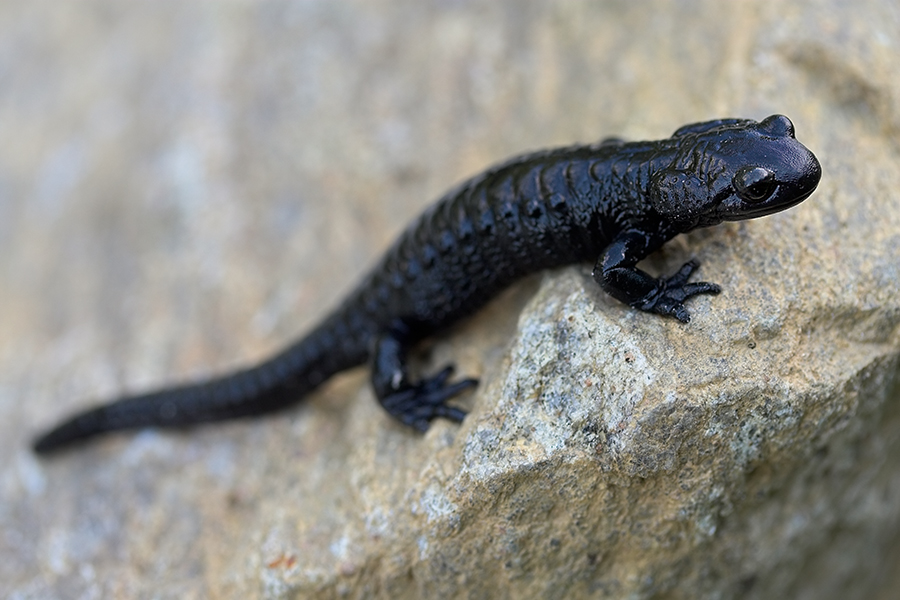 Alpine SalamanderSalamandra atra
-
 Near Eastern Fire SalamanderSalamandra infraimmaculata
-
 North African Fire SalamanderSalamandra algira
-
 Corsican Fire SalamanderSalamandra corsica
-
 Lanza's Alpine SalamanderSalamandra lanzai
-
 Eastern NewtNotophthalmus viridescens
-
 Rough-skinned NewtTaricha granulosa
-
 Northern Crested NewtTriturus cristatus
Compare
Questions and answers
What is the scientific name of the Fire Salamander?
The scientific name of the Fire Salamander is Salamandra salamandra. Written with its author, the full name is Salamandra salamandra (Linnaeus, 1758).
Which family does the Fire Salamander belong to?
Salamandra salamandra belongs to the family Salamandridae, in the order Caudata and the class Amphibia.
Where is the Fire Salamander found?
Checklists and occurrence records place Salamandra salamandra in 29 countries, including France, Switzerland, Germany, Austria, Spain and Portugal.
What is the conservation status of the Fire Salamander?
The IUCN Red List category recorded for Salamandra salamandra is Vulnerable (VU).
What other names does the Fire Salamander have?
Salamandra salamandra is also known in English as Common Fire Salamander, European Salamander and Spotted Salamander.
How poisonous is fire salamander?
Its conspicuous coloration serves as a warning to predators about its toxicity. It can also actively spray defensive chemicals at predators.[41][25]
Why are fire salamanders called fire?
The species' common name is associated with traditional stories that salamanders could survive in fire.[42]
What is the habitat of the fire salamander?
It inhabits forests in central Europe, particularly hilly areas. It prefers shaded deciduous woodland with fallen leaves, moss-covered tree trunks and nearby ponds or streams.[9][10][11]
What does the fire salamander eat?
Its diet includes insects, spiders, millipedes, centipedes, earthworms, slugs, flies and beetles. It occasionally consumes newts and young frogs.[14][16][15]
Sources
Passages the profile rests on
- The fire salamander has a black body marked with yellow spots or stripes that vary in extent between individuals. Source passage: “It is black with yellow spots or stripes to a varying degree; some specimens can be nearly completely black while on others the yellow is dominant.” — English Wikipedia
- Some individuals have red or orange markings instead of, or mixed with, yellow markings. Source passage: “Shades of red and orange may sometimes appear, either replacing or mixing with the yellow according to subspecies.” — English Wikipedia
- The underside is generally dark grey and has fewer spots than the upper body. Source passage: “The underside is usually dark grey with fewer spots.” — animaldiversity.org
- Its body is longer than its tail, and its limbs are stout. Source passage: “Body length exceeds tail length, and the limbs are stout.” — animaldiversity.org
- The species has conspicuous parotoid glands. Source passage: “and has conspicuous parotoid glands.” — amphibiaweb.org
- Adults typically measure 15–25 centimetres in length. Source passage: “The fire salamander is one of Europe's largest salamanders and can grow to be 15–25 centimetres (5.9–9.8 in) long.” — English Wikipedia
- Some individuals exceed 30 centimetres in length. Source passage: “ranging from 15 to 25cm long, with some individuals exceeding 30cm.” — animaldiversity.org
- Females tend to be slightly larger than males. Source passage: “Females tend to be slightly larger than males, but little other sexual dimorphism exists.” — animaldiversity.org
- The species inhabits forests in central Europe and is particularly common in hilly areas. Source passage: “Fire salamanders live in the forests of central Europe and are more common in hilly areas.” — English Wikipedia
- It prefers deciduous forests where fallen leaves and moss-covered tree trunks provide hiding places. Source passage: “They prefer deciduous forests since they like to hide in fallen leaves and around mossy tree trunks.” — English Wikipedia
- The species prefers shaded woodland habitats with nearby ponds or streams. Source passage: “S. salamandra prefers woodland habitats, especially those with much shade and nearby ponds or streams for breeding.” — animaldiversity.org
- Its habitat requires small brooks or ponds containing clean water for larval development. Source passage: “They need small brooks or ponds with clean water in their habitat for the development of the larvae.” — English Wikipedia
- It shelters beneath rocks and logs and inside crevices to maintain protection and moisture. Source passage: “It spends much time beneath rocks or logs, or hiding in crevices to stay protected and moist.” — animaldiversity.org
- Its diet includes insects, spiders, millipedes, centipedes, earthworms and slugs. Source passage: “The diet of the fire salamander consists of various insects, spiders, millipedes, centipedes, earthworms and slugs” — English Wikipedia
- Its prey includes earthworms, slugs, flies, millipedes, centipedes and beetles. Source passage: “These include soft-bodied prey such as earthworms and slugs, and harder-bodied prey such as flies, millipedes, centipedes, and beetles among others.” — animaldiversity.org
- It occasionally consumes newts and young frogs. Source passage: “but they also occasionally eat newts and young frogs.” — English Wikipedia
- The species generally consumes the invertebrates that are most abundant in its habitat. Source passage: “The diet of S. salamandra consists of invertebrate prey and is generally a mixture of the most abundant species available in the salamander's particular habitat.” — animaldiversity.org
- Fire salamanders spend much of their time concealed beneath wood and other objects. Source passage: “They spend much of their time hidden under wood or other objects.” — English Wikipedia
- The species is shy and frequently shelters in shaded crevices and beneath logs. Source passage: “S. salamandra is a shy species and spends much time hidden in shady crevices, under logs, or other such spots that will provide protection and moisture.” — animaldiversity.org
- They are primarily active during evenings and nights but can also be active during rainy daytime conditions. Source passage: “They are active in the evening and the night, but on rainy days they are active in the daytime as well.” — English Wikipedia
- Its main activity periods occur on mild nights. Source passage: “Its main periods of activity are on mild nights;” — animaldiversity.org
- Individuals can remain loyal to the same home range for many years. Source passage: “The Fire Salamander typically will stay loyal to the same home range for many years.” — animaldiversity.org
- Some individuals have returned to the same cave for hibernation for as long as 20 years. Source passage: “one experiment found individuals returned to the same cave to hibernate for up to 20 years.” — animaldiversity.org
- When hunting in darkness, the species primarily uses smell to locate prey. Source passage: “However, when hunting in the dark, it uses olfaction as its primary cue since vision is impaired.” — animaldiversity.org
- The species can actively spray defensive chemicals at predators. Source passage: “The Fire Salamander is capable of actively spraying these chemicals at predators to discourage attack, rather than relying on escaping once the predator realizes it makes an unpleasant meal.” — animaldiversity.org
- Fertilization occurs internally after the male deposits a spermatophore. Source passage: “If successful, the female draws the sperm packet in and her eggs are fertilized internally.” — English Wikipedia
- The female may retain sperm before ovulation and fertilization occur. Source passage: “The female may retain the sperm for some time before ovulation and fertilization occur.” — animaldiversity.org
- Females deposit larvae into water when the eggs hatch. Source passage: “The eggs develop internally and the female deposits the larvae into a body of water just as they hatch.” — English Wikipedia
- The subspecies fastuosa and bernadezi are viviparous, whereas the other recognized subspecies are ovoviviparous. Source passage: “Most notable are the subspecies fastuosa and bernadezi, which are the only viviparous subspecies – the others are ovoviviparous.” — English Wikipedia
- In European populations, larvae are generally born in the spring following summer mating and winter hibernation. Source passage: “This helps to account for the long gestation between the peak of mating season in the summer and the birth of the larvae in the following spring, after the winter hibernation.” — animaldiversity.org
- Some populations give birth to young that have already completed metamorphosis. Source passage: “although some populations deposit young that have already metamorphosed.” — animaldiversity.org
- In warmer Middle Eastern populations, breeding takes place from October through January. Source passage: “This seasonal pattern shifts in the warmer Middle Eastern populations, where breeding occurs October-January” — animaldiversity.org
- In warmer Middle Eastern populations, larval birth occurs in November or December of the following period. Source passage: “with larval birth occuring the following November-December” — animaldiversity.org
- The species was classified as Vulnerable on the IUCN Red List in 2023. Source passage: “In 2023, the fire salamander was officially moved from 'Least Concern' to 'Vulnerable' on the IUCN Red List” — English Wikipedia
- Infection by the introduced fungus Batrachochytrium salamandrivorans has caused severe population declines in parts of its range. Source passage: “which has caused severe declines in fire salamanders in parts of its range.” — English Wikipedia
- The fungus Batrachochytrium salamandrivorans was identified as the cause of population declines in the Netherlands in 2013. Source passage: “In 2013, the cause of the decline was officially identified as a new chytrid fungus, Batrachochytrium salamandrivorans (Bsal)” — English Wikipedia
- The Dutch population declined by 96% from 2010, with its largest population decreasing from 241 individuals to four in 2011. Source passage: “since 2010, there has been a staggering 96% population decline, with the largest population dropping from 241 individuals to only four in 2011.” — English Wikipedia
- Habitat fragmentation is identified as a potential threat because individuals are strongly attached to their home ranges and overwintering sites. Source passage: “Habitat fragmentation is also a potential problem since these animals are so loyal to their home ranges and overwintering sites.” — animaldiversity.org
- The species has been popular in the pet trade. Source passage: “The Fire Salamander has been a popular species in the pet trade” — animaldiversity.org
- The species has been used as an animal model in research. Source passage: “and has also been utilized as an animal model in research (Griffiths 1996).” — animaldiversity.org
- Its conspicuous coloration serves as a warning to predators about its toxicity. Source passage: “This bright coloration is highly conspicuous and acts to deter predators by honest signalling of its toxicity (aposematism).” — English Wikipedia
- The species' common name is associated with traditional stories that salamanders could survive in fire. Source passage: “Traditional folklore held that salamanders could survive in fire; the term "salamander" actually comes from an Arab term for "lives in fire."” — animaldiversity.org
Data
- Catalogue of Life, 2026-10-16 XR cc by
- Global Biodiversity Information Facility CC BY 4.0
- Wikidata CC0
- GeoNames CC BY 4.0
- Wikimedia Commons per image; credit shown with each image
- iNaturalist per image; credit shown with each image
- Within the Catalogue of Life, this name comes from The Integrated Taxonomic Information System cc0
This species in other databases
- Catalogue of Life 6XB2G
- Wikidata Q26395
- iNaturalist 27726
- WoRMS urn:lsid:marinespecies.org:taxname:1507481
Page built on 24 November 2026. See how the catalog is made and all sources and licences.
Cite this page
ScientificNames.org. (2026). Salamandra salamandra (Fire Salamander). Retrieved November 24, 2026, from https://scientificnames.org/species/salamandra-salamandra
“Salamandra salamandra (Fire Salamander).” ScientificNames.org, 2026, scientificnames.org/species/salamandra-salamandra. Accessed 24 Nov. 2026.
ScientificNames.org. “Salamandra salamandra (Fire Salamander).” Accessed November 24, 2026. https://scientificnames.org/species/salamandra-salamandra.
@misc{scientificnames_salamandra_salamandra_fire_salamander,
  author = {{ScientificNames.org}},
  title = {Salamandra salamandra (Fire Salamander)},
  year = {2026},
  url = {https://scientificnames.org/species/salamandra-salamandra},
  note = {Accessed 2026-11-24}
}