Species · Flowering plants
California Chia Salvia columbariae
The scientific name of the California Chia is Salvia columbariae. It is a species of flowering plant in the family Lamiaceae (mint family), order Lamiales.
- Scientific name
- Salvia columbariae Benth.
- Common name
- California Chia
- Genus
- Salvia
- Family
- Lamiaceae (Mint Family)
- Order
- Lamiales
- Class
- Magnoliopsida
- Recorded in
- 2 countries
- Name status
- accepted in the Catalogue of Life
Overview
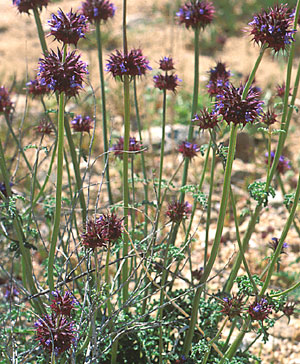
California chia (Salvia columbariae Benth.) is an annual flowering plant. It occurs in California, Nevada, Utah, Arizona, New Mexico, Sonora, and Baja California. Its basal leaves are oblong-ovate, pinnately dissected, and have irregularly rounded lobes.
Written 26 November 2026 from the sources listed below. Each statement was checked against the passage it cites; statements that could not be supported were removed.
Appearance
California chia grows between 10 and 50 cm tall and generally has short, sparsely distributed stem hairs. Its basal leaves measure 2–10 cm in length and are oblong-ovate, pinnately dissected, with irregularly rounded lobes.[1][2][3][4]
The inflorescence is generally scapose, with a long peduncle emerging from ground level and bearing round bracts that terminate in awns. It usually contains one or two flower clusters.[5][6][7]
The calyx measures 8–10 mm in length and has an unlobed upper lip with two, occasionally three, awns. Its lower lip is approximately twice the size of its upper lip.[8][9]
The flowers range from pale blue to blue and have purple tips, with stamens extending slightly beyond the flower. The fruits are tan to grey nutlets measuring 1.5–2 mm in length.[10][11][12][13]
Habitat
California chia occurs in dry, undisturbed sites and grows in chaparral and coastal sage scrub. It generally grows at elevations below 2,500 m.[14][15][16]
In cultivation, California chia prefers well-drained soil, sunny conditions, and dry weather.[17]
Reproduction and life cycle
California chia is an annual plant.[18]
Uses
California chia is an important food resource for Native Americans. Its seeds are used in the same way as those of Salvia hispanica.[19][20]
The Cahuilla used ground seeds as a poultice to disinfect infections. The Cahuilla, Ohlone, Kawaiisu, and Mahuna used the gelatinous seeds to remove foreign matter from eyes, and the seeds were also used in the eyes to address infections and inflammation.[21][22][23]
The Ohlone consumed the seeds to reduce fevers. The Kumeyaay chewed them during walking journeys to obtain strength.[24][25]
The Cahuilla, Kawaiisu, Mohave, Tohono O'odham, Chumash, and Akimel O'odham ground the seeds and mixed them with water to prepare a thick beverage. The Cahuilla also dried the seeds to prepare cakes or mush.[26][27]
The Ohlone, Mohave, and Pomo used the seeds to make pinole. The Kumeyaay mixed them with wheat to improve its flavor.[28][29]
The Mahuna, Paiute, and Akimel O'odham prepared the seeds as a gelatinous material and cooked them into porridge. The Luiseno, Tubatulabal, and Yavapai used the species extensively as a food source.[30][31]
The Mahuna used California chia as a fiber covering for their dwellings.[32]
Classification of the California Chia
| Kingdom | Plantae |
|---|---|
| Subkingdom | Pteridobiotina |
| Phylum | Tracheophyta |
| Class | Magnoliopsida |
| Order | Lamiales |
| Family | Lamiaceae (Mint Family) |
| Subfamily | Nepetoideae |
| Tribe | Mentheae |
| Subtribe | Salviinae |
| Genus | Salvia (Sage) |
| Species | Salvia columbariae Benth. |
Where the California Chia is found
Checklists and occurrence records place Salvia columbariae in 2 countries across North America. GBIF holds 20,059 georeferenced records of it.
Countries
Regions and cities with the most records
- California, United States 15,596
- Arizona, United States 1,524
- Altadena, United States 846
- La Cañada Flintridge, United States 788
- La Crescenta-Montrose, United States 782
- Pasadena, United States 776
- South Pasadena, United States 746
- Glendale, United States 736
- Desert Hot Springs, United States 681
- Burbank, United States 679
- Yucca Valley, United States 679
- Monrovia, United States 674
- Alhambra, United States 673
- Arcadia, United States 671
- San Gabriel, United States 655
- Temple City, United States 633
- Baja California, Mexico 624
- Duarte, United States 620
- Monterey Park, United States 581
- Rosemead, United States 568
- Twentynine Palms, United States 539
- El Monte, United States 529
- South El Monte, United States 485
- Campbell, United States 434
- Azusa, United States 428
- Baldwin Park, United States 417
- Los Gatos, United States 414
- Lake Elsinore, United States 410
- San Jose, United States 396
- Nevada, United States 390
- Agoura, United States 379
- Mead Valley, United States 375
- Vincent, United States 373
- Rancho Santa Margarita, United States 369
- North Tustin, United States 361
- Agoura Hills, United States 357
Range as the checklists state it
USA (Arizona, California, New Mexico, Nevada, Utah); Mexico (Baja California Norte, Baja California Sur, Sonora)
A number beside a place is its count of GBIF occurrence records. A place without a number comes from a checklist alone. Records show where a species has been observed or collected, which can include escapes and vagrants.
Common names
English
- California Chia
- California Sage
- Desert Chia
- Chia Sage
Names in 7 other languages
- Chinese
- 加州鼠尾草
- Czech
- Šalvěj kalifornská
- German
- Kalifornische Chia
- Icelandic
- Dúfnasalvía
- Malayalam
- സാൽവിയ കൊളംബേറിയ
- Russian
- Шалфей голубиный
- mte
- pasida
Synonyms
2 other scientific names have been used for this species and are now treated as synonyms of Salvia columbariae.
- Pycnosphace columbariae (Benth.) Rydb.
- Salvia columbariae var. bernardina Jeps.
Subspecies and varieties
- Salvia columbariae var. argillacea variety
- Salvia columbariae var. columbariae (Chia Sage) variety
- Salvia columbariae var. ziegleri variety
Related species
-
 Diviner's SageSalvia divinorum
- Common SageSalvia officinalis
-
 Californian White SageSalvia apiana
-
 Baby SageSalvia microphylla
-
 Mealy Blue SageSalvia farinacea
-
 Mexican Bush SageSalvia leucantha
-
 Russian SageSalvia yangii
-
 Clary SageSalvia sclarea
Compare
Questions and answers
What is the scientific name of the California Chia?
The scientific name of the California Chia is Salvia columbariae. Written with its author, the full name is Salvia columbariae Benth..
Which family does the California Chia belong to?
Salvia columbariae belongs to the family Lamiaceae, in the order Lamiales and the class Magnoliopsida.
Where is the California Chia found?
Checklists and occurrence records place Salvia columbariae in 2 countries: United States and Mexico.
What other names does the California Chia have?
Salvia columbariae is also known in English as California Sage, Desert Chia and Chia Sage.
What is the lifespan of a chia plant?
California chia is an annual plant.[18]
What is the botanical name for chia?
The botanical name of California chia is Salvia columbariae Benth.[18]
Sources
Passages the profile rests on
- The plant has generally short and sparsely distributed stem hairs. Source passage: “Its stem hairs are generally short and sparse in distribution.” — English Wikipedia
- The basal leaves are oblong-ovate, pinnately dissected, and have irregularly rounded lobes. Source passage: “It has oblong-ovate basal leaves that are 2 to 10 cm (0.79 to 3.94 in) long. The leaves are pinnately dissected and the lobes are irregularly rounded.” — English Wikipedia
- The plant grows between 10 and 50 cm tall. Source passage: “Salvia columbariae grows 10 to 50 cm (3.9 to 19.7 in) tall.” — English Wikipedia
- The basal leaves measure 2–10 cm in length. Source passage: “It has oblong-ovate basal leaves that are 2 to 10 cm (0.79 to 3.94 in) long.” — English Wikipedia
- The inflorescence is generally scapose, with a long peduncle emerging from ground level and bearing bracts. Source passage: “The inflorescence is more or less scapose, meaning it has a long peduncle that comes from the ground level that has bracts.” — English Wikipedia
- The plant's bracts are round and terminate in awns. Source passage: “The bracts are round and awn-tipped.” — English Wikipedia
- The inflorescence usually contains one or two flower clusters. Source passage: “There are usually 1 or 2 clusters of flowers within the inflorescence.” — English Wikipedia
- The calyx measures 8–10 mm in length and has an unlobed upper lip with two, occasionally three, awns. Source passage: “The calyx is 8 to 10 mm (0.31 to 0.39 in) long and the upper lip is unlobed but has 2 (sometimes 3) awns.” — English Wikipedia
- The lower lip of the calyx is approximately twice the size of its upper lip. Source passage: “The lower lip is about twice the size of the upper lip.” — English Wikipedia
- The flowers range from pale blue to blue and have purple tips. Source passage: “The flower color can be pale blue to blue and purple tipped.” — English Wikipedia
- The stamens extend slightly beyond the flower. Source passage: “The stamens of the plant are slightly exserted.” — English Wikipedia
- The fruits are tan to grey nutlets. Source passage: “The fruit of S. columbariae is a nutlet that is tan to grey in color” — English Wikipedia
- The fruit nutlets measure 1.5–2 mm in length. Source passage: “and 1.5 to 2 mm (0.059 to 0.079 in) long.” — English Wikipedia
- The species occurs in dry, undisturbed sites. Source passage: “Salvia columbariae can be found in dry undisturbed sites, chaparral, and coastal sage scrub.” — English Wikipedia
- The species grows in chaparral and coastal sage scrub. Source passage: “Salvia columbariae can be found in dry undisturbed sites, chaparral, and coastal sage scrub.” — English Wikipedia
- The species generally grows at elevations below 2,500 m. Source passage: “It generally grows at elevations lower than 2,500 m (8,200 ft).” — English Wikipedia
- In cultivation, the species prefers well-drained soil, sunny conditions, and dry weather. Source passage: “In cultivation, it prefers good drainage, sun, and dry weather.” — English Wikipedia
- Salvia columbariae is an annual plant. Source passage: “Salvia columbariae is an annual plant” — English Wikipedia
- The species' seeds are used in the same way as those of Salvia hispanica. Source passage: “because its seeds are used in the same way as those of Salvia hispanica (chia).” — English Wikipedia
- The species is an important food resource for Native Americans. Source passage: “and is an important food for Native Americans.” — English Wikipedia
- The Cahuilla used ground seeds of the species as a poultice to disinfect infections. Source passage: “The Cahuilla used the columbariae Benth. variety as a disinfectant by grinding the seeds to mush and applying it to infections as a poultice.” — English Wikipedia
- The Cahuilla, Ohlone, Kawaiisu, and Mahuna used the gelatinous seeds to remove foreign matter from eyes. Source passage: “The Cahuilla, Ohlone, Kawaiisu, and Mahuna used the gelatinous seeds to cleanse out foreign matter in the eyes.” — English Wikipedia
- The seeds were used in the eyes to address infections and inflammation. Source passage: “The seeds were placed in the eyes for infections and inflammation” — English Wikipedia
- The Ohlone consumed the seeds to reduce fevers. Source passage: “The Ohlone also used it to reduce fevers by consuming the seeds” — English Wikipedia
- The Kumeyaay chewed the seeds during walking journeys to obtain strength. Source passage: “the Kumeyaay chewed the seeds on journeys by foot to give strength.” — English Wikipedia
- The Cahuilla, Kawaiisu, Mohave, Tohono O'odham, Chumash, and Akimel O'odham ground the seeds and mixed them with water to prepare a thick beverage. Source passage: “The Cahuilla, Kawaiisu, Mohave, Tohono O'odham, Chumash, and Akimel O'odham grind the seeds and mix them into water to make a thick beverage.” — English Wikipedia
- The Cahuilla dried the seeds to prepare cakes or mush. Source passage: “They also dry the seeds to make cakes or mush.” — English Wikipedia
- The Ohlone, Mohave, and Pomo used the seeds to make pinole. Source passage: “The Ohlones, Mohave, and Pomo make pinole.” — English Wikipedia
- The Kumeyaay mixed the seeds with wheat to improve its flavor. Source passage: “The Kumeyaay added the seeds to wheat to improve flavor.” — English Wikipedia
- The Mahuna, Paiute, and Akimel O'odham prepared the seeds as a gelatinous material and cooked them into porridge. Source passage: “The Mahuna, Paiute, and Akimel O'odham make it into a gelatinous material, then cook it into porridge.” — English Wikipedia
- The Luiseno, Tubatulabal, and Yavapai used the species extensively as a food source. Source passage: “The Luiseno, Tubatulabal, and Yavapai used it extensively as a food source.” — English Wikipedia
- The Mahuna used the plant as a fiber covering for their dwellings. Source passage: “The Mahuna made it into a fiber and covered their dwellings with it.” — English Wikipedia
Data
- Catalogue of Life, 2026-10-16 XR cc by
- Global Biodiversity Information Facility CC BY 4.0
- Wikidata CC0
- GeoNames CC BY 4.0
- Wikimedia Commons per image; credit shown with each image
- Within the Catalogue of Life, this name comes from Synonymic Checklists of the Vascular Plants of the World cc by
References
- Benth. Labiat. Gen. Spec. [Bentham] 302 (1833). where the name was published
This species in other databases
- Catalogue of Life 6XFBN
- Wikidata Q796692
- iNaturalist 53200
- World Flora Online wfo-0000300738
- GRIN 315102
Page built on 29 November 2026. See how the catalog is made and all sources and licences.
Cite this page
ScientificNames.org. (2026). Salvia columbariae (California Chia). Retrieved November 29, 2026, from https://scientificnames.org/species/salvia-columbariae
“Salvia columbariae (California Chia).” ScientificNames.org, 2026, scientificnames.org/species/salvia-columbariae. Accessed 29 Nov. 2026.
ScientificNames.org. “Salvia columbariae (California Chia).” Accessed November 29, 2026. https://scientificnames.org/species/salvia-columbariae.
@misc{scientificnames_salvia_columbariae_california_chia,
  author = {{ScientificNames.org}},
  title = {Salvia columbariae (California Chia)},
  year = {2026},
  url = {https://scientificnames.org/species/salvia-columbariae},
  note = {Accessed 2026-11-29}
}